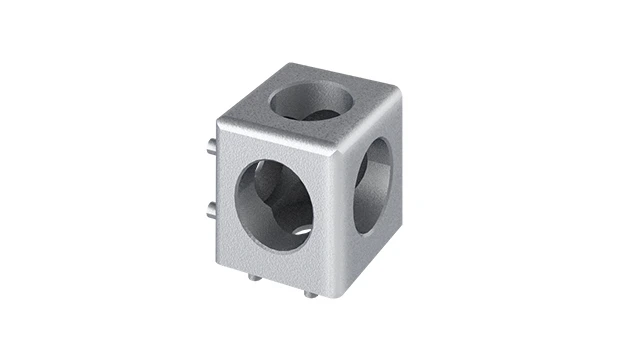
Okay, so 3 Way Connectors are flexible and strong. But how do they translate into real-world solutions? Let's look at two of the most common warehousing needs—
workbenches
and
flow racks
—and see how these connectors make them smarter, more adaptable, and more efficient.
Building Workbenches That Grow With Your Tasks
A workbench isn't just a table; it's a command center. Whether you're assembling electronics, packing orders, or inspecting parts, your workbench needs to fit the task. With traditional workbenches, you're stuck with a fixed height, fixed surface area, and limited accessory options. Not anymore.
Using Aluminum Profile 3 Way Connectors, you can build a workbench that adjusts to your team's needs. Need a taller bench for standing work? Swap out the legs for longer profiles. Adding a tool rail above? Attach it using a 3 Way Connector to the back of the bench frame. Want to split the surface into sections for different tasks? Add a crossbeam with a 3 Way Connector to create dividers. And when your project ends? Disassemble the bench, repurpose the profiles and connectors, and build something new—like a mobile cart or a parts shelf.
One warehouse in Ohio recently shared how they cut setup time for new assembly lines by 60% using this approach. Instead of waiting 2 weeks for custom workbenches, they built and adjusted their own in a day using 3030 profiles, 3 Way Connectors, and plywood tops. "We even added ESD (electrostatic discharge) mats to the surface using T-slot brackets—something our old steel benches could never do without drilling holes," said their operations manager.
Flow Racks That Keep Materials Moving (No Welding Required)
Flow racks are the backbone of lean warehousing, using gravity to feed materials from the back to the front, reducing picking time and minimizing errors. But traditional flow racks are often built with fixed angles and permanently attached roller tracks. If you switch to a bulkier product, the rollers might jam. If demand drops, you're stuck with unused space.
Aluminum Profile 3 Way Connectors solve this by letting you adjust the angle of the flow rack, add or remove roller tracks, and even change the depth of the shelves—all without tools beyond a hex key. For example, using 4040 profiles and 3 Way Connectors, you can build a flow rack with 3 levels (using vertical connectors) and 4 lanes per level (using horizontal connectors). If you need to add more lanes, simply insert a new profile between two existing 3 Way Connectors and slide in new roller tracks. If a product is heavier, swap out plastic rollers for steel ones using T-slot adapters.
A distribution center in Texas used this flexibility to handle seasonal spikes. During the holidays, they reconfigured their flow racks to hold smaller, high-demand items with more lanes. In slower months, they expanded the shelf depth to store bulkier products. "We used to rent extra racking during peak season," their logistics director noted. "Now, we just reconfigure what we have. The 3 Way Connectors make it so easy—our team can do it in an afternoon."