- Company Articles
- Products and Technology
- Product knowledge
- Aluminum Profile 3 Way Connectors: Key Specifications to Check Before Buying

Aluminum Profile 3 Way Connectors: Key Specifications to Check Before Buying
Related Product
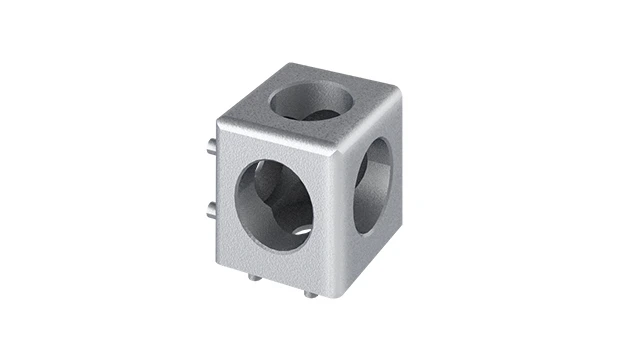
Aluminum Profile 3 Way Connector
The 3 way - squared corner connector is an external fastening method that is typically used to create a corner connection between three profiles. It is a heavy-duty connection that is simple to use and provides a polished look.
If you've ever walked through a busy workshop, a well-organized warehouse, or even a home DIY garage, you've probably seen the backbone of modern workspace efficiency: aluminum profiles. These sleek, modular tubes form the structure of everything from sturdy workbenches and material racks to intricate lean system setups, where every inch of space and movement is optimized. But here's the thing—aluminum profiles are only as strong as the connectors that hold them together. And when it comes to building branching structures, 3 way connectors are the unsung heroes. They're the reason you can have a workbench with a side shelf, a material rack with multiple tiers, or a roller track that splits to feed two assembly lines. But choosing the wrong 3 way connector? It's like trying to build a house with mismatched bricks—frustrating, time-consuming, and ultimately, a recipe for instability.
Whether you're setting up a small home workshop or scaling a full production line, the right 3 way connector ensures your aluminum profile projects hold up under pressure, save you from costly rework, and keep your workflow running smoothly. In this guide, we'll walk through the critical specifications you need to check before hitting "buy," so you can avoid the headaches of ill-fitting, weak, or incompatible parts. Let's dive in.
1. Material Quality: The Foundation of Durability
First things first: what's the connector made of? Aluminum profile accessories come in a range of materials, and 3 way connectors are no exception. The material dictates not just how long the connector will last, but also how well it handles weight, corrosion, and daily wear and tear. Let's break down the most common options:
Real Scenario:
Maria, a small business owner, needed to build a material rack B (3 row and 3 floor) to organize inventory in her garage workshop. She opted for budget-friendly plastic 3 way connectors to save money. Within three months, the plastic began to warp under the weight of boxes, causing the shelves to tilt. She had to replace all connectors with aluminum ones—costing more in the long run than if she'd invested in quality from the start.
Aluminum: The gold standard for most applications. Aluminum connectors are lightweight, corrosion-resistant, and strong enough for medium to heavy loads. They're ideal for indoor use (like workbenches) and even some outdoor settings if treated. Look for connectors made from high-grade aluminum (like 6061 or 6063 alloys) for better strength.
Steel: Heavier and stronger than aluminum, steel connectors are great for industrial-grade setups where maximum load capacity is key (think: factory conveyor systems or heavy machinery frames). However, they're prone to rust if not coated (zinc-plated or powder-coated), so they're less ideal for humid environments.
Plastic (Nylon/ABS): Lightweight and affordable, plastic connectors work for light-duty tasks—like temporary displays or DIY projects with minimal weight. But as Maria learned, they lack the rigidity for long-term heavy use. Avoid them if your setup involves frequent loading/unloading or static weight over 20-30 lbs per connector.
Stainless Steel: The premium choice for corrosive environments (e.g., food processing, marine settings). Stainless steel resists rust and chemicals but comes with a higher price tag. Unless you're working in a harsh environment, aluminum is usually a better balance of cost and performance.
When evaluating material, check for signs of cheap manufacturing: thin walls, rough edges, or inconsistent coloring. A high-quality connector will feel solid in your hand, with smooth, precise machining—no burrs or gaps that could weaken the structure.
2. Dimensional Accuracy: Fit Matters More Than You Think
You've picked the right material—now, will the connector actually fit your aluminum profile? Nothing is more frustrating than unboxing a batch of connectors only to find they're too loose, too tight, or the holes don't align with your profile's T-slots. Dimensional accuracy is non-negotiable here, and it starts with understanding your aluminum profile's specs.
Aluminum profiles are categorized by their cross-section dimensions (e.g., 2020, 3030, 4040), where the numbers represent width and height in millimeters. A 2020 profile is 20mm x 20mm, a 4040 is 40mm x 40mm, and so on. Each size has a specific T-slot width (the groove running along the profile) and hole spacing, which the connector must match.
| Aluminum Profile Type | Typical T-Slot Width (mm) | Recommended Connector Pin Diameter (mm) | Common Hole Spacing (mm) |
|---|---|---|---|
| 2020 EU Standard | 6 | 5.8-6.0 | 20 |
| 3030 National Standard Profile A | 8 | 7.8-8.0 | 30 |
| 4040 EU Standard Aluminum Profile | 8 | 7.8-8.0 | 40 |
| 4080 EU Standard Aluminum Profile | 10 | 9.8-10.0 | 40 |
Key measurements to check on the connector:
- Pin/Stud Diameter: The part of the connector that inserts into the T-slot. It should be slightly smaller than the slot width (e.g., 5.8mm for a 6mm slot) to allow easy insertion but tight enough to hold securely.
- Overall Length/Width: Ensures the connector doesn't overhang or sit too recessed on the profile, which can throw off alignment with other parts.
- Hole Diameter: If the connector uses bolts to attach to the profile, the bolt holes must match the profile's hole spacing (e.g., 20mm for 2020 profiles).
Pro Tip:
If you're unsure about your profile's specs, check the manufacturer's datasheet or measure the T-slot width with a caliper. When buying connectors, look for listings that explicitly mention compatibility with your profile type (e.g., "Compatible with 3030 EU Standard Aluminum Profile").

3. Load Capacity: How Much Weight Can It Really Handle?
A connector that fits perfectly is useless if it bends or breaks under the weight of your tools, materials, or products. Load capacity—how much weight the connector can support without failing—is critical, especially for vertical structures like shelving, workbenches, or material racks.
Manufacturers usually list two types of load capacity: static load (weight applied and left in place, like a stack of boxes on a shelf) and dynamic load (weight that moves, like parts sliding down a roller track). For most workshop or lean system setups, static load is the primary concern, but if you're building a conveyor or roller track system, dynamic load matters too.
Real Scenario:
A manufacturing team needed to build a workbench E (single deck-without caster) for assembling electronics. They chose 3 way connectors rated for 50kg static load, assuming that would be enough for tools and components. But when they added a heavy soldering station and testing equipment (total weight ~70kg), the connectors began to deform, causing the bench top to sag. They had to reinforce the corners with higher-capacity connectors, delaying production by two days.
To avoid this, always calculate the total weight your structure will bear, then add a 20-30% buffer (safety margin) to account for unexpected loads. For example:
- A material rack B with 3 rows and 3 floors, each holding 10 boxes at 5kg per box: Total load = 3 rows x 3 floors x 10 boxes x 5kg = 450kg. Divide by the number of connectors (e.g., 12 connectors) = ~37.5kg per connector. Choose connectors rated for at least 45-50kg static load.
- A workbench with a 100kg tool chest: If the bench uses 4 corner connectors, each needs to support ~25kg. Opt for connectors rated for 30kg+.
Note that load capacity drops if the connector is used at an angle (e.g., a 45° joint vs. a straight 90° joint). Always check the manufacturer's load charts for angle-specific ratings.

4. Connection Type: Fixed, Swivel, or Threaded? Choose Based on Your Needs
Not all 3 way connectors attach the same way. The connection type determines how easy it is to install, whether you can adjust the angle after assembly, and how secure the joint will be long-term. Here are the most common types:
| Connection Type | How It Works | Best For | Pros | Cons |
|---|---|---|---|---|
| Threaded (Bolt-On) | Uses bolts/nuts to clamp the connector to the profile's T-slot. | Permanent, heavy-load setups (workbenches, material racks). | Extremely secure; high load capacity. | Requires tools; hard to adjust once tightened. |
| Snap-Fit (Push-On) | Snaps into the T-slot with spring-loaded pins; no tools needed. | Temporary setups or projects needing frequent reconfiguration. | Quick to install/remove; tool-free. | Lower load capacity; may loosen over time with vibration. |
| Swivel/Rotary | Has a rotating joint to adjust angles (e.g., 0°-90°). | Sloped surfaces, roller tracks, or angled shelving. | Flexible angle adjustment; versatile. | More complex; may have lower load capacity than fixed types. |
| Weld-On | Welded directly to the profile (permanent). | Industrial-grade, high-stress applications. | Maximum strength; no risk of loosening. | Requires welding equipment; not reusable. |
For most DIYers and small businesses, threaded or snap-fit connectors are the way to go. Threaded is better for long-term stability (like a workbench you'll use daily), while snap-fit is great if you need to rearrange your setup often (like a lean system that evolves with production needs).
5. Corrosion Resistance: Protecting Against Rust and Wear
Even the strongest connector will fail prematurely if it rusts or corrodes. This is especially true if you're working in humid environments (e.g., garages, basements), near water, or with chemicals. Corrosion resistance depends on both the base material and any protective coatings.
Aluminum connectors naturally resist corrosion thanks to their oxide layer, but they can still tarnish or pit in highly acidic/alkaline environments. For extra protection, look for anodized aluminum connectors—anodizing adds a hard, protective layer that boosts corrosion resistance and wear. Steel connectors, as mentioned earlier, need zinc plating, powder coating, or chrome plating to prevent rust. Plastic connectors are corrosion-proof but lack the strength for heavy loads.
Scenario to Avoid:
A bakery owner built a roller track system using uncoated steel connectors in their kitchen. Within months, the humid environment caused the connectors to rust, leaving orange stains on the bakery boxes and weakening the joints. They had to replace the entire system with stainless steel swivel roller balls and anodized aluminum connectors—costing twice the original budget.
If your workspace is prone to moisture, chemicals, or temperature swings, prioritize connectors with explicit corrosion-resistant ratings. Look for terms like "anodized," "zinc-plated," "stainless steel," or "corrosion-resistant coating" in the product description.
6. Compatibility with Other Accessories
Your 3 way connector doesn't work in isolation—it needs to play nice with other aluminum profile accessories, like aluminum pipe clamps, caster wheels, or roller track guides. For example, if you're building a mobile workbench, the connectors at the base need to attach to caster mounting plates. If you're adding a roller track to a shelf, the connector should have holes or slots to mount roller track placon mounts.
Before buying, map out all the accessories you plan to use and check if the connector has the necessary mounting points (holes, slots, or threads). For instance:
- Need to add a caster wheel? Look for connectors with pre-drilled holes that match your caster's mounting plate (common sizes: 50mm x 50mm or 60mm x 60mm).
- Installing a roller track? Ensure the connector has flat surfaces or threaded holes to attach roller track placon mounts (e.g., "roller track placon mount for aluminum profile flat").
- Adding a workbench top? Check if the connector has a flange or lip to support the tabletop material (wood, metal, or aluminum honeycomb panel).
Pro Tip:
Buy a small sample pack of connectors first to test compatibility with your profiles and accessories. It's cheaper to return a few samples than a bulk order that doesn't work.
Conclusion: Invest in Quality, Save in the Long Run
Aluminum profile 3 way connectors might seem like small, parts, but they're the glue that holds your workspace together. By prioritizing material quality, dimensional accuracy, load capacity, connection type, corrosion resistance, and accessory compatibility, you'll ensure your projects are sturdy, reliable, and built to last.
Remember: the cheapest connector isn't always the best deal. A few extra dollars spent on a high-quality, compatible connector saves you from the frustration of rework, delays, and potential safety hazards down the line. Whether you're a DIY hobbyist or a lean system supplier scaling production, taking the time to check these specs will pay off in smoother workflows and peace of mind.
So, before your next order, grab your calipers, check your profile specs, and ask the supplier tough questions about load capacity and material. Your aluminum profile projects (and your sanity) will thank you.