- Company Articles
- Products and Technology
- Product knowledge
- Aluminum Profile 3 Way Connectors: The Backbone of Modern Manufacturing Flexibility

Aluminum Profile 3 Way Connectors: The Backbone of Modern Manufacturing Flexibility
Related Product
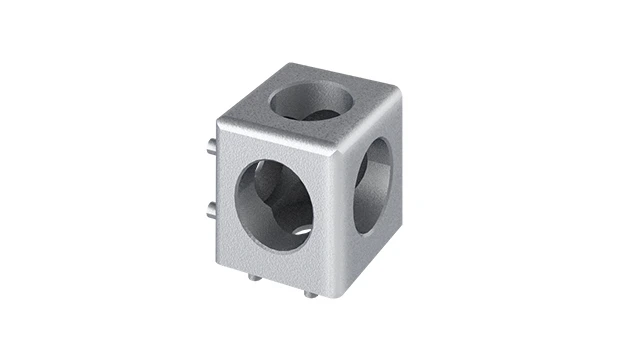
Aluminum Profile 3 Way Connector
The 3 way - squared corner connector is an external fastening method that is typically used to create a corner connection between three profiles. It is a heavy-duty connection that is simple to use and provides a polished look.
In today's fast-paced manufacturing world, where production lines shift overnight, product cycles shrink by the month, and customization is no longer a luxury but a necessity, one thing has become crystal clear: rigidity is the enemy. Traditional manufacturing setups—think welded steel frames, fixed conveyor belts, and bolted-down workbenches—were built for stability, not speed. They worked when factories churned out the same product for years, but those days are gone. Now, manufacturers need setups that can pivot, adapt, and reconfigure as quickly as their customers' demands change. Enter modular systems, and at the heart of these systems? Aluminum extrusion profiles and the unsung heroes holding them together: connectors. And among these connectors, few are as versatile or vital as the aluminum profile 3 way connector.
The Rise of Aluminum Extrusion Profiles in Manufacturing
Before we dive into the specifics of 3 way connectors, let's talk about the foundation they attach to: aluminum extrusion profiles. Why aluminum? For starters, it's a manufacturing dream material. It's lightweight—about a third the weight of steel—so even large structures are easy to move and reposition. But don't let the lightness fool you: aluminum is surprisingly strong, especially when alloyed with elements like magnesium or silicon. It's also naturally corrosion-resistant, thanks to a thin oxide layer that forms on its surface, meaning it holds up in dusty factories, humid warehouses, and even outdoor settings. And let's not forget sustainability: aluminum is 100% recyclable, with recycled aluminum requiring just 5% of the energy needed to produce new aluminum. For manufacturers aiming to reduce their carbon footprint, that's a big win.
But what really makes aluminum extrusion profiles game-changing is the extrusion process itself. Extrusion involves heating aluminum billets and forcing them through a die to create long, continuous shapes with precise cross-sections. This process allows for incredible consistency—every profile off the line is identical to the last—and the ability to design profiles with built-in features. The most critical of these features? T-slots. These grooves running along the length of the profile are like the universal language of modular manufacturing. They let you attach almost anything—connectors, panels, shelves, tools—without drilling or welding. Just slide a bolt or nut into the slot, tighten, and you're done. It's this T-slot design that turns a simple aluminum bar into a building block for endless possibilities.
Aluminum Profile Accessories: The Glue That Holds Modularity Together
If aluminum extrusion profiles are the building blocks, then aluminum profile accessories are the mortar. These include everything from end caps that protect T-slots from debris to brackets that mount tools, but none are more essential than connectors. Connectors are what turn individual profiles into structures—workbenches, racks, conveyors, you name it. They come in all shapes and sizes, each designed for a specific job: 90° connectors for right-angle joints, 45° connectors for slopes, swivel connectors for adjustable angles. But if there's one connector that embodies the spirit of modular flexibility, it's the 3 way connector.
So, what exactly is an aluminum profile 3 way connector? At its core, it's a small, often cube or T-shaped component that lets you join three aluminum profiles at a single point. Depending on the design, those three profiles can meet at 90° angles (like the corner of a cube), 135° angles (for octagonal structures), or even adjustable angles for custom setups. Some 3 way connectors are fixed, meaning the angles are set, while others are swivel or multi-angle, letting you tweak the position of the profiles after assembly. Most are made from the same aluminum alloy as the profiles themselves, ensuring they match in strength and corrosion resistance, and they attach to the profiles using bolts or screws that fit into the T-slots—no welding, no drilling, no permanent modifications.

Aluminum Profile 3 Way Connectors: Design, Functionality, and Why They Matter
Let's get into the nitty-gritty of 3 way connectors. Take a standard fixed 3 way connector, for example. It might look like a small cube with three threaded holes, each aligned at 90° to the others. To use it, you slide a bolt through the T-slot of one aluminum profile, thread it into one hole of the connector, and tighten. Repeat with the other two profiles, and suddenly you've got a sturdy corner where three profiles meet—perfect for the corner of a workbench or the junction of a material rack. More advanced 3 way connectors might have slots instead of fixed holes, allowing you to adjust the position of the profiles along the connector before tightening. This is a lifesaver when you need to fine-tune the alignment of a structure, like making sure the shelves of a rack are perfectly level.
Load capacity is another key factor. A well-designed 3 way connector can handle significant weight—often 200 kg or more per joint, depending on the size of the connector and the profile it's attached to. This is critical in manufacturing settings, where workbenches might hold heavy machinery or material racks might be stacked with parts. Manufacturers test these connectors rigorously, subjecting them to tension, compression, and shear forces to ensure they don't fail under real-world conditions. And because they're made from aluminum alloy, they're not just strong—they're also lightweight, so they don't add unnecessary bulk to the structures they build.
But what really sets 3 way connectors apart is their versatility. Think about a typical manufacturing workbench. You might need a main frame (four vertical profiles), a top shelf (horizontal profiles), and side shelves for tools or materials. The corners where the vertical profiles meet the top shelf? That's 90° connectors. But where the side shelves meet the main frame? That's where 3 way connectors shine. They let you branch off from the main structure, adding a third profile (the side shelf) without disrupting the existing joints. Need to add a light above the workbench? Use a 3 way connector to attach a vertical profile upward from the back corner, then mount the light to that. Want to add a bin for scrap materials below the bench? A 3 way connector can support a horizontal profile extending outward, with the bin hanging from it. The possibilities are limited only by your imagination—and the number of T-slots on your profiles.
A Closer Look: Comparing Common Aluminum Profile Connectors
To truly appreciate 3 way connectors, it helps to see how they stack up against other common connector types. Let's break it down:
| Connector Type | Key Design Features | Best For | Max Load Capacity (Approx.) |
|---|---|---|---|
| 3 Way Connector | Joins 3 profiles at 90°/135° angles; T-slot or bolt-on attachment | Workbench corners, material rack junctions, branching structures | 150–300 kg per joint |
| 90° Angle Connector | Joins 2 profiles at right angle; compact, low-profile design | Straight edges, frame corners, vertical-horizontal joints | 100–250 kg per joint |
| 45° Connector | Joins 2 profiles at 45° angle; used for slopes or diagonal bracing | Incline conveyor tracks, sloped work surfaces, truss structures | 80–200 kg per joint |
| Swivel Connector | Adjustable angle (0°–180°); rotating joint for dynamic setups | Tilt tables, adjustable shelves, ergonomic workstations | 50–150 kg per joint |
As the table shows, 3 way connectors offer a unique combination of strength and versatility. They're not the only connectors you'll need—you'll still reach for 90° connectors for straight corners or swivel connectors for adjustable setups—but they're the ones that let you build complex, multi-branched structures without overcomplicating things. And because they're modular, you can mix and match connector types to create exactly the structure you need.

Real-World Applications: How 3 Way Connectors Power Lean Manufacturing Systems
Let's move beyond theory and talk about how 3 way connectors are actually used in manufacturing. Take lean manufacturing, for example. Lean systems are all about eliminating waste—whether that's wasted space, wasted time, or wasted effort. Modular aluminum structures built with 3 way connectors align perfectly with this philosophy because they're adaptable. When a production line needs to shrink to make room for a new machine, you can disassemble the old material rack, reconfigure the profiles with 3 way connectors, and build a smaller rack in hours. When a new product requires a taller workbench, you can add vertical profiles using 3 way connectors, raising the height without buying a whole new bench.
Consider a small electronics manufacturer that produces both smartphones and tablets. Smartphones are small, so their assembly line uses low workbenches with side shelves for tiny components. Tablets are larger, requiring taller workbenches and more surface area. With traditional fixed workbenches, this would mean two separate lines—doubling the space and cost. But with aluminum profiles and 3 way connectors, they can reconfigure the same basic frames. By adding vertical profiles (using 3 way connectors) to the smartphone workbenches, they raise the height. By attaching additional horizontal profiles (again, via 3 way connectors) to the sides, they expand the surface area. When the tablet order is done, they disassemble the extra parts and revert to the smartphone setup. No waste, no extra cost, just flexibility.
Material racks are another area where 3 way connectors shine. A typical material rack might have vertical posts, horizontal beams for shelves, and diagonal bracing for stability. The corners where the vertical posts meet the horizontal beams? 90° connectors. But where the diagonal bracing meets both the vertical post and the horizontal beam? That's a 3 way connector. It lets you attach three profiles (post, beam, brace) at a single point, creating a strong, stable joint that can support heavy loads of parts or products. And if you need to add a fourth shelf halfway up the rack? Just use 3 way connectors to attach new horizontal beams to the vertical posts—no need to cut or weld new supports.
Even conveyor systems benefit from 3 way connectors. Roller tracks (like the plastic roller track guide rail or aluminum guide rail mentioned in the keywords) are often mounted to aluminum profile frames. When the conveyor needs to turn a corner or split into two lines, 3 way connectors let you branch off the main track, creating a Y-shape or T-shape without complex welding. This is especially useful in warehouses where order fulfillment paths change based on demand—during peak seasons, you can add a branch to speed up shipping; during slow seasons, you can remove it to save space.
The Benefits of Choosing Aluminum Profile 3 Way Connectors
By now, you might be thinking, "Okay, 3 way connectors are useful, but why should I choose them over other modular solutions?" Let's break down the key benefits:
- Cost Savings: Traditional welded steel structures are expensive to build and even more expensive to modify. If you need a new rack, you pay for materials, labor, and welding. If you need to change it later, you might as well scrap it and start over. With aluminum profiles and 3 way connectors, you pay for the initial profiles and connectors, but you can reuse them indefinitely. A rack today, a workbench tomorrow, a conveyor frame next month—same components, endless uses.
- Time Efficiency: Building with 3 way connectors is fast. There's no waiting for welds to cool or paint to dry. A small team can assemble a basic workbench in an hour, a material rack in half a day. Reconfiguration is even faster—just loosen the bolts, adjust the profiles, and retighten. This is a game-changer for manufacturers with tight deadlines or frequent setup changes.
- Durability: Aluminum is tough. It resists rust, dents, and corrosion, so structures built with aluminum profiles and 3 way connectors last for years—even in harsh factory environments. Unlike plastic connectors, which can crack or warp under heat, aluminum connectors stand up to the daily grind of manufacturing.
- Safety: Welded steel structures can have sharp edges or weak points if the weld is poor. Aluminum profiles have smooth, rounded edges, and 3 way connectors attach securely via T-slots, reducing the risk of accidents. Plus, since you can reconfigure structures without cutting or welding, there's no risk of fire or toxic fumes in the factory.
The Future of Aluminum Profile Systems: What's Next for 3 Way Connectors?
As manufacturing continues to evolve, so too will aluminum profile systems and the connectors that power them. We're already seeing innovations like smart connectors with built-in sensors that monitor load levels, alerting workers if a rack is overloaded. Imagine a 3 way connector that can send a notification to your phone if the material rack it's part of is carrying too much weight—preventing collapses and improving safety. We're also seeing advances in materials, with some manufacturers experimenting with carbon fiber-reinforced aluminum connectors that are even stronger and lighter than traditional alloys.
Another trend is customization. While standard 3 way connectors work for most applications, some manufacturers need unique angles or load capacities. Thanks to 3D printing, it's becoming easier and cheaper to produce custom 3 way connectors tailored to specific needs. A factory building a specialized machine might design a 3 way connector with an unusual angle, print it in aluminum alloy, and have it ready in days—not weeks. This level of customization was unheard of a decade ago, but it's quickly becoming the norm.
Conclusion: 3 Way Connectors—Small Parts, Big Impact
In the grand scheme of manufacturing, aluminum profile 3 way connectors might seem small—even insignificant. They're not as flashy as robots or as high-tech as 3D printers. But without them, the modular systems that make modern manufacturing flexible, efficient, and sustainable simply wouldn't exist. They're the backbone of the workbenches where products are built, the racks where materials are stored, and the conveyors that move goods through the factory. They let manufacturers adapt to change, reduce waste, and stay competitive in a world where the only constant is change itself.
So, the next time you walk through a factory, take a closer look at the workbenches, the racks, the conveyor frames. Chances are, you'll spot a 3 way connector holding them together—quietly, reliably, and flexibly. And if you're a manufacturer looking to future-proof your operation, maybe it's time to ask: Could aluminum extrusion profiles and 3 way connectors help you build the flexible system you need?