- Company Articles
- Products and Technology
- Application Cases
- Aluminum Roller Track Black ESD with Side Guide: Application in Solar Panel Production Lines

Aluminum Roller Track Black ESD with Side Guide: Application in Solar Panel Production Lines
Related Product
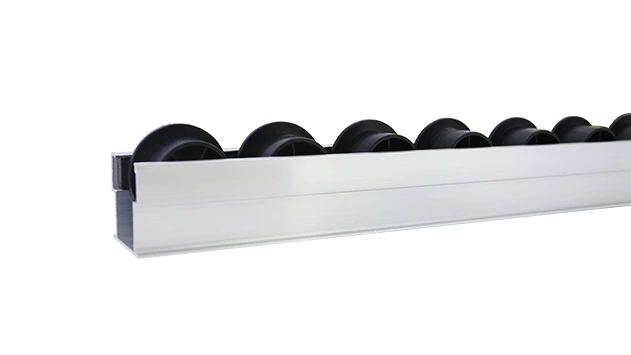
Aluminum Roller Track Black ESD With Side Guide
Heavy duty roller tracks with flanged plastic rollers for use in processing, logistics and materials handling operations. Ideal for transporting goods quickly and easily as well as for installing on shelving to aid in picking operations.
Aluminum Roller Track Black ESD with Side Guide: Application in Solar Panel Production Lines
Introduction
Let's talk about solar panel production—an industry that's booming as the world shifts to renewable energy, but it's not without its daily struggles. If you're in this space, you know how easy it is to lose money to static damage, how frustrating it is when panels get misaligned mid-line, and how slow your process can be if material handling isn't up to par. That's where szsunqit's Aluminum Roller Track Black ESD with Side Guide steps in. This isn't just a piece of metal with rollers; it's a solution designed to fix those exact pain points. In this article, we'll walk through what this track does, why it's perfect for solar lines, how it fits into your existing setup, and real-world results you can expect.
What Is the Aluminum Roller Track Black ESD with Side Guide?
First, let's get the basics out of the way. This roller track is made from high-strength aluminum alloy—so it's lightweight enough to reconfigure but tough enough to handle heavy solar panels (we're talking up to 200kg per meter). The black coating isn't just for aesthetics; it's an ESD (electrostatic discharge) layer that keeps static electricity from building up. Those side guides? They're integrated into the track and made from the same ESD material, so they don't just keep panels straight—they also prevent static sparks. Whether you're moving tiny silicon wafers or full-sized 72-cell modules, this track ensures everything stays in line and static-free.
Here's the thing: Solar cells are super sensitive to static. A single spark can create permanent defects like hot spots, which reduce a panel's efficiency or even make it useless. And if panels go off-track during transfer, you're looking at rework time or scrapped parts. This roller track solves both problems in one go.
Key Challenges in Solar Panel Production That This Track Solves
Let's dive into the specific issues this track addresses for solar manufacturers:
1. ESD Damage Risk
Silicon wafers and solar cells are semiconductors. Even a small static charge (like the one you get from rubbing your shoes on carpet) can cause a voltage spike that damages the cell's structure. According to industry data, ESD damage accounts for up to 5% of scrap in solar production lines. That's a lot of money down the drain—especially when panels are getting more expensive to produce.
The Aluminum Roller Track Black ESD with Side Guide is grounded, so any static charge on the panels or track is dissipated immediately. No sparks, no damage, no scrap.
2. Alignment Issues
Solar panels need to be perfectly aligned during key processes like lamination (where glass, EVA, cells, and backsheet are pressed together) and soldering (connecting cells into strings). If a panel is even a few millimeters off, the lamination process will result in uneven bonding, leading to water ingress or reduced durability. Soldering misalignment can cause poor electrical connections, which lower the panel's output.
The side guides on this track keep panels exactly in the right position as they move through the line. You don't have to worry about manual adjustments or rework—just set the guide width once, and every panel stays aligned.
3. Slow Material Handling
In busy solar lines, every second counts. If panels take too long to move from one station to the next, your overall throughput drops. Traditional roller tracks often have sticky rollers or lack smooth movement, which slows things down. This track's rollers are designed for low friction, so panels glide along quickly—without any jams or delays.
4. Lack of Flexibility
Solar manufacturers often need to switch between producing different panel sizes (like 60-cell vs. 72-cell) or adjust their line layout for new processes. Rigid tracks make this hard—you have to replace entire sections or buy new equipment. But this track is modular: you can add or remove sections, adjust the side guide width, and even connect it to other lean system components without tools. Reconfiguring your line takes hours instead of days.
Application Scenarios in Solar Panel Production Lines
Let's look at how this track is used in real solar production lines:
1. Wafer Transfer Stage
After slicing silicon ingots into wafers, the wafers need to be moved to cleaning stations. These wafers are tiny (usually 156mm or 182mm) and extremely sensitive to static. The Aluminum Roller Track Black ESD with Side Guide is perfect here: it moves the wafers smoothly, keeps them aligned (so they don't fall off), and prevents static damage. Many manufacturers use this track in conjunction with a flow rack to store wafers before cleaning—this allows FIFO (first-in-first-out) storage, so older wafers are used first, reducing waste.
2. Cell Stringing & Soldering
Once wafers are turned into cells, they're strung together with solder. This process requires precise alignment: each cell must be placed exactly 2-3mm apart to ensure proper electrical flow. The track feeds cells directly to the soldering machine, with side guides keeping them in line. After soldering, the cell strings are moved to an ESD workstation where workers inspect them. The track connects directly to the workstation, so the strings arrive static-free and aligned—no need to reposition them manually.
3. Module Assembly & Lamination
In module assembly, cell strings are attached to a backsheet, covered with EVA, and then placed under glass. The entire sub-assembly needs to be moved to the laminator without misalignment. The track's side guides ensure the sub-assembly stays straight as it enters the laminator. After lamination, the finished module is moved to a testing station via the same track—again, static-free and aligned.
4. Quality Inspection & Packaging
Finished modules go through several tests: IV curve testing (to measure efficiency), EL testing (to check for defects), and visual inspection. The track moves modules from one test station to the next, keeping them aligned so tests are accurate. Once passed, modules are packed into boxes and moved to a shipping area via a conveyor system that integrates with the track. The track's durability handles heavy boxes (up to 50kg each) with ease.
Integration with Other Lean System Components
The best part about this track is how well it works with other lean system components from szsunqit. Let's see:
Many solar production steps (like cell inspection or module repair) are done at ESD workstations. These workstations have ESD mats, grounding wires, and static-free tools. The Aluminum Roller Track Black ESD with Side Guide connects directly to these workstations—so parts arrive static-free and aligned. This eliminates the need to carry parts manually, reducing the risk of damage and saving time.
2. Flow Rack
Flow racks are used to store semi-finished parts (like cell strings or sub-assemblies) in FIFO order. The track is installed on the flow rack's shelves, so parts slide down to the front when needed. This reduces waste (no expired parts) and speeds up production—workers don't have to search for parts; they're always at the front.
3. Conveyor System
For long production lines, the track is integrated with a conveyor system. The conveyor moves modules from one end of the line to the other, with the track handling shorter transfers between stations. This combination ensures smooth, continuous movement—no bottlenecks, no delays.
Some manufacturers use lean pipe workbenches for manual assembly tasks. The track can be attached to the workbench, feeding parts directly to the worker. This reduces the time workers spend reaching for parts, boosting productivity.
Technical Specifications (Table)
| Feature | Specification | Benefit for Solar Production |
|---|---|---|
| Material | High-strength aluminum alloy (6063-T5) | Lightweight yet durable; resists corrosion in clean production environments |
| ESD Coating | Black ESD plastic (surface resistance: 10^6 - 10^9 Ω) | Prevents static discharge damage to sensitive solar cells/modules |
| Side Guide | Adjustable ESD plastic (width range: 100mm - 2200mm) | Keeps panels aligned for precise processes like soldering/lamination |
| Roller Diameter | 38mm | Smooth movement for small wafers and large modules alike |
| Load Capacity | Up to 200kg per linear meter | Handles heavy modules and packed boxes with ease |
| Modularity | Tool-free connection with lean pipe joints | Easy to reconfigure for different panel sizes or line layouts |
| Compatibility | Works with flow racks, ESD workstations, and conveyors | Seamless integration into existing lean systems; no third-party adapters needed |
Case Study: GreenSolar Tech's Success with This Track
GreenSolar Tech is a mid-sized solar panel manufacturer in Guangdong, China. They were facing two big problems: 5% scrap rate due to ESD damage, and slow transfer times (10 seconds per module between stations). They decided to replace their old roller tracks with szsunqit's Aluminum Roller Track Black ESD with Side Guide. Here's what happened:
First, they installed 50 meters of track in their cell stringing, lamination, and testing stages. They also integrated the track with their existing ESD workstations and flow racks. Within a month, their scrap rate dropped to 1.2%—a 76% reduction! This saved them over $100,000 in material costs per year.
Second, transfer times decreased to 5 seconds per module—doubling their throughput. They could now produce 200 more modules per shift. This increased their revenue by 15%.
Third, they could reconfigure their line for new 210mm modules in just 2 days—instead of the 1 week it took before. This allowed them to take on a new client order that would have been impossible otherwise.
GreenSolar's production manager said: "This track changed our business. We no longer worry about ESD damage, our line is faster, and we can adapt to new orders quickly. It's one of the best investments we've ever made."
Why Choose szsunqit's Aluminum Roller Track Black ESD with Side Guide?
There are many roller tracks on the market, but szsunqit's stands out for three reasons:
1. Customization
szsunqit offers custom track lengths, side guide widths, and even special coatings if needed. Whether you have a small line or a large factory, they can tailor the track to your exact needs.
2. Quality
Every track is tested for ESD resistance, load capacity, and durability before shipping. szsunqit uses only high-grade aluminum and ESD materials, so you don't have to worry about premature wear or failure.
3. Lean Expertise
szsunqit specializes in lean systems—so they understand how to design components that reduce waste and improve efficiency. This track isn't just a piece of equipment; it's part of a larger lean solution that helps you optimize your entire production line.
Conclusion
If you're in the solar panel production business, szsunqit's Aluminum Roller Track Black ESD with Side Guide is a must-have. It solves critical problems like ESD damage, alignment errors, and slow transfer times. It integrates seamlessly with other lean system components like ESD workstations and flow racks. And it's built to last, so you get a great return on investment.
Whether you're looking to upgrade your existing line or build a new one, this track will help you produce more panels, reduce waste, and adapt to changing market needs. So why wait? Give your solar line the boost it needs with szsunqit's Aluminum Roller Track Black ESD with Side Guide.