- Company Articles
- Products and Technology
- Product knowledge
- Aluminum Workbench A: A Sustainable Alternative to Disposable Workstations

Aluminum Workbench A: A Sustainable Alternative to Disposable Workstations
Related Product
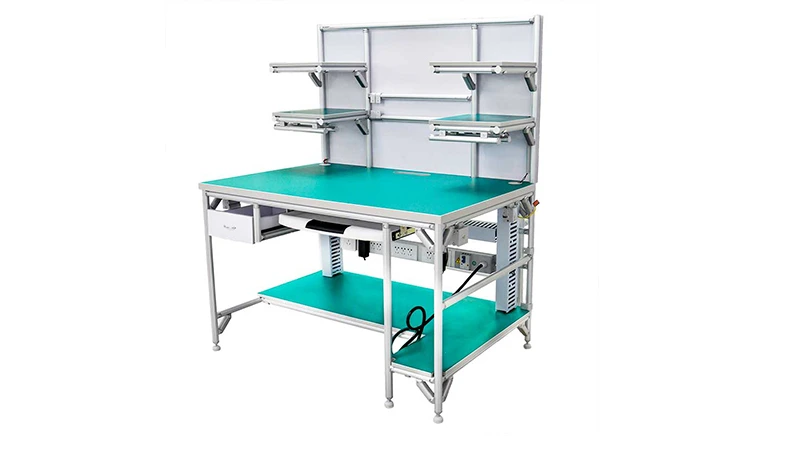
Aluminum Workbench A
Aluminum tube workbench is more flexible and durable, compared with traditional PE/ABS coated steel tube. It is easy to assemble, anti corrosion, rust protection, and recycle use after disassemble.
The Hidden Cost of "Quick Fix" Workstations
Walk into any small manufacturing shop, electronics assembly line, or warehouse, and you'll likely spot them: workstations that look like they're held together by hope and duct tape. Particleboard tops stained with oil and glue, rickety metal frames that wobble when you set down a drill, and wheels on rolling carts that lock up or fall off after a few months of use. These are the "disposable workstations"—cheap, quick to set up, and even quicker to wear out. They're the default choice for businesses trying to save money upfront, but what if that "savings" is actually costing you more in the long run?
Let's break it down. A basic particleboard workbench might cost $150. Sounds great, right? But if it warps after six months of exposure to humidity or tool weight, you're buying a new one twice a year. That's $300 annually. Multiply that by 10 workstations, and suddenly you're spending $3,000 a year on replacements. Then there's the hidden cost: downtime. When a workstation breaks, workers stop production to fix it or wait for a new one. A single hour of downtime in a small factory can cost hundreds of dollars in lost output. Add in the frustration of unstable surfaces—tools sliding off, parts getting scratched—and you've got a recipe for inefficiency, not savings.
And let's not forget the planet. Disposable workstations are often made with materials that don't hold up to recycling: particleboard glued with toxic resins, plastic components that degrade into microplastics, or low-grade steel that rusts and becomes unusable. Every time you toss a broken workstation, it ends up in a landfill, contributing to the 25 million tons of industrial waste generated annually in the U.S. alone. For businesses trying to shrink their environmental footprint, this cycle of buy, break, replace is a silent but significant problem.
Meet Aluminum Workbench A: Built to Last, Designed to Adapt
Enter Aluminum Workbench A —not just a workstation, but a long-term investment in your workflow, your team, and the planet. At first glance, it might seem pricier than that $150 particleboard quick fix. But look closer: this workbench is built with aluminum profile , a material known for its strength, light weight, and durability. Aluminum doesn't warp, rust, or degrade under heavy use. It's resistant to moisture, chemicals, and the daily wear and tear of a busy shop floor. And because it's made from extruded aluminum—a process that shapes metal into precise, consistent profiles—it fits together with aluminum profile accessories (think brackets, connectors, and shelves) to create a workstation that's as adaptable as your needs.
Aluminum Workbench A isn't a one-size-fits-all solution. Its modular design means you can start with a basic single-deck setup (the "Workbench E (single deck-without caster)" model, if you prefer specifics) and add shelves, tool hooks, or lighting as your operations grow. Need to move it? Add caster wheels —sturdy, lockable ones that glide smoothly over concrete or tile without leaving marks. Working with sensitive electronics? Opt for an ESD-safe surface to prevent static damage to components. The point is: this workbench grows with you, so you're not stuck replacing it every time your process changes.

How Aluminum Workbench A Supports Lean Systems
If you've ever dabbled in manufacturing best practices, you've probably heard of "lean systems"—a philosophy centered on minimizing waste (muda) while maximizing value. Lean is all about cutting out the unnecessary: excess inventory, waiting time, inefficient movement. Disposable workstations, ironically, are a hotbed of waste. They break, causing downtime (waiting waste). They're hard to reconfigure, so you end up with extra steps (movement waste). They're not built for organization, so tools get lost (inventory waste). Aluminum Workbench A, on the other hand, is lean by design.
Take workflow, for example. In a lean system, materials should flow to workers, not the other way around. Aluminum Workbench A integrates seamlessly with flow racks —those sloped shelves where parts roll forward as they're used. Attach a flow rack to the side of your workbench, and suddenly components are within arm's reach, eliminating the need for workers to walk to a storage area. No more wasted steps, no more interrupted focus. It's a small change, but in a fast-paced assembly line, those seconds add up to minutes, and minutes add up to hours of saved production time.
Then there's the "5S" method—sort, set in order, shine, standardize, sustain. Aluminum Workbench A excels here, too. Its flat, easy-to-clean surface makes "shine" (keeping the workspace clean) a breeze. Modular accessories let you "set in order" tools and materials exactly where workers need them, reducing search time. And because it's durable, it stays "standardized"—no more jerry-rigging repairs that throw off your process. When your workspace is organized and reliable, sustaining those good habits becomes second nature.

Key Features That Make a Difference
Let's get into the details. What exactly makes Aluminum Workbench A stand out from both disposable workstations and even other "premium" options? Here are the features that matter most:
- Aluminum Profile: The Backbone of Durability – Aluminum extrusion profiles are strong but lightweight, so the workbench is easy to move (with caster wheels) but can support heavy tools, parts, or equipment. Unlike steel, aluminum doesn't rust, so it holds up in humid environments (think food processing or automotive shops). And when it does reach the end of its life (decades from now), aluminum is 100% recyclable—no waste, no guilt.
- Caster Wheels for Mobility Without Compromise – Not all caster wheels are created equal. The ones designed for Aluminum Workbench A are heavy-duty, with ball bearings that reduce friction and lockable brakes that keep the workstation steady during use. No more wobbly carts or wheels that seize up after a month. They're also easy to swap out if you ever need to replace them (though you probably won't for years).
- ESD Workstation Compatibility – For electronics manufacturers, static electricity is a constant threat. Aluminum Workbench A can be fitted with an ESD-safe top and grounding points to dissipate static charges, protecting sensitive components from damage. This isn't an add-on; it's built into the design, so you don't have to duct-tape anti-static mats to a warped particleboard surface.
- Flow Rack Integration – As mentioned earlier, flow racks are a lean system staple. Aluminum Workbench A's side rails and brackets make it easy to attach flow racks (like the "Material Rack B (3 row and 3 floor)" model) directly to the workstation. This creates a seamless material flow: parts roll from the rack to the workbench, workers assemble, and finished products move to the next station—all without extra steps.
Real-World Impact: A Hypothetical Case Study
Let's put this in context with a scenario that might sound familiar. Meet "TechCraft Electronics," a small manufacturer that builds circuit boards for medical devices. Three years ago, their assembly line relied on 12 disposable workstations: 8 particleboard tables with basic steel frames and 4 rolling carts with plastic wheels. Here's how their old setup worked (or didn't):
- Every 6–8 months, 3–4 workstations needed replacement due to warped tops or broken frames.
- Workers spent 2–3 hours weekly fixing stuck caster wheels or repositioning wobbly tables.
- Static damage from non-ESD surfaces caused 5% of circuit boards to fail quality checks.
- Material flow was disorganized: parts were stored on separate shelves, so workers walked 20+ feet per assembly to grab components.
In 2022, TechCraft switched to 12 Aluminum Workbench A stations, each with ESD tops, caster wheels, and integrated flow racks. The upfront cost was higher—about $3,000 total, compared to $1,800 for the disposable setups—but the results spoke for themselves:
- Zero replacements in 3 years – The aluminum frames and tops showed no signs of wear, even with daily use.
- 10 hours saved monthly – No more fixing broken workstations; workers focused on assembly instead of repairs.
- Static-related failures dropped to 0.5% – The ESD surfaces protected components, reducing waste and rework.
- Assembly time per unit cut by 15% – Flow racks brought parts to the workbench, eliminating unnecessary movement.
By year three, TechCraft had saved over $5,000 in replacement costs alone, not counting the value of increased production and reduced waste. That's the power of investing in a workstation that's built to last.
Sustainability Beyond the Workbench
We've talked about cost and efficiency, but let's circle back to the planet. Aluminum is one of the most sustainable materials on the market. It takes 95% less energy to recycle aluminum than to produce it from raw ore, and nearly 75% of all aluminum ever produced is still in use today. When you choose Aluminum Workbench A, you're not just buying a workstation—you're choosing a material that can be melted down and reused at the end of its life, with no loss in quality.
Compare that to disposable workstations. Particleboard is often made with formaldehyde-based glues, which off-gas harmful chemicals and make recycling nearly impossible. Cheap steel rusts, so even if you try to recycle it, much of the material is lost to corrosion. Plastic components? They break down into microplastics, polluting landfills and waterways. Aluminum Workbench A, by contrast, is a closed-loop solution: use it for 20 years, recycle it, and it becomes a new workbench, a bike frame, or a window frame. No waste, no harm.
Aluminum Workbench A vs. Disposable Workstations: A Comparison
| Feature | Aluminum Workbench A | Disposable Particleboard Workstation | Basic Steel Workbench |
|---|---|---|---|
| Material | Extruded aluminum profile | Particleboard with cheap steel frame | Low-grade steel |
| Estimated Lifespan | 15–20 years | 6–8 months | 3–5 years (with rusting) |
| Recyclability | 100% recyclable | Non-recyclable (glued materials) | Recyclable, but 20–30% material lost to rust |
| Mobility (Caster Wheels) | Sturdy, lockable caster wheels (optional) | Plastic wheels, prone to breaking | Heavy; wheels often seize due to rust |
| ESD Compatibility | Yes (optional ESD top) | No (requires aftermarket mats) | Yes (but heavy and prone to rust) |
| Initial Cost | $250–$350 per unit | $100–$150 per unit | $180–$250 per unit |
| Annual Cost (Replacement/Repair) | $0–$20 (occasional accessory upgrades) | $150–$300 (2–3 replacements/year) | $50–$100 (rust repairs, wheel replacements) |
Why "Cheap" Often Costs More
It's easy to look at the $150 price tag of a disposable workstation and think, "That's a deal." But as TechCraft's story shows, the true cost isn't just the sticker price—it's the hidden expenses: replacement fees, downtime, wasted materials, and environmental harm. Aluminum Workbench A, by contrast, is an investment. It costs more upfront, but it pays for itself in 1–2 years through reduced replacements and increased efficiency. After that, it's pure savings—for your business and the planet.
Think about it this way: if a disposable workstation costs $150 and lasts 6 months, its annual cost is $300. Aluminum Workbench A, at $300, lasts 20 years—an annual cost of $15. That's a 95% reduction in long-term spending. And that doesn't even include the value of saved time, reduced waste, or happier workers (who wouldn't prefer a stable, organized workspace?).
Choosing the Right Workstation for Your Business
So, how do you know if Aluminum Workbench A is right for you? Start by asking yourself these questions:
- How often do I replace workstations? If the answer is "more than once a year," you're throwing money away on disposables.
- Do my workers struggle with workspace organization? Modular aluminum profile accessories can fix that.
- Am I working with sensitive materials (electronics, food, etc.)? ESD compatibility and easy cleaning make Aluminum Workbench A a no-brainer.
- Do I care about sustainability? Aluminum's recyclability and long lifespan align with green business goals.
If you answered "yes" to any of these, it's time to stop settling for disposable workstations. Aluminum Workbench A isn't just a tool—it's a partner in your success. It's the kind of investment that doesn't just improve your bottom line, but makes your workplace safer, more efficient, and more sustainable.
Final Thoughts: Invest in Longevity, Not Landfills
In a world that often prioritizes quick fixes over long-term solutions, Aluminum Workbench A is a reminder that "saving money" shouldn't mean sacrificing quality, efficiency, or the planet. It's a workstation built for the businesses that want to grow, adapt, and thrive—without leaving a trail of broken tables and wasted resources in their wake.
So, the next time you're tempted by that $150 disposable workstation, ask yourself: What's the real cost of "cheap"? For TechCraft Electronics, and for countless other businesses like it, the answer was clear. Aluminum Workbench A wasn't just a purchase—it was a step toward a more sustainable, efficient, and profitable future. Isn't that the kind of future your business deserves?