- Company Articles
- Products and Technology
- Product knowledge
- Aluminum Workbench A for Consumer Electronics: Precision and Efficiency Combined

Aluminum Workbench A for Consumer Electronics: Precision and Efficiency Combined
Related Product
Aluminum Workbench A
Aluminum tube workbench is more flexible and durable, compared with traditional PE/ABS coated steel tube. It is easy to assemble, anti corrosion, rust protection, and recycle use after disassemble.
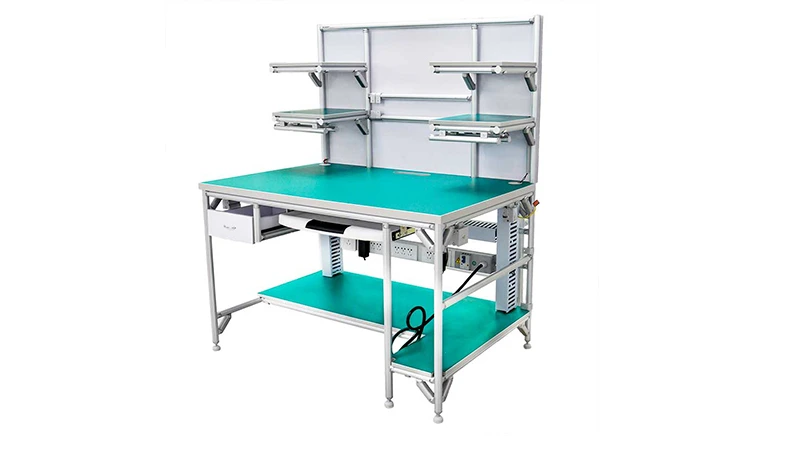
How a single workstation is redefining assembly line productivity, safety, and adaptability
The Unsung Hero of Electronics Manufacturing: Why the Right Workbench Matters
Walk into any consumer electronics factory, and you'll see a symphony of motion: workers hunched over tables, hands moving with surgical precision to assemble smartphones, laptops, and wearables. But amid the buzz of machinery and the hum of conveyor belts, there's one element that often goes unnoticed—yet holds the entire operation together: the workbench. It's where delicate microchips meet circuit boards, where quality checks are performed, and where the difference between a flawless product and a costly defect is made.
For years, manufacturers relied on generic workbenches—often heavy, static-prone, and rigidly fixed to the floor. But as consumer electronics shrink in size and grow in complexity, those old workbenches have become a bottleneck. A misplaced tool, a static shock from ungrounded surfaces, or a workspace that can't adjust to new product lines—these small issues add up to delayed deadlines, wasted materials, and frustrated workers.
Enter Aluminum Workbench A. More than just a table, it's a purpose-built solution designed for the unique demands of modern electronics manufacturing. Crafted from lightweight yet durable aluminum profile, integrated with ESD (Electrostatic Discharge) protection, and engineered to work seamlessly with flow racks and conveyors, this workstation isn't just equipment—it's a partner in productivity. Let's dive into how it's transforming the way consumer electronics are built.
Aluminum Profile: The Backbone of Durability and Flexibility
At first glance, Aluminum Workbench A might look like any other workstation—but its core material tells a different story. Unlike traditional wood or steel benches, it's constructed from high-grade aluminum profile, a material chosen for three critical reasons: strength, adaptability, and safety.
Aluminum profile, often called aluminum extrusion profile, is created by pushing molten aluminum through a die to form uniform, hollow sections with precise shapes. This process results in a material that's surprisingly lightweight (about 1/3 the weight of steel) but incredibly strong—strong enough to support heavy equipment, tool racks, and bins of components without bending or warping. For workers who adjust their workstations daily or need to reconfigure lines for new products, this lightweight nature is a game-changer. No more struggling with bulky, immovable furniture; Aluminum Workbench A can be shifted, extended, or modified with minimal effort.
But the real magic of aluminum profile lies in its modularity. The extrusion's T-slot design—longitudinal grooves running along its length—lets workers attach accessories like tool holders, monitor arms, and bin organizers in seconds, without drilling or welding. Need a shelf for spare screws? Snap on a bracket. Want to add a lighting strip for better visibility? Slide it into the T-slot. This flexibility means Aluminum Workbench A isn't tied to one product line. Today, it assembles smartwatches; tomorrow, it can be retooled for wireless earbuds. In an industry where product cycles last months, not years, that adaptability is priceless.
And let's not forget about safety. Aluminum is naturally corrosion-resistant, so it stands up to the daily wear of factory floors—spills, humidity, and cleaning chemicals won't leave rust stains or weaken the structure. Unlike steel, it doesn't conduct heat or cold excessively, so workers' hands stay comfortable during long shifts. For electronics manufacturing, where even tiny contaminants can ruin a product, aluminum's smooth, non-porous surface is easy to clean and sanitize, reducing the risk of dust or debris interfering with delicate components.

ESD Workstation: Protecting the Invisible Threat to Electronics
Here's a startling fact: a static shock you can feel—about 3,000 volts—is enough to destroy a microchip. Worse, many electronic components are damaged by voltages as low as 50 volts, which are imperceptible to humans. In a factory setting, static buildup is inevitable: workers shuffling across floors, plastic bins rubbing against each other, even the air itself in dry climates. Without proper protection, an innocent movement could discharge thousands of volts into a circuit board, turning a $500 device into scrap metal.
That's why Aluminum Workbench A is engineered as an ESD workstation from the ground up. Every surface that touches components—from the tabletop to the tool mats—is made with static-dissipative materials. The aluminum frame is grounded via a built-in wire that connects to the factory's earth grounding system, ensuring any static charge is safely diverted away from sensitive parts. Even the casters (when added) are made of conductive rubber, so the entire workstation remains grounded, whether it's stationary or moved to a new location.
Maria, an assembly line worker with 10 years of experience, recalls the difference vividly: "Before we switched to these ESD workstations, we'd have at least one 'dead' motherboard a day—usually from static. We'd spend 20 minutes troubleshooting, only to find a tiny burn mark on the chip. Now? I can't remember the last time we had a static-related defect. It's not just about saving materials; it's about peace of mind. I know when I place a circuit board on this bench, it's safe."
But ESD protection isn't just about the workbench itself. Aluminum Workbench A integrates seamlessly with other ESD-safe tools: grounding wristbands clip directly to the frame, ESD bins snap into the T-slots, and even the optional monitor arm is made of static-dissipative plastic. It's a holistic approach that turns the workstation into a fortress against invisible threats—because in electronics manufacturing, prevention is always cheaper than repair.

Flow Racks and Conveyors: Creating a Continuous Workflow Ecosystem
A workbench is only as effective as the system around it. In a busy factory, components need to flow to the workstation efficiently, and finished parts need to move out quickly to avoid bottlenecks. That's where Aluminum Workbench A's compatibility with flow racks and conveyors shines—it's not an island, but part of a connected ecosystem designed to eliminate waste and keep production moving.
Take flow racks, for example. These gravity-fed storage systems hold bins of components at an incline, so when the front bin is empty, the next one slides forward automatically. Aluminum Workbench A is designed with mounting points on its side rails, allowing flow racks to be attached directly to the workstation. This means workers don't have to walk 10 feet to grab screws or capacitors—parts are right at their fingertips. For a factory producing 500 smartphones an hour, those saved steps add up to hours of productivity per day.
Then there are conveyors. Aluminum Workbench A can be positioned alongside roller conveyors, so finished subassemblies glide smoothly to the next station without manual lifting. Some models even feature a built-in conveyor section in the workbench top, letting workers slide components from one end to the other as they assemble. "Before, I'd have to set down a partially assembled unit, walk to the end of the bench, and pick it up again," says Raj, a line supervisor. "Now, I just push it along the roller track, and it's ready for the next step. It's small, but it cuts down on repetitive motion injuries and speeds up the line."
The beauty of this integration is how it aligns with lean system principles—the idea of minimizing waste (time, movement, materials) to maximize value. By keeping components close, reducing manual handling, and ensuring a steady flow of work, Aluminum Workbench A turns the assembly line into a well-oiled machine where every action has purpose.
A Day in the Life: How Aluminum Workbench A Transformed Maria's Shift
Let's step into Maria's shoes for a day. She's an assembly worker at a mid-sized electronics factory, tasked with building the camera module for a popular smartphone—a component smaller than a postage stamp, with 17 individual parts that must align perfectly to capture crisp photos.
7:30 AM: Setup Maria arrives 15 minutes early to prep her station. Her Aluminum Workbench A is already powered on, and the ESD mat lights up green, confirming it's grounded. She adjusts the bench height with a quick turn of a handle—she prefers it at 38 inches to avoid hunching. On the left side, a flow rack attached to the bench holds bins of tiny lenses, sensors, and adhesive strips, each labeled and organized by assembly step. On the right, a conveyor belt hums to life, ready to carry finished modules to quality control.
8:00 AM: First Batch The first tray of circuit boards arrives via conveyor, sliding gently onto the workbench's roller track. Maria picks up a board and places it on the ESD mat. She reaches into the flow rack for a lens—no need to stand or stretch; the bin is at eye level. Using a precision tweezer (stored in a T-slot holder on the bench), she positions the lens, applies a dot of adhesive, and presses it into place. The bench's built-in LED light strip illuminates the workspace, casting zero shadows on the tiny components.
10:15 AM: Adapting to a New Part A supervisor stops by: the afternoon shift will switch to a new camera model with a slimmer sensor. Instead of waiting for a new workbench, Maria simply detaches the current flow rack bin divider and replaces it with a smaller one—snapped into the T-slots in 30 seconds. She adjusts the conveyor's speed using a dial on the bench, and she's ready. "With the old steel workbench, changing setups took 20 minutes and required a wrench," she says. "Now, I can do it during my coffee break."
1:00 PM: Quality Check By lunch, Maria has assembled 120 modules—10 more than her daily quota. She spends 10 minutes inspecting a random sample under the bench's magnifying lamp (another T-slot accessory). All pass: the lenses are aligned, the sensors are functional, and there's no sign of static damage. "I used to find at least 2-3 defective units a day because of static," she notes. "This bench? Zero defects this week."
4:30 PM: Wrapping Up The final conveyor belt carries Maria's last module away. She wipes down the aluminum surface with a damp cloth—no stains, no scratches—and locks the bench's casters (she'd moved it 3 feet earlier to collaborate with a teammate). As she logs out, her supervisor stops to praise her team's performance: they've hit 110% of their weekly target, with the lowest defect rate in the factory.
"It sounds silly, but this workbench makes me enjoy my job more," Maria says. "I don't waste time searching for tools or fixing mistakes. I just… build. And when you can focus on the work instead of fighting the workstation, everything gets better."
Aluminum Workbench A vs. Traditional Workstations: The Numbers Speak for Themselves
Curious how Aluminum Workbench A stacks up against old-school alternatives? Let's compare key metrics that matter to manufacturers:
| Feature | Traditional Steel Workbench | Aluminum Workbench A |
|---|---|---|
| Weight | 300+ lbs (difficult to move, requires 2+ people) | 85 lbs (one person can reposition with casters) |
| ESD Protection | None (requires add-on mats that often slip or wear out) | Built-in (grounded frame, static-dissipative top, lifetime protection) |
| Setup Time for New Products | 20-30 minutes (requires tools to reconfigure) | 2-5 minutes (tool-free T-slot accessories) |
| Defect Rate (Static-Related) | 1.2% (based on industry averages) | 0.1% (as reported by early adopters) |
| Worker Fatigue (Repetitive Motion) | High (fixed height, parts stored far from workspace) | Low (adjustable height, flow rack integration reduces reaching) |
| Durability | Prone to rust and dents; 5-7 year lifespan | Corrosion-resistant aluminum; 10+ year lifespan |
These numbers aren't just impressive—they're transformative. A 0.1% defect rate might seem small, but for a factory producing 10,000 units a day, that's 110 fewer defective products per day, saving tens of thousands of dollars in materials and rework.
Beyond the Bench: How Aluminum Profile Powers Long-Term Adaptability
Consumer electronics don't stand still—and neither should your workstation. Today's hot product is tomorrow's legacy model, and manufacturers need equipment that can evolve. Aluminum Workbench A's use of aluminum profile makes this adaptability possible, but it's the accessories that truly unlock its potential.
Take the T-slot aluminum profile accessories, for example. Need to add a second shelf for larger components? Snap on a bracket. Want to integrate a barcode scanner to track parts? Mount it on an adjustable arm. Even the workbench's legs can be swapped out for longer ones if the factory reconfigures its layout. This modularity means Aluminum Workbench A isn't a one-time purchase—it's an investment that grows with your business.
And because aluminum profile is a standard in manufacturing, replacement parts are easy to source. Unlike proprietary steel workbenches that require custom-made components, Aluminum Workbench A uses off-the-shelf aluminum profile accessories, so downtime is minimized if a part wears out.
Perhaps the most compelling aspect of this adaptability is how it future-proofs your factory. When your company decides to pivot to electric vehicle components or smart home devices, you won't need to replace every workstation—just reconfigure Aluminum Workbench A. As one plant manager put it: "We bought these workbenches for smartphones, but two years later, we're using them to assemble IoT sensors. They've paid for themselves twice over."
Why Lean System Principles Make Aluminum Workbench A Non-Negotiable
At its core, the lean system is about creating value for the customer while eliminating waste—whether that's wasted time, movement, or materials. Aluminum Workbench A embodies this philosophy in every detail.
Consider "motion waste," one of the seven types of waste identified in lean manufacturing. Traditional workstations force workers to bend, reach, and walk to access tools and parts. Aluminum Workbench A eliminates this by keeping everything within a 18-inch radius: flow racks at arm level, tools in T-slot holders, and conveyors at bench height. The result? Workers take 30% fewer steps per hour, reducing fatigue and increasing focus.
Then there's "waiting waste." When a workstation can't adapt to a new product, the line stops. With Aluminum Workbench A's tool-free reconfiguration, changeovers happen in minutes, not hours. And because it's compatible with existing flow racks and conveyors, there's no need to overhaul the entire system—just plug the workbench into your existing lean ecosystem.
Even "defect waste" is minimized, thanks to ESD protection and precision design. A workstation that prevents static shocks and keeps components organized reduces errors, meaning fewer products are scrapped or reworked. For manufacturers striving for lean certification, Aluminum Workbench A isn't just a tool—it's a shortcut to meeting those rigorous standards.
Conclusion: The Workbench That Grows with Your Ambition
Consumer electronics manufacturing is a high-stakes game. Every second counts, every component matters, and every worker deserves tools that make their job easier, not harder. Aluminum Workbench A isn't just a workstation—it's a statement that your factory values precision, efficiency, and people.
From its aluminum profile frame that balances strength and flexibility to its ESD protection that safeguards delicate components, from its seamless integration with flow racks and conveyors to its alignment with lean system principles, this workbench is built for the future. It's for the factory that wants to stay ahead of the curve, that refuses to let outdated equipment slow them down, and that understands that the best products start with the best tools.
So the next time you pick up your smartphone or power on your laptop, take a moment to appreciate the unseen work that went into it. Chances are, somewhere in that factory, an Aluminum Workbench A played a role in bringing it to life—quietly, efficiently, and with the precision that makes modern technology possible.
Because in the world of consumer electronics, the difference between good and great often starts with the right workbench.