- Company Articles
- Products and Technology
- Product knowledge
- Aluminum Workbench A for High-Volume Production: Handling the Pressure

Aluminum Workbench A for High-Volume Production: Handling the Pressure
Related Product
Aluminum Workbench A
Aluminum tube workbench is more flexible and durable, compared with traditional PE/ABS coated steel tube. It is easy to assemble, anti corrosion, rust protection, and recycle use after disassemble.
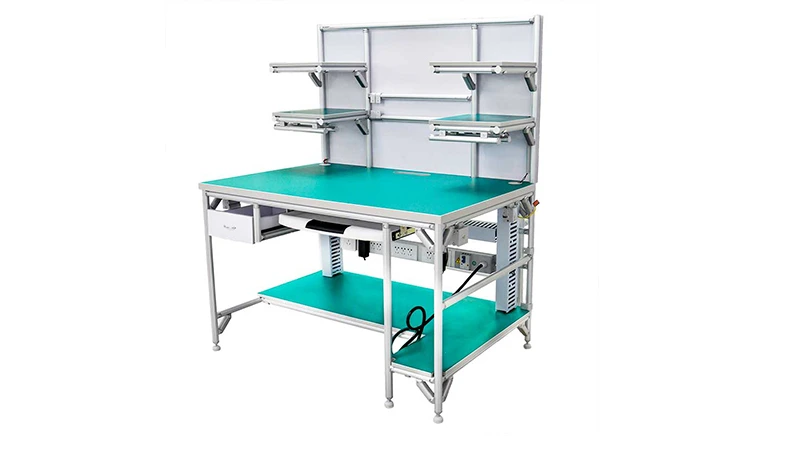
In the world of high-volume manufacturing, where deadlines loom like storm clouds and every second counts, the unsung heroes often aren't the flashy machines or cutting-edge software. They're the workbenches—the sturdy, reliable surfaces where teams transform raw materials into finished products, one precise step at a time. Today, we're shining a light on a game-changer in this space: Aluminum Workbench A. More than just a table, it's a partner in productivity, a cornerstone of lean systems, and a testament to how thoughtful design can turn daily chaos into streamlined success.
The High-Volume Grind: Why Workbenches Matter More Than You Think
Walk into any high-volume production facility, and you'll feel it immediately—the pulse of urgency. Conveyors hum, pneumatic tools chatter, and teams move with the coordinated rhythm of a well-rehearsed orchestra. But beneath that rhythm lies a pressure cooker: quotas to hit, quality to maintain, and workers who need to stay sharp for 8–12 hour shifts. In this environment, a workbench isn't just a piece of furniture. It's the command center where operators spend 60% of their day, the stage where precision meets pace, and the first line of defense against errors, delays, and fatigue.
Consider this: A typical assembly line worker might reach for parts, adjust components, or test products hundreds of times per hour. If their workbench is too high, their shoulders ache. If it's cluttered, they waste seconds hunting for tools. If it wobbles, delicate parts get damaged. And in high-volume settings, those seconds add up—to missed deadlines, frustrated teams, and shrinking profit margins. "We used to lose 20 minutes a day per worker just to poor bench design," says Mark, a production manager at Streamline Electronics, a manufacturer of consumer tech with daily output targets of 10,000 units. "That's 100 hours a week across the floor. It wasn't sustainable."
Aluminum Workbench A: Built for the Grind
Enter Aluminum Workbench A. At first glance, it might seem unassuming—sleek aluminum surfaces, clean lines, and a modular frame. But look closer, and you'll see why it's become a staple in factories like Streamline. Let's break down what makes it tick:
Aluminum Profile: The Backbone of Durability
The secret starts with its core material: aluminum profile. Unlike traditional steel workbenches that rust, warp, or require heavy lifting to move, aluminum profile strikes the perfect balance of strength and agility. "Aluminum is 30% lighter than steel but just as tough," explains Lena, an engineer at LeanTech Solutions, a leading supplier of production equipment. "We tested Aluminum Workbench A with 500-pound loads for 12-hour cycles, and it didn't so much as creak. That's critical for high-volume settings where benches take a beating—parts dropping, tools being set down hard, constant movement."
But it's not just about strength. Aluminum's natural resistance to corrosion means it holds up in humid environments, from automotive plants to food packaging facilities. And unlike wood, which absorbs spills and stains, its smooth surface wipes clean in seconds—no more scrubbing oil or chemical residues. "We used to have wooden benches in our electronics area," Mark recalls. "After a month, soda spills and solder flux left permanent marks. With aluminum, a quick wipe with a cloth, and it's like new. Our QA team loves it—cleanliness means fewer contaminants on circuit boards."
Modular by Design: Adapt to the Chaos
High-volume production isn't static. One week, you're assembling smartphones; the next, you're shifting to tablets. Aluminum Workbench A's modular designs this unpredictability. Its aluminum profile accessories—shelves, tool hooks, monitor mounts, and even ESD (Electrostatic Discharge) mats—snap into place without welding or drilling. "Last quarter, we switched from assembling 5-inch to 7-inch screens," Mark says. "With our old steel benches, we'd have needed a crew to drill new holes for the larger fixtures. With Aluminum Workbench A? We reconfigured the shelves and added side rails in under an hour. No downtime, no hassle."

Lean System Integration: From Waste to Flow
In today's manufacturing world, a workbench can't exist in a vacuum—it needs to play nice with the broader lean system. Lean manufacturing, with its focus on eliminating waste (muda) and optimizing flow, has become the gold standard for high-volume operations. Aluminum Workbench A wasn't just designed to be a sturdy surface; it was built to be a lean system ally.
Flow Rack Compatibility: Parts at Your Fingertips
One of the biggest time drains in production? Workers walking to fetch parts. Aluminum Workbench A solves this by integrating seamlessly with flow racks—tilted shelving units that use gravity to feed components directly to the bench. "We mounted a flow rack right next to each Aluminum Workbench A," Mark explains. "Now, resistors, capacitors, and screws roll down to the front as soon as the bin empties. No more walking 10 feet to the stockroom 20 times a day. Our time-per-unit dropped by 45 seconds—just like that."
The math here is staggering: 45 seconds per unit, 5,000 units per day, 250 workdays a year. That's over 156,000 minutes saved—nearly 2,600 hours—enough to train 50 new employees or launch a whole new product line.
5S-Friendly Design: Sort, Set in Order, Shine
Lean's 5S methodology (Sort, Set in Order, Shine, Standardize, Sustain) thrives on organization, and Aluminum Workbench A was practically made for it. Its aluminum profile T-slots let teams attach custom tool holders, label bins, and even mount small monitors for work instructions—all within arm's reach. "Before, our benches looked like junk drawers," admits Carlos, a lead assembler at Streamline. "Tools everywhere, parts mixed up. Now? Every screwdriver has a spot, every bin is labeled, and the monitor above the bench shows the next step. I can focus on building, not hunting."

ESD Workstation Capabilities: Protecting the Sensitive Stuff
For industries like electronics, medical devices, or aerospace, static electricity is a silent killer. A single electrostatic discharge can fry a microchip, render a pacemaker useless, or ruin a $1,000 circuit board. That's where Aluminum Workbench A's ESD workstation features come into play.
"Our ESD version has a conductive aluminum profile frame and a specialized surface mat that grounds static charges," Lena from LeanTech explains. "Every operator wears a wrist strap connected to the bench, and the whole system is grounded to the factory floor. We tested it with a static meter—no discharges above 100 volts, which is well below the 2,000-volt threshold for sensitive electronics."
For Streamline's electronics division, this was a game-changer. "We used to have 3–5 damaged units a week due to static," Raj, an electronics supervisor, says. "Now? Maybe one a month. That's $40,000 a year in saved components alone. Plus, our QA rejections dropped by 12%—customers notice that kind of reliability."
The Human Touch: Ergonomics That Keep Teams Going
At the end of the day, even the most advanced workbench is only as good as the people using it. High-volume production demands speed, but speed without comfort leads to burnout. Aluminum Workbench A prioritizes ergonomics, turning 8-hour shifts from a grind into a sustainable rhythm.
Adjustable Height: One Bench, Many Workers
Factories aren't one-size-fits-all, and neither are workers. Aluminum Workbench A's optional height-adjustable legs (from 30 to 42 inches) mean operators of all statures can set their bench to elbow height—reducing strain on shoulders, necks, and backs. "I'm 5'2", and my teammate Juan is 6'3"," says Maria, an assembler. "Before, I was standing on a mat, and he was hunching over. Now, we each hit a button, and the bench adjusts. No more aches at the end of the day."
Anti-Fatigue Features: Small Changes, Big Impact
Even the little details matter. The bench's rounded edges prevent bumps and scrapes, while its non-slip surface keeps tools from sliding during use. "We added a small lip along the edge to catch falling screws—genius," Carlos laughs. "Before, I'd spend 10 minutes a day crawling under the bench to find dropped parts. Now, they just roll into the lip, and I scoop 'em up. It's the little things that make you love your job."
How Does It Stack Up? A Comparison
Still not convinced Aluminum Workbench A is worth the switch? Let's put it head-to-head with traditional options:
| Feature | Aluminum Workbench A | Traditional Steel Bench | Wooden Workbench |
|---|---|---|---|
| Weight (empty) | 85 lbs (easy for 2 people to move) | 180 lbs (requires forklift) | 120 lbs (heavy, prone to warping) |
| Assembly Time | 30 minutes (modular, no welding) | 4 hours (welding, bolting) | 2 hours (screwing, gluing) |
| Customization | Unlimited (aluminum profile accessories, T-slots) | Limited (requires drilling/welding) | Minimal (fixed shelves, no add-ons) |
| ESD Compatible | Yes (conductive frame, ESD mat options) | With modifications (costly) | No (insulating material) |
| Estimated Lifespan | 15+ years (rust-resistant, durable) | 10 years (prone to rust, dents) | 5 years (warping, staining, splintering) |
| Maintenance | Low (wipe clean, tighten bolts yearly) | High (paint touch-ups, rust removal) | High (sanding, refinishing, replacing warped boards) |
Choosing the Right Supplier: More Than Just a Purchase
Investing in Aluminum Workbench A isn't just about buying a product—it's about partnering with a supplier who understands your lean system, your production challenges, and your team's needs. "We didn't just order benches online," Mark says. "Our supplier sent a consultant to walk our floor, measure our space, and ask about our pain points. They even let us test a prototype for a week. That's the kind of service that turns a purchase into a long-term relationship."
When shopping for a supplier, look for these red flags: vague specs, no customization options, and unresponsive customer service. The best suppliers will offer:
- On-site consultations to design the perfect setup
- Customization (height, accessories, ESD features)
- Fast lead times (high-volume production can't wait 3 months)
- Warranties (at least 5 years for structural components)
- Training for your team on assembly and maintenance
The Bottom Line: More Than a Bench
At the end of the day, Aluminum Workbench A isn't just a workbench. It's a tool that transforms how teams work—reducing waste, boosting morale, and turning high-pressure production days into manageable, even enjoyable, experiences. It's the difference between meeting quotas and exceeding them, between stressed-out teams and engaged ones, between a factory that survives and one that thrives.
"I've been in this industry 20 years, and I've never seen a tool that impacts so many parts of the job," Mark says, watching his team breeze through their morning quota. "It's not just about the bench—it's about what the bench lets us do: focus on quality, take pride in our work, and go home feeling accomplished. That's the real win."
In a world where high-volume production demands more than ever, Aluminum Workbench A isn't just keeping up—it's leading the way. And for factories ready to handle the pressure, that's a game-changer.