- Company Articles
- Products and Technology
- Product knowledge
- Aluminum Workbench A for Small-Scale Workshops: Compact Design, Big Results

Aluminum Workbench A for Small-Scale Workshops: Compact Design, Big Results
Related Product
Aluminum Workbench A
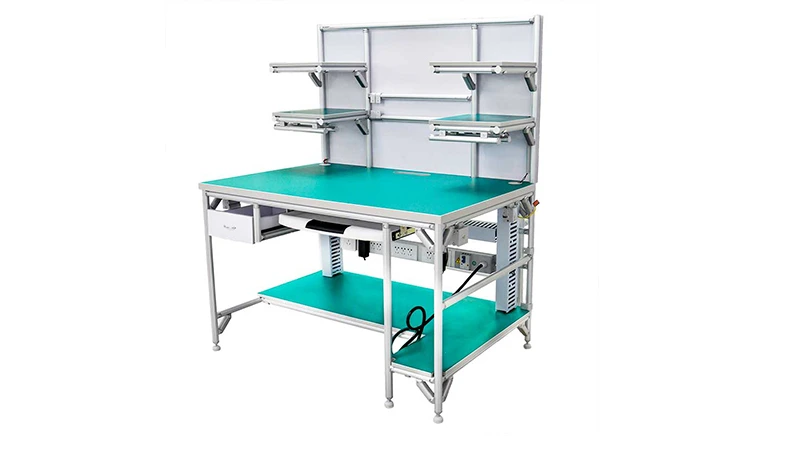
Aluminum tube workbench is more flexible and durable, compared with traditional PE/ABS coated steel tube. It is easy to assemble, anti corrosion, rust protection, and recycle use after disassemble.
The Small Workshop Struggle: When Space Feels Like Your Biggest Limitation
Walk into any small workshop—whether it's a garage turned woodshop, a spare room kitted out for electronics assembly, or a cozy corner in a manufacturing facility—and you'll notice the same challenge staring back at you: space. Every square foot is accounted for. A tool chest here, a material rack there, a workbench that's seen better days wedged between them. It's not just about having enough room to move; it's about having room to work . When your workbench is too bulky, you can't rearrange for a new project. When it's too flimsy, it wobbles mid-task. When it's fixed in place, you're stuck with a layout that might not make sense next month. For small-scale operations, where efficiency and adaptability are everything, a subpar workbench isn't just a hassle—it's a bottleneck.
But what if your workbench could do more than just hold your tools? What if it was designed to solve the space problem instead of adding to it? That's where the Aluminum Workbench A comes in. It's not a one-size-fits-all table. It's a lean, mean, space-saving machine built for workshops that refuse to let "small" stand in the way of big results. Let's dive into why this workbench is quickly becoming the secret weapon for small workshop owners everywhere.
Aluminum Extrusion Profile: The Unsung Hero Behind the Design
At first glance, the Aluminum Workbench A might look like any other sturdy workbench. But take a closer look, and you'll notice something special: it's built with aluminum extrusion profile . If you're not familiar with extrusion, think of it as the manufacturing equivalent of shaping clay—only with molten aluminum and industrial precision. Aluminum is heated until it's pliable, then forced through a custom die (a metal mold) to create long, uniform pieces with specific cross-sections. For the Aluminum Workbench A, those cross-sections include T-slots—long, narrow grooves that run the length of the profile. These slots aren't just for show; they're the reason this workbench is a game-changer for small spaces.
Why aluminum? Let's start with the basics: strength and weight. Aluminum has a remarkable strength-to-weight ratio, meaning the workbench can support heavy tools, materials, and projects without feeling like you're wrestling a boulder. A typical wooden workbench of the same size might weigh 150+ pounds; the Aluminum Workbench A clocks in at under 80 pounds. That matters when you need to shift it across the workshop to make room for a new machine or rearrange your workflow. And unlike steel, aluminum won't rust—perfect for workshops where spills, humidity, or even the occasional rain (looking at you, garage workshops) are part of life.
But the real magic is in the extrusion profile's T-slots. They let you attach accessories—shelves, tool holders, monitor arms, even small material racks—without drilling a single hole. Slide a T-nut into the slot, tighten a bolt, and your accessory is secure. Need to move the shelf up a few inches? Loosen the bolt, slide, retighten. No tools, no hassle, no permanent damage. For small workshops, this adaptability is gold. One day, you're assembling circuit boards and need a parts bin holder at waist height; the next, you're building a prototype and need extra surface space, so you remove the bin and fold down an extension. The Aluminum Workbench A doesn't just fit into your space—it evolves with it.

Aluminum Workbench A: Compact by Design, But Never Compromised
Let's talk specifics. The Aluminum Workbench A isn't just "compact" in the vague sense—it's engineered to maximize every inch. Standard dimensions? 48 inches wide (that's 4 feet, plenty for most tasks), 24 inches deep (shallow enough to fit in tight corners but deep enough for large projects), and adjustable in height from 30 to 36 inches (so you can work standing or sitting, no more hunching). Compare that to a traditional wooden workbench, which often stretches to 60 inches wide and 30 inches deep—wasting precious floor space you can't afford to lose.
But compactness doesn't mean cutting corners on functionality. The single-deck design (without casters, though casters are optional if you need mobility) keeps the footprint small, but the surface itself is built to handle abuse. The tabletop is a 1.5-inch thick aluminum honeycomb panel—lightweight but surprisingly strong, with a weight capacity of 500 pounds. That means you can clamp a vice to one end, stack a 30-pound toolbox on the other, and still have a rock-solid surface for precision work. No more wobbling, no more sagging, no more worrying if it can handle your next project.
And let's not overlook the little details that make a big difference. The edges are rounded to prevent snags (no more tearing gloves or scratching materials). The T-slots run along all four sides of the tabletop, not just the front and back, so you can mount accessories wherever they're most useful. Even the color—matte gray—was chosen to reduce glare, making it easier to focus on detailed work without straining your eyes. This isn't just a workbench; it's a tool for working smarter .

Big Results: How a Compact Workbench Transforms Your Workflow
So, the Aluminum Workbench A saves space. Great. But how does that translate to better results ? Let's break it down with a scenario we've all lived through: the "project switch." You've been working on a batch of custom wooden shelves all week, and your workbench is covered in clamps, sandpaper, and stain. Now, a client needs a rush order for electronic enclosures—small, delicate parts that need a clean, organized space. With a traditional workbench, you'd spend an hour clearing everything off, hunting for a place to store your woodworking tools, and then setting up for electronics. By the time you're ready, you've lost valuable time.
With the Aluminum Workbench A? It's different. Since the accessories are modular, you can pop off the woodworking clamps and tool holders in minutes. Slide on a set of small parts bins (attached via T-slots) and a static-dissipative mat (for electronics work), and you're ready. No clearing, no rearranging the entire workshop—just a quick swap. That's an hour saved, minimum. Multiply that by how many times you switch projects in a month, and suddenly you're looking at days of recovered productivity.
Then there's the lean system angle. Lean manufacturing isn't just for big factories; it's about eliminating waste—whether that's wasted time, wasted space, or wasted effort. The Aluminum Workbench A aligns with lean principles perfectly. Its compact design reduces "motion waste" (you don't have to walk across the workshop to grab tools because they're mounted right on the bench). Its adaptability reduces "inventory waste" (you don't need multiple workbenches for different tasks). And its durability means you won't be replacing it in a year, reducing "waste of defects." For small workshops, where every dollar and minute counts, lean isn't a buzzword—it's survival. The Aluminum Workbench A makes lean possible .
How Does It Stack Up? A Side-by-Side With the "Old Reliables"
Still not convinced? Let's put the Aluminum Workbench A head-to-head with the workbenches you're probably used to. Here's how it compares:
| Feature | Aluminum Workbench A | Traditional Wooden Workbench | Basic Steel Workbench |
|---|---|---|---|
| Dimensions (WxDxH) | 48" x 24" x 30-36" (adjustable) | 60" x 30" x 34" (fixed) | 54" x 28" x 34" (fixed) |
| Weight | 78 lbs (easy to move if needed) | 150+ lbs (nearly impossible to move) | 120+ lbs (heavy, even with casters) |
| Weight Capacity | 500 lbs (sturdy for heavy tools) | 400 lbs (prone to sagging over time) | 600 lbs (strong, but overkill for small tasks) |
| Customization | Unlimited (T-slots, modular accessories) | Limited (drill holes or add permanent shelves) | Basic (some have pre-drilled holes for accessories) |
| Durability | Rust-resistant, scratch-proof, no warping | Prone to warping, staining, and water damage | Prone to rust (unless painted), heavy to repair |
| Maintenance | Wipe clean with a damp cloth; no special care | Sand and refinish yearly; avoid moisture | Touch up paint; oil moving parts (casters) |
The verdict? The Aluminum Workbench A isn't just better for small spaces—it's better, period. It's lighter than steel, more durable than wood, and infinitely more adaptable than both. For small workshops, it's not just a tool; it's an upgrade to how you work.
Beyond the Bench: Aluminum Profile Accessories That Extend Its Power
A workbench is only as good as the tools you use with it, and the Aluminum Workbench A plays well with others—specifically, aluminum profile accessories . These aren't just add-ons; they're extensions of the bench itself, turning it into a full-fledged workstation.
Take the basics: tool hooks. Slide a few T-slot hooks into the side of the bench, and you've got a place for your hammer, tape measure, and screwdrivers—no more digging through a messy drawer. Need to organize small parts? Add a stackable bin holder, which clips into the T-slots and can be adjusted to any height. For electronics work, there's an ESD (electrostatic discharge) mat that lays flat on the tabletop and connects to a ground wire, protecting sensitive components from static damage. And if you need extra storage, attach a small material rack (like the Material Rack B, 3 rows and 3 floors) to the back of the bench—suddenly, you've got a place for raw materials without sacrificing floor space.
But the real standout is the roller track. Aluminum roller track (think small, smooth wheels mounted in a track) can be attached to the edge of the workbench, turning it into a mini conveyor. Need to pass a project from one station to the next? Slide it along the roller track. Assembling parts in a sequence? Line up the track to feed materials directly to your hands. For small assembly lines—even ones with just one or two people—this small addition can cut down on time spent reaching, bending, or walking to grab materials. It's the kind of detail that feels small until you use it, then you wonder how you ever worked without it.
And because all these accessories are made from the same aluminum extrusion profile as the bench, they match in quality and design. No mismatched parts, no flimsy plastic add-ons that break after a month. Everything clicks together, looks professional, and works as hard as you do.
Real Workshops, Real Results: Stories From the Field
Don't just take our word for it. Let's hear from small workshop owners who've made the switch to the Aluminum Workbench A.
Mark, Electronics Repair Shop Owner: "I run a phone and laptop repair shop out of a 200 sq ft garage. Before the Aluminum Workbench A, I had a rickety wooden table that took up half the space. I could barely fit my tools, let alone move around. Now? The bench is narrow enough that I can walk behind it, and the T-slots let me mount my soldering iron holder, parts bins, and magnifying lamp exactly where I need them. I used to spend 10 minutes hunting for the right screwdriver; now, it's right there on a hook. Repairs are faster, my space is cleaner, and I can actually take on more work. Best investment I've made."
Jamie, Custom Jewelry Maker: "I work with delicate metals and small stones, so I need a workbench that's sturdy but not intimidating. The Aluminum Workbench A is perfect. It's lightweight enough that I can move it near the window for natural light, but solid enough that my jewelry tools don't slide around. The adjustable height means I can sit when I'm doing detailed work, which saves my back. And the aluminum surface? It doesn't scratch, so I don't have to worry about ruining it with my tools. Plus, when I need to expand, I can just add more accessories—no need for a whole new bench."
Carlos, Small-Batch Woodworker: "I make custom cutting boards and small furniture in a tiny workshop. My old steel bench was so heavy, I couldn't rearrange when I got a new saw. The Aluminum Workbench A is light enough that I can tip it on its side and roll it (with the optional casters) out of the way in 30 seconds. The T-slots let me mount a vice on one end and a roller track on the other, so I can slide boards across without lifting. And cleanup? Wipe it down with a damp cloth—no more sanding sawdust out of wooden cracks. It's like having a workshop that finally works with me, not against me."
Durability That Lasts: Why Aluminum Outlives the Rest
Small workshops don't have the budget to replace equipment every few years. You need tools that last, and the Aluminum Workbench A is built to outlive your current lease (and maybe the next one). Aluminum doesn't rust, so even if you spill oil, water, or chemicals on it, it won't corrode. It doesn't warp, unlike wood, which swells with humidity and shrinks with dryness. It's scratch-resistant—those T-slots and edges can take a beating from tools, clamps, and heavy projects without showing wear. And because it's modular, if a part does get damaged (say, a roller track wheel cracks), you can replace just that part, not the whole bench. For small businesses, that's not just cost-effective—it's peace of mind.
Think about it: a wooden workbench might last 5-7 years before it starts to sag or rot. A steel bench might last 10, but it'll rust if you don't baby it, and it's so heavy you'll probably have to replace it when you move. The Aluminum Workbench A? With basic care, it'll last 15+ years. That's a decade and a half of projects, workflow changes, and growth—all supported by a single workbench. When you're running a small workshop, that kind of longevity isn't just a nice-to-have; it's a must .
The Bottom Line: Your Workspace Deserves More Than "Good Enough"
Small workshops are where big ideas start. They're where passion turns into products, where side hustles become full-time businesses, where innovation happens one project at a time. But to thrive, you need tools that don't hold you back. The Aluminum Workbench A isn't just a workbench—it's a partner in that growth. It's compact enough to fit into your space today, adaptable enough to grow with you tomorrow, and durable enough to see you through every project in between.
So, if you're tired of wrestling with a workbench that's too big, too flimsy, or too fixed in place, it's time to upgrade. The Aluminum Workbench A isn't just about saving space—it's about reclaiming your productivity, your sanity, and your workshop's potential. Because in a small workshop, every inch matters. And with the right workbench, every inch can work for you.