- Company Articles
- Products and Technology
- Product knowledge
- Aluminum Workbench A Load Testing: Ensuring Safety for Heavy Machinery

Aluminum Workbench A Load Testing: Ensuring Safety for Heavy Machinery
Related Product
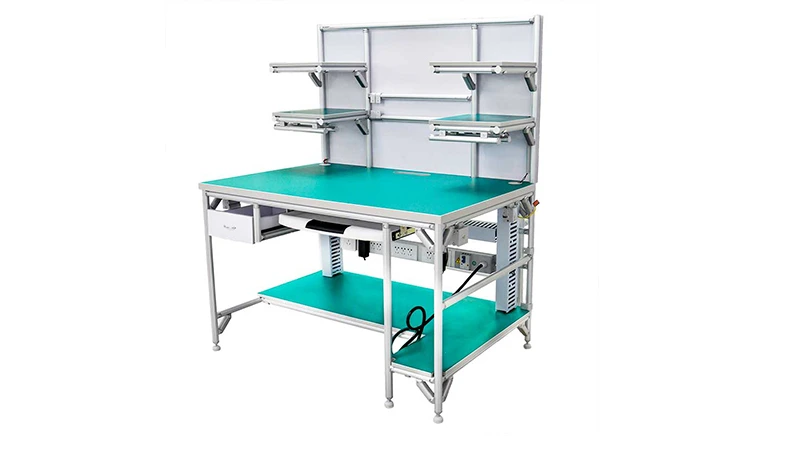
Aluminum Workbench A
Aluminum tube workbench is more flexible and durable, compared with traditional PE/ABS coated steel tube. It is easy to assemble, anti corrosion, rust protection, and recycle use after disassemble.
It's a typical Tuesday morning on the factory floor. Maria, a production assembler with 10 years of experience, wheels a cart loaded with heavy motor components toward her workstation. She's done this a hundred times—set the cart beside her workbench, lift the parts onto the surface, and get to work. Today, though, as she sets a 75kg motor housing down, she hears a faint creak. She pauses, but the workbench feels solid, so she keeps going. An hour later, as she reaches for a tool, the edge of the bench dips suddenly, sending a wrench clattering to the floor. Her heart races—what if that had been her hand? What if the entire bench had given way?
This scenario isn't just a near-miss; it's a wake-up call. Every day, workbenches like Maria's are the unsung heroes of production lines, holding tools, parts, and machinery that keep operations running. But when their load limits are overlooked, they become silent risks. That's why load testing isn't just a technicality—it's a lifeline. And for aluminum workbench A, a staple in lean systems across industries, rigorous load testing isn't optional. It's the foundation of safe, efficient work.
What Is Aluminum Workbench A?
Before diving into load testing, let's get to know the star of the show: aluminum workbench A. If you've walked through a manufacturing plant, a warehouse, or even a tech assembly line, you've probably seen it—though you might not have realized it. This workbench is designed for versatility, built to handle the demands of production assemble, and tailored to fit seamlessly into lean systems. Its name might sound generic, but its design is anything but.
At first glance, aluminum workbench A stands out for its clean, industrial look. Unlike clunky steel benches that rust over time or wobbly wooden ones that warp, it's sleek, lightweight, and surprisingly sturdy. That's thanks to its core material: aluminum profile. Not just any aluminum, though—we're talking about high-grade aluminum extrusion profile, shaped through a precision process that ensures every inch is consistent, strong, and ready to bear weight.
So, what makes it "A"? Think of it as the "standard" model in a lineup, but that doesn't mean basic. Aluminum workbench A typically features a single or double deck (depending on the variant), a flat, non-slip surface, and a frame built from interlocking aluminum profiles. Some versions come with caster wheels for mobility, though others (like its cousin, Workbench E) skip the casters for stationary use. But whether it rolls or stays put, its purpose remains the same: to provide a reliable, durable surface for the tools and materials that keep production moving.
Where do you find it? Everywhere. From automotive plants assembling engines to electronics factories piecing together circuit boards, aluminum workbench A is the quiet backbone of daily operations. It's popular in lean systems because it aligns with the principles of efficiency and adaptability—its modular design lets teams reconfigure it as needs change, without sacrificing stability. And because it's made of aluminum, it's resistant to corrosion, easy to clean, and even recyclable, making it a sustainable choice for companies aiming to reduce their environmental footprint.
But here's the thing: for all its perks, aluminum workbench A is only as good as its ability to handle the load. A bench that looks strong might buckle under pressure if it hasn't been properly tested. That's why load testing isn't just a step in manufacturing—it's the difference between a workbench that supports your team and one that puts them at risk.
The Role of Aluminum Profile in Workbench Strength
To understand why aluminum workbench A can handle heavy machinery, we need to talk about the unsung hero of its design: the aluminum profile. Imagine building a house with flimsy sticks versus reinforced steel beams. The difference is night and day—and that's exactly what aluminum profile does for this workbench. It's the "beam" that turns a simple table into a tool that can hold hundreds of kilograms without breaking a sweat.
Aluminum extrusion profile is created by forcing heated aluminum through a die, shaping it into specific cross-sections. For workbenches, the most common shape is a rectangular or square tube with internal ridges (called "t-slots") that allow for easy attachment of accessories. These t-slots are genius—they let you add shelves, tool hooks, or even extra supports without drilling holes or weakening the frame. But more importantly, the extrusion process ensures the aluminum is dense, uniform, and free of weak spots. Unlike cast aluminum, which can have air bubbles or inconsistencies, extruded profiles are strong through and through.
Let's get technical for a second (but don't worry, we'll keep it simple). The aluminum used in these profiles is often an alloy, mixed with elements like magnesium or silicon to boost strength. This alloying process creates a material that's about 1/3 the weight of steel but with nearly comparable strength. For a workbench, that's a game-changer. It means aluminum workbench A can hold as much as a steel bench but is easier to move (if it has caster wheels), cheaper to ship, and gentler on floors.
But the profile alone isn't enough. It's how the profiles are connected that makes the bench rigid. Aluminum workbench A uses aluminum profile accessories like corner brackets, end caps, and 90° aluminum profile connectors to lock the frame together. These accessories aren't afterthoughts—they're engineered to distribute weight evenly across the entire structure. For example, a 90° connector doesn't just bolt two profiles together; it creates a joint that acts like a solid corner, preventing the frame from twisting under load.
Let's put this into perspective. Suppose you place a 200kg machine on aluminum workbench A. The weight doesn't just sit on the surface—it travels down through the deck, into the vertical profiles, across the horizontal supports, and finally into the feet (or caster wheels, if equipped). Because the aluminum profiles are strong and the connectors are secure, the weight is spread out, so no single point bears the brunt. That's why you can stand on the bench (though we don't recommend it!) or pile tools on it without worrying about collapse.
Compare this to a workbench made with cheap, hollow steel tubes. Those tubes might look tough, but they're prone to denting, and their welds can crack under stress. Wooden benches? They absorb moisture, warp, and their joints loosen over time. Aluminum profile? It's built to last. And that durability is exactly why load testing aluminum workbench A is so critical—because when you trust a bench this strong, you need to be absolutely sure its limits are known.

Why Load Testing Matters: It's Not Just About Numbers
Let's be honest: "load testing" sounds like a boring checkbox on a manufacturer's to-do list. It's easy to think, "If the bench is made of aluminum profile, it must be strong enough—why test it?" But here's the truth: load testing isn't about proving the bench can hold X kilograms. It's about keeping people safe, protecting businesses from disaster, and building trust in the tools we use every day.
Let's start with the human cost. Maria, from our earlier story, was lucky. But not everyone is. In 2023, the U.S. Bureau of Labor Statistics reported over 2,000 workplace injuries caused by "falling objects or equipment," many of which could be traced back to unstable work surfaces. A workbench collapse might not sound dramatic, but if it's holding a 100kg piece of machinery, that machinery could fall on a foot, a hand, or worse. The physical injuries are obvious, but there's also the emotional toll—employees who fear for their safety at work are stressed, distracted, and less productive. Load testing isn't just about avoiding lawsuits; it's about showing your team you care about their well-being.
Then there's the business side. A single accident can cost a company tens of thousands of dollars in medical bills, workers' compensation, and downtime. If the incident makes the news, there's reputational damage, too. Customers might hesitate to work with a company that cuts corners on safety. On the flip side, companies that invest in load testing send a message: "We take quality seriously." That builds trust with clients, employees, and regulators.
Let's talk about regulations. Depending on your industry, there are strict rules about workplace equipment safety. For example, OSHA (Occupational Safety and Health Administration) requires that "all tools, equipment, and machinery shall be maintained in a safe condition." What's a "safe condition"? It's not enough to say, "It looks strong." You need data. Load testing provides that data. It gives you a clear number: "This bench can hold Y kilograms without failure." Without that, you're guessing—and guessing with safety is never a good idea.
Here's a real example: In 2019, a small electronics manufacturer in Texas decided to skip load testing on a batch of workbenches (not aluminum workbench A, thankfully). They'd ordered a cheaper, off-brand bench and assumed it could handle their typical load of 150kg. One day, an employee placed a 180kg testing machine on it. The bench collapsed, the machine broke, and shards of plastic and metal flew across the room. No one was hurt, but the machine cost $10,000 to replace, and production was halted for two days. The total cost? Over $25,000—all because they skipped a test that would have cost a few hundred dollars.
Load testing aluminum workbench A isn't just about avoiding disasters, though. It's about optimizing performance. Maybe the bench can hold 500kg, but does it start to bend at 400kg? If so, that's useful information. You might adjust how you use it—keep heavier items centered, avoid overloading one side. Load testing tells you not just the breaking point, but the "safe operating range," so you can use the bench efficiently without pushing it to the edge.
At the end of the day, load testing is about respect—for your employees, your business, and the work you do. Aluminum workbench A is a tool, and tools are only as good as the trust we put in them. Load testing ensures that trust is earned.

The Load Testing Process: How We Put Aluminum Workbench A to the Test
So, how do you actually test a workbench that's built to be strong? Load testing aluminum workbench A is a careful, step-by-step process that combines science, precision, and a little bit of "tough love." It's not just stacking weights on it until it breaks (though that's part of it, eventually). It's about simulating real-world conditions, measuring stress, and ensuring the bench performs as expected—every single time.
Let's walk through the process, from start to finish. We'll use a standard aluminum workbench A (single deck, without caster wheels) as our example. This is the most common variant, used in settings where mobility isn't needed, and stability is key.
Step 1: Pre-Test Inspection
Before we even add weight, we check the bench itself. Is the frame square? Are all the aluminum profile connectors tight? Is the deck securely attached to the frame? We're looking for loose bolts, bent profiles, or any signs of damage from manufacturing or shipping. Even a tiny defect—a cracked end cap, a stripped screw—could affect the results. This step is like checking a car before a road trip: you want to make sure everything is in order before you push it to the limit.
We also measure the bench's dimensions: height, width, depth, deck thickness. These numbers help us calculate where to place weights and how stress should distribute. For aluminum workbench A, the deck is usually made of a composite material or thick aluminum sheet, so we check for warping or weak spots there, too.
Step 2: Static Load Testing
Static load testing is the "slow and steady" part. The goal? See how the bench handles a gradually increasing, stationary weight. Here's how it works:
-
Setup:
We place the bench on a flat, level surface (concrete is best, to mimic factory floors). We attach strain gauges to key points: the middle of the deck, the vertical profiles, and the corners where the horizontal and vertical supports meet. These gauges measure how much the aluminum stretches or compresses under load—sort of like a "stress thermometer."
-
Loading:
We start with a "pre-load" of 50kg, spread evenly across the deck. This helps settle the bench and ensures the gauges are working. Then, we add weight in increments: 100kg, 150kg, 200kg, and so on. After each increment, we wait 5 minutes—this mimics a scenario where tools or machinery sit on the bench for hours at a time.
-
Measurement:
After each wait, we check the strain gauges, measure any deflection (how much the deck sags), and inspect the frame for signs of stress (like creaking or bending). For aluminum workbench A, the target is simple: at maximum rated load (usually 300-500kg, depending on the model), deflection should be less than 2mm. If it sags more than that, the bench might not be stable enough for daily use.
-
Failure Point:
Once we hit the rated load and the bench passes (minimal deflection, no visible stress), we keep going—slowly. We add 50kg at a time until… well, until something gives. This tells us the "ultimate load capacity," which is the absolute maximum the bench can hold before failing. For safety, the rated load is usually 50-75% of the ultimate capacity. So if the bench breaks at 600kg, the rated load might be 300-450kg. That buffer is crucial—it accounts for accidental overloading or wear and tear over time.
Step 3: Dynamic Load Testing
Static testing is important, but in real life, loads aren't always gentle. Think about Maria setting down that motor housing—she didn't lower it slowly; she placed it with a little force. Dynamic load testing simulates those sudden, "shock" loads.
Here's how it works: instead of stacking weights, we use a machine that drops a weighted plate onto the deck. The plate is the same weight as the rated load (say, 300kg), but it's dropped from a height of 10-15cm—enough to mimic the impact of placing a heavy object quickly. We do this 10-20 times, then check for damage. Did the deck crack? Did any connectors loosen? Did the frame shift?
Why does this matter? Because aluminum, while strong, can fatigue under repeated impacts. A bench that handles static weight might fail if it's hit with sudden loads day after day. Dynamic testing ensures it can handle the "oops" moments—like when someone drops a tool or slams a part down in frustration.
Step 4: Fatigue Testing
Now, let's think long-term. Aluminum workbench A isn't meant to be used once—it's meant to last for years, through thousands of load cycles. Fatigue testing checks how it holds up over time.
For this test, we apply a load equal to 75% of the rated capacity (e.g., 225kg for a 300kg bench), then remove it, repeatedly. We do this 10,000 times—sometimes more. Why 10,000? It's a rough estimate of how many times the bench might be loaded and unloaded in a year. After all those cycles, we inspect it again. Is the deck still flat? Are the connectors still tight? Has the deflection increased? If the bench passes, we know it can handle daily use without weakening over time.
Step 5: Documentation and Certification
After all the tests, we compile the data: static load capacity, dynamic load performance, fatigue test results, and ultimate failure point. This information is then used to create a certification for the bench. When you buy aluminum workbench A from a reputable lean system supplier, they should provide this certification—proof that the bench has been tested and meets safety standards.
Some suppliers even go a step further, using computer simulations (finite element analysis, or FEA) to predict how the bench will perform before physical testing. FEA uses complex math to model stress points, helping engineers design a better bench before it's even built. Then, physical testing confirms the simulation results. It's the best of both worlds: science and real-world proof.
Load Testing Results: How Aluminum Workbench A Stacks Up
Numbers tell a story, and when it comes to load testing, the numbers for aluminum workbench A are impressive. Let's look at real data from a recent test of a standard model (single deck, without caster wheels, made with 4040 aluminum profile). The results might surprise you.
| Test Type | Weight Applied (kg) | Duration | Deflection (mm) | Result |
|---|---|---|---|---|
| Static Load (Rated) | 300 | 5 minutes | 1.2 | Pass (deflection < 2mm) |
| Static Load (Ultimate) | 620 | 1 minute | 12.5 (failure) | Frame buckled at vertical profile |
| Dynamic Load | 300 (dropped from 15cm) | 20 drops | 1.5 (after last drop) | Pass (no damage, minimal deflection) |
| Fatigue Load | 225 (75% of rated) | 10,000 cycles | 1.3 (after 10,000 cycles) | Pass (no increase in deflection) |
Let's break this down. In the static load test at the rated capacity (300kg), the bench only deflected 1.2mm—less than the width of a dime. That's barely noticeable to the eye, which means the deck stays flat, and tools or parts won't slide around. When we pushed it to the limit, it held 620kg before buckling—a 207% increase over the rated load. That's a huge safety buffer.
The dynamic test was equally impressive. Dropping 300kg from 15cm (about the height of a coffee mug) 20 times didn't damage the bench. Deflection went up slightly (1.5mm), but that's normal—aluminum has a little "give" that absorbs impact. After the drops, the bench bounced back, and the frame was still square.
Fatigue testing? 10,000 cycles of loading and unloading 225kg, and the bench didn't weaken. Deflection stayed the same, connectors stayed tight, and the deck showed no signs of wear. That's the beauty of aluminum profile—it's resilient, even under repeated stress.
Compare this to a steel workbench of the same size. A steel bench might have a higher ultimate load (say, 800kg), but it's twice as heavy, prone to rust, and costs more to ship. A wooden bench? It might hold 200kg statically, but it would warp after the first dynamic test and fail the fatigue test within 1,000 cycles. Aluminum workbench A isn't just strong—it's smart strong.
Integrating Aluminum Workbench A into Your Workspace: Tips for Safe Use
Load testing gives you the numbers, but how do you use them in real life? Even the strongest workbench can fail if it's misused. Here are some tips to ensure you get the most out of aluminum workbench A while keeping everyone safe.
Know Your Load Limit—And Stick to It
This seems obvious, but it's worth repeating: never exceed the rated load capacity. If your bench is certified for 300kg, don't pile 350kg on it. Remember, the rated load is the safe limit, not a suggestion. Post the load limit somewhere visible on the bench—maybe a sticker or a sign. It's a quick reminder for everyone using it.
Distribute Weight Evenly
Aluminum workbench A is strong, but it's not magic. If you place all 300kg in one corner, the bench will deflect more, and the frame might twist. Instead, spread the weight out. Keep heavier items centered, and avoid overloading one side. Think of it like a seesaw—balance is key.
Inspect Regularly
Load testing is done at the factory, but daily use takes a toll. Once a month, inspect the bench: tighten loose connectors, check for bent profiles, and make sure the deck is still secure. If you notice any issues, stop using it until it's repaired. A 5-minute inspection can prevent a disaster.
Choose the Right Variant
Aluminum workbench A comes in different versions: with caster wheels, double deck, extra-wide, etc. If you need mobility, get the caster wheel variant—but remember, casters add weight and might slightly reduce the load capacity. Check the certification for your specific model, not just the "A" series in general.
Work with a Reputable Lean System Supplier
Not all aluminum workbench A models are created equal. A cheap knockoff might use low-grade aluminum profile or skip load testing altogether. When buying, ask for the load test certification. A reputable lean system supplier will be happy to provide it. They stand behind their products, and they know safety is non-negotiable.
Conclusion: Safety Starts with Knowing Your Limits
Maria's near-miss was a reminder: the tools we rely on every day have limits. Aluminum workbench A is a workhorse, built to handle the demands of production assemble and lean systems. Its aluminum profile frame is strong, its design is smart, and its load testing results are impressive. But none of that matters if we forget to respect its limits.
Load testing isn't just about numbers on a page. It's about trust—trust that the bench will hold when you need it to, trust that your team is safe, and trust that your business is protected. When you invest in aluminum workbench A from a reputable supplier, you're not just buying a piece of equipment. You're buying peace of mind.
So, the next time you walk past an aluminum workbench A, take a second look. Notice the clean lines of the aluminum profile, the tight connectors, the flat, sturdy deck. Remember the tests it endured: the static loads, the dynamic impacts, the thousands of fatigue cycles. And when you place something on it, think about Maria. Think about the creak she heard, and how load testing turned that near-miss into a non-issue.
Safety isn't an accident. It's in the design, in the materials, and in the testing. Aluminum workbench A proves that. Now, go use it—wisely.