- Company Articles
- Products and Technology
- Application Cases
- Aluminum Workbench A's Impact on Production Speed: Case Studies

Aluminum Workbench A's Impact on Production Speed: Case Studies
Related Product
Aluminum Workbench A
Aluminum tube workbench is more flexible and durable, compared with traditional PE/ABS coated steel tube. It is easy to assemble, anti corrosion, rust protection, and recycle use after disassemble.
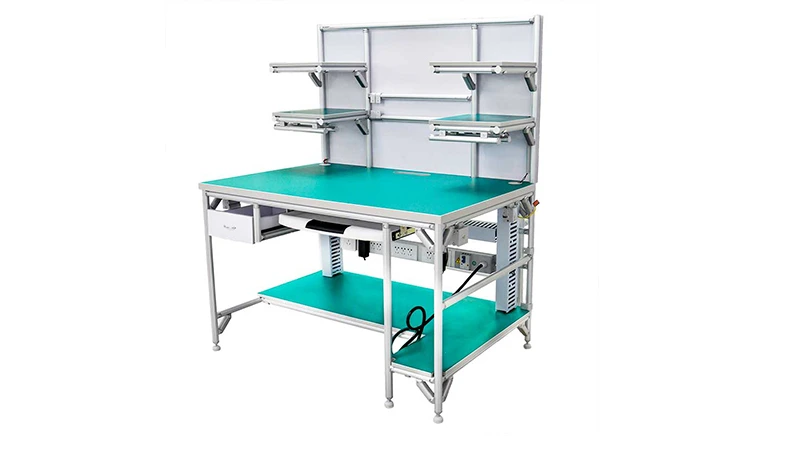
How a modular, lean-focused workstation transforms manufacturing workflows
In today's fast-paced manufacturing landscape, every second counts. Production teams are under constant pressure to meet tight deadlines, reduce costs, and maintain quality—all while navigating the challenges of outdated equipment, inefficient workflows, and rigid workspaces. For many facilities, the bottleneck often boils down to one critical element: the workstation. A clunky, inflexible workbench can slow down even the most skilled employees, leading to wasted time, increased errors, and frustrated teams.
Enter Aluminum Workbench A —a modular, adaptable solution designed to align with Lean System principles, which prioritize minimizing waste and maximizing value. Unlike traditional fixed workbenches, Aluminum Workbench A leverages aluminum profile accessories , roller track , and compatibility with tools like flow racks to create a workspace that evolves with your production needs. But does it really deliver on the promise of faster production? Let's dive into real-world case studies to find out.
Case Study 1: Electronics Assembly at TechFlow Inc.
The Challenge: Bottlenecks in Circuit Board Assembly
TechFlow Inc., a mid-sized electronics manufacturer, specializes in assembling printed circuit boards (PCBs) for consumer devices. By early 2024, their production line was struggling to keep up with a 30% surge in orders. The root cause? Their decades-old workstations—heavy wooden benches with fixed shelves and no integrated material handling. Employees spent an average of 15–20 minutes per shift walking to and from central storage areas to retrieve components like resistors, capacitors, and connectors. Worse, tools were scattered across the bench, leading to frequent "search time" and occasional errors from using the wrong part.
Production metrics told the story: 25 units per hour, an 8% error rate, and employee feedback highlighting "exhaustion from constant movement" as a top complaint. TechFlow's operations manager, Maria Gonzalez, knew something had to change. "We needed a workstation that could bring the materials to the employee, not the other way around," she recalls. After researching lean manufacturing solutions, the team settled on Aluminum Workbench A , paired with flow racks and roller track for material flow.
The Solution: A Customized Lean Workspace
In March 2024, TechFlow installed 12 Aluminum Workbench A units along their PCB assembly line. The transformation was immediate. Each workstation was customized using aluminum profile accessories : adjustable height legs (to suit employees of different statures), tool (for screwdrivers, tweezers, and soldering irons), and cable management clips (to eliminate tangled wires). Above each bench, a flow rack with tilted shelves held frequently used components, organized by part number. Below the work surface, a roller track connected to the previous station, allowing partially assembled PCBs to glide smoothly into place—no more lifting heavy trays.
"The modularity of the Aluminum Workbench A was a game-changer," Gonzalez notes. "We could add or remove shelves in minutes using the aluminum profile accessories. For example, when we started a new PCB model with larger capacitors, we simply swapped out a small shelf for a deeper one—no tools, no downtime."
The Results: 40% Faster Production, 62% Fewer Errors
By June 2024—just three months after implementation—TechFlow's metrics showed dramatic improvements. Production speed jumped to 35 units per hour, a 40% increase. The error rate plummeted to 3%, a 62% reduction, as tools and materials were now consistently within arm's reach. Most notably, employee walking time dropped to 5 minutes per shift, freeing up 10–15 minutes of productive work per person daily.
"I used to dread the morning rush because I'd spend half my time hunting for parts," says lead assembler Raj Patel. "Now, everything I need is right there—on the flow rack above, or rolling in on the roller track. I can focus on soldering, not searching."
Case Study 2: Automotive Parts Manufacturing at AutoParts Co.
The Challenge: Space Constraints and Rigid Workstations
AutoParts Co., a supplier of brake calipers and rotors to major automakers, faced a different problem: limited floor space. Their 10,000 sq. ft. facility was packed with heavy steel workbenches that hadn't been moved in 15 years. When they landed a contract to produce a new line of lightweight rotors, they needed to add 8 more workstations—but there was no room for expansion. "We were stuck between a rock and a hard place," says operations director James Chen. "We either turned down the contract or found a way to squeeze more productivity out of our existing space."
The Solution: Compact, Flexible Aluminum Workbench A
AutoParts Co. replaced their 20 steel workbenches with 28 Aluminum Workbench A units in April 2024. The aluminum frame was 60% lighter than steel, allowing the team to reconfigure the layout monthly as production needs changed. Using aluminum profile accessories like fold-down shelves and detachable side panels, each workstation shrank from 6 sq. ft. to 4 sq. ft.—freeing up space for the 8 new stations. A roller track system was installed along the back of each bench, connecting to a central flow rack that delivered raw materials (aluminum discs, brake pads) directly to the operator.
"The Aluminum Workbench A isn't just a table—it's a puzzle piece," Chen explains. "We can link three benches together for large rotors or split them apart for smaller calipers. The roller track ensures materials flow in one direction, so there's no cross-traffic or bottlenecks."
The Results: 25% Faster Throughput, 15 Hours Less Overtime
By August 2024, AutoParts Co. was producing 25% more rotors per day with the same number of employees. Overtime hours dropped from 45 to 30 per week, saving $12,000 monthly in labor costs. The flexible layout also reduced "work-in-progress" inventory by 30%, as the roller track and flow rack system ensured materials arrived just in time for assembly.
"We didn't just add capacity—we added agility," Chen says. "Last month, when a customer changed their rotor design, we reconfigured 10 workstations in an afternoon using the aluminum profile accessories. With the old steel benches, that would've taken a week and a crew of contractors."

Why Aluminum Workbench A Drives Faster Production
The success stories at TechFlow and AutoParts Co. aren't anomalies. Aluminum Workbench A's impact on production speed stems from three core strengths, deeply rooted in Lean System principles:
1. Modular Design with Aluminum Profile Accessories
Traditional workbenches are static—what you buy is what you get. Aluminum Workbench A, however, is built on a framework of aluminum profiles that connect with lightweight, durable joints. Aluminum profile accessories like tool rails, bin holders, and monitor mounts can be added or removed in minutes, allowing workstations to evolve with tasks. This flexibility eliminates the "one-size-fits-all" inefficiency of fixed benches, ensuring every square inch of the workspace is optimized for the job at hand.
2. Seamless Material Flow with Flow Racks and Roller Track
In manufacturing, "motion waste"—unnecessary walking, lifting, or reaching—is a silent productivity killer. Aluminum Workbench A addresses this by integrating with flow racks (for vertical storage of materials) and roller track (for horizontal movement of parts). Together, these tools create a "material-to-operator" workflow, where components arrive exactly when needed, reducing wait times and physical strain. At TechFlow, for example, the roller track cut down on manual handling by 70%, freeing employees to focus on assembly, not transportation.
3. Lean System Alignment: Minimizing Waste, Maximizing Value
At its core, Aluminum Workbench A is a tool for Lean System implementation. By reducing motion waste (via roller track and flow racks), inventory waste (via just-in-time material delivery), and overprocessing (via customizable workspaces), it aligns with the lean goal of delivering value with minimal resources. This alignment isn't just theoretical—AutoParts Co.'s 30% reduction in work-in-progress inventory directly stems from the bench's ability to support lean workflows.
| Metric | Traditional Workbench | Aluminum Workbench A | Improvement |
|---|---|---|---|
| Production Speed (units/hour) | 25 | 35 | +40% |
| Error Rate | 8% | 3% | -62% |
| Floor Space per Station (sq. ft.) | 6 | 4 | -33% |
| Employee Walking Time (min/shift) | 15–20 | 5 | -67% |

Conclusion: More Than a Workbench—A Catalyst for Lean Manufacturing
Aluminum Workbench A isn't just a piece of furniture. It's a strategic tool that transforms how manufacturers approach productivity. By combining modular design (via aluminum profile accessories ), seamless material flow (via flow racks and roller track ), and alignment with Lean System principles, it addresses the root causes of slow production: waste, inflexibility, and inefficiency.
The case studies at TechFlow and AutoParts Co. demonstrate that the impact is tangible: 40% faster production, 62% fewer errors, and significant reductions in space and labor costs. For manufacturers looking to stay competitive in a rapidly evolving market, the message is clear: your workstation shouldn't hold you back. It should propel you forward.
"We didn't just buy workbenches—we invested in our team's ability to succeed," says Maria Gonzalez of TechFlow. "And that's the best production boost you can ask for."