Aluminum Workbench A's Modular Joints: How They Enable Quick Reconfiguration
Related Product
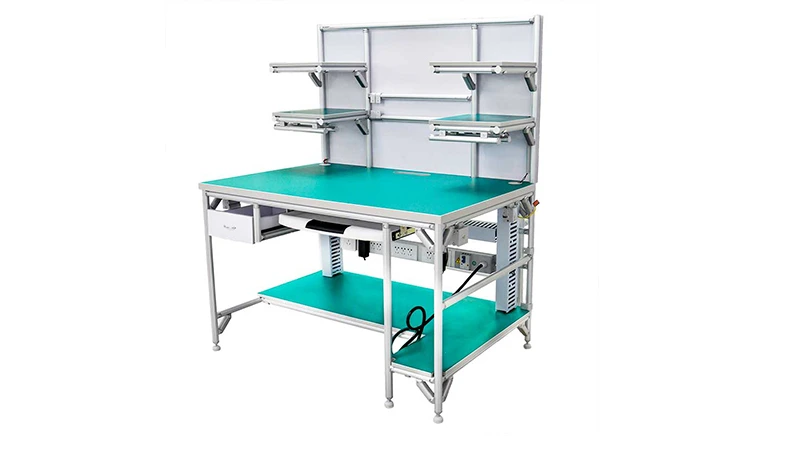
Aluminum Workbench A
Aluminum tube workbench is more flexible and durable, compared with traditional PE/ABS coated steel tube. It is easy to assemble, anti corrosion, rust protection, and recycle use after disassemble.
Aluminum Workbench A

It's 8:15 AM on a Wednesday at BrightTech Electronics, and the production floor is already humming with activity. But today, there's a buzz of tension mixed in. The night shift left a note: the new batch of circuit boards—smaller, more delicate than the last—won't fit on the current workbench setup. The morning team needs to rearrange the workspace before the 9 AM deadline, or the entire day's production could fall behind.

Three workers gather around the old steel workbench, tools in hand. Bolts are rusted, brackets are welded in place, and adjusting the height requires two people and a wrench. By 8:45, they're sweating through their uniforms, and the bench still isn't right. "This is ridiculous," mutters Lina, the team lead, frustration edging her voice. "We need something that moves with us, not against us."

Across the floor, in the newer assembly area, things look different. There, a group is reconfiguring an Aluminum Workbench A for a similar task. One person, using just a hex key, twists a joint here, slides a rail there, and in 15 minutes, the bench has transformed from a flat surface into a tiered workstation with side shelves and a lower tray for tools. No sweat, no stress—just smooth, intentional movement.

The difference? Internal rotatary aluminum joints . These unassuming components are the unsung heroes of modern workspaces, turning rigid furniture into adaptable tools that keep pace with changing needs. In this article, we'll dive into how these modular joints work, why they matter, and how they're redefining productivity for manufacturers, workshops, and creators everywhere.

The Problem with "Set It and Forget It" Workbenches

For decades, workbenches were built to be permanent. Heavy steel frames, fixed shelves, and welded brackets—they were designed to "last forever," but that durability came at a cost: flexibility. In a world where product cycles shrink, customization demands grow, and teams need to pivot quickly, a static workbench isn't just inconvenient—it's a bottleneck.

Consider a small automotive parts shop. One week, they're assembling brake components that require deep storage bins for small parts. The next, they're testing larger engine parts that need a clear, flat surface. With a traditional workbench, switching between these setups means either buying a second bench (wasting space and money) or spending hours disassembling and rebuilding the first.

Then there's the issue of ergonomics. A workbench that's perfect for a 6-foot-tall technician might force a 5'4" colleague to hunch over, leading to fatigue and long-term injuries. Fixed heights and rigid layouts don't account for the diversity of people who use these tools every day.

And let's not forget growth. As a business expands, adding new tools, machinery, or team members often means overhauling the entire workspace. What if your workbench could grow with you instead of requiring a complete replacement? That's where modular design—and specifically, modular joints—changes the game.

Aluminum Workbench A: Built Around Adaptability

Aluminum Workbench A isn't just a workbench—it's a system designed for change. At its core is a lightweight but incredibly strong frame made from aluminum profile , a material chosen for its unique blend of durability, corrosion resistance, and maneuverability. But the real magic lies in how these profiles connect: through internal rotatary aluminum joints that turn a static frame into a dynamic, reconfigurable tool.

Unlike traditional welded or bolted joints, these modular components allow for 360-degree rotation, height adjustments, and quick disassembly—all without specialized tools. Imagine a joint that can pivot to create angled shelves, lock into place to support heavy loads, or slide along the aluminum profile to reposition accessories. That's the flexibility we're talking about.

But don't just take our word for it. Let's meet Raj, a production manager at a medical device plant that switched to Aluminum Workbench A last year. "We used to have a workbench for every product line," he says. "Now, with one bench, we can reconfigure it for catheters in the morning, surgical tools in the afternoon, and packaging prep in the evening. The joints make it so easy—even the interns can do it."

Inside the Joint: How Internal Rotary Aluminum Joints Work

To understand why these joints are so revolutionary, let's peek under the hood. An internal rotatary aluminum joint might look simple, but its design is the result of careful engineering. Here's a breakdown of its key components and how they work together:

1. The Housing: A Home for Flexibility

The joint's outer shell is made from high-grade aluminum alloy, matching the aluminum profile of the workbench frame. This ensures a seamless fit—no wobbling or mismatched parts. The housing features precision-machined T-slots, which align with the T-grooves on the aluminum profile, allowing it to slide into place and lock securely.

2. The Rotating Core: Smooth Movement, Firm Locking

Inside the housing is a rotating core with ball bearings, designed for friction-free movement. This core connects to the adjacent aluminum profile, allowing it to pivot horizontally or vertically. When you need to set the joint in place, a simple locking mechanism—usually a hex screw or cam lever—tightens against the core, creating a vice-like grip that won't budge, even under heavy loads.

3. Compatibility: Playing Well with Others

These joints aren't one-trick ponies. They're engineered to work with a wide range of aluminum profile accessories , from tool hooks and storage bins to monitor mounts and lighting arms. Want to add a shelf? Slide a short aluminum profile into the joint, lock it at 90 degrees, and attach the shelf bracket. Need to lower the work surface? Loosen the joint, adjust the height, and lock it again. It's that simple.

"The first time I used one, I was shocked by how smooth it was," says Mia, a workshop owner who switched to Aluminum Workbench A last year. "I'd spent years wrestling with bolted joints that seized up or stripped. These rotate like butter, and once locked, they feel solid as a rock. I even stood on a reconfigured shelf once to reach a high cabinet—don't tell OSHA—and it didn't budge."

The Benefits of Quick Reconfiguration: More Than Just Speed

At first glance, the biggest advantage of these modular joints is speed. What once took hours now takes minutes. But the benefits run deeper—touching on productivity, employee satisfaction, and even bottom-line savings. Let's break them down:

1. Downtime? What Downtime?

When production lines stop, money stops flowing. Traditional workbench reconfigurations can halt operations for hours, but with internal rotatary joints, the average setup time drops from 2+ hours to under 20 minutes. For a manufacturer producing 100 units per hour, that's 160+ units saved per reconfiguration.

2. Ergonomics That Keep Teams Happy (and Healthy)

A 2023 study by the National Institute for Occupational Safety and Health (NIOSH) found that work-related musculoskeletal disorders cost U.S. businesses over $50 billion annually. Much of this stems from poorly designed workspaces. With modular joints, employees can adjust their workbench height, angle, and layout to fit their body, reducing strain and boosting morale.

"I used to come home with a sore back every night," says Tom, a technician at an aerospace plant. "Now I tweak my bench to stand or sit, depending on the task. My back pain? Gone. And I'm way more focused when I'm not uncomfortable."

3. Scalability Without the Hefty Price Tag

Buying new furniture every time your business grows is expensive. Aluminum Workbench A's modular design lets you start small and expand as needed. Add a section here, swap out a component there—no need to replace the entire bench. Over time, this can save thousands in equipment costs.

4. Future-Proofing for Changing Needs

Remember the circuit board example from earlier? With modular joints, BrightTech's new assembly area handled the switch in 15 minutes, while the old area took over an hour (and still wasn't right). In a world where product designs and customer demands evolve overnight, adaptability isn't a nice-to-have—it's survival.

Real-World Applications: How Teams Use Modular Joints Every Day

Modular joints aren't just theoretical—they're transforming workspaces across industries. Here are a few examples of how teams are putting them to use:

Electronics Manufacturing: From SMT to Testing

In electronics plants, workbenches need to handle everything from surface-mount technology (SMT) assembly—where precision and static control are critical—to final testing, which requires access to multiple tools. With internal rotatary joints, a single Aluminum Workbench A can switch from a low, flat SMT workstation (with ESD-safe mats) in the morning to a tiered testing station (with tool hooks and cable management) in the afternoon. No disassembly, no extra benches.

Small-Batch Workshops: Customization on Demand

Artisan workshops and custom fabricators thrive on uniqueness—but unique projects need unique setups. A woodworker might use their Aluminum Workbench A as a clamping station one day (with adjustable arms to hold irregularly shaped pieces) and a finishing table the next (with a raised edge to catch sawdust). The joints make it easy to swap between configurations without sacrificing stability.

Medical Device Assembly: Clean, Flexible, and Compliant

Medical device manufacturing requires strict adherence to cleanliness and precision standards. Aluminum's corrosion resistance makes it easy to sanitize, while modular joints allow teams to reconfigure workbenches to fit sterile protocols—like adding transparent barriers or specialized lighting—without compromising on workflow.

"We build custom prosthetics, so every project is different," says Dr. Lee, who runs a small medical device lab. "One day we're working on a pediatric arm, the next an adult leg. With our old benches, we'd waste hours moving tools around. Now, we reconfigure the Aluminum Workbench A in minutes, and everything stays organized. It's like having a new workspace for every patient."

Traditional vs. Modular: A Side-by-Side Comparison

Still on the fence? Let's put traditional workbenches and Aluminum Workbench A head-to-head. The table below compares key factors that matter most to teams on the ground:

Factor Traditional Steel Workbench Aluminum Workbench A (with Internal Rotary Joints)
Reconfiguration Time 2–4 hours (requires tools, multiple people) 15–30 minutes (single person, basic tools)
Weight Heavy (often 200+ lbs; hard to move) Lightweight (60–100 lbs; easy to relocate with casters)
Customization Limited (fixed shelves, welded brackets) Unlimited (adjustable height, angles, and accessories)
Durability Prone to rust; bolts seize over time Corrosion-resistant aluminum; joints designed for 10,000+ adjustments
Ergonomics Fixed height (one-size-fits-none) Adjustable height and angle (fits users of all sizes)
Long-Term Cost High (need to replace benches as needs change) Low (adaptable; add/swap components instead of replacing)

The Future of Workspaces: Modular Joints as Catalysts for Innovation

As workplaces evolve—becoming more agile, more human-centered, and more focused on adaptability—the tools we use to build them matter. Internal rotatary aluminum joints aren't just parts; they're a philosophy. They say, "Your workspace should work for you, not the other way around."

Think about it: when reconfiguration is easy, teams experiment more. They try new layouts, test better workflows, and find ways to work smarter, not harder. This culture of experimentation leads to innovation—and innovation leads to growth.

For Lina and her team at BrightTech, the switch to Aluminum Workbench A wasn't just about solving a one-time problem. It was about creating a workspace that could keep up with their ambition. "Now, when the night shift leaves a note about a new product, we don't panic," she says. "We grab a hex key, twist a few joints, and we're ready. It's not just faster—it's empowering. We feel like we're in control of our work, not stuck fighting against it."

So, what does the future hold? As aluminum profile technology advances and more accessories hit the market, the possibilities for modular workspaces will only expand. But at the heart of it all will be those small, unassuming joints—quietly enabling the flexibility that turns good teams into great ones.

After all, in a world that never stops changing, the best workbench is the one that can change with it.


Get In Touch with us

Hey there! Your message matters! It'll go straight into our CRM system. Expect a one-on-one reply from our CS within 7×24 hours. We value your feedback. Fill in the box and share your thoughts!