- Company Articles
- Products and Technology
- Application Cases
- Aluminum Workbench A Success Stories: Real-World Applications in Mechanical Manufacturing

Aluminum Workbench A Success Stories: Real-World Applications in Mechanical Manufacturing
Related Product
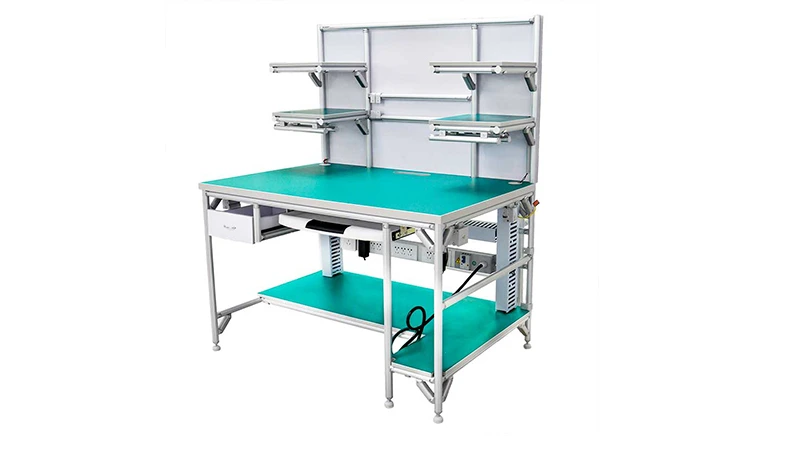
Aluminum Workbench A
Aluminum tube workbench is more flexible and durable, compared with traditional PE/ABS coated steel tube. It is easy to assemble, anti corrosion, rust protection, and recycle use after disassemble.
Case Study 1: Revitalizing a Stagnant Automotive Parts Line with Aluminum Workbench A and Lean Systems
When Maria Gonzalez, the production manager at Precision Auto Components (PAC), walked onto her factory floor in early 2023, she knew something had to change. For years, the company's main assembly line for brake calipers had been stuck in a rut: production targets were consistently missed, employee turnover was high, and the defect rate hovered at a frustrating 4.5%. The root cause, she quickly realized, was staring her in the face: the workstations themselves.
"Our old workbenches were relics," Maria recalls. "Heavy, wooden tables bolted to the floor, with tools scattered across the surface or stuffed into overcrowded drawers. Workers were constantly bending, reaching, or walking to grab parts from distant shelves. By mid-shift, you could see the fatigue—people moving slower, making small mistakes that added up." The setup was the opposite of efficient; it was a breeding ground for waste, both in time and resources.
After researching solutions, Maria's team landed on a lean system overhaul centered around the aluminum workbench A. "What sold us was the flexibility," she says. "The aluminum profile construction meant we could customize each bench to the exact needs of the task—height-adjustable legs for ergonomics, built-in tool rails, and slots to mount accessories like LED task lights. And because they weren't bolted down, we could reconfigure the line in hours, not days, if we needed to adjust the workflow."
The transformation began with replacing the wooden benches with aluminum workbench A units. Each workstation was tailored to the brake caliper assembly process: one bench for initial component sorting (fitted with small parts bins), another for precision machining (equipped with a vice and anti-fatigue matting), and a final bench for quality checks (with integrated ESD protection to prevent static damage to sensitive components). But the workbenches were just the starting point. To complete the lean system, PAC added flow racks along the line to hold raw materials and semi-finished parts, positioned at waist height so workers could grab what they needed without bending or stretching. A small conveyor belt, linking the machining bench to the quality check station, eliminated the need for manual part transport—no more carrying heavy calipers across the floor.
The results were immediate. Within the first month, production time per unit dropped from 12 minutes to 8.5 minutes. By the end of the quarter, the defect rate had plummeted to 1.2%, and employee complaints about fatigue decreased by 68%. "One worker told me, 'I used to go home with a backache every night. Now, I feel like I could work another shift,'" Maria laughs. "That's when I knew we'd made the right choice."
Perhaps the most unexpected benefit was the boost in team morale. With tools organized, parts within arm's reach, and a workspace that felt "designed for them," employees took more ownership of their stations. "People started suggesting small improvements—'What if we angle the flow rack here?' or 'Can we add a shelf for finished parts?'" Maria says. "That's the power of a lean system built around the aluminum workbench A: it doesn't just change the tools; it empowers the people using them."
Today, PAC's brake caliper line is the company's most efficient, consistently exceeding production targets and boasting a defect rate that's the envy of their competitors. And Maria isn't stopping there: she's already planning to roll out the aluminum workbench A to the suspension components line next quarter. "It's not just about buying equipment," she says. "It's about investing in your team's ability to succeed. The aluminum workbench A didn't just fix our production problems—it gave us a new way to think about how we work."
| Metric | Before Implementation | After Implementation (6 Months Later) | Improvement |
|---|---|---|---|
| Production Time per Unit | 12 minutes | 8.5 minutes | 30.8% reduction |
| Defect Rate | 4.5% | 1.2% | 73.3% reduction |
| Employee Turnover (Quarterly) | 18% | 5% | 72.2% reduction |
| Material Handling Time per Shift | 2.5 hours | 45 minutes | 80% reduction |
Case Study 2: Cutting Waste in Electronics Manufacturing with Aluminum Workbench A and Flow Racks
For a company that prides itself on precision, the scene at MicroTech Circuits' circuit board assembly line was nothing short of chaotic. "Imagine a table covered in tiny resistors, capacitors, and IC chips—some in unlabeled bags, others rolling onto the floor," says Raj Patel, MicroTech's operations director. "Our assemblers were spending more time hunting for parts than actually soldering. And when you're working with components smaller than a grain of rice, that's a recipe for disaster."
MicroTech, a mid-sized electronics manufacturer specializing in custom circuit boards for medical devices, was struggling with two critical issues in 2022: high material waste (due to lost or damaged components) and slow throughput (average 15 boards per hour, well below the target of 25). The problem, Raj realized, was a lack of organization. "Our workbenches were generic—just flat surfaces with no built-in storage. Parts were stored in bins on shelves 10 feet away, so assemblers would carry armfuls of bins to their stations, only to have parts spill or get mixed up. It was inefficient and stressful."
The solution came from an unlikely source: a visit to a trade show where Raj saw the aluminum workbench A on display. "What caught my eye was the way it integrated with flow racks," he says. "The bench itself had a sleek, flat surface for soldering, but the real magic was the aluminum profile frame—we could attach small parts organizers, tool holders, and even a mini flow rack right onto the bench. No more walking to get parts; everything was right there."
MicroTech's team partnered with a supplier to design custom aluminum workbench A setups for each assembly station. Each bench featured:
- A heat-resistant top (critical for soldering work) with embedded ESD mats to protect sensitive components from static.
- Side-mounted flow racks with tilted bins, each labeled and color-coded for specific components (resistors in red, capacitors in blue, etc.).
- Overhead tool rails with hooks for soldering irons, tweezers, and magnifying glasses, keeping tools within easy reach.
- Under-bench drawers with dividers for storing larger items like wire cutters and spools of solder.

Case Study 3: Scaling Up Heavy Machinery Production with Aluminum Workbench A and Conveyors
When Global Heavy Machinery (GHM) landed a contract to produce 500 industrial pumps for a mining client in 2023, CEO James Wilson knew his factory wasn't ready. "Our existing setup was built for small-batch production—heavy steel workbenches, manual material handling, and a workflow that relied on workers pushing carts loaded with pump parts across the floor," James says. "Scaling up to 500 units would mean longer hours, more overtime, and a high risk of missed deadlines. We needed a way to make our process more efficient without sacrificing quality."
The pumps, which weigh up to 80 pounds, required assembling large components like motor housings, impellers, and gaskets. The old steel workbenches were sturdy but immobile, so workers were stuck in fixed positions, waiting for parts to be carted to them. "It was like a relay race with no baton," James jokes. "One team would finish assembling the motor housing, then push it on a cart to the next station, where the next team was twiddling their thumbs. We were wasting hours every day on transit time."
After consulting with a lean manufacturing expert, James decided to invest in a production line built around aluminum workbench A units and a powered roller conveyor system. "At first, I was skeptical—aluminum? For heavy machinery?" he admits. "But when I saw the specs, I was convinced. The aluminum profile used in the workbench A is reinforced with internal ribs, so it can handle loads up to 500 pounds. And because it's lighter than steel, we could add casters to the benches, making them movable. That was a game-changer."
The new line was designed as a U-shape, with six aluminum workbench A stations linked by a conveyor. Here's how it worked:
- Station 1 (Housing Prep): Workers mounted pump housings onto the aluminum workbench A, which was fitted with a rotating top to allow easy access to all sides. A nearby flow rack held raw housings, fed by the conveyor from the warehouse.
- Station 2 (Motor Installation): Once the housing was prepped, it moved via conveyor to Station 2, where workers bolted in the motor. The bench here had height-adjustable legs to reduce bending, and a built-in torque wrench holder to ensure consistent tightening.
- Station 3 (Impeller & Gasket Fitting): The partially assembled pump moved to Station 3, where the aluminum workbench A featured a vice to hold the housing steady during impeller installation. Small parts (gaskets, bolts) were stored in under-bench drawers with dividers.
- Station 4 (Testing): A specialized aluminum workbench A with integrated pressure testing equipment. The bench's top was sloped slightly to drain water (used in testing) into a catch pan, preventing slips.
- Station 5 (Painting Prep): Workers cleaned and masked the pump here. The bench had a built-in vacuum port to suck up dust and debris, keeping the workspace clean.
- Station 6 (Final Assembly): The finished pump was inspected, labeled, and packed into boxes. The aluminum workbench A here had extendable sides to hold packaging materials.