- Company Articles
- Products and Technology
- Product knowledge
- Aluminum Workbench A vs. Workbench E: Comparing Lean Workbench Models

Aluminum Workbench A vs. Workbench E: Comparing Lean Workbench Models
Related Product
Aluminum Workbench A
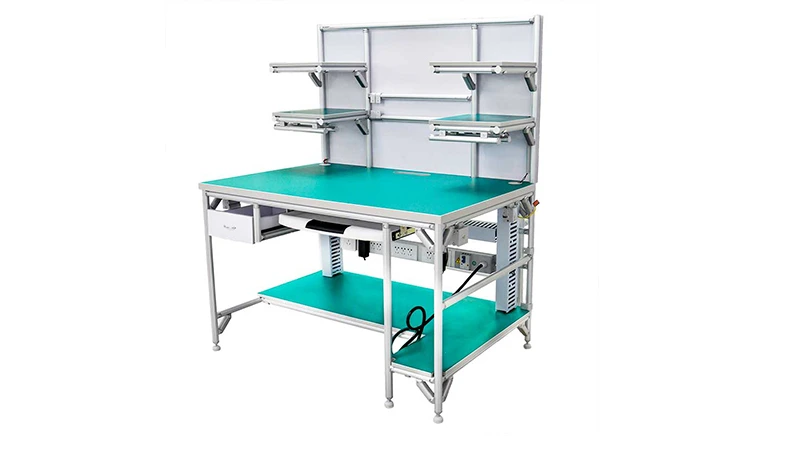
Aluminum tube workbench is more flexible and durable, compared with traditional PE/ABS coated steel tube. It is easy to assemble, anti corrosion, rust protection, and recycle use after disassemble.
In the fast-paced world of manufacturing, where every second and every square inch of space counts, the tools we use to build, assemble, and organize can make or break a team's efficiency. Lean manufacturing isn't just a buzzword—it's a philosophy that hinges on eliminating waste, streamlining workflows, and creating systems that adapt to the people using them. And at the heart of many lean operations? The humble workbench. But not all workbenches are created equal. Today, we're diving into two popular models that often land on production managers' shortlists: Aluminum Workbench A and Workbench E (single deck-without caster). Both promise to elevate your lean system, but which one is right for your shop floor, assembly line, or warehouse?
Choosing between these two isn't just about picking a surface to work on. It's about aligning your tools with your team's unique rhythm—whether that means prioritizing mobility, stability, ESD protection, or raw durability. Let's break down their design, functionality, and real-world performance to help you make a decision that feels less like a guess and more like a step forward for your operation.
Meet the Contenders: Aluminum Workbench A & Workbench E
First, let's get acquainted with our two stars. Both are marketed as "lean workbenches," but their DNA tells different stories.
Aluminum Workbench A is often hailed as the "all-rounder" of the lean workbench family. Built with high-grade aluminum profile—a material prized for its strength-to-weight ratio—it's designed to balance durability with flexibility. Think of it as the Swiss Army knife of workbenches: adaptable, easy to customize with aluminum profile accessories, and built to integrate seamlessly into existing workflows. It's not uncommon to see it outfitted with roller track attachments for material flow or caster wheels for on-the-fly repositioning, making it a favorite in dynamic environments where layouts shift based on production needs.
Workbench E (single deck-without caster) , on the other hand, is the "steady hand" of the pair. As its name suggests, it's a single-deck model with no built-in caster wheels, prioritizing stability over mobility. While it shares the aluminum construction trend, its design is more stripped back—no frills, just a solid, fixed workspace. It's the kind of workbench you set down once and rely on for years, ideal for tasks that demand precision and minimal movement, like electronics assembly or quality inspection.
Design & Build: The Bones of the Workbench
To truly understand how these workbenches perform, we need to start with what they're made of and how they're put together. After all, a workbench is only as good as its frame and surface—especially in high-pressure settings where tools, materials, and even operators lean on it daily.
Aluminum Workbench A: Built for Adaptability
Aluminum Workbench A's claim to fame starts with its aluminum extrusion profile frame. If you're not familiar with aluminum extrusion, think of it as industrial-grade tinker toys for grown-ups: precision-machined aluminum bars with internal channels that let you attach accessories—shelves, tool hooks, roller track, you name it—without welding or drilling. This isn't just about convenience; it's about future-proofing. As your needs change, you can swap out parts or add new components (like a second deck or a side rail) without replacing the entire bench.
The work surface itself is typically a thick, non-slip aluminum honeycomb panel or a composite material, both of which stand up to scratches, spills, and heavy tool use. Many models also offer ESD (electrostatic discharge) options, making them suitable as an esd workstation for electronics manufacturing, where static electricity can fry sensitive components. And here's where mobility comes into play: most versions of Workbench A come standard with lockable caster wheels (often 3-inch or 4-inch heavy-duty caster wheel models), letting you roll it across the shop floor and lock it in place when needed. It's a small feature that transforms how teams collaborate—imagine shifting the bench from one assembly station to another in 30 seconds instead of 30 minutes of disassembling and rebuilding.
Workbench E: Simplicity Meets Stability
Workbench E takes a "less is more" approach. Its frame is also aluminum (no cheap steel here), but it's built with a fixed, single-deck design—no caster wheels, no adjustable height, just a rock-solid base. The lack of mobility might sound like a downside, but it's intentional: without wheels, there's zero wobble. When you're soldering tiny circuit boards or torqueing bolts to exact specifications, that stability is non-negotiable. A workbench that shifts even a fraction of an inch can lead to errors, rework, or worse—scrapped parts.
The surface is similar to Workbench A's—durable, easy to clean, and available in ESD variants—but the real difference is in the details. Workbench E often skips extra features like built-in storage or roller track mounts to keep the focus on the work surface. That single deck is spacious, though—typically 120cm to 180cm long—giving operators plenty of room to spread out materials without clutter. And because it's fixed, you can bolt it to the floor for added security, making it a permanent fixture in your workflow rather than a temporary solution.

Functionality: How They Fit Into Your Lean System
A workbench isn't just a table—it's a hub for your team's workflow. Lean manufacturing thrives on minimizing waste, and that includes wasted motion (walking to grab tools), wasted time (searching for parts), and wasted space (benches that take up more room than they need). Let's see how Workbench A and Workbench E stack up in these critical areas.
Workflow Support: Flexibility vs. Focus
Aluminum Workbench A is a workflow chameleon. Thanks to its aluminum profile accessories, you can tailor it to almost any task. Need a place to stage incoming parts? Add a roller track on one side to let bins slide into place. Assembling small parts? Mount tool holders and a magnetic parts tray. Packaging finished goods? Attach a lower shelf for boxes. It's designed to grow with your process, which is why it's popular in lean environments that use kaizen (continuous improvement) practices—today's "good enough" setup can become tomorrow's "perfect" setup with a few tweaks.
Workbench E, by contrast, is a specialist. Without the distraction of extra features, it excels at one job: providing a stable, dedicated workspace for high-concentration tasks. In electronics manufacturing, for example, where an operator might spend 8 hours a day testing circuit boards, a cluttered bench with too many accessories can be more of a hindrance than a help. Workbench E's simplicity reduces visual noise, letting teams focus on the task at hand. It also pairs well with standalone material racks (like material rack b, a 3-row, 3-floor unit) placed nearby—so parts are within arm's reach, but the work surface stays clear.
Mobility: When (and Why) Wheels Matter
We've touched on this, but it's worth diving deeper: the caster wheel debate. Workbench A's mobility is a game-changer for teams that need to adapt quickly. For example, in a small-batch manufacturing shop, you might use the same bench for prototyping in the morning and final assembly in the afternoon. Rolling it between stations cuts down on setup time and eliminates the need for multiple benches. In contrast, Workbench E's fixed design is better for high-volume, repetitive tasks where the bench stays in one spot. If your workflow is predictable and stationery—like a dedicated inspection line—you won't miss the wheels. But if your team frequently collaborates across different areas, Workbench A's mobility can reduce walk time by 20% or more, according to lean consultants we've spoken with.

Practical Applications: Which Workbench Thrives Where?
To really get a sense of which bench is right for you, let's look at real-world scenarios. We've talked to production managers, shop foremen, and lean coordinators across industries to see where Workbench A and Workbench E shine (and where they fall short).
Aluminum Workbench A: Ideal for Dynamic Environments
If your shop floor looks different week to week, Workbench A is your ally. Here are a few industries and tasks where it stands out:
- Automotive Assembly: Teams often need to move tools and benches between car models on the same line. Workbench A's caster wheels and customizable accessories (like roller track for moving parts) make it easy to adapt.
- Prototyping Labs: Engineers and designers rarely stick to one project. Workbench A's ability to reconfigure with aluminum profile accessories lets them switch from 3D printing prep to circuit testing without skipping a beat.
- Warehouse Picking Stations: In e-commerce or distribution, picking lists change hourly. Rolling Workbench A to different zones reduces the distance pickers walk, cutting down on fatigue and speeding up order fulfillment.
Workbench E: Best for Static, High-Precision Tasks
Workbench E isn't for everyone, but in the right setting, it's irreplaceable. Here's where it dominates:
- Electronics Manufacturing: As an esd workstation, its stable surface and ESD options protect sensitive components. The fixed design also ensures consistent alignment for automated tooling (like pick-and-place machines).
- Quality Control: Inspectors need to measure, test, and document parts with zero margin for error. A wobble-free bench ensures calipers, microscopes, and gauges give accurate readings every time.
- Heavy Machinery Repair: When you're working on engines or large parts, you need a bench that can handle 500+ pounds without shifting. Workbench E's fixed legs and reinforced frame make it a safe choice for heavy lifting.
Pros & Cons: The Honest Breakdown
No workbench is perfect, and both models have trade-offs. Let's cut through the marketing jargon and get real about what works and what doesn't.
Aluminum Workbench A: The Good and the Not-So-Good
Pros:
- Adaptable: Aluminum profile accessories let you customize on the fly—no tools required.
- Mobile: Caster wheels make it easy to reposition, saving time and labor.
- ESD-Ready: Many models offer ESD-safe surfaces, critical for electronics work.
- Durable: Aluminum resists rust and corrosion, even in humid or messy environments.
Cons:
- Price: All that flexibility comes at a cost—typically 20-30% pricier than Workbench E.
- Wobble Risk: Even with locked casters, it's not as stable as a fixed bench for ultra-precise tasks.
- Over-Customization: It's easy to add too many accessories, cluttering the workspace.
Workbench E: The Good and the Not-So-Good
Pros:
- Rock-Solid Stability: No casters mean zero movement during high-precision work.
- Cost-Effective: Simpler design translates to a lower price tag—great for tight budgets.
- Low Maintenance: Fewer moving parts mean fewer things to break or replace.
- Space-Efficient: Fixed design lets you tuck it into corners or line multiple benches up with zero gaps.
Cons:
- Zero Mobility: Moving it requires disassembly—no quick shifts.
- Limited Customization: No built-in accessory channels; adding shelves or tools means drilling holes.
- Static Layout: If your workflow changes, the bench becomes a fixed obstacle.
Side-by-Side Spec Comparison
Sometimes, numbers tell the story best. Here's how Aluminum Workbench A and Workbench E stack up on key specs (note: actual specs may vary by supplier, but these are industry averages):
| Feature | Aluminum Workbench A | Workbench E (Single Deck-Without Caster) |
|---|---|---|
| Frame Material | Aluminum extrusion profile (typically 40x40mm or 30x30mm) | Aluminum profile (fixed, non-extruded frame) |
| Work Surface Material | Aluminum honeycomb panel or ESD composite | Aluminum or steel composite (ESD option available) |
| Standard Dimensions (LxWxH) | 120cm x 60cm x 80cm (customizable) | 120cm x 60cm x 80cm (fixed) |
| Weight Capacity | 300-500kg (evenly distributed) | 400-600kg (evenly distributed) |
| Mobility | Lockable caster wheels (4x caster wheel, 3-4 inch) | Fixed (no casters) |
| ESD Compliance | Yes (optional) | Yes (optional) |
| Customization | High (aluminum profile accessories, roller track, shelves) | Low (basic add-ons only, no built-in channels) |
| Price Range (USD) | $400-$800 | $300-$500 |
Choosing the Right One: It's About Your Workflow, Not Just the Bench
At the end of the day, there's no "better" workbench—only the better workbench for your team. To decide, ask yourself these questions:
- How often does your layout change? If you're rearranging stations monthly (or weekly), Workbench A's mobility is a must. If your setup is set in stone, Workbench E's stability will serve you better.
- What's your primary task? Electronics assembly or precision work? Go with Workbench E. Dynamic tasks like prototyping or mixed-model assembly? Workbench A's flexibility wins.
- Do you need ESD protection? Both offer it, but Workbench A's ESD options are often more integrated (e.g., ESD caster wheels, grounded accessories).
- What's your budget? If you can swing the extra $100-$300, Workbench A's adaptability might save you money in the long run (no need to buy new benches as needs change). If funds are tight, Workbench E delivers reliable performance at a lower cost.
And remember: you don't have to choose just one. Many teams mix and match—Workbench A for dynamic zones and Workbench E for precision stations. It's all about building a lean system that fits your workflow, not forcing your workflow to fit your tools.
Final Thoughts: Investing in Your Team's Success
Aluminum Workbench A and Workbench E (single deck-without caster) are both excellent tools, but they serve different masters. Workbench A is for the innovators, the adapters, the teams that thrive on change. Workbench E is for the specialists, the precisionists, the teams that need stability above all else. Whichever you choose, remember this: a workbench isn't just a piece of equipment. It's a foundation for your team's productivity, safety, and success. Invest in one that makes their jobs easier, and they'll repay you with faster turnaround, fewer errors, and a workflow that feels like it's working with them—not against them.
So, take a walk around your shop floor. Talk to your operators. Ask them what frustrates them about their current setup. Then, let their answers guide you. Whether it's the roll-and-lock convenience of Workbench A or the unshakable stability of Workbench E, the right choice will feel obvious once you align it with the people who'll use it every day. After all, lean manufacturing isn't about tools—it's about people. And the best tools are the ones that help people do their best work.