- Company Articles
- Products and Technology
- Product knowledge
- Aluminum Workbench B and Sustainability: How It Promotes Reusable Manufacturing Solutions

Aluminum Workbench B and Sustainability: How It Promotes Reusable Manufacturing Solutions
Related Product
Aluminum Workbench B
Aluminum tube workbench is more flexible and durable, compared with traditional PE/ABS coated steel tube. It is easy to assemble, anti corrosion, rust protection, and recycle use after disassemble.
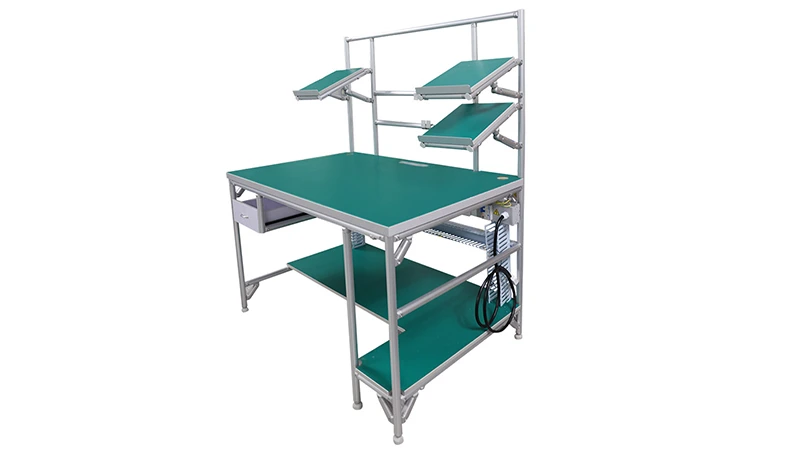
In today's fast-paced manufacturing world, the pressure to do more with less has never been greater. Factories and production facilities are constantly seeking ways to cut costs, reduce waste, and meet increasingly strict environmental standards—all while keeping up with evolving consumer demands. One often-overlooked piece of the puzzle? The humble workbench. Far more than just a surface to place tools, workbenches are the backbone of daily operations, dictating workflow efficiency, adaptability, and yes, even sustainability. Enter the Aluminum Workbench B: a modular, durable, and eco-friendly solution that's quietly revolutionizing how manufacturers approach reusable, sustainable production. Let's dive into how this unassuming piece of equipment is making a big impact on the future of manufacturing.
The Sustainability Crisis in Traditional Manufacturing
Before we talk about Aluminum Workbench B, let's set the stage: manufacturing is resource-intensive. From raw material extraction to energy use in production, the industry has long struggled with its environmental footprint. According to the United Nations Industrial Development Organization (UNIDO), manufacturing accounts for nearly 30% of global energy consumption and 20% of greenhouse gas emissions. A significant portion of this waste comes from outdated, inflexible equipment—including workbenches.
Traditional workbenches are often built to last "forever," but in reality, they're anything but permanent. Made from materials like solid wood, steel, or even plastic, they're heavy, static, and difficult to modify. When a production line changes, a new product is introduced, or a facility expands, these workbenches become obsolete. Instead of being repurposed, they're typically discarded, ending up in landfills or requiring energy-intensive recycling processes. This cycle of "use-and-replace" not only drives up costs for manufacturers but also exacerbates the industry's sustainability problem.
Consider a small electronics manufacturer, for example. They start with a line of workbenches designed for assembling smartphones. A year later, they shift to tablets, which require more surface area and different tool storage. The old workbenches, bolted to the floor and made of thick steel, can't be adjusted. So, they're torn out, and new ones are ordered. The steel from the old benches might be recycled, but the process uses energy, and the wood or plastic components often end up in landfills. Multiply this scenario across thousands of factories worldwide, and the environmental impact becomes staggering.
Aluminum Workbench B: A Sustainable Game-Changer
Aluminum Workbench B wasn't designed to be just another workbench. It was engineered with sustainability and reusability at its core. Let's break down what makes it different—and why it's becoming a go-to for manufacturers committed to reducing waste.
1. The Power of Aluminum Extrusion Profile
At the heart of Aluminum Workbench B is its construction material: aluminum extrusion profile. Unlike solid steel or wood, aluminum extrusion profile is created by pushing heated aluminum through a die, forming custom cross-sections (like T-slots, channels, or angles) that are lightweight, strong, and infinitely adaptable. This process uses less energy than forging steel or cutting solid wood, and the resulting material has some key sustainability benefits:
- Durability: Aluminum is naturally resistant to corrosion, rust, and wear, meaning Aluminum Workbench B can withstand years of heavy use without degrading. Its lifespan often exceeds that of traditional workbenches by 50% or more.
- Lightweight: Aluminum is about one-third the weight of steel, making the workbench easy to move, reconfigure, or transport—no need for heavy machinery or permanent installation.
- Recyclability: Aluminum is 100% recyclable, and recycling it uses just 5% of the energy required to produce new aluminum. Even at the end of its long life, an Aluminum Workbench B can be melted down and turned into new aluminum products with minimal environmental impact.
Compare this to a steel workbench: steel is strong but heavy, making it hard to move, and while it's recyclable, the process is more energy-intensive. Wood workbenches, meanwhile, are prone to warping, splintering, and pest damage, and their recyclability is limited (most end up as mulch or landfill waste). Aluminum extrusion profile strikes the perfect balance of strength, adaptability, and eco-friendliness.
2. Modularity: The Key to Reusability
But material alone isn't enough. What truly sets Aluminum Workbench B apart is its modular design, made possible by aluminum profile accessories. Instead of being a single, fixed structure, it's built from interchangeable parts: aluminum tubes, joints, connectors, and panels that can be easily disassembled and reassembled. This modularity turns "one-size-fits-all" into "one-size-fits-many."
Let's say a manufacturer needs to adjust their workflow. Maybe they're adding a new conveyor system, or they need to accommodate taller workers, or they're shifting from manual assembly to automated processes. With Aluminum Workbench B, they don't need a new workbench. They can simply swap out components: raise the height using longer aluminum tubes, add a shelf with aluminum guide rail for tool storage, or attach roller track to create a material flow system. The aluminum profile accessories—like internal rotatary aluminum joints or parallel aluminum joint A—make these adjustments quick and tool-free in some cases.
This isn't just convenient; it's sustainable. By reusing the same core components, manufacturers drastically reduce the need for new raw materials. A 2023 study by the Lean Manufacturing Institute found that companies using modular workbenches reduced equipment waste by an average of 35% compared to those using traditional static workbenches. That's 35% fewer workbenches ending up in landfills, 35% less energy spent on manufacturing replacements, and 35% fewer carbon emissions from transportation and production.
3. Aligning with Lean System Principles
Aluminum Workbench B doesn't just reduce waste—it actively supports lean system practices, a methodology focused on eliminating waste and continuous improvement. Lean manufacturing aims to streamline processes, minimize resource use, and maximize value for customers. Aluminum Workbench B fits seamlessly into this framework:
- Eliminating Waste (Muda): Traditional workbenches create waste in the form of excess inventory (spare parts), overproduction (buying more workbenches than needed), and defects (workbenches that don't fit new workflows). Aluminum Workbench B's modularity eliminates these by adapting to changing needs, reducing the need for backups or replacements.
- Flexibility (Heijunka): Lean systems thrive on flexibility to handle demand fluctuations. Aluminum Workbench B can be quickly reconfigured to scale up or down production, ensuring resources are used efficiently.
- Continuous Improvement (Kaizen): By allowing workers to adjust their own workbenches (e.g., adding a roller track for smoother material flow), Aluminum Workbench B empowers teams to identify and solve inefficiencies—core to the kaizen philosophy.
In short, Aluminum Workbench B isn't just a tool; it's a lean system enabler. It turns static workspaces into dynamic, adaptable environments that grow with the business—all while keeping sustainability front and center.

Real-World Impact: How Manufacturers Are Benefiting
Numbers and principles are one thing, but real-world examples tell the best story. Let's look at how two different manufacturers—one small, one large—have leveraged Aluminum Workbench B to boost sustainability and bottom-line results.
Case Study 1: A Small Automotive Parts Supplier
AutoParts Inc., a family-owned manufacturer of brake components in Michigan, was struggling with waste. Their facility was filled with old steel workbenches, many of which had been bolted to the floor for decades. When they won a contract to produce parts for electric vehicles (EVs), they needed to reconfigure their assembly line to accommodate larger components. The old workbenches were too short, too narrow, and impossible to move.
Instead of buying new steel workbenches (which would have cost $45,000 and generated 3 tons of waste from the old ones), they invested in 15 Aluminum Workbench B units, along with aluminum profile accessories like roller track and internal rotatary joints. The total cost? $30,000—33% less than new steel benches. But the savings didn't stop there.
Six months later, AutoParts Inc. landed another contract, this time for smaller, precision parts. Instead of buying more workbenches, they disassembled three of the Aluminum Workbench B units and reassembled them with shorter aluminum tubes and additional shelves (using leftover aluminum profile accessories). The process took two workers just a day, with zero waste. Over two years, they estimate they've saved $60,000 in equipment costs and reduced landfill waste by 8 tons. "We used to see workbenches as a 'set-it-and-forget-it' expense," says plant manager Maria Gonzalez. "Now, they're a flexible asset. We can adapt without breaking the bank—or the planet."
Case Study 2: A Global Electronics Manufacturer
On a larger scale, TechGiant, a Fortune 500 electronics company, was looking to reduce its carbon footprint across 20 global facilities. One of their targets: cutting waste from equipment replacement by 25% within three years. They turned to Aluminum Workbench B as part of their lean system initiative.
TechGiant replaced 500 traditional workbenches with Aluminum Workbench B units and standardized on aluminum extrusion profile and accessories across all plants. The results were striking: over three years, they reduced workbench-related waste by 32% (exceeding their target) and saved $2.1 million in equipment costs. Because the modular design allowed for easy reconfiguration, they also cut downtime during production line changes by 40%. "Aluminum Workbench B isn't just sustainable—it's smart business," says their sustainability director, James Chen. "By reusing components, we're not just helping the environment; we're making our operations more agile and cost-effective."

Beyond the Workbench: Supporting a Circular Economy
Aluminum Workbench B's impact extends beyond individual factories. It's part of a larger shift toward a circular economy—one where resources are kept in use for as long as possible, and waste is minimized. In a linear economy (the traditional "take-make-dispose" model), products have a single lifecycle. In a circular economy, they're designed to be reused, repaired, or recycled, creating a closed loop of resource use.
Aluminum Workbench B fits perfectly into this model. Its aluminum extrusion profile is not only durable but also highly recyclable. Even when a workbench reaches the end of its usable life (after 15–20 years of service, in many cases), the aluminum can be melted down and reused to make new aluminum products—with no loss in quality. This contrasts with steel, which loses strength when recycled, or wood, which can only be recycled a limited number of times.
What's more, the modular design encourages a "shared resource" mindset. Manufacturers can sell or donate used Aluminum Workbench B components to other businesses, extending their lifecycle even further. A small startup might buy secondhand aluminum tubes and joints from a larger manufacturer, reducing the need for new production. This kind of collaboration is key to building a more sustainable manufacturing ecosystem.
The Future of Workbenches: Why Aluminum Workbench B Is Here to Stay
As manufacturers face increasing pressure to reduce their environmental impact—from regulations, consumers, and investors—sustainability is no longer optional. It's a business imperative. Aluminum Workbench B represents a simple, scalable way to meet this challenge without sacrificing efficiency or productivity. Its combination of aluminum extrusion profile, modular design, and alignment with lean system principles makes it more than just a workbench; it's a sustainability tool.
Looking ahead, we can expect to see even more innovation in this space. Manufacturers are already experimenting with integrating smart technology into Aluminum Workbench B—like sensors that monitor usage and suggest optimizations, or IoT-connected components that automatically adjust height or lighting based on worker preferences. But at its core, the focus will remain on reusability: designing workbenches that can adapt to whatever the future of manufacturing brings.
So, the next time you walk through a factory, take a closer look at the workbenches. Are they static, outdated, and destined for the landfill? Or are they dynamic, modular, and built to last—like Aluminum Workbench B? The choice between these two options isn't just about equipment. It's about choosing a more sustainable, efficient, and resilient future for manufacturing.
Aluminum Workbench B vs. Traditional Workbenches: A Quick Comparison
| Feature | Aluminum Workbench B | Traditional Steel Workbench | Traditional Wood Workbench |
|---|---|---|---|
| Material | Aluminum extrusion profile | Solid steel | Solid wood or plywood |
| Weight | Lightweight (easy to move) | Heavy (requires machinery to move) | Medium-heavy (difficult to move) |
| Modularity | High (easily disassembled/reconfigured with aluminum profile accessories) | Low (fixed structure, hard to modify) | Low (fixed structure, prone to damage when modified) |
| Recyclability | 100% recyclable (low energy use for recycling) | Recyclable (high energy use for recycling) | Limited (often ends up in landfills) |
| Typical Lifespan | 15–20 years (extendable with component replacement) | 10–15 years (prone to rust/corrosion) | 5–10 years (prone to warping/damage) |
| Cost Over Time | Lower (reusable components reduce replacement costs) | Higher (frequent replacement needed) | Highest (short lifespan, frequent replacement) |
Conclusion: Small Changes, Big Impact
Aluminum Workbench B may seem like a small part of the manufacturing puzzle, but it's a powerful example of how sustainable design can drive real change. By prioritizing aluminum extrusion profile, modularity, and reusability, it challenges the status quo of "use-and-replace" equipment and paves the way for a more circular, efficient future. For manufacturers looking to reduce waste, cut costs, and meet sustainability goals, the message is clear: the workbench of tomorrow isn't just a surface to work on—it's a tool for building a better world.
So, whether you're a small startup or a global enterprise, consider this: your workbenches could be the first step toward a more sustainable manufacturing process. And with Aluminum Workbench B, that step is easier, more affordable, and more impactful than you might think.