- Company Articles
- Products and Technology
- Procurement Guidelines
- Aluminum Workbench B Buying Tips: Avoiding Common Mistakes for New Buyers

Aluminum Workbench B Buying Tips: Avoiding Common Mistakes for New Buyers
Related Product
Aluminum Workbench B
Aluminum tube workbench is more flexible and durable, compared with traditional PE/ABS coated steel tube. It is easy to assemble, anti corrosion, rust protection, and recycle use after disassemble.
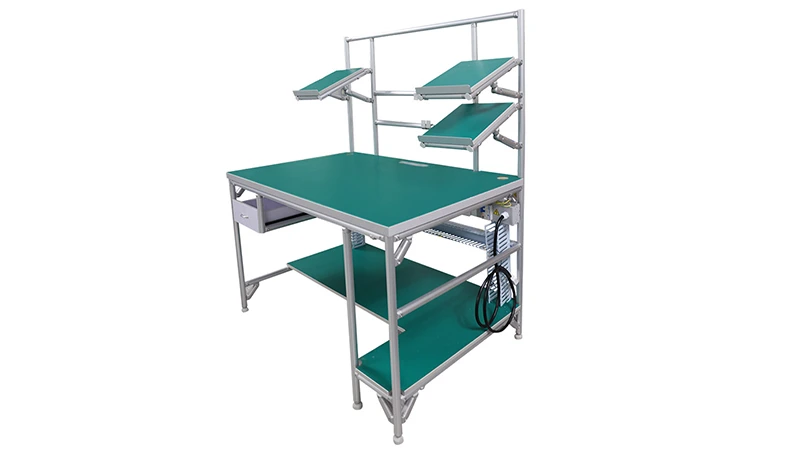
So, you're in the market for an aluminum workbench—exciting! Whether you're setting up a home workshop, outfitting a small manufacturing line, or upgrading a lab space, an aluminum workbench is more than just a table. It's the backbone of your daily workflow, the spot where projects come to life, and (let's be real) sometimes where you'll sip your morning coffee while troubleshooting a tricky task. But if you're new to buying workbenches, that excitement can quickly mix with anxiety. With so many options, specs, and jargon thrown around, how do you make sure you're not wasting money on a bench that doesn't fit your needs?
Enter the Aluminum Workbench B—a popular choice for its balance of durability, flexibility, and affordability. It's a staple in workshops and production floors, but even with its reputation, new buyers often stumble into avoidable mistakes. These missteps can turn your "dream workbench" into a frustrating hassle: a wobbly surface that can't hold your tools, a bench that's too big to move (or too small to use), or accessories that break after a month. In this guide, we'll walk through the most common pitfalls new buyers face when shopping for an Aluminum Workbench B, why they matter, and how to steer clear of them. Let's dive in.
Mistake #1: Guessing (Instead of Calculating) Load Capacity Needs
Here's a scenario I hear all the time: A first-time buyer walks into a supplier's shop, glances at the Aluminum Workbench B, and thinks, "That looks sturdy enough. I'll just get the standard one." Two months later, they're panicking because their 500-pound drill press is making the bench creak, or their stack of metal sheets has started to bow the surface. Sound familiar? The number one mistake new buyers make is guessing how much weight their workbench needs to handle—instead of calculating it.
Aluminum is strong, but not all aluminum workbenches are built the same. The load capacity depends largely on the aluminum profile used in the frame. For example, a bench made with 4040-series aluminum profiles (a common industrial grade) can typically support more weight than one with 3030-series profiles. But even within the same profile series, factors like wall thickness, cross-sectional design, and how the profiles are joined matter.
| Aluminum Profile Series | Wall Thickness (mm) | Static Load Capacity (lbs/linear ft) | Best For |
|---|---|---|---|
| 2020 | 1.0–1.5 | 50–75 | Light tools, small parts, hobby work |
| 3030 | 1.5–2.0 | 100–150 | Medium tools, assembly work, lab equipment |
| 4040 | 2.0–3.0 | 200–300 | Heavy machinery, metalworking, industrial use |
| 4080 | 2.5–3.5 | 350–500 | Large equipment, automotive work, high-load production |
But load capacity isn't just about "how much weight can the top hold." You also need to think about dynamic load —the weight that moves or is placed/removed frequently. If you're constantly sliding heavy boxes onto the bench or clamping vibrating tools (like sanders or grinders), that's harder on the structure than a static load (e.g., a stationary drill press). Aluminum Workbench B, for instance, might have a static load rating of 1,000 lbs, but its dynamic load could be 700 lbs. Ignore that, and you're asking for premature wear.
How to avoid it: Grab a notebook and list every item that will live on your workbench—tools, materials, equipment, even that coffee mug (okay, maybe not the mug). Weigh the heaviest items (yes, actually weigh them!) and add 30% to account for "oops, I forgot that" moments (like that extra box of parts you'll stack on the corner). Then, check the manufacturer's specs for Aluminum Workbench B to ensure its load capacity (both static and dynamic) exceeds that total. If the specs don't list dynamic load, ask the supplier—that's a red flag if they can't tell you.
Mistake #2: Falling for "One-Size-Fits-All" Dimensions
"It's a workbench—how complicated can the size be?" I get it. When you're excited to set up your space, measuring feels like a chore. But here's the truth: An Aluminum Workbench B that's the "wrong size" is worse than no workbench at all. I once helped a client who bought a 6-foot-long bench because "bigger is better," only to realize it blocked the door to their storage closet. They ended up sawing off a foot (ruining the warranty) and losing $200 in the process. Don't be that person.
Aluminum Workbench B often comes in standard dimensions—say, 48"L x 24"D x 36"H—but "standard" doesn't equal "right for you." Let's break down the key measurements to nail:
- Length: Think about your workflow. Do you need space for multiple projects at once (e.g., assembling on one end, testing on the other)? Or is it a single-task station? Measure the wall space where the bench will go, then subtract 18–24 inches from each side for walking room. You don't want to be squeezing past it like a contortionist.
- Depth: This is where people really drop the ball. A 24-inch deep bench sounds roomy, but if you're using clamps or mounting tools to the back edge, you might only have 18 inches of usable space. If you work with large sheets (wood, metal, plastic), go deeper—30–36 inches. For small parts or electronics, 18–24 inches is fine. Pro tip: Lay out a cardboard box on the floor with your desired depth and place your tools on it. Can you reach everything comfortably?
- Height: Ergonomics matter! If you're standing at the bench 8 hours a day, the wrong height will wreck your back. Standard height is 36 inches, but adjust based on your height. The rule of thumb: when standing with arms relaxed, your elbows should bend at a 90° angle when resting on the bench. If you're shorter (under 5'6"), 34 inches might be better; taller folks (over 6'), 38 inches. Some Aluminum Workbench B models offer adjustable legs—snap those up if you can.
Another dimension trap: overhang . If you mount a vice or tool on the edge, make sure the bench top extends past the frame enough to support it without tipping. A 2-inch overhang is fine for a small vice, but a 10-inch overhang with a 50-pound tool? That's a recipe for a wobbly mess. Check if Aluminum Workbench B has a reinforced edge or if you'll need to add a support bracket (part of aluminum pipe accessories ).
How to avoid it: Grab a tape measure and a friend. Measure the exact spot where the bench will go—width, depth, ceiling height (if you're mounting overhead racks). Sketch it on paper, then cut out a cardboard template to tape to the floor. Live with it for a day: walk around it, simulate working on it, open nearby doors/drawers. If it feels cramped, downsize. If it feels tiny, upsizing might be worth it—but only if the space allows.

Mistake #3: Underestimating the Importance of Aluminum Pipe Accessories
Let's talk about the "hidden heroes" of your workbench: the accessories. When new buyers shop for Aluminum Workbench B, they fixate on the bench top and frame but skimp on aluminum pipe accessories —joints, connectors, brackets, and fasteners. Big mistake. A bench is only as strong as its weakest link, and cheap accessories are that weak link.
Take joints, for example. Aluminum workbenches use internal rotatary aluminum joints or external brackets to connect the frame. A low-quality joint might look okay at first, but after a few months of tightening/loosening tools or shifting weight, it'll strip or crack. I've seen workbenches collapse because the joints couldn't handle the stress—luckily, no one was hurt, but the tools on top weren't so lucky.
Then there are the little things: corner brackets, shelf supports, and even screws. If the supplier uses soft, low-grade aluminum for brackets, they'll bend under pressure. If the screws are too short or made of weak metal, they'll pull out of the aluminum profile. These might seem like minor details, but they add up to a bench that's unstable, noisy, and unsafe.
Aluminum pipe accessories also affect flexibility . One of the perks of aluminum workbenches is their modularity—you can add shelves, tool rails, or lighting later. But that only works if the accessories are compatible. A cheap joint might not fit standard aluminum profile slots, locking you into a "fixed" bench that can't grow with your needs. Imagine wanting to add a second shelf six months in, only to find the brackets don't match the frame—frustrating, right?
How to avoid it: Don't just ask, "What's included?" Ask, "What brand are the accessories?" Reputable suppliers use accessories from trusted manufacturers (even if they don't advertise it). Inspect the joints: they should feel solid, not flimsy, with smooth rotation (if they're rotary). Check for weight ratings on brackets—if a shelf bracket says it holds 50 lbs, don't trust it to hold 100 lbs. And when in doubt, upgrade: spending $20 more on heavy-duty joints now beats replacing a collapsed bench later.

Mistake #4: Forgetting About Mobility (or Overcomplicating It)
Mobility is a "nice to have" until it's a "need to have." Let's say you buy a stationary Aluminum Workbench B because "I'll never need to move it." Then, six months later, you rearrange your shop, or a big project requires the bench near the window for natural light. Suddenly, you're recruiting three coworkers to heave it across the room, scratching the floor and risking injury. On the flip side, adding caster wheels when you don't need them is just as bad—they add cost, take up space, and can make the bench wobbly if you're not moving it.
So, when does mobility matter? Ask: Will you ever need to clean under the bench? Do you work on large projects that require the bench in different spots? Do you share the space with others who might need the bench moved? If yes, caster wheels are a must. But not just any casters—quality matters.
Caster wheel specs to check: load capacity (each caster should handle at least 1/4 of the total bench weight, plus items on it), wheel material (rubber for hardwood floors, polyurethane for concrete to avoid marks), and brakes (dual-locking brakes are best—they lock both the wheel and the swivel). A cheap caster might have a plastic wheel that cracks on rough floors or a brake that slips, turning your "mobile bench" into a runaway train.
Aluminum Workbench B might come with optional caster kits, or you might need to buy them separately (as part of aluminum pipe accessories). If you don't need mobility, skip the casters—go for fixed feet (adjustable leveling feet are great for uneven floors). Workbench E, for example, is a single-deck model without casters, designed for stationary use. But if you're on the fence, opt for casters with brakes—you can lock them when you need stability and unlock when you need to move.
How to avoid it: List your "mobility scenarios" upfront. If you can't think of more than one or two, skip the casters. If you can think of five, invest in quality ones. Test them if possible: roll the bench (with weight on it!) across your floor type to check for noise, smoothness, and brake strength. And remember: casters add height—if you're tight on ceiling space or need a specific bench height, factor that into your dimensions.
Mistake #5: Choosing Price Over Long-Term Value
Let's end with the most tempting mistake: chasing the lowest price. I get it—budgets are tight, and $200 less on a workbench feels like a win. But here's the hard truth: An aluminum workbench is an investment, not an expense. A cheap Aluminum Workbench B might save you money today, but it'll cost you more in the long run—repairs, replacements, lost productivity.
What makes a "cheap" bench cheap? Thin aluminum profiles, low-grade aluminum pipe accessories, flimsy bench tops (like particleboard with a thin aluminum veneer instead of solid aluminum or plywood core), and no warranty. I once had a client who bought a $300 "aluminum workbench" online, only to have the top warp after a week of use (it was just painted MDF). They ended up buying a quality Aluminum Workbench B for $600 a month later—so they spent $900 total instead of $600 upfront.
On the flip side, "expensive" doesn't always mean "better." Some suppliers charge premium prices for fancy branding but use the same aluminum profile and accessories as mid-range options. So how do you spot value?
- Warranty: A reputable supplier will stand behind their product. Look for at least a 2-year warranty on the frame and 1-year on accessories. If they offer a "lifetime warranty," ask what that covers (parts? labor? shipping?)
- Material transparency: They should list the aluminum grade (e.g., 6061-T6, a strong, corrosion-resistant alloy), profile dimensions, and accessory specs. If they say "high-quality aluminum" without details, run.
- Customer reviews: Check for reviews from buyers with similar needs (e.g., "small workshop," "electronics assembly"). If multiple reviews mention "wobbly" or "accessories broke," that's a red flag.
Aluminum Workbench B, when bought from a trusted supplier, hits that sweet spot: durable enough to last 10+ years, flexible enough to adapt to your needs, and priced fairly for the quality. It might cost $100–$200 more than a budget option, but think of it as $10–$20 a year over a decade—worth every penny to avoid the headache of a bench that fails.
How to avoid it: Set a realistic budget, then add 20% for "quality buffer." Compare 2–3 suppliers: check specs, warranties, and reviews. If one is significantly cheaper, ask why—are they cutting corners on materials or accessories? If the answer isn't clear, go with the mid-range option. Your future self (and your back, and your tools) will thank you.
Wrapping Up: Your Workbench, Your Success
Buying an Aluminum Workbench B shouldn't feel like a guessing game. By avoiding these five mistakes—miscalculating load capacity, ignoring dimensions, skimping on aluminum pipe accessories, misjudging mobility needs, and choosing price over value—you'll end up with a workbench that's not just a piece of furniture, but a partner in your projects.
Remember: This bench will see early mornings, late nights, frustrating fixes, and triumphant finishes. It deserves thought, research, and a little patience. Take the time to measure, ask questions, and test (if you can). When you finally set it up and place your first tool on it, you'll know it was worth it—because this time, you didn't just buy a workbench. You built the foundation for success.