- Company Articles
- Products and Technology
- Procurement Guidelines
- Aluminum Workbench B Cost Analysis: Short-Term Investment vs. Long-Term Savings

Aluminum Workbench B Cost Analysis: Short-Term Investment vs. Long-Term Savings
Related Product
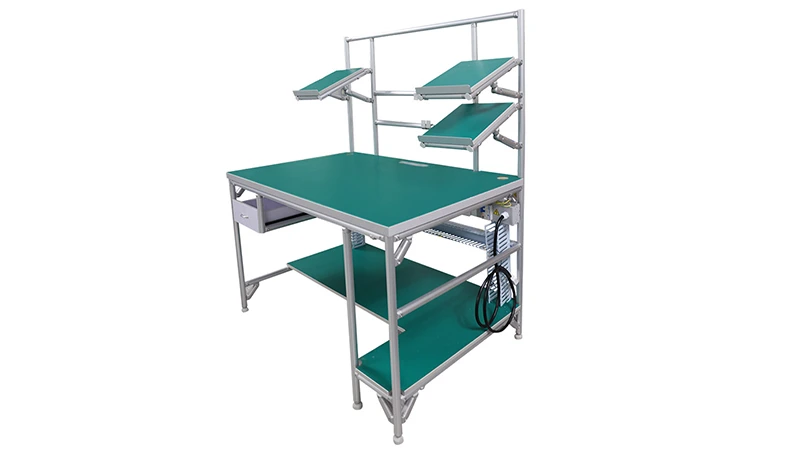
Aluminum Workbench B
Aluminum tube workbench is more flexible and durable, compared with traditional PE/ABS coated steel tube. It is easy to assemble, anti corrosion, rust protection, and recycle use after disassemble.
The Hidden Cost of "Cheap" Workbenches
Let's be honest: when you're running a workshop, factory, or any production space, every dollar counts. It's tempting to cut corners on equipment—especially something as "basic" as a workbench. Why splurge on a fancy model when a wooden table or a budget steel frame gets the job done, right? Here's the thing: that "cheap" workbench might be costing you far more than you realize. Warped wood after a year of use, rusted steel that sticks and stains your parts, wobbly legs that slow down assembly—these aren't just minor annoyances. They're silent productivity killers, eating into your team's time, your maintenance budget, and eventually, your bottom line.
That's where the
aluminum workbench B
comes in. At first glance, it might seem like a bigger upfront expense than those budget options. But if you zoom out and look at the bigger picture—5 years, 10 years, even just 2 years—you'll start to see why so many manufacturers are swapping out their old workbenches for aluminum. This isn't just about having a shiny new table; it's about investing in a tool that pays you back, month after month, in saved time, reduced hassle, and improved workflow. Let's break it down: short-term investment versus long-term savings. Spoiler: the math might surprise you.
Meet Aluminum Workbench B: More Than Just a Table
Before we dive into numbers, let's talk about what makes
aluminum workbench B
different. This isn't your average workbench. It's built with
aluminum extrusion profiles
—those sleek, strong aluminum pieces shaped through a precise extrusion process that balances lightweight flexibility with industrial-grade durability. Think of it as the backbone of a system, not just a standalone piece of furniture. The frame is made from high-quality aluminum tubes, joined with sturdy connectors that keep everything stable but also let you tweak the setup if your needs change. The top is a smooth, easy-to-clean surface (no more splinters or rust stains), and it's designed to handle the daily grind of production—whether you're assembling small electronics or heavy machinery parts.
But what really sets it apart is its modularity. Unlike a fixed wooden or steel workbench,
aluminum workbench B
plays well with
aluminum profile accessories
. Need a shelf above? Add it. Want a tool rail on the side? Screw it in. Even better, if your workflow shifts six months from now—maybe you need to lower the height or add a bin for parts—you don't have to buy a whole new workbench. Just reconfigure the existing one with a few new accessories. That adaptability? It's a game-changer for long-term cost control.

The Short-Term Investment: What You'll Pay Upfront
Let's get the elephant in the room out of the way:
aluminum workbench B
costs more upfront than a basic workbench. There's no sugarcoating that. A standard wooden workbench might run you $200–$300. A budget steel one could be $300–$400.
Aluminum workbench B
? You're looking at around $500–$700, depending on size and accessories. That's a 50–100% jump in initial cost. For a small business with tight cash flow, that sticker shock can feel like a dealbreaker. But here's the question: is that extra $200–$400 a waste, or is it an investment?
Let's break down the upfront costs more carefully. The base price for
aluminum workbench B
(single deck, without casters) is about $550. If you add casters for mobility (a must for most workshops), that's another $80. Maybe you want a shelf or two? Add $50 for
aluminum profile accessories
like brackets and connectors. So total upfront cost: roughly $680. Compare that to a mid-range steel workbench with casters and a shelf—about $450. On paper, steel is cheaper by $230. But let's dig deeper. What are you really getting for that $450?
Quick Reality Check:
A steel workbench might seem sturdy, but steel rusts—especially in humid workshops or if you're working with liquids. Within a year, you might notice rust spots on the frame or the surface. That rust doesn't just look bad; it can transfer to parts, damage tools, and weaken the structure over time. Wood? It warps with moisture, splinters with heavy use, and needs regular sanding and sealing to stay functional.
Aluminum extrusion profiles
, on the other hand, are naturally corrosion-resistant. No rust, no warping, no need for sealing. That's the first clue that the initial cost difference might be worth it.
Upfront Cost Comparison: Aluminum vs. Traditional Workbenches
| Cost Category | Aluminum Workbench B (w/ Casters + 1 Shelf) | Mid-Range Steel Workbench (w/ Casters + 1 Shelf) | Basic Wooden Workbench (w/ Casters + 1 Shelf) |
|---|---|---|---|
| Base Workbench | $550 | $380 | $250 |
| Casters | $80 | $70 | $60 (weaker, plastic casters) |
| Shelf + Accessories | $50 (aluminum profile accessories) | $40 (steel brackets) | $30 (wooden planks + screws) |
| Total Upfront Cost | $680 | $490 | $340 |

Long-Term Savings: Why the Upfront Cost Pays Off
Now, let's fast-forward. Let's say you buy 10 workbenches for your workshop—either aluminum, steel, or wood. What happens over the next 5 years? That's where the true cost of "cheap" workbenches starts to add up. Let's break down the long-term savings in four key areas: durability, maintenance, adaptability, and efficiency.
1. Durability: Less Replacement, More ROI
Wood workbenches have a lifespan of about 2–3 years in a busy workshop. The wood warps, the legs loosen, and the surface gets too beat up to use. Steel? Maybe 3–4 years, but only if you're meticulous about rust prevention (which means regular painting or coating—more on that later).
Aluminum workbench B
? Thanks to those
aluminum extrusion profiles
, it's built to last 10+ years. Even with daily use, the frame won't rust, the surface won't warp, and the joints stay tight.
Let's do the math for 10 workbenches over 5 years. With wood: you'll need to replace them once (after 2–3 years), so 10 new workbenches at $340 each = $3,400. Total cost: initial $3,400 + replacement $3,400 = $6,800. With steel: replace once after 3–4 years, so $4,900 initial + $4,900 replacement = $9,800. With aluminum: no replacement needed. Just the initial $6,800. That's already a savings of $0 (vs. wood) or $3,000 (vs. steel) over 5 years. But wait—there's more.
2. Maintenance: Time (and Money) Saved
Maintenance isn't just about fixing things when they break—it's about the time your team spends keeping workbenches functional. Wooden workbenches need sanding to remove splinters (1 hour per bench every 3 months), sealing to prevent warping (2 hours per bench every 6 months), and tightening loose screws (30 minutes per bench monthly). Steel workbenches need rust removal (1 hour per bench every 3 months), repainting (2 hours per bench yearly), and lubricating stuck parts (30 minutes per bench monthly).
Aluminum workbench B
? Maintenance is almost non-existent. Wipe down the surface with a damp cloth if it gets dirty. Tighten a joint once a year if it feels loose. That's it. No sanding, no painting, no rust removal. Let's value your team's time at $25/hour (a conservative estimate for a production worker). For 10 workbenches over 5 years:
| Maintenance Task | Wooden Workbenches (Annual Time per Bench) | Steel Workbenches (Annual Time per Bench) | Aluminum Workbenches (Annual Time per Bench) |
|---|---|---|---|
| Sanding/Sealing/Rust Removal | 8 hours | 6 hours | 0 hours |
| Tightening/Lubrication | 6 hours | 6 hours | 1 hour |
| Total Annual Time per Bench | 14 hours | 12 hours | 1 hour |
| Total 5-Year Time for 10 Benches | 700 hours ($17,500) | 600 hours ($15,000) | 50 hours ($1,250) |
That's a savings of $16,250 (vs. wood) or $13,750 (vs. steel) just in maintenance time over 5 years.
3. Adaptability: No Need to Reinvent the Wheel
Workflows change. Maybe next year, you switch from assembling small parts to larger components, so you need taller workbenches. Or you adopt a
lean system
and need to rearrange your layout for better flow. With a wooden or steel workbench, you're stuck—you either live with the old setup (hurting efficiency) or buy new workbenches (wasting money).
Aluminum workbench B
is designed for adaptability. Those
aluminum profile accessories
—like adjustable legs, removable shelves, and modular brackets—let you reconfigure the workbench in minutes. Need to raise the height? Swap out the leg extensions. Want to add a tool rack? Screw in a new bracket. No need to buy a new workbench—just repurpose the one you have. Over 5 years, how many times might your workflow change? Even once could mean saving $3,400 (for 10 wooden benches) or $4,900 (for 10 steel benches) in replacement costs.
4. Efficiency: When Your Workbench Works With You
Here's the intangible that often gets overlooked: efficiency. A rickety, unorganized workbench slows your team down. If tools are hard to reach, if parts roll off a warped surface, if the bench is too low (causing back strain), your team spends more time fixing problems and less time producing.
Aluminum workbench B
is designed with
lean system
principles in mind—everything has a place, the height is adjustable for ergonomics, and the smooth surface keeps parts from getting stuck.
Let's say a disorganized workbench costs your team just 5 minutes per hour in lost productivity. For a team of 10 people working 8-hour days, that's 5 minutes x 8 hours x 10 people = 400 minutes (6.67 hours) per day. Over 250 workdays a year, that's 1,667 hours of lost productivity. At $25/hour, that's $41,675 per year. Even if
aluminum workbench B
cuts that waste by just 20%, that's $8,335 saved annually—or $41,675 over 5 years. Suddenly, that upfront cost seems tiny.
Real Numbers: A 5-Year Cost Projection
Let's pull it all together. We'll compare the total cost of 10 workbenches over 5 years for wood, steel, and aluminum. We'll include initial cost, replacement cost, maintenance cost, and efficiency savings (conservatively assuming aluminum cuts waste by 20%).
| Cost Category | Wooden Workbenches (10 units) | Steel Workbenches (10 units) | Aluminum Workbenches (10 units) |
|---|---|---|---|
| Initial Cost | $3,400 | $4,900 | $6,800 |
| Replacement Cost (5 years) | $3,400 (1 replacement) | $4,900 (1 replacement) | $0 |
| Maintenance Cost (5 years) | $17,500 | $15,000 | $1,250 |
| Efficiency Loss (5 years) | $208,375 (no savings) | $208,375 (no savings) | $166,700 (-$41,675 saved) |
| Total 5-Year Cost | $232,675 | $233,175 | $174,750 |
Key Takeaway:
Over 5 years,
aluminum workbench B
saves you $57,925 compared to wooden workbenches and $58,425 compared to steel. That's not pocket change—it's money you can reinvest in growing your business, hiring more staff, or upgrading other equipment.
Conclusion: Investing in Your Workflow's Future
At the end of the day,
aluminum workbench B
isn't just a workbench. It's an investment in your team's productivity, your workshop's efficiency, and your business's long-term profitability. Yes, the upfront cost is higher than a basic wooden or steel model. But when you factor in durability, maintenance, adaptability, and efficiency, it's clear that "cheap" workbenches cost you far more in the long run.
Think of it this way: would you buy a car that breaks down every year, just because it's cheaper upfront? Probably not—you'd invest in a reliable model that saves you money on repairs and keeps you on the road. Your workbenches are no different. They're the foundation of your production process, and a strong foundation pays off.
So, if you're ready to stop throwing money at temporary solutions and start investing in tools that grow with your business,
aluminum workbench B
is worth every penny. Its
aluminum extrusion profiles
and compatibility with
aluminum profile accessories
make it flexible, durable, and efficient—turning that initial investment into years of savings and smoother workflows. Your team (and your bottom line) will thank you.