- Company Articles
- Products and Technology
- Product knowledge
- Aluminum Workbench B Demystified: How It Supports Reusable and Sustainable Workflows

Aluminum Workbench B Demystified: How It Supports Reusable and Sustainable Workflows
Related Product
Aluminum Workbench B
Aluminum tube workbench is more flexible and durable, compared with traditional PE/ABS coated steel tube. It is easy to assemble, anti corrosion, rust protection, and recycle use after disassemble.
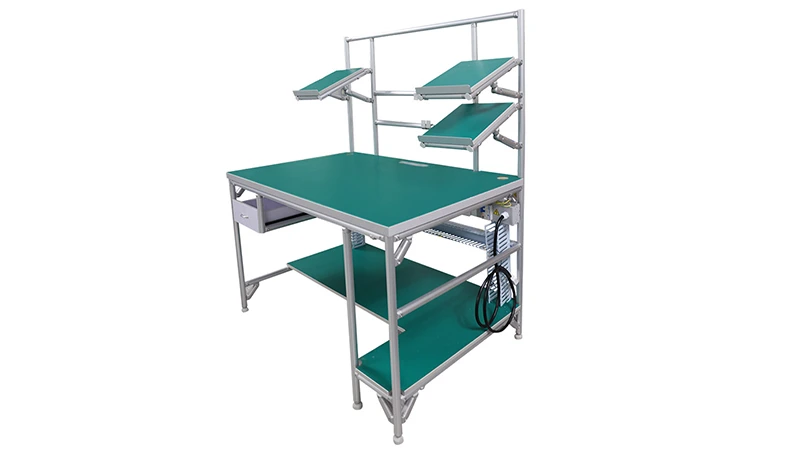
Walk into any modern workshop, manufacturing plant, or assembly line, and you'll notice a quiet revolution happening—one that's reshaping how we think about workspaces. Gone are the days of clunky, one-size-fits-all workbenches bolted to the floor, destined for the landfill the moment production needs shift. Instead, there's a new star on the scene: the aluminum workbench. But not just any aluminum workbench—today, we're diving deep into aluminum workbench B , a modular powerhouse designed to keep up with the fast-paced, ever-changing demands of modern work. What makes it so special? How does it turn rigid workflows into flexible, sustainable systems? Let's pull back the curtain.
The Problem with "Set It and Forget It" Workspaces
Imagine a small electronics manufacturer I visited last year. Their assembly line was a maze of wooden workbenches, each built to fit a specific device: smartphones on one bench, tablets on another, chargers on a third. When they landed a contract to produce smartwatches—a smaller, more intricate product—they hit a wall. The existing benches were too tall, too wide, and had no built-in storage for tiny components. Their solution? Buy new wooden benches, disassemble the old ones, and haul the scraps to the dumpster. Cost: $15,000 in new materials, two weeks of downtime, and a mountain of waste. Sound familiar?
This scenario plays out in workshops worldwide. Traditional workbenches—whether wood, steel, or plastic—are static by design. They're built for a single purpose, and when that purpose changes, they become liabilities. Workers contort their bodies to use ill-fitting surfaces, production lines stall during reconfigurations, and resources are squandered on replacements. It's a cycle of waste that contradicts everything modern businesses stand for: agility, efficiency, and sustainability.
Enter aluminum workbench B. It's not just a table with a metal top; it's a rethink of what a workspace can be. Lightweight but tough, customizable without tools, and built to evolve with your needs. Let's start with the basics: what is aluminum workbench B, anyway?
What Is Aluminum Workbench B? A Closer Look
At first glance, aluminum workbench B might look like any other workbench. It has a flat surface, a sturdy frame, and enough space to spread out tools and materials. But peek under the hood, and you'll spot the magic: it's built entirely from aluminum extrusion profiles —hollow, lightweight beams with precision-engineered T-slots running their length. These slots aren't just for show; they're the key to its flexibility. Think of them as the "universal adapter" of workbench design: you can slide, lock, and rearrange accessories—shelves, tool holders, bins—anywhere along the profile, no drilling or sawing required.
Unlike some bulkier models, aluminum workbench B is designed with simplicity in mind. It features a single deck (no cluttered double layers) and, notably, no built-in casters—though if mobility is needed, you can add caster wheels later using compatible brackets (more on that in a bit). This stripped-down design keeps costs low while maximizing adaptability. It's the kind of workbench that says, "I'll grow with you," whether you're a startup assembling 10 products a day or a factory churning out thousands.
But what really sets it apart is its commitment to sustainability. Aluminum isn't just strong; it's one of the most recyclable materials on the planet. Nearly 75% of all aluminum ever produced is still in use today, thanks to its ability to be melted down and reused without losing quality. When you invest in aluminum workbench B, you're not just buying a tool—you're investing in a resource that can be repurposed, recycled, or reconfigured long after its first job is done.

The Backbone: Why Aluminum Extrusion Profiles Make All the Difference
To understand aluminum workbench B, you need to understand its DNA: the aluminum extrusion profile . Extrusion is a manufacturing process where raw aluminum is heated to a malleable state and forced through a die (a custom-shaped mold) to create long, uniform profiles. The result? Beams with intricate cross-sections—like the T-slots we mentioned—engineered for strength, lightness, and versatility.
Let's break down the benefits: First, weight. Aluminum is about 1/3 the weight of steel, which means aluminum workbench B is easy to move (even without casters) when you need to rearrange your floor plan. A team of two can reposition it in minutes, no forklift required. Second, strength. Don't let the lightness fool you—extruded aluminum profiles have a high strength-to-weight ratio, meaning they can support heavy tools, machinery, and materials without bending or warping. I've seen these benches hold 500+ pounds of electronics components without so much as a creak.
Third, corrosion resistance. Unlike steel, aluminum forms a natural oxide layer that protects it from rust, making it ideal for humid environments (think food processing, marine assembly) or workshops that use water-based cleaning solutions. And fourth, precision. The T-slots in extrusion profiles are cut to exact tolerances, so accessories fit snugly every time. No wobbly shelves, no loose brackets—just a tight, secure fit that stands up to daily use.
Compare this to wooden workbenches, which warp with moisture, or steel ones, which rust and require regular painting. Aluminum extrusion profiles don't just last longer—they stay functional and attractive for decades. It's the difference between buying a disposable product and investing in a legacy tool.

Building Blocks: Aluminum Profile Accessories That Unlock Flexibility
If aluminum extrusion profiles are the bones of aluminum workbench B, then aluminum profile accessories are the muscles and joints that let it move. These small, unassuming parts—connectors, brackets, end caps, and more—turn a basic frame into a fully customized workspace. Let's meet the key players:
Connectors: The "Glue" of Modularity
Ever tried to build furniture with a hex key and a vague instruction manual? Frustrating, right? Aluminum profile accessories skip the hassle with tool-free connectors. Take the 90° aluminum profile connector: it slides into the T-slot, twists into place, and locks with a simple lever. Need to angle a shelf at 45° instead? Swap in a 45° connector—no drilling, no screws, no sweat. These connectors are designed to withstand vibration and heavy loads, so your setup stays stable even during high-speed assembly.
End Caps and Rubber Strips: The Little Details That Matter
Ever run your hand along a metal beam and get a nasty cut from a sharp edge? Aluminum workbench B avoids that with T-slot rubber seal covers—flexible strips that snap into the profile's slots, covering rough edges and preventing debris (like screws or dust) from clogging the T-slots. End caps, made from durable plastic or rubber, cap off the ends of profiles, adding a clean finish and keeping out moisture. It's these small touches that make the bench feel less like industrial equipment and more like a tool built for people .
Shelves and Tool Holders: Adapt to Your Day
Need a shelf for power tools on Monday, a bin for screws on Tuesday, and a monitor mount for digital work instructions on Wednesday? Aluminum profile accessories have you covered. Shelves slide into T-slots and lock in place; tool holders clamp on without drilling; monitor arms adjust with a twist. It's like having a new workbench every day—without the waste.
Aluminum Workbench B and Lean Systems: A Match Made in Efficiency Heaven
If you've spent any time in manufacturing, you've heard of "lean systems"—the philosophy of eliminating waste, streamlining workflows, and continuous improvement. Aluminum workbench B isn't just compatible with lean; it's practically a poster child for it. Here's how:
Waste Reduction: From Trash to Treasure
Lean's first rule? Eliminate "muda" (waste). Traditional workbenches generate waste in spades: waste of space (they take up more room than needed), waste of materials (they're overbuilt for static tasks), and waste of time (reconfiguring requires disassembly). Aluminum workbench B cuts this waste by design. Its modular frame means you only use the space you need; its lightweight materials reduce overbuilding; and its tool-free reconfiguration slashes setup time from days to hours.
Take the electronics manufacturer I mentioned earlier. After switching to aluminum workbench B, they reconfigured their smartwatch line in four hours instead of two weeks. No new materials, no dumpster runs—just sliding accessories and locking connectors. Waste? Practically zero.
Continuous Improvement: Grow Without Growing Pains
Lean isn't a one-time fix; it's a mindset of constant evolution. Aluminum workbench B grows with that mindset. Add a second shelf when you need more storage. Extend the frame when your team expands. Swap out the worktop for a heat-resistant surface when you start soldering. Every component is reusable, so when you upgrade, the old parts don't go to waste—they get repurposed elsewhere. It's sustainability in action, and it's how lean systems are meant to work.
Sustainability: More Than a Buzzword
Sustainability isn't just about recycling coffee cups in the break room—it's about rethinking how we build the tools we rely on. Aluminum workbench B checks every box:
Recyclability: Aluminum's Superpower
Aluminum is 100% recyclable, and here's the kicker: recycling it uses just 5% of the energy required to produce new aluminum. That means even if your aluminum workbench B eventually reaches the end of its life (which, with proper care, could be 50+ years), its components can be melted down and turned into new profiles, accessories, or even other products—no quality lost, no waste created.
Longevity: Buy Once, Use Forever (Almost)
The average wooden workbench lasts 3–5 years before warping or rotting. Steel? Maybe 10–15 years, if you're lucky and avoid rust. Aluminum workbench B? With minimal maintenance (a quick wipe down, occasional tightening of connectors), it can last 50+ years. That's not just durability—that's generational sustainability. A bench bought today could still be in use by your grandkids' generation.
Lightweight = Lower Carbon Footprint
Shipping heavy steel or wooden workbenches guzzles fuel and emits CO2. Aluminum workbench B, being 1/3 the weight of steel, slashes transportation emissions. A truck that can carry 10 steel benches can carry 30 aluminum ones—meaning fewer trips, less fuel, and a smaller carbon footprint.
How Does It Stack Up? A Comparison of Workbench Options
Still on the fence? Let's put aluminum workbench B head-to-head with traditional options. The table below breaks down key factors like cost, sustainability, and flexibility—so you can see why it's not just a better choice, but a smarter investment.
| Feature | Aluminum Workbench B | Traditional Wooden Workbench | Traditional Steel Workbench |
|---|---|---|---|
| Material | Aluminum extrusion profiles + aluminum profile accessories | Solid wood or plywood | Steel tubing or sheet metal |
| Weight | Light (50–80 lbs for a standard size) | Heavy (100–200 lbs) | Very heavy (150–300 lbs) |
| Customization | Tool-free reconfiguration; add/remove shelves, accessories daily | Fixed design; requires sawing/drilling to modify | Limited; welding required for major changes |
| Reusability | 100% reusable components; repurpose for new setups | Low; often damaged during disassembly | Moderate; heavy, hard to repurpose without cutting |
| Sustainability | 100% recyclable; 50+ year lifespan; low transportation emissions | Limited recyclability; short lifespan (3–5 years); high waste | Recyclable but energy-intensive; prone to rust; shorter lifespan (10–15 years) |
| Cost (Initial vs. Long-Term) | Higher initial ($800–$1,500); lower long-term (no replacements) | Lower initial ($300–$600); higher long-term (replace every 3–5 years) | High initial ($1,000–$2,000); moderate long-term (replace every 10–15 years) |
| Integration with Lean Systems | Seamless; supports waste reduction, flexibility, continuous improvement | Poor; static design creates waste | Limited; heavy, hard to reconfigure |
Real-World Stories: Aluminum Workbench B in Action
Numbers and specs tell part of the story, but let's hear from the people who use aluminum workbench B every day. Take Maria, a production supervisor at a medical device plant in Ohio. "We used to have steel workbenches that took two people and a wrench to move," she told me. "When we switched to aluminum workbench B, it was like night and day. Last month, we had to reconfigure three lines in one day for a new batch of pacemakers. My team did it in two hours—no tools, no stress. The best part? We didn't throw anything away. We just moved the accessories around and kept going."
Then there's Raj, who runs a small woodworking shop (yes, even woodworkers use aluminum benches!). "I build custom furniture, so every project is different," he said. "One week I'm making a dining table, the next a bookshelf. With my old wooden bench, I was always jury-rigging clamps or adding temporary shelves. Now, I just slide on a new clamp holder or adjust the shelf height. It's like having a bench that thinks ahead."
These stories aren't anomalies. They're the result of a design philosophy that puts people and planet at the center. Aluminum workbench B doesn't just support sustainable workflows—it makes them possible .
The Future of Workspaces: Why Modularity Isn't a Trend—It's a Necessity
The world of work isn't slowing down. Product cycles are shorter, customer demands are more varied, and sustainability is no longer a "nice-to-have"—it's a business imperative. In this landscape, static workspaces are liabilities. They trap businesses in outdated workflows, waste resources, and demoralize workers who struggle with ill-fitting tools.
Aluminum workbench B is more than a product; it's a statement. It says, "We value adaptability." "We care about our team's ability to do their best work." "We're committed to leaving the planet better than we found it." It's a small change that ripples outward: less waste, happier workers, more efficient production, and a future where workspaces grow with us—not against us.
Ready to Make the Switch? What to Look For
If aluminum workbench B sounds like a fit for your workspace, here's what to keep in mind when shopping: Look for benches made with high-quality aluminum extrusion profiles (ask about wall thickness—1.5mm or higher for durability). Check that the aluminum profile accessories are compatible with standard T-slot sizes (most use 20mm or 40mm slots) to ensure you can mix and match accessories from different suppliers. And don't forget to test the reconfiguration process—grab a connector, slide it into a T-slot, and see how easy it is to lock and release. If it feels clunky, keep looking.
Most importantly, think long-term. Yes, aluminum workbench B has a higher upfront cost than a basic wooden bench, but when you factor in reusability, durability, and sustainability, it pays for itself in 2–3 years. And unlike traditional benches, it won't end up in a landfill—it'll be there, evolving with your business, for decades to come.
Final Thoughts: Workspaces That Grow With You
Aluminum workbench B isn't just a workbench. It's a symbol of progress—a rejection of waste, a celebration of flexibility, and a commitment to building workspaces that honor both people and the planet. It's proof that sustainability and efficiency don't have to be trade-offs; in fact, they're better together.
So the next time you walk into your workshop, take a look at your current setup. Is it holding you back, or propelling you forward? If it's the former, maybe it's time to say hello to aluminum workbench B. Your team, your bottom line, and the planet will thank you.