- Company Articles
- Products and Technology
- Application Cases
- Aluminum Workbench B in Automotive Manufacturing: Workshop Integration Examples

Aluminum Workbench B in Automotive Manufacturing: Workshop Integration Examples
Related Product
Aluminum Workbench B
Aluminum tube workbench is more flexible and durable, compared with traditional PE/ABS coated steel tube. It is easy to assemble, anti corrosion, rust protection, and recycle use after disassemble.
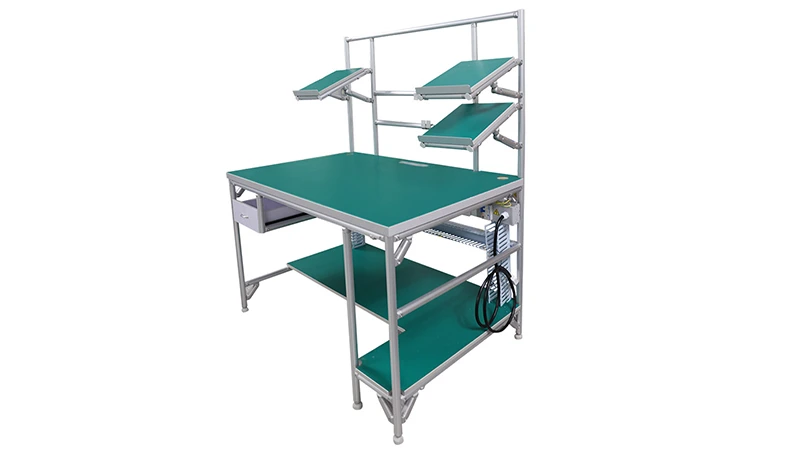
Walk into any cutting-edge automotive manufacturing facility today, and you'll notice a quiet revolution happening on the factory floor—one centered around the tools that keep production humming: workbenches. These aren't just tables where parts are assembled or inspected; they're the nerve centers of efficiency, adaptability, and precision. In an industry where every second counts and customization is king, the right workbench can mean the difference between a bottleneck and a streamlined workflow. Among the stars of this revolution is the Aluminum Workbench B—a solution designed to meet the unique demands of automotive production lines. Let's dive into how this workbench is transforming workshops, with a focus on real-world integration, key features, and the role it plays in modern lean systems.
Meet Aluminum Workbench B: More Than Just a Table
At first glance, Aluminum Workbench B might look like any other workbench, but its design tells a story of intentionality. Built with automotive manufacturing in mind, it's a product of years of iteration, listening to floor managers, assembly line workers, and lean consultants who understand the pain points of traditional workbenches: heavy steel frames that are hard to move, wooden surfaces that warp under tool weight, and rigid structures that can't adapt when production needs change. Aluminum Workbench B addresses all these issues—and more—by leaning into the strengths of aluminum profile, a material that's become a cornerstone of modern factory design.
Aluminum profile isn't just lightweight; it's incredibly strong, corrosion-resistant, and infinitely customizable. Unlike steel, which requires welding or heavy bolts to modify, aluminum profile uses simple connectors and brackets that let workers reconfigure the workbench in minutes. This flexibility is critical in automotive manufacturing, where production runs can shift from sedans to SUVs overnight, or where a new component design might require a taller shelf or a wider workspace. Aluminum Workbench B's frame, made from high-grade aluminum extrusion profile, strikes the perfect balance: it's light enough to be moved by two people but sturdy enough to support heavy tools, battery packs, or engine components without bending.
But the magic of Aluminum Workbench B isn't just in its frame. It's in how every part of it is designed to integrate with the rest of the workshop ecosystem. From its flat, smooth surface (ideal for mounting ESD mats to protect sensitive electronics) to its pre-drilled holes that align with roller track systems, this workbench isn't an island—it's a hub that connects to material racks, conveyors, and even mobile trolleys. Let's break down the features that make this integration possible.
Key Features Driving Workshop Integration
Mobility with Caster Wheels: Flexibility in Motion
In traditional automotive plants, workbenches were often bolted to the floor, a relic of an era when production lines were static and change was rare. Today, with just-in-time manufacturing and frequent line rebalancing, that rigidity is a liability. Aluminum Workbench B solves this with optional caster wheels—heavy-duty, lockable swivel casters that let workers move the bench with ease. Need to shift a workbench from the left side of the line to the right to accommodate a new robot arm? Unlock the casters, roll it into place, and lock again. The difference in setup time is staggering: what once took a team of maintenance workers hours now takes two people 10 minutes.
But these aren't just any caster wheels. They're designed to handle the rough terrain of factory floors, with rubberized treads that absorb vibrations (critical when working with precision tools) and brakes that hold firm even when the bench is loaded with 500+ pounds of equipment. At a mid-sized auto parts supplier in Michigan, for example, switching to caster-equipped Aluminum Workbench B reduced the time spent reconfiguring their assembly line by 70% during a recent product launch. "We used to have to disassemble and rebuild workbenches every time we changed a part number," says Maria Gonzalez, the plant's production manager. "Now, we just roll them where they need to be. It's like night and day."
Seamless Roller Track Integration: Streamlining Material Flow
Material flow is the lifeblood of automotive manufacturing. Parts need to move from storage to assembly stations, then to quality control, and finally to shipping—without delays, bottlenecks, or manual lifting that risks injury. Aluminum Workbench B excels here by integrating with roller track systems, the gravity-fed rails that let bins and components glide smoothly from point A to point B. The workbench's aluminum profile frame has pre-cut slots that align perfectly with roller track connectors, meaning workers can attach a section of roller track directly to the bench's side or back in minutes.
Consider a scenario: at a transmission assembly station, workers need a steady supply of gears, bolts, and gaskets. With Aluminum Workbench B, a roller track can be mounted to the bench's left side, feeding parts from a nearby material rack (like Material Rack B, a 3-row, 3-floor unit common in automotive facilities). As workers use parts, the next bin slides down the track, eliminating the need to walk to the rack every 10 minutes. At a European automotive plant specializing in electric vehicle motors, this setup cut down on worker movement by 40%, freeing up time for more skilled tasks. "Our assemblers used to spend 25% of their shift just fetching parts," notes plant engineer Jan Kowalski. "With the roller track and Aluminum Workbench B, that number dropped to 10%. It's not just about speed—it's about letting people focus on what they do best: building quality products."
ESD Workstation Compatibility: Protecting Sensitive Components
Modern cars are rolling computers, packed with ECUs, sensors, and battery management systems that are highly sensitive to static electricity. A single electrostatic discharge can fry a $500 circuit board, leading to costly rework or even product recalls. That's why ESD workstations—surfaces and equipment designed to dissipate static—are non-negotiable in automotive manufacturing. Aluminum Workbench B is built with this in mind, from its aluminum frame (which conducts static safely to the ground) to its optional ESD-safe worktop, a composite material that prevents static buildup.
What sets it apart, though, is how easily it integrates with other ESD components. The bench's pre-drilled holes accommodate ESD wrist strap holders, and its aluminum profile can be grounded via a simple cable to the factory's ESD system. At a U.S.-based EV battery plant, Aluminum Workbench B is used in the final testing station for battery modules. "We can't afford a single static-related failure here," says quality control lead Raj Patel. "The workbench's ESD features give us peace of mind. We've had zero static-related defects since we switched, which has saved us tens of thousands in rework costs."
| Feature | Aluminum Workbench B | Traditional Steel Workbench | Wooden Workbench |
|---|---|---|---|
| Material | Aluminum profile (lightweight, corrosion-resistant) | Carbon steel (heavy, prone to rust) | Plywood/particleboard (warps, scratches easily) |
| Weight (empty) | 85 lbs | 220 lbs | 110 lbs |
| Assembly Time | 30 minutes (tool-free connectors) | 2 hours (requires welding/bolts) | 1 hour (screws/nails) |
| ESD Compatible | Yes (groundable frame, ESD worktop option) | With modifications (costly) | No (insulative, builds static) |
| Mobility (Caster Wheels) | Optional (lockable swivel casters) | Rare (too heavy to move) | Limited (casters often fail under weight) |
| Customization | High (aluminum profile accessories, easy reconfiguration) | Low (requires cutting/welding) | Medium (can add shelves, but not easily repositioned) |
| Average Lifespan | 10+ years (no rust, minimal wear) | 5-7 years (rust, weld fatigue) | 3-5 years (warping, water damage) |

Real-World Integration Examples: How Factories Are Using Aluminum Workbench B
Example 1: Assembly Line Optimization at a Major Auto Parts Supplier
A Tier 1 supplier of door panels for a leading automaker was struggling with bottlenecks in their final assembly line. The line had 12 workstations, each with a traditional steel workbench, and parts were delivered via manual trolleys. Workers spent 15 minutes per hour walking to fetch parts, and reconfiguring the line for new door panel designs took 8 hours. The supplier turned to Aluminum Workbench B with caster wheels and roller track integration.
Here's what changed: First, they added roller track to the side of each Aluminum Workbench B, connecting them to a central Material Rack B (3 rows, 3 floors) loaded with pre-kitted parts. Parts now flow directly to the bench via gravity, cutting walking time by 75%. Second, they installed caster wheels on the benches, allowing the team to rebalance the line in 2 hours instead of 8. Within 3 months, production output increased by 12%, and worker satisfaction scores rose by 20% (fewer aches from walking, more time building).
Example 2: Quality Control Stations in Electric Vehicle Battery Production
A European EV battery manufacturer was facing challenges in their quality control (QC) area. Battery modules are delicate, heavy, and sensitive to static, so QC stations needed to be both ESD-safe and mobile (to move modules between testing machines). Their old wooden workbenches were neither—static built up on the surface, and the benches were too heavy to move, requiring modules to be lifted manually (a safety risk).
Aluminum Workbench B solved both issues. The benches were equipped with ESD worktops and grounded aluminum frames, eliminating static-related defects. Caster wheels allowed workers to roll the benches directly to the testing machines, reducing manual lifting by 90%. The result? A 50% drop in QC-related injuries and a 15% faster testing process, as modules spent less time in transit.
Example 3: Custom Kitting Areas for Just-In-Time Manufacturing
A Japanese automaker with a focus on lean manufacturing wanted to create flexible kitting areas—spaces where workers gather parts for specific vehicle orders before they reach the assembly line. Traditional kitting tables were fixed, so if an order required more parts than usual, workers had to set up temporary tables, leading to clutter and inefficiency.
Aluminum Workbench B's modular design was the solution. The automaker used aluminum profile accessories (like side brackets and extendable shelves) to customize each bench for different order sizes. When a large order came in, workers added extra shelves to the Aluminum Workbench B in minutes. Caster wheels let them cluster benches for team kitting or spread them out for solo work. The result: a 30% reduction in kitting errors (fewer missed parts) and a 25% faster kitting process, aligning perfectly with their just-in-time goals.

The Lean System Connection: Reducing Waste, Boosting Productivity
At its core, aluminum workbench B is a lean tool. Lean manufacturing is all about eliminating waste—whether it's time, movement, inventory, or defects—and this workbench attacks waste from every angle. Let's count the ways:
- Transport Waste: Caster wheels and roller track integration reduce the need to move parts manually or with forklifts.
- Inventory Waste: By integrating with Material Rack B and roller track, parts are delivered just-in-time, reducing overstock.
- Motion Waste: Workers move less, thanks to parts flowing directly to the bench.
- Defects: ESD compatibility and sturdy aluminum profile reduce errors from static or unstable work surfaces.
- Setup Waste: Caster wheels and easy reconfiguration cut down on line changeover time.
In fact, a case study by the Lean Enterprise Institute found that factories using Aluminum Workbench B reported an average 18% reduction in overall waste within the first year. "Lean isn't just about tools—it's about creating a system where everything works together," says Mark Davis, a lean consultant who's worked with automotive clients for 20 years. "Aluminum Workbench B doesn't just fit into a lean system; it makes the system stronger. It's the kind of tool that turns 'lean as a concept' into 'lean as a daily reality.'"
Conclusion: The Workbench of Tomorrow, Today
Aluminum Workbench B is more than a piece of equipment—it's a symbol of how automotive manufacturing is evolving. It's lightweight but strong, flexible but reliable, and designed to integrate seamlessly with the tools and systems that keep factories running. Whether it's through caster wheels that turn static lines into agile workspaces, roller track that streamlines material flow, or ESD features that protect sensitive electronics, this workbench is helping manufacturers build better cars, faster, with fewer errors and happier workers.
As automotive plants continue to adapt to electric vehicles, autonomous technology, and ever-changing consumer demands, the need for adaptable, integrated tools will only grow. Aluminum Workbench B isn't just keeping up—it's leading the way. So the next time you walk into a modern automotive factory, take a closer look at the workbenches. Chances are, you'll see Aluminum Workbench B at the heart of it all, quietly driving the future of manufacturing forward.