- Company Articles
- Products and Technology
- Application Cases
- Aluminum Workbench B in Consumer Electronics Production: Real-World Use Cases

Aluminum Workbench B in Consumer Electronics Production: Real-World Use Cases
Related Product
Aluminum Workbench B
Aluminum tube workbench is more flexible and durable, compared with traditional PE/ABS coated steel tube. It is easy to assemble, anti corrosion, rust protection, and recycle use after disassemble.
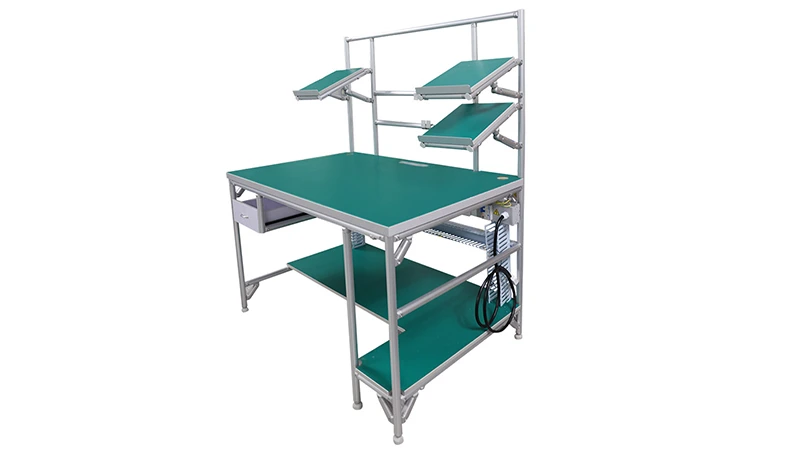
In the fast-paced world of consumer electronics manufacturing, where precision, speed, and adaptability are non-negotiable, the tools and equipment that form the backbone of production lines play a critical role. Among these, workbenches are more than just surfaces—they are the command centers where technicians assemble delicate components, test intricate circuits, and ensure that every device meets the strict quality standards of today's market. Enter Aluminum Workbench B: a modular, durable, and highly functional solution designed to address the unique challenges of modern electronics production. From its lightweight yet robust aluminum profile construction to its seamless integration with ESD workstations, flow racks, and conveyors, this workbench has become a cornerstone of lean system implementations in factories worldwide. In this article, we'll explore real-world use cases that demonstrate how Aluminum Workbench B is transforming production floors, enhancing efficiency, and future-proofing operations for consumer electronics manufacturers.
The Consumer Electronics Production Challenge: Why Traditional Workbenches Fall Short
Consumer electronics—smartphones, laptops, tablets, wearables, and smart home devices—are defined by their miniaturization, complexity, and rapid product lifecycles. A single smartphone, for example, contains over 300 individual components, many of which are sensitive to static electricity, physical damage, or misalignment. To assemble these devices efficiently, production lines must balance three key demands: precision (to avoid costly defects), flexibility (to adapt to frequent product redesigns), and safety (to protect both workers and components).
Traditional workbenches, often made of wood, steel, or generic plastic, struggle to meet these demands. Wooden workbenches, while cheap, are prone to splintering, absorb moisture, and offer no protection against electrostatic discharge (ESD)—a silent killer of microchips and circuit boards. Steel workbenches, though durable, are heavy and inflexible; reconfiguring them for a new product line can take hours, if not days, and their weight makes them difficult to move, limiting floor layout optimization. Even basic metal workbenches lack the modularity needed to integrate with other production tools like flow racks (for material storage) or conveyors (for component transport), creating bottlenecks where technicians waste time retrieving parts or manually moving assemblies.
For manufacturers, these limitations translate to tangible costs: higher defect rates due to ESD damage, longer changeover times between product runs, and reduced floor space efficiency. In an industry where profit margins are tight and competition is fierce, these inefficiencies can mean the difference between leading the market and falling behind.
Aluminum Workbench B: A Purpose-Built Solution for Modern Production
Aluminum Workbench B was engineered to solve these pain points. At its core is a frame constructed from high-grade aluminum profile—lightweight, corrosion-resistant, and inherently ESD-safe when treated with anti-static coatings. Unlike traditional materials, aluminum profile allows for modular assembly using aluminum profile accessories (such as brackets, joints, and connectors), enabling technicians to reconfigure the workbench in minutes, not days. Whether adding a shelf for tools, integrating a built-in ESD mat, or mounting a small conveyor for component delivery, the workbench adapts to the task at hand.
Key features of Aluminum Workbench B include:
- ESD Protection: The aluminum frame, combined with optional ESD-safe work surfaces and grounding kits, ensures that static electricity is safely dissipated, protecting sensitive components like microprocessors and sensors.
- Modularity: Aluminum profile accessories (e.g., T-slot connectors, adjustable shelves, and tool holders) allow for quick customization. Need to add a bin for screws? Snap on a bracket. Want to raise the work surface by 10cm? Swap out the legs—no welding or drilling required.
- Lightweight Durability: Aluminum is 60% lighter than steel but offers comparable strength, making the workbench easy to move (with optional casters) while supporting heavy loads (up to 500kg for the single-deck, without caster model).
- Seamless Integration: Designed to work with other lean system components, Aluminum Workbench B connects effortlessly to flow racks (for vertical material storage), conveyors (for automated component transport), and ESD workstations (for specialized testing or assembly steps).
- Low Maintenance: Aluminum resists rust, scratches, and chemical damage from cleaning agents, ensuring the workbench remains functional and visually consistent even after years of heavy use.
These features make Aluminum Workbench B more than just a work surface—it's a hub that connects people, tools, and materials into a cohesive, efficient system. Let's dive into real-world scenarios where this integration has delivered measurable results.

Use Case 1: Smartphone Assembly with ESD Workstation Integration
The Challenge: Static Damage and Component Loss in High-Volume Production
A leading global smartphone manufacturer operates a production line in Southeast Asia, churning out over 5,000 devices per shift. The line's most critical stage is the "motherboard assembly," where technicians mount tiny chips (as small as 0.5mm x 0.5mm) onto circuit boards using precision tools. Prior to adopting Aluminum Workbench B, the line used steel workbenches with generic plastic surfaces. Despite strict ESD training, the manufacturer was losing approximately 2% of motherboards to static damage—equating to 100 defective units per shift, or $50,000 in wasted components monthly. Additionally, technicians spent 15 minutes per shift searching for misplaced tools (tweezers, screwdrivers, anti-static wristbands), as the workbenches lacked dedicated storage.
The Solution: Aluminum Workbench B as an ESD Workstation Hub
The manufacturer replaced 20 steel workbenches with Aluminum Workbench B units, configured as ESD workstations. Each workbench was equipped with:
- An ESD-safe aluminum honeycomb work surface, grounded to the factory's ESD system via built-in conductive strips.
- Modular tool holders (attached via aluminum profile accessories) for tweezers, screwdrivers, and anti-static wristbands, ensuring tools were always within arm's reach.
- Under-shelf flow racks (3-row, 3-floor design) mounted to the workbench's side rails, holding component bins labeled by part number for quick access.
- Swivel roller balls (1-inch, stainless steel) embedded in the workbench's edge, allowing technicians to slide partially assembled motherboards onto a adjacent conveyor belt without lifting, reducing physical strain.
The Results: 90% Reduction in ESD Defects and 12% Faster Assembly
Within the first month, the impact was clear. Static damage dropped from 2% to 0.2%—a 90% reduction—saving the manufacturer $45,000 monthly in component costs. Tool storage integration cut search time to less than 2 minutes per shift, freeing up 13 minutes per technician daily. With 20 technicians per shift, this translated to 260 extra minutes of productive work per shift, increasing motherboard assembly output by 12% (600 more units per shift). The swivel roller balls also reduced ergonomic injuries, with reported wrist strain cases falling by 40% in the first quarter.

Use Case 2: Laptop Production Line Integration with Flow Racks and Conveyors
The Challenge: Bottlenecks in Material Handling and Line Flexibility
A mid-sized laptop manufacturer in Eastern Europe faced a different set of challenges: its production line for 15-inch laptops was struggling to keep up with demand due to bottlenecks in material flow. The line used a mix of wooden workbenches and standalone steel racks, with technicians manually carrying laptop casings, screens, and batteries from storage areas to assembly stations. This created two issues: first, long wait times when a technician's bin of casings ran empty, and second, difficulty reconfiguring the line to produce a new 14-inch model, which required rearranging workbenches and racks—a process that took 8 hours and forced the line to shut down for a full shift.
The Solution: Aluminum Workbench B with Flow Rack and Conveyor Connectivity
The manufacturer redesigned the line around Aluminum Workbench B, integrating it with flow racks and conveyors to create a continuous material flow system. Here's how it worked:
- Workbench Layout: 10 Aluminum Workbench B units were placed in a U-shape, with each station dedicated to a specific task (casing preparation, motherboard mounting, screen attachment, testing).
- Flow Rack Integration: Material rack B (3-row, 3-floor) units were mounted to the back of each workbench, stocked with components by a dedicated material handler. Bins slid forward via gravity, ensuring technicians always had access to the next part.
- Conveyor Connection: A 40 steel roller track (yellow wheel) was mounted along the front edge of each workbench, connected via roller track placon mount connectors to a main conveyor belt. Partially assembled laptops moved automatically from one station to the next, eliminating manual carrying.
- Quick-Change Design: The workbenches' aluminum profile frames allowed for tool-less adjustment of height (via adjustable leveling feet) and width (by adding/removing aluminum guide rails), enabling the team to reconfigure the line for the 14-inch model in just 90 minutes—down from 8 hours.
The Results: 25% Faster Line Speed and Zero Shutdowns for Changeovers
The new setup transformed the line's performance. Material wait times dropped from 12 minutes per technician per shift to less than 2 minutes, as flow racks ensured a steady supply of components. The conveyor system eliminated 2 hours of manual carrying per shift, allowing technicians to focus on assembly. Most notably, the line's changeover time for the 14-inch model was reduced to 90 minutes, which the manufacturer scheduled during a lunch break—no more full-shift shutdowns. Overall, line speed increased by 25%, enabling the factory to meet demand without adding extra shifts.
Use Case 3: Lean System Implementation in a Tablet Factory
The Challenge: Waste Reduction and Space Optimization in a Crowded Facility
A tablet manufacturer in Mexico aimed to implement lean manufacturing principles to reduce waste and free up floor space. Lean systems focus on eliminating "muda" (waste) in seven categories: overproduction, waiting, transport, processing, inventory, motion, and defects. The factory's existing layout, however, was a maze of standalone workbenches, bulky steel racks, and manual material carts, making it difficult to implement key lean practices like 5S (sort, set in order, shine, standardize, sustain) or kanban (just-in-time inventory). For example, excess inventory was stored in random locations, leading to overstocking; technicians walked an average of 2 miles per shift retrieving parts; and workbenches were cluttered with unused tools, causing "processing waste" (time spent searching for needed items).
The Solution: Aluminum Workbench B as the Foundation of a Lean System
The manufacturer chose Aluminum Workbench B as the centerpiece of its lean transformation, leveraging the workbench's modularity and integration capabilities to address all seven waste categories:
- Inventory Waste: Flow racks mounted to the workbenches were paired with kanban cards, triggering material restocks only when bins reached a "reorder point." This reduced on-hand inventory by 30%.
- Motion Waste: Each workbench was customized with aluminum pipe accessories (tool hooks, bin holders, cable management clips) to keep tools and components within a 12-inch "golden zone" (the area a technician can reach without leaning or stretching), cutting walking time by 60%.
- Transport Waste: Aluminum Workbench B units were mounted on casters (360° swivel expanding stem casters with brakes), allowing the team to rearrange the line into a U-shape (minimizing travel distance between stations) and move workbenches to clean or maintain the floor without heavy equipment.
- Defects: ESD-safe surfaces and integrated testing fixtures (mounted via aluminum profile brackets) reduced defect rates from 3% to 0.5%.
- Processing Waste: Standardized tool layouts across all workbenches (via color-coded aluminum profile accessories) ensured consistency, so technicians didn't waste time adapting to different setups.
The Results: 40% Less Floor Space Used and 18% Higher Productivity
After six months, the lean transformation yielded impressive results: the factory reduced floor space usage by 40% by eliminating redundant storage and optimizing the workbench layout, allowing it to add a second production line without expanding the facility. Productivity increased by 18% as motion and transport waste were minimized, and employee satisfaction scores rose by 22% (due to reduced physical strain and cleaner workspaces). Most importantly, the manufacturer's on-time delivery rate improved from 85% to 98%, as lean practices reduced bottlenecks and delays.
Aluminum Workbench B vs. Traditional Workbenches: A Comparative Analysis
| Feature | Traditional Steel Workbench | Aluminum Workbench B | Key Advantage |
|---|---|---|---|
| Material | Carbon steel | High-grade aluminum profile | Aluminum is 60% lighter, corrosion-resistant, and ESD-compatible. |
| ESD Protection | None (unless coated, which adds cost) | Built-in via grounded aluminum surface and conductive strips | Eliminates static damage to sensitive components. |
| Modularity | Fixed design; requires welding/drilling to modify | Tool-less customization via aluminum profile accessories | Reconfigure in minutes for new products or layouts. |
| Integration | Limited (cannot connect to flow racks/conveyors without adapters) | Seamless connection to flow racks, conveyors, and ESD systems | Reduces bottlenecks and manual material handling. |
| Durability | Prone to rust; heavy use causes dents | Scratch-resistant, corrosion-proof, and impact-absorbent | Lasts 2–3x longer than steel in high-moisture environments. |
| Cost (5-Year TCO) | Lower upfront cost, but higher maintenance and replacement costs | Higher upfront cost, but 30% lower TCO due to durability and efficiency gains | More cost-effective over time for high-volume production. |
Why Aluminum Workbench B is the Future of Electronics Manufacturing
The use cases above highlight a clear trend: in consumer electronics production, where change is constant and efficiency is king, Aluminum Workbench B is more than a tool—it's a strategic investment. Its ability to adapt to new products, integrate with lean systems, and protect sensitive components makes it a future-proof solution for manufacturers looking to stay ahead. As electronics continue to shrink in size and grow in complexity, and as factories embrace automation and Industry 4.0, the demand for modular, connected workbenches will only increase. Aluminum Workbench B, with its aluminum profile foundation and endless customization options, is built to meet that demand.
For manufacturers still relying on traditional workbenches, the message is clear: the cost of inaction is higher than the investment in change. Whether it's reducing ESD defects, cutting changeover times, or implementing lean principles, Aluminum Workbench B delivers measurable returns that go straight to the bottom line. In the end, it's not just about a workbench—it's about building a production line that can keep up with the future.