- Company Articles
- Products and Technology
- Application Cases
- Aluminum Workbench B in Small-Batch Production: Adapting to Dynamic Manufacturing Needs

Aluminum Workbench B in Small-Batch Production: Adapting to Dynamic Manufacturing Needs
Related Product
Aluminum Workbench B
Aluminum tube workbench is more flexible and durable, compared with traditional PE/ABS coated steel tube. It is easy to assemble, anti corrosion, rust protection, and recycle use after disassemble.
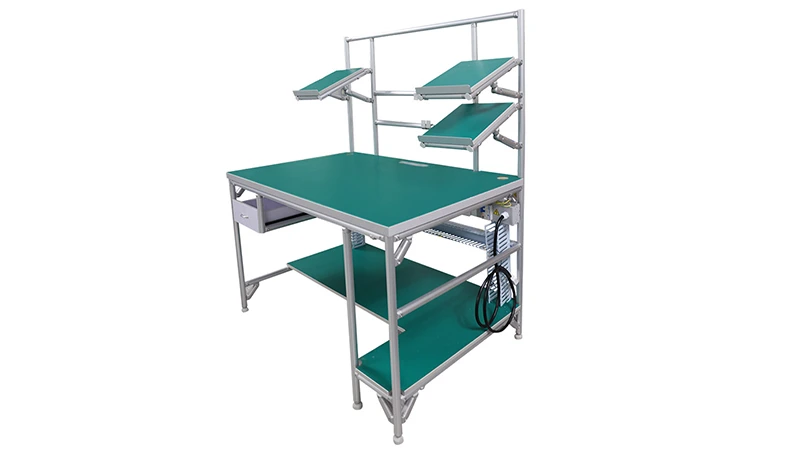
Small-batch production has always been the heartbeat of innovation in manufacturing. Whether you're a startup crafting custom electronics, a workshop building artisanal furniture, or a factory testing new product lines, the ability to pivot quickly, adjust workflows, and maintain efficiency amid constant change is what separates success from struggle. But here's the catch: traditional manufacturing setups—with their heavy, fixed workstations and rigid processes—were never designed for this kind of dynamism. They slow you down, limit your creativity, and turn what should be a nimble operation into a logistical headache. That's where Aluminum Workbench B steps in. More than just a table with a surface, it's a silent partner in adaptability, a tool that bends to your needs instead of forcing you to bend to its limitations. Let's dive into how this unassuming piece of equipment is redefining what's possible in small-batch manufacturing.
The Unique Challenges of Small-Batch Production
To understand why Aluminum Workbench B matters, we first need to talk about what makes small-batch production so… tricky. Unlike mass production, where you're churning out the same product day in and day out, small-batch work is all about variety. One week, you might be assembling 50 units of a compact sensor; the next, shifting to 30 larger, more complex controllers. Each product has different tool needs, different material requirements, and different workflow demands. And if your workspace can't keep up? You're looking at wasted time, frustrated employees, and missed deadlines.
Take Maria, for example. She runs a small electronics assembly shop that specializes in custom circuit boards for startups. A few months ago, she landed a client who needed three different board designs—each with unique component layouts—produced in batches of 20. Her team was using old steel workbenches bolted to the floor. To switch from one design to the next, they had to unbolt tools, rearrange storage bins, and even bring in extra tables to spread out components. What should have taken an hour of setup ballooned into three hours of chaos. "We were spending more time moving stuff around than actually building," Maria told me. "By the end of the week, everyone was exhausted, and we barely hit the deadline."
Maria's story isn't unique. Small-batch manufacturers across industries share three core pain points: rigidity, inefficiency, and scalability. Rigidity in workstations that can't be reconfigured without a wrench (or a miracle). Inefficiency in wasted motion—employees walking back and forth to grab tools or materials because the workspace isn't organized for the current task. Scalability, or the lack thereof—when a sudden rush of orders hits, you can't just "add more space" because your workbenches are fixed in place. These aren't just minor annoyances; they eat into your bottom line and limit your ability to grow.
Aluminum Workbench B: More Than Just a Workbench
So, what makes Aluminum Workbench B different? Let's start with the basics: materials. This workbench is built around aluminum profile—a lightweight, durable material that's become a favorite in modern manufacturing for good reason. Unlike steel, which is heavy and prone to rust, or wood, which warps and splinters over time, aluminum is strong enough to support heavy tools (we're talking drills, soldering stations, even small 3D printers) but light enough that two people can move it across the shop without breaking a sweat. And because it's anodized, it resists scratches and corrosion, so it'll still look sharp after years of use.
But the real magic is in the design. Aluminum Workbench B isn't a single, solid piece; it's a modular system. Think of it like building with high-strength, industrial Legos. The frame is made of aluminum profile tubes connected by simple, hand-tightened joints. Add a tabletop (which comes in options like anti-static ESD laminate for electronics work or solid wood for heavier tasks), and you're good to go. Need a shelf for tools? Snap on an aluminum profile bracket. Want to add a light bar? There's a slot for that. Need to move it to the other side of the shop? Pop on a set of casters (sold separately, but designed to fit perfectly with the workbench's frame).
Let's talk specs—without getting too technical. The standard Workbench B (single deck, without casters, as it's often listed) measures around 120cm long, 60cm deep, and 80cm high—ergonomic for most standing or seated work. The tabletop is 18mm thick, so it won't sag under weight, and the aluminum profile frame can support up to 200kg (that's 440 pounds!) of evenly distributed load. But numbers only tell part of the story. What really matters is how this translates to day-to-day use. For Maria's team, swapping between circuit board designs went from a three-hour ordeal to a 20-minute task. They simply removed the shelf brackets, repositioned the tool hooks, and rolled the workbench to a new spot near the component storage area. No bolts, no power tools, no stress.
Aligning with Lean System Principles: Less Waste, More Value
If you've spent any time in manufacturing, you've probably heard of "lean system" principles—the idea of cutting waste, streamlining processes, and focusing on what adds value for the customer. Aluminum Workbench B isn't just a tool; it's a lean system in action. Let's break down how:
First, waste reduction. In lean terms, "waste" includes everything from excess motion (employees walking to grab tools) to waiting (idle time while a workstation is reconfigured). Workbench B attacks both. Its modular design means tools and materials stay within arm's reach—no more trekking across the shop. And when you need to reconfigure, you're not waiting for maintenance to unbolt a steel bench; your team can do it themselves in minutes.
Then there's continuous improvement, a core lean principle. With traditional workbenches, you're stuck with whatever setup you chose on day one. If you realize a better way to arrange tools six months later, too bad—changing it would mean buying a whole new bench. Aluminum Workbench B grows with you. Add a second shelf as your tool collection expands. Lower the height if a new employee finds standing work uncomfortable. Swap out the tabletop for an ESD (electrostatic discharge) version if you start handling sensitive electronics. It's not just a workstation; it's a canvas for refining your process.
Integration with other lean tools is another win. Pair Workbench B with a flow rack (like Material Rack B, a 3-row, 3-floor design) and suddenly materials flow directly to the workbench, reducing "waiting" waste. Add a short conveyor section (roller track, maybe with plastic guide rails) to move partially assembled products to the next station, and you've created a mini production line that's just as flexible as your batches. Maria's shop did exactly this: they placed a flow rack next to Workbench B, stocked with the components for the current batch, and used a small roller track to send finished boards to a testing station. The result? A 30% reduction in time spent fetching parts and a 15% boost in daily output.
The Star Material: Why Aluminum Profile Makes All the Difference
We've mentioned aluminum profile a few times, but let's zoom in on why this material is the unsung hero of Workbench B's adaptability. Aluminum has a unique combination of strength and lightness—about a third the weight of steel, but just as strong when properly engineered. That means the workbench is easy to move (even without casters) but won't wobble or flex when you're using heavy tools.
But it's not just about weight. Aluminum profile, especially the T-slot variety used in Workbench B, is designed for modularity. The slots running along the length of the profile act as built-in attachment points for brackets, shelves, and accessories. No drilling or welding required—just slide a bolt into the slot, tighten a nut, and you're done. This compatibility with aluminum profile accessories (think joint connectors, pipe clamps, and board holders) means you can customize the workbench to fit almost any task.
Durability is another plus. Aluminum naturally resists corrosion, so even in shops with humidity or occasional spills, Workbench B won't rust or degrade. Compare that to steel, which needs regular painting or coating, or wood, which can warp or rot. And if a part does get damaged? replace just the profile section or joint, not the entire bench. It's sustainable, cost-effective, and future-proof.
John, a manufacturing consultant I spoke to, put it this way: "Aluminum profile changed the game for small-batch shops. Before, you'd spend thousands on custom workstations that became obsolete the second your product line changed. Now, with something like Workbench B, you're investing in a system that adapts as you do. It's like buying a Swiss Army knife instead of a single screwdriver."
Aluminum Workbench B vs. Traditional Workstations: A Head-to-Head Comparison
Still not convinced? Let's put Workbench B side by side with two common alternatives: traditional steel workbenches and wooden worktables. The table below breaks down key factors small-batch manufacturers care about:
| Feature | Aluminum Workbench B | Traditional Steel Workbench | Wooden Worktable |
|---|---|---|---|
| Reconfiguration Time | 20–30 minutes (no tools needed) | 2–4 hours (requires wrenches,) | Not reconfigurable (fixed design) |
| Weight (empty) | ~45kg (easy for 2 people to move) | ~120kg (requires machinery to relocate) | ~60kg (heavy, but prone to damage if moved) |
| Durability | 10+ years (corrosion-resistant, scratch-proof) | 5–7 years (prone to rust without regular maintenance) | 3–5 years (warps, splinters, stains easily) |
| Customization Options | Unlimited (compatible with aluminum profile accessories) | Limited (fixed shelves, pre-drilled holes) | None (fixed surface, no built-in attachment points) |
| Cost Over Time | Lower (no need to replace; upgrade parts as needed) | Higher (may need replacement if production needs change) | Highest (frequent replacement due to wear and tear) |
The table says it all: Aluminum Workbench B isn't just better in one area—it's better across the board for small-batch needs. It's an investment that pays off in saved time, reduced frustration, and the freedom to take on new, more complex projects without worrying if your workspace can handle it.
Real-World Impact: From Struggle to Success
Let's circle back to Maria. After switching to Aluminum Workbench B, her shop's productivity jumped by 25% in the first month. But the biggest change? Morale. "Before, setup days were miserable," she told me. "Everyone would grumble, and mistakes happened because we were rushing to get the benches ready. Now, switching between jobs is almost… easy. The team actually jokes about how quickly we can 'redecorate' the shop. And when people are happy, they work better. We've had zero errors in the last two months—something I never thought possible with such varied work."
Another example: Tom, who runs a small furniture workshop making custom wooden chairs and tables. He used to build workbenches himself out of plywood and 2x4s. They worked, but they were heavy, and if a chair design required a different clamping setup, he'd have to build a whole new bench. Now, with Workbench B, he uses aluminum profile brackets to mount custom clamps, and he can adjust the height of the tabletop to match the ergonomics of each project (taller for chairs, shorter for tables). "I used to spend weekends building workbenches instead of building furniture," Tom laughed. "Now, I'm actually making money on those weekends."
Future-Proofing Your Shop: Scalability and Beyond
Small-batch manufacturers don't just need to adapt to today's needs—they need to prepare for tomorrow's growth. What happens when that batch of 50 units becomes 100? When you add a second shift? When you expand into a new product category? Aluminum Workbench B scales with you. Start with one bench; add a second (or third) as your team grows. Connect them with roller track to create a continuous workflow. Mount overhead shelves using aluminum profile accessories to maximize vertical space. The system is designed to grow with your business, not hold it back.
And let's talk sustainability—a topic that's becoming more important for customers and manufacturers alike. Aluminum is 100% recyclable, and because Workbench B is modular, you're not throwing away entire workstations when you upgrade—just swapping out parts. Compare that to wooden workbenches, which end up in landfills, or steel ones, which require energy-intensive recycling processes. It's a small choice that adds up to a big impact over time.
Conclusion: The Workbench That Grows With You
Small-batch production is never going to be "easy"—but it doesn't have to be hard. Aluminum Workbench B is more than just a piece of equipment; it's a mindset shift. It's about recognizing that your workspace should serve you, not the other way around. It's about embracing flexibility, celebrating adaptability, and focusing on what really matters: creating great products, serving your customers, and growing your business.
Whether you're just starting out or looking to upgrade an existing shop, this workbench is an investment in your future. It's the difference between dreading the next product change and excited to tackle it. Between missing deadlines and exceeding them. Between a shop that struggles to keep up and one that leads the pack.
So, to all the Marias and Toms out there—those building, creating, and innovating in the world of small-batch manufacturing—here's to workspaces that keep up with your ambition. Here's to Aluminum Workbench B.