- Company Articles
- Products and Technology
- Product knowledge
- Aluminum Workbench B Modular Add-Ons: Enhancing Functionality in Dynamic Workshops

Aluminum Workbench B Modular Add-Ons: Enhancing Functionality in Dynamic Workshops
Related Product
Aluminum Workbench B
Aluminum tube workbench is more flexible and durable, compared with traditional PE/ABS coated steel tube. It is easy to assemble, anti corrosion, rust protection, and recycle use after disassemble.
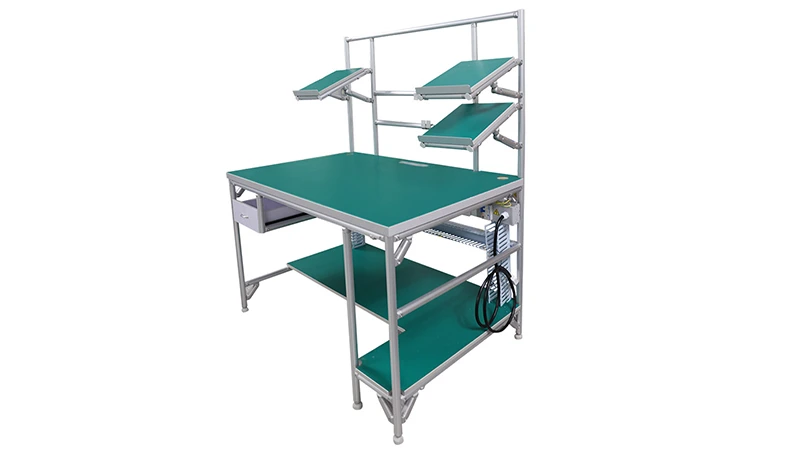
In the heart of every productive workshop lies a simple truth: adaptability isn't just a luxury—it's the backbone of efficiency. Walk into any manufacturing floor, assembly line, or repair shop, and you'll quickly spot the difference between spaces that thrive and those that struggle. The thriving ones? They move with the rhythm of the workday, adjusting to new tasks, shifting priorities, and evolving team needs. The others? They're stuck in place, weighed down by rigid setups that can't keep up. For managers and workers alike, this rigidity translates to wasted time, strained muscles, and missed deadlines. Enter the Aluminum Workbench B—a basic workstation that transforms into a customizable productivity hub, all thanks to its modular add-ons. These small but mighty components turn a static bench into a tool that grows with your team, solving problems before they arise and turning chaos into clarity.
The Foundation: What Makes Aluminum Workbench B Different?
Before diving into the add-ons, let's start with the base. The Aluminum Workbench B is more than just a flat surface on legs. Crafted from high-grade aluminum, it's built to withstand the daily grind of industrial environments—think heavy toolboxes, constant foot traffic, and the occasional bump from a forklift. Its single-deck design (similar to the "workbench e (single deck-without caster)" but tailored for modularity) provides a stable, spacious workspace, while its lightweight aluminum frame keeps it easy to handle during initial setup. But what truly sets it apart is its intentional simplicity. Unlike fixed workbenches with built-in features that can't be changed, the Aluminum Workbench B starts as a blank canvas. It's designed to be modified, upgraded, and reconfigured—all through the power of modular add-ons.
Why aluminum, you might ask? For starters, it's tough. Aluminum resists rust and corrosion, making it ideal for workshops where spills, humidity, or chemicals are part of the daily routine. It's also lightweight enough to support add-ons without becoming cumbersome, and its smooth surface is easy to clean—no more scrubbing out stains from wood grain or dealing with chipped paint. But the real magic? Aluminum's compatibility with a wide range of accessories, from caster wheels to roller tracks, which clip, bolt, or snap into place without requiring specialized tools or permanent modifications. This flexibility means the workbench you buy today isn't the same one you'll use five years from now. It grows with your business, one add-on at a time.
Modular Add-Ons: The Building Blocks of Adaptability
Imagine a workbench that can switch from a stationary assembly station in the morning to a mobile material cart by afternoon. Or one that transforms from a solo workstation into a collaborative space for three team members in minutes. That's the power of modular add-ons. Let's break down the most impactful ones, how they work, and why they matter.
1. Caster Wheels: Mobility Without Compromise
First on the list: caster wheels. At first glance, adding wheels to a workbench might seem like a small change, but anyone who's ever had to drag a heavy bench across the shop floor knows better. The right caster wheels turn the Aluminum Workbench B into a movable workstation, eliminating the need for back-breaking relocations or permanently assigning benches to specific tasks. But not all casters are created equal. The "caster wheel" and "caster accessories" designed for this workbench are built with precision: swivel stems with brakes let you lock the bench in place when stability is key (like when using power tools), while durable rubber wheels glide smoothly over concrete, tile, or even slightly uneven floors without leaving scuff marks. For workshops that rearrange layouts weekly—say, switching between small-batch production and large-scale assembly—this add-on alone can save hours of downtime.
Consider Maria, a production supervisor at a small electronics plant. "Before we added casters to our Aluminum Workbench Bs, moving a bench to the soldering station meant rounding up three people and grunting through it," she recalls. "Now, one person can unlock the brakes, roll it over, and lock it down in 30 seconds. We used to lose 15 minutes per shift just rearranging workstations; now that time goes to actual assembly. It's a game-changer."
2. Roller Track: Let Gravity Do the Work
Next up: roller track. If you've ever watched parts pile up on a workbench because no one wants to bend down to grab the next component, you know the struggle. Roller track add-ons solve this by turning the edge of the Aluminum Workbench B into a conveyor belt for materials. Whether it's "plastic roller track guide rail yellow" for visual cues (think: incoming vs. outgoing parts) or "aluminum guide rail a" for heavier loads, these tracks let gravity move items smoothly from point A to point B—no lifting, no straining, no wasted steps.
Take the "roller track placon mount for aluminum profile flat," a small bracket that attaches the track directly to the workbench's aluminum frame. It's unobtrusive but essential, ensuring the track stays secure even when loaded with metal parts or heavy bins. For assembly lines, this means components flow right to the worker's hands; for packaging stations, finished products glide gently into waiting boxes. At a furniture manufacturing plant in Ohio, workers reported a 20% reduction in back pain complaints after installing roller tracks on their Aluminum Workbench Bs—proof that small changes lead to big improvements in ergonomics.
3. Swivel Roller Balls: Spin, Slide, Simplify
Ever tried rotating a large circuit board, a metal panel, or a bulky toolbox on a flat workbench? It's a recipe for strained wrists and scratched surfaces. Enter "swivel roller balls 1 inch"—small, smooth spheres that embed into the workbench surface, turning it into a friction-free zone. These tiny add-ons let workers spin, slide, and reposition heavy or awkward items with a single hand, reducing the risk of injury and making precision work easier. For example, a technician assembling a large machinery part can rotate it 360 degrees without lifting, ensuring every bolt and connector is within reach. Even smaller tasks, like sorting screws or aligning components, become faster when you can glide materials across the bench instead of dragging them.
Jake, a mechanic at an auto repair shop, swears by them: "We used to have to hoist engine parts onto the bench and then wrestle them into place. Now, with the 1-inch swivel balls, I can spin a transmission case like it's a dinner plate. It's not just faster—it's safer. Last month, I avoided a sprain when a heavy bracket slipped; instead of catching it with my back, it just slid gently across the balls."
4. Aluminum Profile Accessories: Organize Every Inch
A cluttered workbench is a productivity killer. Tools get lost, cords tangle, and small parts disappear into cracks. Aluminum profile accessories—like "aluminum profile end caps," "aluminum guide rail b," and "t-slot rubber seal cover"—turn empty space into organized storage. These accessories attach to the workbench's aluminum frame, adding shelves, tool hooks, and cable management solutions without drilling holes or damaging the bench. For example, "aluminum guide rail b" can be mounted vertically above the workbench, holding magnetic tool holders that keep wrenches, screwdrivers, and pliers within arm's reach. "T-slot rubber seal cover" snaps into the frame's grooves, hiding loose cables and preventing small screws from rolling off the edge. Even the "aluminum profile end caps" play a role, covering sharp corners to protect hands and preventing dust buildup in hard-to-reach crevices.
At a medical device assembly plant, where precision is non-negotiable, workers use these accessories to create "stations within stations." Each Aluminum Workbench B has a vertical rail with labeled tool hooks, a shelf for component bins, and a cable management slot for power tools—all added via aluminum profile accessories. "Everything has a place now," says Lisa, a quality control inspector. "Before, we'd spend 10 minutes hunting for a specific screwdriver. Now, it's hanging right where I need it. The bench isn't just a workspace—it's an extension of our process."

Choosing the Right Add-Ons: A Quick Guide
With so many options, how do you pick the add-ons that fit your workshop? Start by asking: What slows us down? Where do we waste time or energy? The table below breaks down common pain points and the add-ons that solve them:
| Workshop Pain Point | Modular Add-On | How It Helps |
|---|---|---|
| Workstations need to move between areas | Caster wheel with brake | Enables one-person relocation; locks in place for stability during use |
| Workers strain to lift heavy materials | Swivel roller balls 1 inch | Reduces friction for easy sliding/rotation of bulky items |
| Tools and parts are disorganized | Aluminum guide rail a + tool hooks | Vertical storage keeps essentials visible and accessible |
| Materials pile up at the bench edge | Plastic roller track guide rail yellow | Creates a dedicated path for incoming/outgoing items |
| Sharp edges on the workbench frame | Aluminum profile end cap | Covers rough corners to prevent cuts and scrapes |

Real-World Impact: When Add-Ons Transform Workshops
It's one thing to talk about add-ons in theory, but their true value shines in real workshops. Take Precision Parts Co., a mid-sized manufacturer of aerospace components. A year ago, their assembly line relied on wooden workbenches bolted to the floor. When they landed a contract for a new, larger part, they faced a problem: the existing benches were too low, too small, and impossible to reposition. The solution? They replaced 12 wooden benches with Aluminum Workbench Bs and outfitted each with caster wheels, roller tracks, and swivel roller balls. The results were immediate.
"We used to spend two hours every morning just moving materials to each bench," says Mike, the plant manager. "With roller tracks, parts now roll directly to the workers. The casters let us reconfigure the line in 30 minutes instead of a full day. And the swivel balls? Our defect rate dropped by 15% because workers can position parts perfectly. We didn't just buy workbenches—we bought a more efficient way to work."
Or consider a small auto repair shop in Texas that added aluminum profile accessories to their Aluminum Workbench B. By mounting a vertical rail with tool hooks and a shelf for oil cans, they freed up 40% of the bench surface. "We used to have tools scattered everywhere," says the owner, Carlos. "Now, everything's up off the bench, and we can actually see what we're working on. It's cleaner, faster, and my guys aren't tripping over toolboxes anymore."
Why Modularity Matters: Beyond the Workbench
At first glance, modular add-ons might seem like "nice-to-haves"—small upgrades that improve convenience but not bottom lines. But any workshop manager will tell you: convenience in the workplace translates to dollars saved. When workers spend less time searching for tools, moving materials, or adjusting their position, they spend more time doing the work that drives revenue. Modular add-ons also future-proof your investment. A fixed workbench becomes obsolete the moment your needs change. An Aluminum Workbench B with add-ons? It adapts. Need to add a new tool? Clip on an aluminum profile bracket. Expand production? Add more roller track to handle increased material flow. Hire a taller worker? Adjust the height with leg extensions (another modular add-on). In a world where business needs shift overnight, this adaptability isn't just smart—it's essential.
And let's not forget the human element. Workshops are filled with people—people who get tired, get frustrated, and deserve tools that make their jobs easier. Modular add-ons reduce physical strain, cut down on frustration, and turn tedious tasks into manageable ones. When workers feel supported by their tools, morale rises, and turnover drops. As one technician put it: "I used to dread coming into work because the bench felt like it was working against me. Now? It feels like a partner. And when you're working with a partner, you get more done—and you enjoy doing it."
The Bottom Line: Small Add-Ons, Big Results
In the end, the Aluminum Workbench B isn't just a workstation. It's a philosophy: that workspaces should adapt to people, not the other way around. Its modular add-ons—caster wheels that move with your rhythm, roller tracks that keep materials flowing, swivel balls that reduce strain, and aluminum profile accessories that organize chaos—turn this philosophy into reality. They're the unsung heroes of the workshop, solving problems you didn't know you had and turning a basic bench into a tool that grows, evolves, and succeeds alongside your team. So the next time you walk into your workshop, take a look at your workbenches. Are they holding you back, or are they helping you move forward? With the right modular add-ons, the answer can be the difference between just getting by and thriving.