- Company Articles
- Products and Technology
- Product knowledge
- Aluminum Workbench B: Recyclable, Reusable, and Reducing Industrial Waste

Aluminum Workbench B: Recyclable, Reusable, and Reducing Industrial Waste
Related Product
Aluminum Workbench B
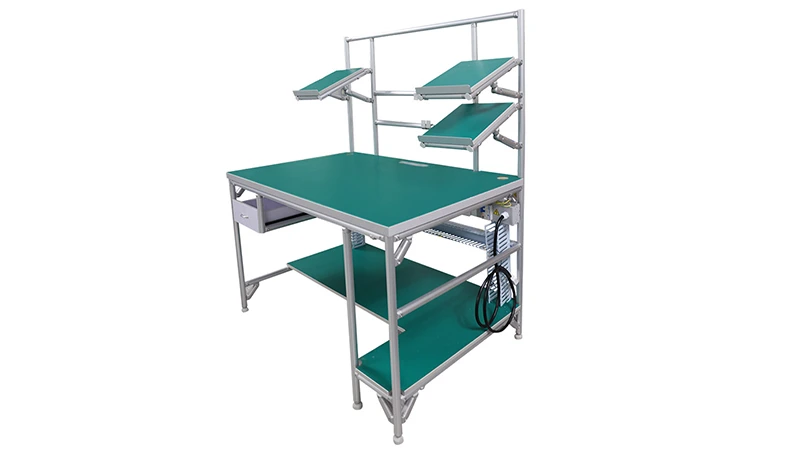
Aluminum tube workbench is more flexible and durable, compared with traditional PE/ABS coated steel tube. It is easy to assemble, anti corrosion, rust protection, and recycle use after disassemble.
Walk into any manufacturing plant, warehouse, or assembly line, and you'll likely find a common thread: workbenches. They're the unsung heroes of production—where components are assembled, tools are organized, and ideas take tangible form. But here's a less talked-about reality: traditional workbenches, often made of wood, steel, or plastic, have a hidden cost. When they break, become obsolete, or no longer fit a company's evolving needs, they're often discarded, ending up in landfills and contributing to the growing crisis of industrial waste. In 2023 alone, the U.S. manufacturing sector generated over 11 million tons of non-hazardous waste from equipment and furniture, according to the EPA. That's where Aluminum Workbench B comes in—not just as a tool for productivity, but as a quiet revolution in sustainability. Let's dive into how this unassuming piece of equipment is redefining what it means to build for both efficiency and the planet.
The Problem with "Throwaway" Workbenches
For decades, the industrial world has operated on a "use-and-replace" model. A workbench is purchased, used until it cracks, rusts, or no longer suits the workflow, then hauled away to make room for a new one. Let's take wood first: sturdy, yes, but prone to warping, splintering, and water damage. Once it's worn, it's often too degraded to repair, so it's chopped up or dumped. Steel workbenches, while durable, face their own issues. Welding or bolted joints can corrode over time, and if a leg bends or a surface dents, fixing it often costs more than replacing the entire unit. Plastic? Lightweight but flimsy, especially under heavy loads, and it rarely recycles well—most plastic workbenches end up in landfills, where they take centuries to decompose.
The result? A cycle of waste that hits businesses twice: first in the cost of constant replacements, and second in the environmental guilt (and increasingly, regulatory pressure) of contributing to landfill overflow. For small to mid-sized manufacturers already operating on tight margins, this cycle isn't just unsustainable—it's unaffordable. "We used to replace our steel workbenches every 3–4 years," says Raj Patel, operations manager at a electronics assembly plant in Ohio. "Each one cost $800, and when they rusted out, we'd pay another $150 to haul them away. Over five years, that's $950 per bench—money we could've invested in better tools or employee training."
Then there's the issue of rigidity. Production lines evolve: new products require new layouts, team sizes fluctuate, and lean manufacturing principles demand flexibility. A fixed wooden or steel workbench can't adapt. If you need to add a shelf, extend the surface, or reposition it for a new workflow, you're out of luck. So you buy a new bench, and the old one becomes waste. It's a lose-lose scenario: inefficiency for the business, harm for the planet.
The result? A cycle of waste that hits businesses twice: first in the cost of constant replacements, and second in the environmental guilt (and increasingly, regulatory pressure) of contributing to landfill overflow. For small to mid-sized manufacturers already operating on tight margins, this cycle isn't just unsustainable—it's unaffordable. "We used to replace our steel workbenches every 3–4 years," says Raj Patel, operations manager at a electronics assembly plant in Ohio. "Each one cost $800, and when they rusted out, we'd pay another $150 to haul them away. Over five years, that's $950 per bench—money we could've invested in better tools or employee training."
Then there's the issue of rigidity. Production lines evolve: new products require new layouts, team sizes fluctuate, and lean manufacturing principles demand flexibility. A fixed wooden or steel workbench can't adapt. If you need to add a shelf, extend the surface, or reposition it for a new workflow, you're out of luck. So you buy a new bench, and the old one becomes waste. It's a lose-lose scenario: inefficiency for the business, harm for the planet.
Maria's Wake-Up Call: A Bench That Broke More Than Just Tools
Maria Gonzalez, a production supervisor at a automotive parts factory in Michigan, remembers the day her team's wooden workbench collapsed. "It was a busy Tuesday morning—we were assembling sensor brackets for a new client order. The bench had been creaking for weeks, but we were short on time, so we kept using it. Then, with a loud crack, the top shelf gave way. Tools, screws, and half-assembled brackets crashed to the floor. We lost two hours of production, and three brackets were ruined. Worse, when we tried to fix the bench, the wood was so rotted inside that the repair kit didn't even help. We had to order a new one, and the old bench? It sat in the corner for a month until we could afford to have it hauled away. That's when I started asking: There has to be a better way."
That "better way" came six months later when Maria's company adopted lean manufacturing practices. As part of the transition, they replaced all traditional workbenches with Aluminum Workbench B. "The difference was night and day," she says. "Not only did the aluminum surface hold up to our tools and parts without scratching, but when we needed to add a second shelf last quarter, we just bought a few extra aluminum profile accessories and clipped them on. No tools, no hassle, no waste. That old wooden bench? I still think about it sometimes—how much time, money, and stress it cost us. Aluminum Workbench B isn't just a workbench. It's a mindset shift."
That "better way" came six months later when Maria's company adopted lean manufacturing practices. As part of the transition, they replaced all traditional workbenches with Aluminum Workbench B. "The difference was night and day," she says. "Not only did the aluminum surface hold up to our tools and parts without scratching, but when we needed to add a second shelf last quarter, we just bought a few extra aluminum profile accessories and clipped them on. No tools, no hassle, no waste. That old wooden bench? I still think about it sometimes—how much time, money, and stress it cost us. Aluminum Workbench B isn't just a workbench. It's a mindset shift."
Aluminum Workbench B: Built to Recycle, Designed to Reuse
So what makes Aluminum Workbench B different? Let's start with the material: aluminum. Unlike wood, steel, or plastic, aluminum is infinitely recyclable. That means when (and if) the workbench reaches the end of its life, every part—from the frame to the brackets—can be melted down and reused to make new products, with no loss in quality. In fact, recycling aluminum uses just 5% of the energy required to produce new aluminum from raw materials, according to the Aluminum Association. For a business, that's not just eco-friendly—it's energy-efficient, too.
But Aluminum Workbench B takes it a step further: it's designed to be reused, not just recycled. Let's break down its anatomy. The core is made of aluminum extrusion profile—hollow, lightweight, and incredibly strong. These profiles are connected using aluminum pipe accessories like internal rotary aluminum joints and T-slot connectors, which allow for tool-free assembly and disassembly. Need to shorten the bench? Unclip the joints, remove a section of aluminum profile, and reattach. Want to add wheels for mobility? Swap out the fixed feet for casters (yes, Aluminum Workbench B is compatible with standard caster accessories). The surface, a single-deck without casters as standard, can be replaced with a thicker or specialized top (like ESD-safe material for electronics) without changing the entire frame.
This modularity is key. Traditional workbenches are "fixed" by design—welded, glued, or bolted into a single shape. Aluminum Workbench B, by contrast, is a kit of parts that can be reconfigured, expanded, or repurposed as needs change. A bench used for small-parts assembly today can become a material rack tomorrow by adding shelves, or a mobile workstation by adding casters. "We had a client who used their Aluminum Workbench B for three different tasks in two years," says Jake Lin, a sales rep at a leading lean system supplier. "First, it was an assembly station for circuit boards. Then, when they launched a new product line, they took it apart and rebuilt it as a testing bench. Now, it's a packing station. They haven't bought a new workbench since 2021. That's the power of reusability."
But Aluminum Workbench B takes it a step further: it's designed to be reused, not just recycled. Let's break down its anatomy. The core is made of aluminum extrusion profile—hollow, lightweight, and incredibly strong. These profiles are connected using aluminum pipe accessories like internal rotary aluminum joints and T-slot connectors, which allow for tool-free assembly and disassembly. Need to shorten the bench? Unclip the joints, remove a section of aluminum profile, and reattach. Want to add wheels for mobility? Swap out the fixed feet for casters (yes, Aluminum Workbench B is compatible with standard caster accessories). The surface, a single-deck without casters as standard, can be replaced with a thicker or specialized top (like ESD-safe material for electronics) without changing the entire frame.
This modularity is key. Traditional workbenches are "fixed" by design—welded, glued, or bolted into a single shape. Aluminum Workbench B, by contrast, is a kit of parts that can be reconfigured, expanded, or repurposed as needs change. A bench used for small-parts assembly today can become a material rack tomorrow by adding shelves, or a mobile workstation by adding casters. "We had a client who used their Aluminum Workbench B for three different tasks in two years," says Jake Lin, a sales rep at a leading lean system supplier. "First, it was an assembly station for circuit boards. Then, when they launched a new product line, they took it apart and rebuilt it as a testing bench. Now, it's a packing station. They haven't bought a new workbench since 2021. That's the power of reusability."

Aluminum Profile: The Backbone of Durability and Sustainability
At the heart of Aluminum Workbench B is aluminum profile—a material that's revolutionized manufacturing in recent decades. Aluminum extrusion profile is created by pushing heated aluminum through a die, shaping it into precise cross-sections (like T-slots, channels, or tubes). This process allows for complex, custom shapes that are both strong and lightweight. For workbenches, this means a frame that can support heavy loads (up to 500 lbs for Aluminum Workbench B, depending on configuration) without the bulk of steel.
But what really sets aluminum profile apart for sustainability is its longevity. Unlike wood, it doesn't rot or warp. Unlike steel, it doesn't rust (aluminum forms a natural oxide layer that resists corrosion). Unlike plastic, it doesn't crack under UV exposure or extreme temperatures. In a factory setting—where spills, humidity, and heavy use are daily realities—this durability translates to a workbench that lasts. "Our first batch of Aluminum Workbench B units is going on seven years now," says Patel, the Ohio operations manager. "They look almost new—we just replace the occasional caster wheel or joint if it wears out. Compare that to our old steel benches, which started rusting after two years. It's not just sustainable; it's smart business."
And when the time does come to retire a section of aluminum profile (say, if a T-slot gets bent beyond repair), it's 100% recyclable. Most aluminum suppliers, including the ones that produce Aluminum Workbench B's components, have recycling programs where old profiles can be returned and repurposed. "We send our scrap aluminum back to the supplier, and they give us a credit on our next order," Patel adds. "It's a closed loop—we're not just reducing waste; we're turning it into savings."
But what really sets aluminum profile apart for sustainability is its longevity. Unlike wood, it doesn't rot or warp. Unlike steel, it doesn't rust (aluminum forms a natural oxide layer that resists corrosion). Unlike plastic, it doesn't crack under UV exposure or extreme temperatures. In a factory setting—where spills, humidity, and heavy use are daily realities—this durability translates to a workbench that lasts. "Our first batch of Aluminum Workbench B units is going on seven years now," says Patel, the Ohio operations manager. "They look almost new—we just replace the occasional caster wheel or joint if it wears out. Compare that to our old steel benches, which started rusting after two years. It's not just sustainable; it's smart business."
And when the time does come to retire a section of aluminum profile (say, if a T-slot gets bent beyond repair), it's 100% recyclable. Most aluminum suppliers, including the ones that produce Aluminum Workbench B's components, have recycling programs where old profiles can be returned and repurposed. "We send our scrap aluminum back to the supplier, and they give us a credit on our next order," Patel adds. "It's a closed loop—we're not just reducing waste; we're turning it into savings."

How Aluminum Workbench B Fits Into a Lean System
Lean manufacturing isn't just about cutting costs—it's about eliminating waste in all forms: time, materials, and yes, physical waste. Aluminum Workbench B aligns perfectly with this philosophy. Let's break down the "7 Wastes" of lean (muda) and see how the workbench addresses each:
1. Overproduction: Traditional workbenches are often "one-size-fits-all," leading to buying larger units than needed. Aluminum Workbench B's modular design lets you build only what you need, avoiding excess.
2. Waiting: If a workbench is too small or poorly organized, employees waste time searching for tools. Aluminum Workbench B's customizable shelves and tool hooks keep everything within reach, cutting down on delays.
3. Transportation: Fixed workbenches mean moving parts, not the bench. With optional casters, Aluminum Workbench B can be wheeled to the assembly line, reducing unnecessary movement of materials.
4. Overprocessing: Repairing a broken wooden or steel bench often requires specialized tools or outsourcing. Aluminum Workbench B's tool-free assembly means in-house teams can fix or reconfigure it in minutes.
5. Inventory: Spare parts for traditional workbenches (like replacement wooden tops or steel legs) take up storage space. Aluminum Workbench B uses standard aluminum profile accessories, which are lightweight and easy to stock in small quantities.
6. Motion: A cluttered, non-adjustable workbench forces employees into awkward positions. Aluminum Workbench B's height-adjustable feet and customizable layout reduce strain and improve ergonomics.
7. Defects: A wobbly or damaged workbench can lead to errors in assembly (like misaligned parts). Aluminum Workbench B's stable, durable frame minimizes defects caused by equipment issues.
"Lean is all about continuous improvement," says Maria Gonzalez. "With our old workbenches, we were stuck—if we wanted to improve the workflow, we'd have to buy new furniture. Now, with Aluminum Workbench B, we can tweak the setup whenever we need. Last month, we rearranged three benches into a U-shape to reduce movement between stations. Productivity went up by 15%, and we didn't spend a dime on new equipment. That's lean in action."
1. Overproduction: Traditional workbenches are often "one-size-fits-all," leading to buying larger units than needed. Aluminum Workbench B's modular design lets you build only what you need, avoiding excess.
2. Waiting: If a workbench is too small or poorly organized, employees waste time searching for tools. Aluminum Workbench B's customizable shelves and tool hooks keep everything within reach, cutting down on delays.
3. Transportation: Fixed workbenches mean moving parts, not the bench. With optional casters, Aluminum Workbench B can be wheeled to the assembly line, reducing unnecessary movement of materials.
4. Overprocessing: Repairing a broken wooden or steel bench often requires specialized tools or outsourcing. Aluminum Workbench B's tool-free assembly means in-house teams can fix or reconfigure it in minutes.
5. Inventory: Spare parts for traditional workbenches (like replacement wooden tops or steel legs) take up storage space. Aluminum Workbench B uses standard aluminum profile accessories, which are lightweight and easy to stock in small quantities.
6. Motion: A cluttered, non-adjustable workbench forces employees into awkward positions. Aluminum Workbench B's height-adjustable feet and customizable layout reduce strain and improve ergonomics.
7. Defects: A wobbly or damaged workbench can lead to errors in assembly (like misaligned parts). Aluminum Workbench B's stable, durable frame minimizes defects caused by equipment issues.
"Lean is all about continuous improvement," says Maria Gonzalez. "With our old workbenches, we were stuck—if we wanted to improve the workflow, we'd have to buy new furniture. Now, with Aluminum Workbench B, we can tweak the setup whenever we need. Last month, we rearranged three benches into a U-shape to reduce movement between stations. Productivity went up by 15%, and we didn't spend a dime on new equipment. That's lean in action."
Traditional vs. Aluminum Workbench B: A Waste Comparison
| Feature | Traditional Wood/Steel Workbench | Aluminum Workbench B |
|---|---|---|
| Lifespan | 3–5 years (wood); 5–7 years (steel) | 10+ years (with component replacements) |
| Recyclability | Low (wood: limited; steel: high energy cost to recycle; plastic: rarely recycled) | 100% recyclable (aluminum profile and accessories) |
| Reusability | Low (fixed design; difficult to reconfigure) | High (modular; can be repurposed 3–5 times over its lifespan) |
| Waste Generated | High (entire bench discarded when obsolete/damaged) | Low (only worn components replaced; recyclable) |
| Total Cost Over 10 Years* | $2,500–$3,000 (2–3 replacements + disposal fees) | $800–$1,200 (1 bench + minor component replacements) |
*Estimates based on average costs for a mid-sized workbench ($800–$1,000 initial price; $150 disposal fee per traditional bench). Aluminum Workbench B components (joints, casters) cost $50–$200 total over 10 years.
Beyond the Factory: Where Else Can Aluminum Workbench B Make an Impact?
While Aluminum Workbench B was designed with manufacturing in mind, its versatility makes it a fit for any industry where workbenches are essential. Let's explore a few examples:
Electronics Repair Shops: ESD (electrostatic discharge) protection is critical here. Aluminum Workbench B can be outfitted with an ESD-safe top and grounding accessories, turning it into an ESD workstation. When the shop expands, simply add more aluminum profile sections to create additional workstations.
Lab Research Facilities: Labs often need specialized setups for experiments—shelving for equipment, space for microscopes, or adjustable heights for ergonomics. Aluminum Workbench B's modular design lets researchers customize their workspace without waiting for custom furniture. And when experiments change, the bench can be reconfigured in hours, not weeks.
Retail Warehouses: Order fulfillment centers rely on efficient picking and packing stations. Aluminum Workbench B can be paired with flow racks (using roller track accessories) to create a smooth, gravity-fed system for boxes and packages. When seasonal demand spikes, add casters to make benches mobile, allowing teams to adapt to changing order volumes.
Educational Institutions: Vocational schools and maker spaces need durable, flexible workbenches for students to learn on. Aluminum Workbench B stands up to the wear and tear of classroom use, and its tool-free assembly makes it easy for instructors to rearrange stations for group projects or individual work.
Electronics Repair Shops: ESD (electrostatic discharge) protection is critical here. Aluminum Workbench B can be outfitted with an ESD-safe top and grounding accessories, turning it into an ESD workstation. When the shop expands, simply add more aluminum profile sections to create additional workstations.
Lab Research Facilities: Labs often need specialized setups for experiments—shelving for equipment, space for microscopes, or adjustable heights for ergonomics. Aluminum Workbench B's modular design lets researchers customize their workspace without waiting for custom furniture. And when experiments change, the bench can be reconfigured in hours, not weeks.
Retail Warehouses: Order fulfillment centers rely on efficient picking and packing stations. Aluminum Workbench B can be paired with flow racks (using roller track accessories) to create a smooth, gravity-fed system for boxes and packages. When seasonal demand spikes, add casters to make benches mobile, allowing teams to adapt to changing order volumes.
Educational Institutions: Vocational schools and maker spaces need durable, flexible workbenches for students to learn on. Aluminum Workbench B stands up to the wear and tear of classroom use, and its tool-free assembly makes it easy for instructors to rearrange stations for group projects or individual work.
The Ripple Effect: How One Workbench Reduces Waste Across the Supply Chain
The sustainability of Aluminum Workbench B doesn't stop at the factory door—it ripples backward through the supply chain. Let's start with raw materials: aluminum is one of the most abundant metals on Earth, and modern mining practices are increasingly focused on reducing environmental impact. But the real win is in recycling. Since aluminum can be recycled infinitely, the aluminum profile used in Workbench B often contains recycled content—up to 70% in some cases, according to suppliers. This reduces the need for mining new bauxite (the ore used to make aluminum), which is energy-intensive and disruptive to ecosystems.
Then there's transportation. Aluminum is lightweight—about 1/3 the weight of steel—so shipping Aluminum Workbench B components uses less fuel than shipping steel workbenches. A truckload of Aluminum Workbench B kits can carry 3x as many units as a truckload of steel benches, cutting down on carbon emissions from transportation. "We used to ship two steel workbenches per pallet," says Jake Lin. "Now, we fit six Aluminum Workbench B kits on the same pallet. Our shipping costs are down by 40%, and our carbon footprint from transportation has dropped significantly."
Even the packaging of Aluminum Workbench B is designed for sustainability. Components are shipped in recyclable cardboard boxes with minimal plastic padding (often using recycled paper or biodegradable foam instead). And since the workbench is modular, there's no need for oversized packaging—each part fits neatly, reducing waste from excess box material.
Then there's transportation. Aluminum is lightweight—about 1/3 the weight of steel—so shipping Aluminum Workbench B components uses less fuel than shipping steel workbenches. A truckload of Aluminum Workbench B kits can carry 3x as many units as a truckload of steel benches, cutting down on carbon emissions from transportation. "We used to ship two steel workbenches per pallet," says Jake Lin. "Now, we fit six Aluminum Workbench B kits on the same pallet. Our shipping costs are down by 40%, and our carbon footprint from transportation has dropped significantly."
Even the packaging of Aluminum Workbench B is designed for sustainability. Components are shipped in recyclable cardboard boxes with minimal plastic padding (often using recycled paper or biodegradable foam instead). And since the workbench is modular, there's no need for oversized packaging—each part fits neatly, reducing waste from excess box material.
Aluminum Workbench B isn't just a workbench. It's a statement—a commitment to building businesses that thrive without costing the planet. In a world where "sustainability" is often little more than a buzzword, this piece of equipment delivers tangible results: less waste in landfills, lower costs for businesses, and a more flexible, efficient workspace for employees. It's proof that sustainability and productivity don't have to be at odds—in fact, they can fuel each other.
As Raj Patel puts it: "When we first switched to Aluminum Workbench B, I thought we were just saving money. But now, I see the bigger picture. Our employees are proud to work for a company that cares about the environment. We've reduced our waste disposal costs by 60%, and our clients—especially the ones in the automotive and tech sectors, which are pushing hard for sustainability—love that we're using eco-friendly equipment. It's not just good for the planet; it's good for our reputation, too."
So the next time you walk into a factory or workshop, take a look at the workbenches. Are they part of the problem, or part of the solution? With Aluminum Workbench B, the answer is clear: it's time to build better—for our businesses, our teams, and our planet.
As Raj Patel puts it: "When we first switched to Aluminum Workbench B, I thought we were just saving money. But now, I see the bigger picture. Our employees are proud to work for a company that cares about the environment. We've reduced our waste disposal costs by 60%, and our clients—especially the ones in the automotive and tech sectors, which are pushing hard for sustainability—love that we're using eco-friendly equipment. It's not just good for the planet; it's good for our reputation, too."
So the next time you walk into a factory or workshop, take a look at the workbenches. Are they part of the problem, or part of the solution? With Aluminum Workbench B, the answer is clear: it's time to build better—for our businesses, our teams, and our planet.