- Company Articles
- Products and Technology
- Product knowledge
- Aluminum Workbench B vs. Traditional Fixed Workstations: Flexibility Analysis

Aluminum Workbench B vs. Traditional Fixed Workstations: Flexibility Analysis
Related Product
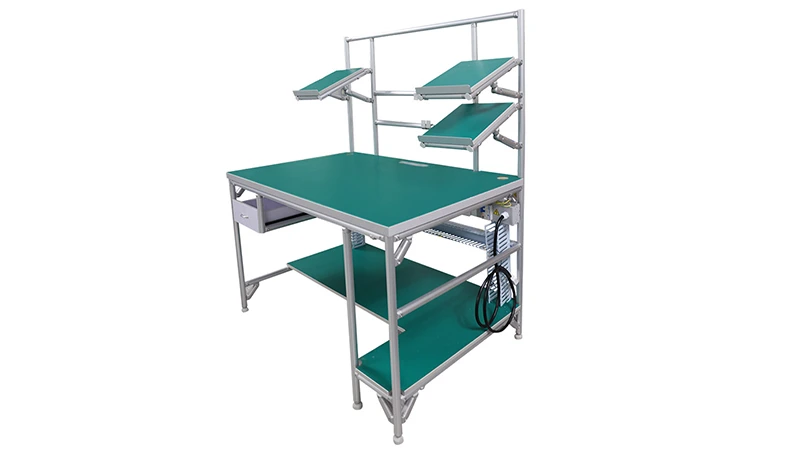
Aluminum Workbench B
Aluminum tube workbench is more flexible and durable, compared with traditional PE/ABS coated steel tube. It is easy to assemble, anti corrosion, rust protection, and recycle use after disassemble.
Walk into any modern manufacturing plant, electronics workshop, or small-scale assembly facility, and you'll notice a quiet revolution happening on the factory floor. The days of clunky, immovable workstations bolted to the ground—stations that seemed to last forever but (adapt) to nothing—are fading. In their place, a new breed of workspace solutions is emerging, designed with one core principle in mind: flexibility. Today, we're diving deep into one such solution—Aluminum Workbench B—and pitting it against the traditional fixed workstation. By the end, you'll understand why flexibility isn't just a buzzword but a make-or-break factor for businesses aiming to stay agile, efficient, and ready for whatever the market throws next.
The Case for Flexibility: Why Workstations Can't Stay "Fixed" Anymore
Let's start with a simple truth: the modern workplace isn't static. Production lines retool for new products. Team sizes fluctuate. New technologies—like collaborative robots or IoT monitoring systems—get integrated. Even something as basic as a shift in workflow (say, moving from a linear assembly line to a cell-based model) can turn a once-efficient workstation into a bottleneck. Traditional fixed workstations, built to serve one purpose in one location, struggle here. They're like old desktop computers: reliable for their time, but impossible to upgrade without a complete overhaul.
Enter Aluminum Workbench B. Part of a broader trend toward modular, lightweight, and adaptable workspace tools, this workstation is designed to grow, change, and move with your business. But before we get into the nitty-gritty of how it stacks up, let's clarify what we mean by "flexibility" in this context. For our analysis, we'll focus on three key areas: design adaptability (can it change shape or function?), mobility (can it move when needed?), and integration with lean principles (does it reduce waste and boost efficiency?). These are the areas where traditional workstations often fall short—and where Aluminum Workbench B aims to shine.
First, Let's Meet the Contenders
Traditional Fixed Workstations: The Old Reliable (But Rigid)
Picture this: a heavy steel frame, a thick wooden or metal top, maybe a few fixed shelves welded on, and bolts drilling it firmly to the concrete floor. That's the classic traditional workstation. For decades, this was the gold standard. It was sturdy—you could hammer, drill, or stack heavy parts on it without a wobble. It was cheap to build upfront, especially for businesses with a set production line and no plans to change. And it lasted forever… assuming your needs never changed.
But here's the catch: "forever" is a long time, and needs always change. A traditional workstation might start as a assembly table for small gadgets, but when your company pivots to larger products, suddenly that fixed height (too low!) or narrow top (too small!) becomes a problem. Want to add a shelf for new tools? You'll need a welder. Need to rearrange the floor plan to accommodate a new machine? You'll have to unbolt the entire station, patch the floor, and rebuild somewhere else—if it even fits. In short, traditional workstations are built for stability, not adaptability.
Aluminum Workbench B: The New Kid on the Block (But Built for Change)
Aluminum Workbench B, on the other hand, is a product of the lean manufacturing era—a time when "waste reduction" and "continuous improvement" aren't just slogans, but daily practices. At first glance, it might look similar to a traditional workstation: a flat work surface, some shelving, maybe a frame. But look closer, and you'll see the difference. The frame is made of lightweight aluminum profile—think of it as industrial-grade tinker toys for adults—with slots and grooves that let you attach, detach, or reposition components in minutes. The worktop is often adjustable. And unlike its fixed cousin, many models (including Aluminum Workbench B) come with optional caster wheels, turning it from a stationary table into a mobile workstation at the flip of a lever.
But what really sets Aluminum Workbench B apart is its modular DNA. It's not just a workstation; it's a system. Need more storage? Add a shelf using aluminum profile accessories like brackets or connectors. Want to lower the worktop for a shorter employee? Adjust the height by repositioning the aluminum legs in their slots. Need to move it to a new part of the factory for a temporary project? Lock the caster wheels, roll it over, and lock again. It's a workstation that doesn't just support your workflow—it adapts to it.

Flexibility Face-Off: Design Adaptability
Let's start with the most obvious area of comparison: design adaptability. Can the workstation change its shape, size, or features to meet new needs? For traditional fixed workstations, the answer is, unfortunately, "rarely." Let's break it down.
Traditional Fixed Workstations: One Size (and Shape) Fits None (After a While)
Traditional workstations are built with a "set it and forget it" mindset. The height is fixed during manufacturing—usually around 36 inches, the "standard" for standing work. The worktop size is determined by the initial use case: maybe 4 feet wide and 2 feet deep for small parts assembly. Shelves, if any, are welded or bolted on at fixed heights. Need to add a tool rail? You'll need to drill holes into the steel frame, risking damage. Want to make the worktop deeper to accommodate larger components? You're better off buying a new workstation—modifying the existing one would cost almost as much as replacing it.
Worse, these workstations often become "junk magnets." Since they can't be easily reconfigured, workers start piling tools, parts, or paperwork on the edges, creating clutter that slows down production. I visited a small electronics shop last year where a traditional workstation, originally built for assembling circuit boards, had been repurposed (poorly) for testing larger devices. The worktop was too small, so the team added a rickety wooden plank extension held on with duct tape. The shelf, now too low for the new equipment, was stacked with boxes of old parts, blocking access to power outlets. It was a safety hazard and an efficiency nightmare—all because the workstation couldn't adapt.
Aluminum Workbench B: Modular by Design, Adaptable by Nature
Aluminum Workbench B, by contrast, is modular to its core. The secret lies in its aluminum profile frame. Aluminum profiles—extruded metal bars with T-shaped slots running along their length—are the building blocks here. These slots allow you to attach accessories (shelves, tool holders, bins, even monitor arms) using simple bolts or brackets, no drilling required. Need a second shelf? Slide a bracket into the slot, tighten a screw, and you're done. Want to raise the worktop by 6 inches to reduce worker strain? Loosen the bolts holding the top to the frame, adjust, and retighten. It's that simple.
Let's take a real-world example. A automotive parts supplier I worked with recently switched to Aluminum Workbench B for their quality control (QC) area. Initially, the workstations were set up with a single shelf below the worktop for storing inspection tools. But when they started receiving larger parts (think engine components instead of small brackets), they needed more vertical storage. Within a day, they added two more shelves—one above the worktop for reference manuals and one below for bulkier tools—using only aluminum profile accessories and a hex key. No welding, no drilling, no downtime. The workstations went from "too basic" to "perfectly configured" in hours, not days.
Another advantage? Ergonomics. Aluminum Workbench B often comes with adjustable height options, either manually or via electric lifts (for higher-end models). This means workers of different heights can tweak the workstation to their comfort, reducing fatigue and injury risk. Traditional workstations, with their fixed heights, force workers to adapt to the station—not the other way around. Over time, that leads to higher turnover, more sick days, and lower productivity.

Flexibility Face-Off: Mobility
Mobility might seem like a secondary feature, but in today's dynamic workplaces, it's often a game-changer. Can your workstation move when your workflow moves? Let's see how our contenders stack up.
Traditional Fixed Workstations: Bolted to the Floor, Stuck in Time
Traditional workstations are, as the name suggests, fixed. Many are literally bolted to the concrete floor to prevent movement during heavy use. Even if they're not bolted, their weight—often 200+ pounds—makes moving them a Herculean task. I once saw a team of four workers spend an entire morning trying to relocate a traditional steel workstation using pry bars and a hand truck. They scratched the floor, dented the workstation, and barely got it two feet from its original spot before giving up. It was a comedy of errors, but it highlighted a critical flaw: immobility kills agility.
This immobility becomes a problem when production needs change. Suppose you run a furniture assembly plant and land a big order for a new line of chairs. To meet the deadline, you want to set up a temporary assembly cell in the middle of the floor, bringing together workers, tools, and materials in one spot. With traditional workstations, that's impossible—they're spread out along the old production line. You'd have to either build new temporary workstations (costly) or disrupt the existing line (risking delays on other orders). Either way, you lose time and money.
Aluminum Workbench B: Roll It, Lock It, Work It
Aluminum Workbench B solves the mobility problem with a simple addition: caster wheels. Most models come with optional heavy-duty caster wheels (some even lockable) that attach to the base of the aluminum profile frame. Suddenly, a workstation that weighs 80-100 pounds (thanks to the lightweight aluminum frame) becomes movable by one person. Need to rearrange the factory floor for a new production layout? Unlock the casters, roll the workstations into place, and lock them again. No pry bars, no scratched floors, no team of workers wasted on moving day.
A food packaging company I consulted with last year used this to great effect. They produce seasonal items, so their production needs change drastically every quarter. In the summer, they focus on snack packs (small, lightweight items), requiring a linear assembly line. In the winter, they switch to larger gift baskets, needing a U-shaped cell layout to reduce worker movement. With Aluminum Workbench B, they reconfigure their entire production area in a single weekend. The workstations roll into the new layout, and accessories (like conveyor attachments for moving baskets) are added via the aluminum profile slots. No downtime, no extra labor costs—just a seamless transition.
Even better, the lockable casters mean mobility doesn't come at the cost of stability. When in use, the wheels lock firmly, preventing the workstation from shifting during heavy tasks (like drilling or assembly). It's the best of both worlds: movable when you need it, rock-solid when you don't.
Flexibility Face-Off: Lean System Integration
Lean manufacturing isn't just about cutting costs—it's about eliminating waste (muda) in all forms: wasted time, wasted space, wasted movement, and wasted resources. Traditional fixed workstations, with their rigidity, often become sources of waste. Aluminum Workbench B, designed with lean principles in mind, actively reduces it. Let's explore how.
Traditional Fixed Workstations: Wasting Space, Wasting Time
Traditional workstations are space hogs. Since they can't be moved or reconfigured, you have to design your factory floor around them, often leaving gaps between stations to accommodate their fixed sizes. Over time, these gaps become dead space—unused areas that could otherwise be used for storage, new equipment, or additional workstations. In a lean system, dead space is waste, and waste eats into profits.
They also waste time. In a traditional setup, workers often have to walk long distances to retrieve tools, parts, or materials because the workstation can't be positioned close to the source. For example, in a fixed assembly line, a worker at Station A might need a part from a bin at Station D, requiring a 30-second walk each time. Multiply that by 50 parts per hour, and you're looking at 25 hours of wasted time per week—just in walking.
Worst of all, traditional workstations resist continuous improvement (kaizen), a cornerstone of lean systems. If a worker suggests rearranging the line to reduce movement, the response is often, "We can't— the workstations are bolted down." Over time, this kills employee engagement and stifles innovation.
Aluminum Workbench B: Lean to the Core
Aluminum Workbench B, by contrast, is a lean dream. Its mobility and modularity let you design a workspace that minimizes waste. For starters, you can arrange workstations in tight, efficient cells, eliminating dead space. Need to bring a workstation closer to a parts bin? Roll it over. Want to create a U-shaped cell where workers pass parts directly to each other, cutting down on walking time? Rearrange the workstations in minutes.
Take the example of a medical device manufacturer I worked with. They implemented Aluminum Workbench B in their assembly area and saw immediate lean wins. By arranging the workstations in small cells (3-4 workers per cell), they reduced the distance parts traveled by 40%. The modular shelves, positioned at arm's reach, eliminated the need for workers to walk to a central tool cart. And because the workstations could be quickly reconfigured, the team held monthly kaizen events where they tested new layouts—leading to a 15% increase in production speed in just six months.
Another lean benefit: scalability. As your business grows, you don't have to replace all your workstations—just add more Aluminum Workbench B units and integrate them into your existing layout. If demand drops, you can move excess workstations to storage or repurpose them for other tasks (like maintenance or shipping). Traditional workstations, once installed, are a sunk cost—you can't downsize without writing them off entirely.
The Numbers Don't Lie: Cost Over Time
At this point, you might be thinking, "Aluminum Workbench B sounds great, but isn't it more expensive upfront?" It's true: Aluminum Workbench B often costs 20-30% more than a basic traditional fixed workstation. But here's the thing: workstations aren't just a one-time purchase—they're a long-term investment. When you factor in adaptability, mobility, and lean efficiency, Aluminum Workbench B almost always comes out ahead financially. Let's crunch the numbers.
| Cost Factor | Traditional Fixed Workstation | Aluminum Workbench B |
|---|---|---|
| Initial Purchase Price | $500-$800 (basic steel model) | $700-$1,000 (modular aluminum with casters) |
| Modification Costs (e.g., adding shelves, adjusting height) | $300-$500 per modification (requires welding/drilling) | $50-$150 per modification (uses aluminum profile accessories) |
| Relocation Costs (moving to new layout) | $200-$400 (labor + potential floor repairs) | $0 (one person can move it with casters) |
| Replacement Cycle | 3-5 years (becomes obsolete as needs change) | 7-10+ years (adaptable to new uses) |
| Annual Efficiency Savings (from lean integration) | ~$0 (no reduction in waste) | $500-$1,000 per workstation (reduced labor, space waste) |
Let's walk through an example. Suppose you buy a traditional workstation for $600. Three years later, you need to modify it to accommodate new equipment: $400 in welding and parts. Then, two years after that, you have to replace it entirely because it can't adapt to a new workflow: another $600. Over 5 years, total cost: $600 + $400 + $600 = $1,600. No efficiency savings, just expenses.
Now, Aluminum Workbench B: initial cost $900. Over 10 years, you modify it twice (adding shelves, adjusting height) for $100 total. No relocation costs. Annual efficiency savings: $700 (conservative estimate). Over 10 years, total cost: $900 + $100 = $1,000. Total savings from efficiency: $700 x 10 = $7,000. Net benefit: $7,000 - $1,000 = $6,000. That's a massive difference—and it doesn't even include savings from reduced worker fatigue or lower turnover (thanks to better ergonomics).
Durability and Sustainability: The Hidden Flexibility Bonus
Flexibility isn't just about adaptability—it's also about longevity. A workstation that falls apart after a year isn't flexible; it's disposable. Here, Aluminum Workbench B has another ace up its sleeve: aluminum's natural durability and sustainability.
Traditional Fixed Workstations: Built to Last… Until They Don't
Traditional workstations are often made of steel, which is strong but prone to rust and corrosion, especially in humid or industrial environments. The wooden worktops warp over time, and welded joints can loosen with heavy use. Even if they don't break, they degrade: paint chips, metal bends, and moving parts (like drawer slides) jam. By the time they're obsolete, they're also worn out—so you can't even resell them. They end up in landfills, contributing to waste.
Aluminum Workbench B: Built to Last, Built to Recycle
Aluminum is naturally resistant to rust and corrosion, thanks to its oxide layer. That means Aluminum Workbench B holds up better in damp workshops or areas with chemical exposure (like automotive painting stations). The aluminum profile frame is lightweight but surprisingly strong—able to support heavy loads (up to 500 pounds or more, depending on the model) without bending. The worktop, often made of laminated plywood or metal, is scratch-resistant and easy to clean.
Even better, aluminum is 100% recyclable. When (if ever) your Aluminum Workbench B reaches the end of its useful life, the frame can be melted down and reused, reducing your company's carbon footprint. Traditional steel workstations, by contrast, are often coated in paints or chemicals that make recycling harder—and their weight makes transportation to recycling centers costly. It's a small point, but in an era where sustainability is increasingly important to customers and regulators, it adds up.
When to Stick with Traditional? (Spoiler: Rarely)
Is there ever a scenario where a traditional fixed workstation is better? Maybe—if your needs will never, ever change. If you're running a workshop that produces one product, in one way, with the same team size, forever, a traditional workstation might suffice. But in today's fast-paced business world, how many companies can say that? Even niche manufacturers face changing regulations, new customer demands, or shifts in raw material availability that require workflow adjustments.
The only other argument for traditional workstations is upfront cost. If you're a startup with zero cash flow and a very short-term project (say, a six-month contract to assemble a single product), a cheap traditional workstation might make sense. But for any business planning to grow or adapt, Aluminum Workbench B is the smarter long-term bet.
Final Verdict: Aluminum Workbench B Wins the Flexibility Battle
At the end of the day, the choice between Aluminum Workbench B and traditional fixed workstations comes down to this: Do you want a workstation that adapts to your business, or a business that has to adapt to your workstation? Traditional workstations belong to a bygone era of manufacturing—an era of stability, not agility. Aluminum Workbench B, with its modular design, mobility, lean integration, and long-term cost savings, is built for the future: a future where flexibility isn't optional, but essential.
So, if you're tired of workstations that hold your business back—stations that can't change, can't move, and can't keep up—consider making the switch. Aluminum Workbench B isn't just a workstation; it's an investment in your company's ability to adapt, grow, and thrive. And in today's world, that's the most flexible advantage of all.