- Company Articles
- Products and Technology
- Application Cases
- Aluminum Workbench C in 3C Assembly: Streamlining Smartphone Production Lines

Aluminum Workbench C in 3C Assembly: Streamlining Smartphone Production Lines
Related Product
Aluminum Workbench C
aluminum-tube-workbench-is-more-flexible-and-durable,-compared-with-traditional-pe/abs-coated-steel-tube.-it-is-easy-to-assemble,-anti-corrosion,-rust-protection,-and-recycle-use-after-disassemble.
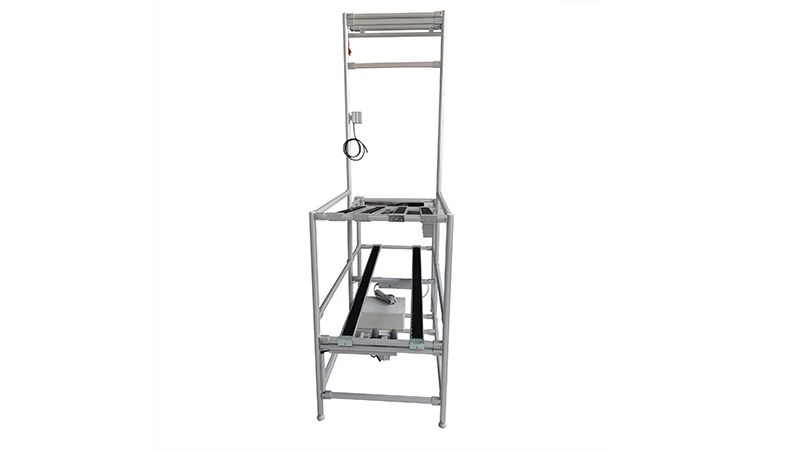
How a single workbench design is revolutionizing precision, speed, and safety on the factory floor
Walk into any modern smartphone assembly plant, and you'll be met with a symphony of motion: robotic arms placing microchips, workers hunched over magnifying glasses attaching 0.5mm screws, and conveyor belts humming with partially built devices. In this high-stakes environment, where a single misplaced component can derail an entire production run, every tool, every surface, and every second counts. Yet for years, one critical element often went overlooked: the workbench itself.
Smartphones today contain over 300 individual parts, from delicate circuit boards to tiny camera modules, each requiring meticulous handling. Traditional workbenches—clunky steel tables, wobbly wooden surfaces, or rigid setups that resisted reconfiguration—often became bottlenecks. Workers wasted precious seconds reaching for tools, parts slid off unorganized surfaces, and electrostatic discharge (ESD) from unprotected benches fried sensitive components, costing factories thousands in scrap. It was clear: to keep up with the demand for faster, more reliable 3C (computers, communications, consumer electronics) products, the industry needed a workbench designed not just to hold parts, but to elevate how work gets done.
Enter Aluminum Workbench C. More than a table, it's a purpose-built command center that addresses the unique challenges of smartphone assembly. By integrating lightweight aluminum profile, lean system principles, ESD protection, and flexible mobility, it's transforming factory floors from chaotic workspaces into models of efficiency. Let's dive into how this unassuming piece of equipment is becoming the unsung hero of 3C manufacturing.
Why Workbenches Are the Unsung Backbone of Assembly Lines
In manufacturing, much attention is paid to high-tech machinery—robots, automated testers, precision dispensers. But ask any factory manager, and they'll tell you: the workbench is where the rubber meets the road. It's the spot where human skill and mechanical precision converge. A poorly designed workbench isn't just an inconvenience; it's a silent productivity killer.
Consider the basics: A worker assembling a smartphone's motherboard needs tools (tweezers, soldering irons, torque screwdrivers) within arm's reach. Parts bins should slide smoothly into place, not require lifting. The surface must be static-free to protect microchips. And if the line needs to reconfigure for a new phone model—say, switching from a 6.1-inch to a 6.7-inch screen—the workbench should adapt quickly, without requiring a team of engineers to disassemble and rebuild.
Traditional workbenches failed on nearly all these fronts. Steel benches were durable but heavy, making reconfiguration a day-long project. Wooden surfaces absorbed moisture and couldn't dissipate static, putting components at risk. And most lacked built-in features for organization—no slots for tools, no rails for parts trays, no way to integrate with the rest of the line. The result? Wasted motion (a key "muda," or waste, in lean manufacturing), higher error rates, and frustrated workers.
Aluminum Workbench C was designed to fix these pain points. By prioritizing modularity, ESD safety, and mobility, it turns the workbench from a passive surface into an active participant in the production process. Let's break down what makes it different.
Aluminum Profile: The Foundation of Durability and Flexibility
At first glance, Aluminum Workbench C's most obvious feature is its material: high-grade aluminum profile. This isn't just any aluminum—it's an extrusion profile, engineered with precision grooves (called T-slots) that run along its length. These slots are the secret to the workbench's adaptability. Unlike steel, which requires welding or drilling to add accessories, aluminum profiles let you attach shelves, tool holders, or roller tracks with simple bolts or brackets—no special tools needed.
Why aluminum? Let's compare: Steel is strong but heavy—a 6-foot steel workbench can weigh 300+ pounds, making it nearly impossible to move without a forklift. Wood is lightweight but porous; it stains easily, harbors bacteria, and can't withstand the harsh chemicals used to clean factory surfaces. Aluminum, by contrast, is 30% lighter than steel but just as strong, corrosion-resistant (critical in humid factory environments), and non-porous, so it wipes clean with a damp cloth.
The extrusion process itself is a marvel of engineering. Molten aluminum is forced through a die to create profiles with consistent shapes—square, rectangular, or custom designs—ensuring every workbench meets the same strict standards. For smartphone assembly, where precision is measured in microns, this consistency matters. A warped steel bench might tilt parts out of alignment; an aluminum profile bench stays level, even after years of heavy use.
But the real magic is in those T-slots. Need to add a shelf for extra parts bins? Slide a bracket into the slot and tighten a screw. Want to mount a monitor for assembly instructions? Attach an arm via the T-slot. This modularity means factories don't have to buy "one-size-fits-all" workbenches; they can customize each station to the task, whether it's soldering, testing, or packaging. It's lean manufacturing in action: no waste, no excess—just exactly what the job needs.

Lean System Integration: From Chaos to Continuous Flow
Lean manufacturing isn't just a buzzword—it's a philosophy centered on eliminating waste and creating smooth, continuous workflows. At its core is the idea that every step in the production process should add value, not consume time or resources. Aluminum Workbench C was built with this philosophy in mind, acting as a bridge between workers, tools, and the broader assembly line.
Take "5S," a lean methodology focused on workplace organization (Sort, Set in Order, Shine, Standardize, Sustain). Traditional workbenches often became dumping grounds for tools and leftover parts—violating the "Sort" and "Set in Order" principles. Aluminum Workbench C, with its T-slot accessories, enforces organization by design. Tool holders snap into the slots, keeping tweezers and screwdrivers in fixed positions. Bins for screws and washers mount under the bench, freeing up surface space. Even the height is standardized: most models adjust from 30 to 40 inches, ensuring every worker—regardless of height—can reach comfortably, reducing the "Shine" (cleaning) time spent searching for misplaced items.
Another lean principle is "continuous flow," where parts move seamlessly from one station to the next, minimizing delays. Here's where roller track integration shines. Aluminum Workbench C can be outfitted with 38 aluminum roller track—small wheels mounted in a rail—that lets parts trays glide from one worker to the next. Imagine a scenario: At Station 1, a worker attaches the battery to the smartphone frame, then pushes the tray along the roller track to Station 2, where another worker installs the motherboard. No lifting, no carrying, no waiting. The flow is continuous, and bottlenecks disappear.
Perhaps the most powerful lean feature is the workbench's mobility, thanks to caster wheels. In traditional lines, reconfiguring for a new product model meant shutting down production for hours—workers would have to unbolt steel benches, move them with forklifts, and rewire tools. With Aluminum Workbench C, each bench sits on four heavy-duty caster wheels with locking mechanisms. Unlock the wheels, push the bench into its new position, relock, and you're done. A line that once took 8 hours to reconfigure now takes 45 minutes. For factories churning out multiple phone models (think: standard, Pro, and Ultra versions), this flexibility is a game-changer.

ESD Workstation Protection: Guarding Against the Invisible Enemy
In the world of electronics manufacturing, there's an invisible enemy: electrostatic discharge (ESD). A single static spark—too small for humans to feel—can destroy a microchip costing $50 or more. In fact, the Electronics Industry Association estimates that ESD damage costs manufacturers $5 billion annually. For smartphone assembly, where every device contains dozens of sensitive components (processors, memory chips, sensors), ESD protection isn't optional—it's existential.
Traditional workbenches offered little defense. A steel bench might conduct static, but without proper grounding, it could channel a charge directly into components. Wooden benches insulated static, letting it build up until it discharged onto a chip. Aluminum Workbench C, by contrast, is engineered as an ESD workstation from the ground up.
The workbench top is made of a special anti-static material—a blend of aluminum and conductive fibers—that dissipates static charge instead of letting it build up. This material has a surface resistance of 10^6 to 10^9 ohms, the sweet spot for ESD protection: high enough to prevent electric shocks to workers, low enough to safely ground static. But the top alone isn't enough. The entire bench is connected to the factory's grounding system via a braided cable, ensuring any static charge flows harmlessly into the earth, never reaching the components on the surface.
Even the accessories are ESD-safe. The roller tracks, tool holders, and bins are made from conductive plastics or grounded aluminum, so every part of the workstation works together to neutralize static. Workers also wear ESD wristbands that connect to the bench, creating a closed loop of protection. It's a system designed to leave no weak links—because in ESD protection, one weak link is all it takes.
The impact is measurable. A factory using traditional benches might see 3-5% of units fail ESD testing; with Aluminum Workbench C, that number drops to less than 0.5%. For a factory producing 50,000 phones a day, that's 2,500 fewer defective units—saving hundreds of thousands of dollars in scrap and rework.
Traditional vs. Aluminum Workbench C: A Side-by-Side Comparison
| Feature | Traditional Workbench | Aluminum Workbench C |
|---|---|---|
| Material | Steel or wood | Aluminum profile (extruded, T-slot) |
| ESD Protection | None (wood) or minimal (steel, ungrounded) | Built-in (anti-static top, grounding cable, ESD accessories) |
| Mobility | Fixed (requires forklift to move) | Lockable caster wheels (movable by hand) |
| Modularity | Low (welding/drilling required for changes) | High (T-slot accessories, no tools needed) |
| Reconfiguration Time | 4–8 hours | 30–60 minutes |
| Maintenance | High (rust, warping, staining) | Low (corrosion-resistant, easy to clean) |

Case Study: How One Factory Boosted Productivity by 30% with Aluminum Workbench C
To truly understand the impact of Aluminum Workbench C, let's look at a real-world example (names have been changed for privacy). FastTech Electronics, a mid-sized manufacturer in Southeast Asia, produces 15,000 smartphones daily for brands sold across Europe. In early 2024, they were struggling to keep up with demand for their new flagship model, the Swift X9. Their production line was plagued by three issues: ESD damage, slow reconfiguration times, and worker fatigue.
"We were losing 5% of units to ESD failures," says Maria Gonzalez, FastTech's Production Manager. "That's 750 phones a day—each worth $300. We were also spending 8 hours reconfiguring the line when switching from the standard X9 to the X9 Pro, which has a larger camera module. And our workers were complaining about back pain from leaning over wide steel benches. We knew we needed a change."
In March 2024, FastTech replaced 20 traditional steel workbenches with Aluminum Workbench C models, equipped with ESD surfaces, roller tracks, and caster wheels. The results were immediate.
First, ESD failures plummeted from 5% to 0.8%. "The anti-static tops and grounding cables made all the difference," Gonzalez notes. "We used to have bins of damaged microchips piling up; now, they're almost empty."
Second, reconfiguration time dropped from 8 hours to 45 minutes. "During our peak season, we switch between models twice a week," Gonzalez explains. "Saving 7 hours per switch adds up to 56 hours of production time a month—enough to make 30,000 more phones."
Third, worker satisfaction scores jumped by 40%. "The adjustable height and roller tracks mean less reaching and lifting," says Juan, a lead assembler. "I used to go home with a sore back; now, I feel fine. And the T-slot tool holders keep everything right where I need it—I don't waste time hunting for screwdrivers anymore."
By the end of the first quarter, FastTech's productivity had increased by 30%, allowing them to meet holiday demand without hiring temporary workers or paying overtime. "Aluminum Workbench C wasn't just an upgrade—it was a transformation," Gonzalez says. "We're now looking to roll it out to our tablet and smartwatch lines."
Future-Proofing Production: Why Aluminum Workbench C Will Outlast Trends
In the fast-moving world of 3C manufacturing, today's innovation is tomorrow's relic. But Aluminum Workbench C is built to last, thanks to three key qualities: adaptability, sustainability, and compatibility with emerging technologies.
Adaptability starts with the aluminum profile itself. As smartphone designs evolve—thinner bodies, foldable screens, more sensors—the workbench can evolve with them. Need to add a robotic arm to assist with delicate tasks? Mount it via the T-slots. Want to integrate AI-powered cameras for quality control? Attach the camera bracket to the profile. The bench doesn't just support today's tools; it's ready for tomorrow's.
Sustainability is another selling point. Aluminum is 100% recyclable, and unlike steel, it doesn't lose strength when recycled. When a workbench finally reaches the end of its life (after 10–15 years of use), the aluminum can be melted down and reused to make new profiles. For factories aiming to reduce their carbon footprint, this is a critical advantage over disposable wooden benches or steel benches that end up in landfills.
Finally, compatibility with Industry 4.0 technologies ensures the workbench stays relevant. Many models now come with built-in USB ports (powered via the grounding cable) for charging tools or connecting tablets. Some even have sensors that track usage—how often the bench is reconfigured, which accessories are most used—to help factories optimize their setups further. As factories adopt "smart" manufacturing, Aluminum Workbench C won't be left behind; it'll be part of the network.
The Workbench as a Catalyst for Change
In the grand scheme of 3C manufacturing, the workbench might seem like a small piece of the puzzle. But as Aluminum Workbench C proves, small changes can lead to massive results. By focusing on the basics—material, mobility, safety, and flexibility—it transforms how workers do their jobs, how lines flow, and how factories adapt to change.
For smartphone manufacturers racing to meet consumer demand, the benefits are clear: fewer defects, faster production, happier workers, and a line that can pivot at a moment's notice. For the broader 3C industry—laptops, smartwatches, IoT devices—the lessons are the same: invest in the tools that make your team's work easier, and they'll repay you with innovation and efficiency.
So the next time you pick up your smartphone, take a moment to appreciate the unseen heroes behind it—not just the engineers or the robots, but the humble workbench that helped bring it to life. Aluminum Workbench C isn't just streamlining production lines; it's helping build the future of technology, one precise, static-free, and perfectly organized workstation at a time.