- Company Articles
- Products and Technology
- Product knowledge
- Aluminum Workbench C vs Workbench E: Key Differences in Flexible Production

Aluminum Workbench C vs Workbench E: Key Differences in Flexible Production
Related Product
Aluminum Workbench C
aluminum-tube-workbench-is-more-flexible-and-durable,-compared-with-traditional-pe/abs-coated-steel-tube.-it-is-easy-to-assemble,-anti-corrosion,-rust-protection,-and-recycle-use-after-disassemble.
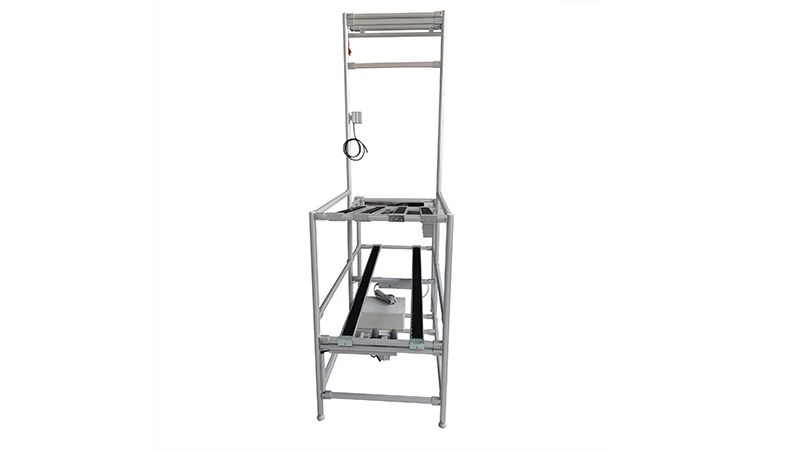
In today's fast-paced manufacturing landscape, flexibility isn't just a buzzword—it's the backbone of staying competitive. As production lines pivot between small batches, custom orders, and sudden demand spikes, every piece of equipment must pull its weight in keeping workflows agile. At the heart of this agility are workbenches: the silent workhorses where assembly, inspection, and material handling come to life. But not all workbenches are created equal. When it comes to balancing durability, adaptability, and cost, two options often rise to the top for lean-oriented facilities: Aluminum Workbench C and Workbench E (single deck-without caster). Let's dive into their key differences, and how each shapes the efficiency of flexible production environments.
1. Design & Build: The Foundation of Flexibility
The first thing that sets these workbenches apart is their core design—choices that ripple through every aspect of their performance, from load capacity to reconfigurability.
Aluminum Workbench C: Built on Aluminum Profile for Modularity
Aluminum Workbench C is a product of modern manufacturing ingenuity, leveraging aluminum profile as its building block. Specifically, it uses aluminum extrusion profiles—hollow, lightweight beams with precision-engineered T-slots running along their length. This isn't just about aesthetics; the T-slots are a modular marvel, allowing operators to attach accessories (shelves, tool holders, bins) in seconds without drilling or welding. Imagine a workbench that can grow with your needs: add a monitor arm for digital work instructions on Monday, a parts bin for small components on Wednesday, and a cable management tray by Friday. That's the flexibility of aluminum extrusion at work.
But it's not just adaptable—it's tough. Aluminum profile strikes a rare balance between strength and weight. A typical Aluminum Workbench C can support 300–500 kg of evenly distributed weight (think heavy power tools, large assemblies, or stacked material boxes) while weighing 30–40% less than a steel equivalent. This lightweight nature is a game-changer for facilities where floor space is precious and layouts shift regularly.
Workbench E: Simplicity in a Single Deck
Workbench E, by contrast, embraces simplicity. As its full name suggests—"Workbench E (single deck-without caster)"—it's a no-frills, stationary work surface. Most models feature a single, solid deck (often steel or particleboard with a laminate top) supported by a fixed frame. There's no T-slot magic here; accessories, if any, are bolted or clamped on permanently. This design prioritizes stability over adaptability: the lack of moving parts or modular joints means it wobbles less under heavy loads, making it a steady platform for tasks like precision measurement or manual assembly where vibration could compromise quality.
The "without caster" detail is critical, too. Unlike mobile workbenches that roll on wheels, Workbench E is anchored to the floor (or sits firmly on fixed feet), making it a permanent fixture in the production line. For teams that value consistency—say, a dedicated station for final inspection—this is a strength. But for those needing to reposition workbenches to align with shifting workflows, it's a limitation.
2. Mobility: Stuck in Place or Ready to Roll?
In flexible production, mobility isn't a luxury—it's a necessity. The ability to move workbenches to where labor or materials are concentrated can cut down on wasted steps, reduce bottlenecks, and turn idle space into productive zones. Here's how the two workbenches stack up.
Aluminum Workbench C: Designed for Dynamic Layouts
While Aluminum Workbench C isn't always sold with wheels, its aluminum frame is engineered to accommodate caster wheel upgrades with minimal effort. Many suppliers offer optional caster kits (lockable, heavy-duty, or even ESD-safe for electronics environments) that bolt directly into the base frame. This transforms the workbench from stationary to mobile in under 10 minutes. Why does this matter? Picture a small-batch electronics manufacturer: one week, they're assembling smartwatches, requiring workbenches clustered near the flow rack holding tiny components. The next week, they shift to tablets, needing more space for larger displays—so they roll the workbenches apart, repositioning them in minutes. No heavy lifting, no downtime, just a quick adjustment to keep pace with demand.
Even without casters, Aluminum Workbench C's lightweight design makes it easier to relocate with a team of two, whereas moving a steel Workbench E might require a forklift or pry bars—a process that disrupts production for hours.
Workbench E: Stationary by Design
Workbench E's "without caster" label isn't an oversight; it's intentional. This workbench is built to stay put. Its fixed legs (often with adjustable feet for leveling on uneven floors) anchor it to the ground, making it ideal for tasks where stability is non-negotiable. For example, in a quality control lab testing fragile glassware, or a workshop assembling heavy machinery parts, a wobbly workbench could lead to errors or accidents. Workbench E's stationary nature eliminates that risk.
But in dynamic environments, this rigidity becomes a liability. If your production line needs to shrink to accommodate a rush order on one side of the facility, Workbench E can't tag along. Instead, materials or workers must travel to it, adding steps to the process and increasing the chance of delays. Over time, these small inefficiencies add up—exactly the kind of waste lean system principles aim to eliminate.

3. Integration with Lean Systems: Waste Reduction in Action
Lean manufacturing isn't just about cutting costs—it's about creating value by eliminating waste (muda), whether that's wasted time, motion, or materials. Both workbenches claim to support lean goals, but their approaches differ dramatically.
Aluminum Workbench C: A Lean System Ally
Aluminum Workbench C is practically a poster child for lean thinking. Its modularity aligns with two core lean pillars: "Jidoka" (automation with a human touch) and "Heijunka" (leveling production). Let's break it down:
Jidoka: By allowing quick accessory changes, the workbench adapts to "poka-yoke" (mistake-proofing) tools. For example, if an assembly step requires a torque wrench, you can mount a wrench holder at eye level to ensure it's always within reach—reducing the chance of errors from misplaced tools.
Heijunka: When production volumes fluctuate, Aluminum Workbench C can be reconfigured to balance workloads. A team assembling 100 units/day might need two workbenches with shared tools; ramp up to 200 units, and you can split the tools across four workbenches (thanks to the modular aluminum profile) without buying new equipment.
Even better, its compatibility with flow rack systems (a staple of lean material handling) is seamless. Position an Aluminum Workbench C at the end of a flow rack, and parts glide directly onto the work surface—eliminating the need for workers to bend, reach, or carry heavy bins. It's a small change that reduces motion waste and cuts cycle times by 15–20% in many cases.
Workbench E: Lean in Static Environments
Workbench E can support lean systems, but only in specific scenarios. Its fixed design works well for "cellular manufacturing" setups where the workflow is stable and predictable. For example, a dedicated cell assembling the same component day in, day out can optimize a Workbench E with permanent tool mounts, labeled bins, and a fixed position relative to material storage. In this case, the lack of mobility reduces the risk of workflow disruptions caused by accidental movement.
However, it struggles with the "flex" in flexible production. If your facility runs multiple product lines or frequently introduces new SKUs, Workbench E becomes a bottleneck. Retooling it for a new product might require unbolting old accessories, drilling new holes, or even replacing the entire deck—wasting hours of labor and halting production. In lean terms, that's "setup waste" (muda of preparation), and it's exactly what modern manufacturers are trying to avoid.

4. Cost & ROI: Short-Term Savings vs. Long-Term Value
Budget is always a factor, but the true cost of a workbench isn't just the sticker price—it's the return on investment (ROI) over its lifespan. Let's crunch the numbers.
Aluminum Workbench C: Higher Upfront Cost, Lower Total Cost of Ownership
Aluminum Workbench C typically costs 20–30% more upfront than Workbench E. Aluminum profile and modular components aren't cheap, after all. But its ROI shines over time:
- Reduced retooling costs: Modular accessories mean you won't need to buy a new workbench when workflows change. A $2,000 Aluminum Workbench C with $500 in accessories can replace three $1,500 fixed workbenches over 5 years.
- Lower labor costs: Quick reconfigurations save 2–4 hours per changeover compared to Workbench E. At $30/hour labor, that's $60–$120 saved per change—adding up fast for facilities with monthly product switches.
- Durability: Aluminum resists corrosion and wear, outlasting steel workbenches in humid or chemical-heavy environments. A typical Aluminum Workbench C lasts 10–15 years, vs. 5–7 for a steel Workbench E.
Workbench E: Lower Initial Price, Higher Hidden Costs
Workbench E is tempting for teams on a tight budget, with upfront costs 30–40% lower than Aluminum Workbench C. But the savings often vanish within a year or two:
- Limited lifespan: Without modularity, Workbench E becomes obsolete when workflows change. A facility that introduces a new product line might need to replace 50% of its Workbench E units, doubling long-term costs.
- Setup waste: As mentioned earlier, retooling takes hours. For a facility with quarterly product changes, that's 8–16 hours of lost production annually—easily wiping out the initial savings.
- Weight penalties: Moving a steel Workbench E (even short distances) requires extra labor or equipment, adding costs to every layout adjustment.
| Feature | Aluminum Workbench C | Workbench E (Single Deck-Without Caster) |
|---|---|---|
| Core Material | Aluminum profile (extrusion with T-slots) | Steel or particleboard (single solid deck) |
| Mobility | Lightweight; optional caster wheels for easy relocation | Stationary (no casters; fixed legs) |
| Modularity | High: T-slots allow tool-free accessory attachment | Low: Accessories require drilling/bolting |
| Lean System Fit | Excellent for dynamic, changing workflows | Good for static, predictable cellular setups |
| Upfront Cost | Higher (20–30% more than Workbench E) | Lower (budget-friendly initial purchase) |
| Long-Term ROI | Strong (reduced retooling/labor costs; 10–15 year lifespan) | Limited (high setup waste; 5–7 year lifespan) |
| Ideal Use Case | Small-batch production, frequent product changes, agile facilities | High-volume, repetitive tasks, stable workflows |

5. Real-World Applications: When to Choose Which
To bring this to life, let's look at two hypothetical manufacturers and how they might choose between the two workbenches.
Case 1: A Startup Electronics Manufacturer (Flexible Production)
A startup building custom IoT devices has a small facility (5,000 sq. ft.) and runs 10–15 product lines annually, each with batches of 50–200 units. Their biggest challenge? Adapting to new designs quickly without overspending. For them, Aluminum Workbench C is a no-brainer. Its lightweight, modular design lets them reconfigure their 8 workbenches weekly to support new assemblies. They use aluminum profile accessories to add ESD-safe mats for circuit board work, then swap them out for tool rails when assembling enclosures. The ability to move workbenches near flow rack stations cuts material handling time by 30%, and the T-slots mean they never waste money on custom tool mounts. After two years, they've expanded to 12 workbenches—all using the same aluminum profile system—without replacing a single unit.
Case 2: A Large Automotive Supplier (Stable Production)
A Tier 1 automotive supplier produces door handles for a single car model, with daily volumes of 5,000 units. Their workflow is fixed: injection-molded parts arrive at one end of the line, are assembled on workbenches, and inspected before packaging. Here, Workbench E thrives. Each of their 20 workbenches is permanently positioned 3 feet from the injection molding machines, with bolted-on tool holders for screwdrivers and torque wrenches. The stationary design ensures consistency (no accidental movement disrupting the assembly sequence), and the solid steel deck handles the repetitive pounding of assembly tools. Since the product hasn't changed in three years, retooling isn't needed—and the lower upfront cost of Workbench E helped them stay under budget during facility setup.
Conclusion: Choosing the Workbench That Grows With You
At the end of the day, the choice between Aluminum Workbench C and Workbench E boils down to one question: How dynamic is your production environment? If your facility thrives on agility—frequent product changes, small batches, or evolving workflows—Aluminum Workbench C is the clear winner. Its aluminum profile modularity, mobility, and lean system integration make it a long-term investment in flexibility.
But if your operations are stable, with predictable workflows and minimal retooling, Workbench E offers simplicity and upfront savings that can make sense. Just be prepared for higher hidden costs if flexibility becomes a priority down the line.
In the era of flexible production, the best workbench isn't just a surface to work on—it's a partner in adaptability. Choose wisely, and it will grow with your facility, turning today's challenges into tomorrow's opportunities.