- Company Articles
- Products and Technology
- Product knowledge
- Aluminum Workbench D Accessories: Must-Have Add-Ons for Enhanced Functionality

Aluminum Workbench D Accessories: Must-Have Add-Ons for Enhanced Functionality
Related Product
Aluminum Workbench D
Aluminum tube workbench is more flexible and durable, compared with traditional PE/ABS coated steel tube. It is easy to assemble, anti corrosion, rust protection, and recycle use after disassemble.
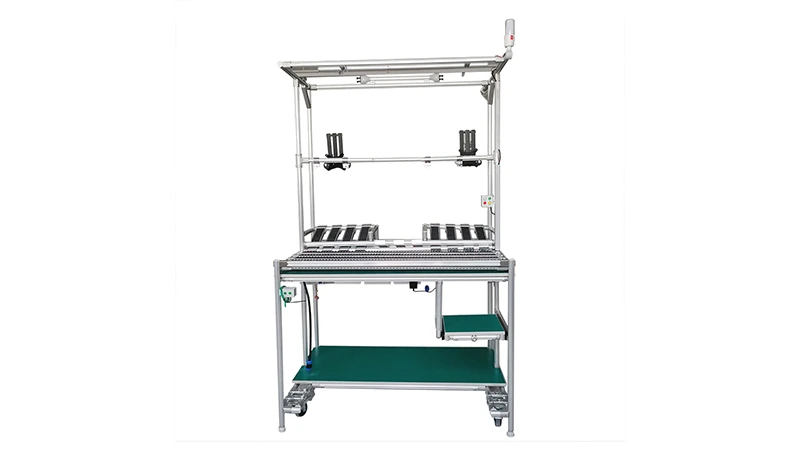
In the bustling world of manufacturing, assembly lines, and workshops, the workbench isn't just a piece of furniture—it's the heartbeat of productivity. Among the many options available, the Aluminum Workbench D stands out for its lightweight durability, sleek aluminum profile, and inherent flexibility. But even the most well-designed workbench reaches its full potential only when paired with the right accessories. These add-ons transform a static surface into a dynamic, workflow-enhancing tool that adapts to your team's needs, reduces friction in daily tasks, and elevates overall efficiency. In this article, we'll dive into the must-have accessories for Aluminum Workbench D, focusing on how they solve real-world challenges and why they're more than just "extras"—they're investments in smoother operations, happier workers, and better results.
Caster Wheels: Mobility That Keeps Pace with Your Workflow
One of the biggest limitations of fixed workbenches is their inability to move—when your project, team, or tools need to shift, the workbench becomes a barrier instead of a helper. That's where caster wheels come in. These small but mighty accessories turn Aluminum Workbench D into a mobile workstation, letting you reposition it in seconds to adapt to changing demands. Whether you're collaborating with a colleague across the shop floor, making space for a deep clean, or moving materials directly to the workbench instead of carrying them, caster wheels eliminate the hassle of a stationary setup.
Not all caster wheels are created equal, though. The key is to choose options that match your workspace's unique needs. For instance, in electronics assembly, where static control is critical, esd workstation -compatible caster wheels with conductive materials prevent electrostatic discharge from damaging sensitive components. In heavier manufacturing environments, where the workbench might hold bulky tools or raw materials, heavy-duty caster wheels with larger diameters (5 inches or more) and higher load capacities (300kg+ per wheel) ensure stability and smooth movement even under strain.
Brake mechanisms are another crucial consideration. Total-lock brakes (which lock both the wheel and swivel motion) are ideal for situations where the workbench needs to stay firmly in place during precision tasks, like soldering or measuring. Swivel-lock brakes, on the other hand, let the wheel rotate but prevent the caster from turning—useful for moving the workbench in a straight line without veering off course. And for floors prone to scratches (like polished concrete or hardwood), rubber or polyurethane wheels offer better grip and floor protection than hard plastic alternatives.
| Caster Wheel Type | Wheel Size (in) | Load Capacity (kg per wheel) | Brake Type | Best For |
|---|---|---|---|---|
| Swivel Caster with Total Lock Brake | 5 | 300 | Locks wheel + swivel | Heavy tools, precision tasks |
| ESD Swivel Caster | 4 | 200 | Swivel lock only | Electronics assembly (static control) |
| Rigid Caster | 3 | 150 | No brake | Straight-line movement, light loads |
In practice, a team using Aluminum Workbench D with swivel casters might start the day assembling circuit boards at a fixed station, then quickly wheel the bench to a testing area in the afternoon—no more carrying heavy boards back and forth. For managers, this mobility also means better space utilization: during slow periods, workbenches can be nested to free up floor space, and during peak times, they can be spread out to accommodate more workers. It's a small change that ripples into big efficiency gains.
Roller Tracks: Sliding Toward Smoother Material Flow
Next to mobility, material handling is often the biggest drain on productivity at a workbench. Reaching for parts, sliding heavy bins, or aligning components manually wastes time and increases the risk of strain. Roller track accessories solve this by turning the workbench surface into a low-friction zone where materials glide into place with minimal effort. Whether you're dealing with small parts, finished products, or tools, roller tracks transform "pushing and pulling" into "effortless sliding."
The beauty of roller tracks lies in their versatility. For example, swivel roller balls (available in 1 inch and 0.5 inch sizes) are small, omnidirectional spheres that let materials move in any direction—perfect for lightweight bins of screws, washers, or electronic components. Imagine a technician assembling a device: instead of lifting a bin to grab a part, they simply slide it across the roller balls, saving seconds per reach that add up to hours over a week.
For longer or heavier items, linear roller tracks are the way to go. These consist of parallel rails with rolling wheels, designed to move materials along a straight path. Options like the 38 aluminum roller track with side guides keep items like PCBs or metal sheets aligned, preventing them from slipping off the bench. In a automotive parts assembly line, for instance, a 40 steel roller track with yellow wheels might transport gearboxes from one end of the workbench to another, ensuring they're positioned exactly where the assembler needs them—no lifting, no tugging, no wasted motion.
Material choice matters, too. Plastic roller tracks (like the yellow or grey plastic roller track guide rails) are cost-effective and gentle on delicate surfaces, making them ideal for electronics or glass components. Aluminum roller tracks, on the other hand, are sturdier and better suited for heavy-duty use, like in metalworking shops. ESD-friendly options, such as black ESD roller tracks, are a must in environments where static electricity could damage sensitive parts—another example of how accessories adapt the workbench to specialized needs.
Even the smallest details count. Roller track connectors and placon mounts (like the roller track placon mount for aluminum profile flat) ensure that tracks attach securely to the Aluminum Workbench D's aluminum profile, eliminating wobble and ensuring smooth operation. End supports with stops prevent materials from sliding off the edge, adding a layer of safety. Together, these components turn the workbench into a mini conveyor system, keeping materials moving and workers focused on the task at hand.

Aluminum Profile Accessories: Customization Without Compromise
What sets Aluminum Workbench D apart from traditional workbenches is its aluminum profile frame—a modular system of T-slot aluminum extrusion profiles that's designed to be customized. To unlock this potential, aluminum profile accessories are essential. These include joints, clamps, guide rails, and brackets that let you build, modify, and expand the workbench without drilling, welding, or permanent changes. It's like having a workshop within a workshop, where the workbench itself evolves with your needs.
Take internal rotatary aluminum joints, for example. These clever connectors let you attach shelves, tool holders, or monitor arms to the workbench and rotate them 360 degrees. A quality control inspector might swing a shelf with magnifying tools into place when checking a part, then rotate it out of the way to make space for the next task. Similarly, aluminum guide rails (A and B types) can be mounted along the edges of the workbench to hold LED task lights, barcode scanners, or cable management clips—keeping essentials within arm's reach but out of the way of the work surface.
For teams that need to organize tools vertically, aluminum pipe clamps and parallel fixation joints are game-changers. These accessories let you mount aluminum pipes to the workbench frame, creating custom tool racks. A mechanic might use this to hang wrenches, screwdrivers, and pliers in order of use, reducing the time spent searching for tools. And since the joints are reusable, the setup can be rearranged if the workflow changes—no need to buy a new rack or drill new holes.
Even the smallest aluminum profile accessories make a difference. End caps for 2020 or 4040 profiles cover sharp edges, improving safety. Rubber strip inserts for T-slots keep debris out and reduce noise when sliding accessories into place. Gusset plates add stability to shelves or extensions, ensuring they can hold heavy loads without bending. Together, these accessories turn the Aluminum Workbench D into a personalized workspace that fits the unique rhythm of your team—not the other way around.

Lean Pipe Joints: Building a Workbench That Grows with You
In today's fast-paced manufacturing environments, flexibility isn't optional—it's survival. That's where lean pipe joint accessories shine. Originally designed for lean manufacturing systems, these joints connect aluminum or steel pipes to create custom structures on or around the Aluminum Workbench D. From overhead part racks to mobile tool trolleys, lean pipe joints let you build exactly what you need, when you need it, and reconfigure it when priorities change.
The magic of lean pipe joints is their simplicity. Most require no tools to assemble—just a twist or a clamp—and they're strong enough to hold significant weight. For example, a 90° fixed lean pipe joint can connect two pipes to form a right angle, perfect for building a side shelf to hold a laptop or manual. A parallel lean pipe joint with one-side rotation lets you attach a hanging bin that swings out of the way when not in use. And since lean pipes are lightweight, even complex structures (like a multi-tiered parts rack) can be assembled by a single person in minutes.
In a small batch production setting, this adaptability is invaluable. One week, the workbench might be set up with a lean pipe parts rack for assembling widgets; the next week, that rack can be disassembled and rebuilt as a tool trolley for maintenance tasks. This "build, use, reconfigure" cycle eliminates the need to invest in multiple specialized workbenches, saving space and money in the long run.
Why These Accessories Matter: Beyond "Nice-to-Haves"
At first glance, caster wheels, roller tracks, aluminum profile accessories, and lean pipe joints might seem like "extras." But in reality, they're foundational to getting the most out of your Aluminum Workbench D. They address the three biggest barriers to productivity at any workbench: limited mobility, inefficient material handling, and rigid setup. By solving these, they don't just save time—they reduce frustration, lower the risk of injury, and empower workers to focus on what they do best: creating, building, and innovating.
So, if you're considering upgrading your Aluminum Workbench D, start by assessing your workflow. Do you need to move the bench frequently? Caster wheels are a must. Are materials hard to slide? Roller tracks will transform your process. Do you need to customize the setup for different tasks? Aluminum profile accessories and lean pipe joints are your allies. Remember: the best workbench isn't just a surface—it's a system, and the right accessories are the parts that make that system work for you.