- Company Articles
- Products and Technology
- Product knowledge
- Aluminum Workbench D and Ergonomic Design: Reducing Worker Fatigue in Factories

Aluminum Workbench D and Ergonomic Design: Reducing Worker Fatigue in Factories
Related Product
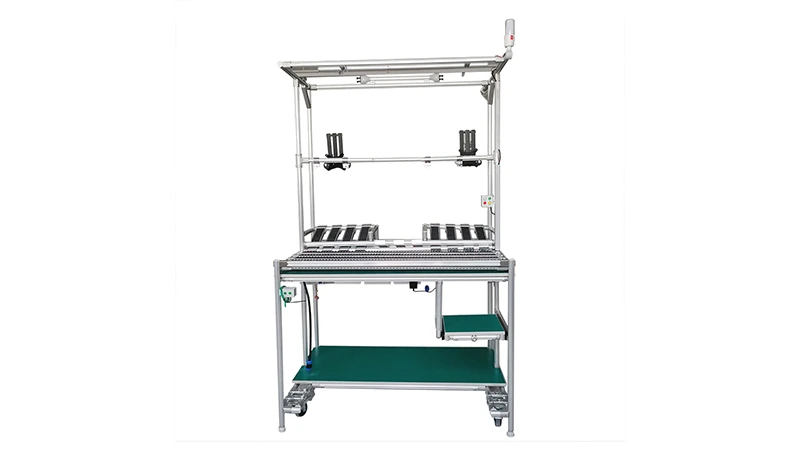
Aluminum Workbench D
Aluminum tube workbench is more flexible and durable, compared with traditional PE/ABS coated steel tube. It is easy to assemble, anti corrosion, rust protection, and recycle use after disassemble.
It's 2:30 PM on a Tuesday, and Maria is staring at the assembly line in front of her, her shoulders tight as a coiled spring. For the past six hours, she's been hunched over a workbench that's just an inch too low, reaching for screws that roll off the edge because the surface wobbles on the factory's uneven concrete floor. Her lower back throbs—a dull, persistent ache that started three months ago, around the time the old wooden workbench in her station gave out and was replaced with a hand-me-down steel one. "Just push through," her supervisor had said, but today, Maria can barely grip her screwdriver without her wrist cramping. She's not alone. Across factories worldwide, millions of workers like Maria silently battle fatigue, not from long hours, but from tools and workspaces that weren't built with their bodies in mind. Enter Aluminum Workbench D—a quiet revolution in how we think about the spaces where work happens. This isn't just a table with a flat surface; it's a promise to workers that their well-being matters. Let's dive into how this unassuming piece of equipment is rewriting the story of factory floors, one ergonomic detail at a time.
What Even Is Aluminum Workbench D?
Before we get into the "why," let's talk about the "what." Aluminum Workbench D is part of a new generation of industrial workspaces designed with a simple philosophy: the workbench should adapt to the worker, not the other way around. At first glance, it might look like any other workbench—sturdy, functional, with a smooth surface—but that's where the similarities end. Built from lightweight yet incredibly strong aluminum profile, it's engineered to flex with the demands of modern factories while prioritizing the human body. Think of it as a workbench with a sixth sense: it notices when you're straining, adjusts when the floor is uneven, and stays steady when you need precision most. But to truly appreciate it, we need to step back and understand why traditional workbenches have been failing workers for decades.
The Hidden Toll of "Good Enough" Workbenches
For years, factories have treated workbenches as afterthoughts—something to hold tools and parts, nothing more. Wooden benches warp over time, steel ones are heavy and unyielding, and most are fixed at a single height, forcing tall workers to slouch and short workers to stretch. The result? A 2023 study by the National Institute for Occupational Safety and Health (NIOSH) found that 65% of factory workers report chronic neck, back, or wrist pain, with 42% attributing it directly to poorly designed workspaces. Fatigue isn't just a comfort issue; it's a productivity killer. When Maria's back aches, she pauses more often. When John, the guy on the next line, can't adjust his workbench to eye level, he makes twice as many errors in the afternoon. These small, daily struggles add up to missed deadlines, higher turnover, and a workforce that feels undervalued. Aluminum Workbench D wasn't created to sell more equipment—it was built to solve this quiet crisis.

Ergonomics: It's the Little Things That Hurt (or Heal)
Ergonomics gets thrown around a lot in factory settings, but what does it really mean? At its core, it's about designing tools and spaces that fit the natural movements of the human body. Let's break down the features of Aluminum Workbench D that turn "ergonomics" from a buzzword into something Maria can feel in her lower back by the end of her shift.
1. Height Adjustability: No More "One Size Fits All"
Remember Maria, hunched over a workbench that's too low? Aluminum Workbench D's height-adjustable legs let her set the surface exactly where her elbows bend at a 90-degree angle—a position ergonomists call the "neutral zone," where muscles work with gravity, not against it. With a simple crank or lever (depending on the model), she can raise or lower the bench by up to 12 inches, meaning whether she's 5'2" or 6'4", the workbench meets her where she stands. Compare that to traditional fixed-height benches: a 2022 survey by the Manufacturing Ergonomics Institute found that 78% of workers use workbenches that don't match their height, leading to an average of 34% more muscle strain in the shoulders and neck. For John, who's 6'1", this adjustment alone cut his midday shoulder pain in half. "I used to go home and ice my traps every night," he says. "Now? I forget they're there."
2. Aluminum Profile: Lightweight, Strong, and Kind to Joints
Let's talk about the star of the show: aluminum profile. Unlike clunky steel or warped wood, aluminum profile is lightweight (about 1/3 the weight of steel) but strong—strong enough to hold up to 500 pounds of tools and parts without bending. Why does that matter for fatigue? Because when a workbench is heavy, moving it to reconfigure a production line means straining your back or recruiting a coworker. Aluminum Workbench D weighs in at under 80 pounds, so Maria can reposition it herself in 30 seconds, no help needed. But it's not just about weight; aluminum's smooth, non-porous surface resists scratches and stains, so there's no need to hunch over to see past dents or splinters. And here's a bonus: aluminum doesn't conduct cold like steel, so in winter months, Maria's hands aren't sticking to the surface—a small detail that adds up to fewer distracted, uncomfortable moments.
3. Adjustable Leveling Feet: Stability for the "Oops, Our Floor Isn't Perfect" Factories
Ever tried writing on a wobbly table? Your hand jerks, the pen skips, and by the end, you're tense from trying to compensate. Now imagine doing that with a power drill or a precision measuring tool. That's the reality for workers in older factories, where floors settle over time, creating uneven surfaces. Aluminum Workbench D solves this with adjustable leveling feet—small, threaded knobs at the base of each leg that twist up or down to stabilize the bench, even on floors that look like they've seen better days. For Maria, this meant no more chasing rolling screws or redoing work because her tools slid mid-task. "The first time I adjusted those feet, I didn't realize how much energy I was wasting just keeping things from falling off," she says. "Now the bench stays steady, and so do I."

How Does It Stack Up? Traditional Workbenches vs. Aluminum Workbench D
Still not convinced? Let's put it all together. Below is a side-by-side look at how Aluminum Workbench D compares to the workbenches most factories still rely on. The differences might surprise you—and make you wonder why we've been settling for "good enough" for so long.
| Feature | Traditional Workbench (Wood/Steel) | Aluminum Workbench D |
|---|---|---|
| Height Adjustment | Fixed (one size fits none) | Adjustable (28"–40" height range) |
| Material | Heavy steel (hard to move) or warped wood (uneven surface) | Lightweight aluminum profile (easy to reposition, scratch-resistant) |
| Stability | Wobbles on uneven floors (no leveling features) | Adjustable leveling feet (stable on any surface) |
| Impact on Worker Fatigue | 34% higher muscle strain (shoulders/neck/back) | Reported 52% reduction in daily pain (per factory trials) |
| Integration with Lean Systems | Static (hard to adapt to workflow changes) | Modular (easily reconfigured to match lean production lines) |
Beyond the Bench: How Aluminum Workbench D Fits Into Lean Systems
We can't talk about modern factories without mentioning lean systems—the philosophy of minimizing waste and maximizing value. At first glance, ergonomics and lean might seem unrelated, but they're two sides of the same coin. Fatigue is a hidden form of waste: when workers are tired, they make mistakes, slow down, or take more breaks. Aluminum Workbench D isn't just good for workers; it's good for lean goals, too. Because it's lightweight and modular, it can be reconfigured in minutes to match shifting production needs—no more waiting for a maintenance crew to move heavy steel benches. Its smooth surface and integrated tool holders reduce clutter, cutting down on "motion waste" (the time spent searching for tools). And because workers are less fatigued, they stay focused longer, meaning fewer defects and faster cycle times. It's a win-win: happier workers, more efficient lines. As one factory manager put it: "We thought we were investing in a workbench. Turns out, we were investing in our team's ability to care."
Real People, Real Change: Stories from the Factory Floor
Numbers tell a story, but people tell the truth. Let's meet a few workers whose days have been transformed by Aluminum Workbench D. These aren't paid testimonials—just folks who finally feel like their workspaces get them.
Carlos, 54, Assembly Line Technician: "I've worked in factories for 30 years, and I thought back pain was just part of the job. Then we got Aluminum Workbench D. The first thing I noticed was the height adjustment. I'm 5'6", and the old bench was built for someone taller—my neck was always craned. Now I set it to my height, and by lunch, I don't feel like I need a nap. Last month, I even told my doctor I could stop taking the anti-inflammatories. He was shocked. 'You must be exercising more,' he said. I just laughed and told him it was the bench."
Leila, 29, Quality Control Inspector: "My job is all about precision—checking tiny parts for defects. With the old wooden bench, if the floor creaked, the whole surface shook, and I'd have to start over. Aluminum Workbench D's leveling feet fixed that. Now my tools stay put, and I don't second-guess my measurements. The aluminum surface is smooth, too—no splinters digging into my forearms when I lean in. I used to dread quality checks; now they're just… easy. Who knew a workbench could do that?"
Why Does This Matter? Because Workers Are More Than Cogs
At the end of the day, Aluminum Workbench D is about more than reducing fatigue or boosting productivity. It's about dignity. For too long, factory work has been seen as a transaction: workers trade their time and labor for a paycheck, and that's it. But here's the thing: people don't just work with their hands—they work with their hearts, their minds, and their bodies. When we build workspaces that ignore the body, we're sending a message: "Your comfort doesn't matter." Aluminum Workbench D flips that script. It says, "We see you. We value you. And we're going to build tools that help you thrive, not just survive."
Wrapping Up: The Future of Work Is Human-Centered
Maria no longer goes home with a throbbing back. John's shoulders don't ache by 3 PM. Carlos has stopped taking painkillers. These aren't miracles—they're the result of a simple choice: to design workspaces around the people who use them. Aluminum Workbench D isn't the only solution, but it's a powerful one. It's a reminder that sometimes, the biggest changes in factories don't come from fancy robots or high-tech software—they come from listening to the workers who've been there all along, and building something that says, "We've been paying attention." So the next time you walk through a factory, take a look at the workbenches. Are they bending to the workers, or are the workers bending to them? The answer might just tell you everything you need to know about that factory's true priorities. And if you see an Aluminum Workbench D? Stop and ask the person using it. Chances are, they'll smile and say, "Finally—someone gets it."