- Company Articles
- Products and Technology
- Solution
- Aluminum Workbench D and Industry 4.0: Integrating with Smart Manufacturing Technologies

Aluminum Workbench D and Industry 4.0: Integrating with Smart Manufacturing Technologies
Related Product
Aluminum Workbench D
Aluminum tube workbench is more flexible and durable, compared with traditional PE/ABS coated steel tube. It is easy to assemble, anti corrosion, rust protection, and recycle use after disassemble.
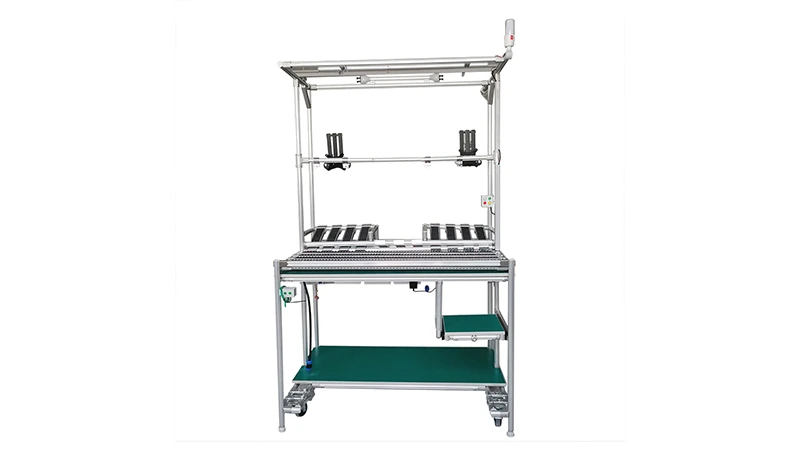
In the bustling heart of modern factories, where machines hum in sync and data flows as freely as the materials on the production line, one piece of equipment often goes unnoticed—yet it's the silent backbone of daily operations: the workbench. For decades, workbenches have been little more than sturdy tables, but in the era of Industry 4.0, they're evolving into intelligent hubs that connect workers, tools, and technology. Enter the Aluminum Workbench D—a game-changer designed not just to hold tools, but to elevate entire production systems. Let's dive into how this unassuming yet powerful workstation is bridging the gap between traditional manufacturing and the smart factories of tomorrow.
The Rise of Industry 4.0: Why Workbenches Matter More Than Ever
Industry 4.0 isn't just a buzzword; it's a revolution reshaping how products are made. Smart factories today rely on interconnected systems, IoT sensors, and real-time data to optimize efficiency, reduce waste, and adapt to changing demands. But amid all the high-tech machinery—robots, automated conveyors, AI-powered analytics—there's a critical human element: the workers who assemble, inspect, and troubleshoot. Their workspace, the workbench, is where the rubber meets the road. A poorly designed workbench can slow down operations, increase errors, and even demotivate teams. A smart workbench, though? It becomes a catalyst for productivity, safety, and innovation.
Consider this: In a typical electronics manufacturing plant, a single workbench might be used for assembling circuit boards, testing components, and packing finished products. If that workbench is clunky, hard to adjust, or lacks proper static protection, workers waste time rearranging tools, risk damaging sensitive parts, and struggle to keep up with fast-paced production schedules. Now imagine a workbench that's lightweight yet durable, customizable to fit any task, and built to integrate with smart tools like barcode scanners, digital work instructions, and ESD (Electrostatic Discharge) monitoring systems. That's the promise of Aluminum Workbench D.
Aluminum Workbench D: Beyond the Basics
At first glance, Aluminum Workbench D might look like any other workstation, but its magic lies in the details. Let's start with its core material: aluminum profile. Unlike traditional steel workbenches that are heavy and hard to modify, aluminum profile is lightweight, corrosion-resistant, and infinitely adaptable. Manufacturers know this well—aluminum extrusion profiles have long been favored in industries where flexibility and durability matter, from automotive to aerospace. When applied to workbenches, this material transforms rigidity into versatility.
Aluminum Workbench D (single deck, without caster, as specified in its design) is built using high-quality aluminum profiles that slot together with precision. The result? A workstation that can be reconfigured in minutes, not hours. Need to add a shelf for extra tools? Attach aluminum profile accessories like brackets or connectors. Want to integrate a monitor arm for digital work instructions? The T-slot design of the aluminum profile makes it easy to mount almost any accessory. This modularity is a cornerstone of Industry 4.0, where production lines must pivot quickly to meet shifting customer needs—whether that's a new product variant or a sudden surge in demand.
But it's not just about customization. Aluminum Workbench D is engineered with ergonomics in mind. Workers spend 8+ hours a day at their benches, so small details like height adjustability, smooth edges, and non-slip surfaces make a big difference. The aluminum profile's sleek, clean lines reduce clutter, while optional add-ons like LED task lighting or cable management channels keep the workspace organized. A tidy, comfortable workstation isn't just nicer to work at—it's proven to reduce errors and boost morale, directly impacting the bottom line.
ESD Workstation Integration: Protecting Sensitive Electronics
In industries like electronics manufacturing, static electricity is a silent enemy. A single electrostatic discharge can fry a microchip, rendering an entire circuit board useless. That's why ESD workstations are non-negotiable. Aluminum Workbench D takes ESD protection seriously, often coming equipped with ESD-safe surfaces, grounding points, and compatible accessories like ESD wristbands or matting. Unlike traditional workbenches that require retrofitting for ESD compliance, Aluminum Workbench D is designed from the ground up to integrate these features seamlessly.
Imagine a semiconductor plant where every component is worth hundreds of dollars. A worker at an ESD workstation built on Aluminum Workbench D can focus on assembling parts, knowing the bench itself is actively dissipating static charges. Sensors embedded in the workbench can even alert supervisors if grounding fails, preventing costly mistakes before they happen. This level of protection isn't just about avoiding defects—it's about building trust in the manufacturing process, ensuring customers receive products that meet the highest quality standards.
Roller Tracks: Connecting Workbenches to the Larger Ecosystem
No workbench exists in isolation. In a smart factory, it's part of a larger ecosystem of material flow—where parts arrive, are assembled, and move on to the next stage. That's where roller tracks come in. Aluminum Workbench D often pairs with roller track systems (like the 38 aluminum roller track with side guides or 40 steel roller track with yellow wheels) to create a seamless path for materials. Instead of workers manually carrying bins of parts from one bench to the next, gravity or motorized roller tracks move items automatically, reducing fatigue and human error.
For example, in an automotive parts assembly line, Aluminum Workbench D might be positioned at a key station where workers attach brackets to engine components. Parts arrive via a roller track from the previous station, gliding smoothly onto the bench. Once assembled, the finished component is pushed onto another roller track leading to quality control. This continuous flow minimizes bottlenecks and ensures that work progresses at a steady pace. Roller track accessories like end supports with stops or connectors make it easy to customize the flow path, whether it's a straight line, a curve, or a split to multiple workstations.

Lean System Principles in Action
At its core, Industry 4.0 is about more than technology—it's about leaner operations. Lean system principles, which focus on eliminating waste (muda) and continuous improvement (kaizen), align perfectly with the design of Aluminum Workbench D. Let's break down how this workbench supports lean manufacturing:
- Waste Reduction: Traditional workbenches often lead to waste in the form of time (searching for tools), space (cluttered surfaces), and materials (damaged parts due to poor ESD protection). Aluminum Workbench D's modular design cuts down on setup time, while its ESD features reduce scrap rates. Roller track integration minimizes transportation waste by moving materials efficiently.
- Continuous Improvement: The ability to reconfigure the workbench on the fly encourages teams to experiment with better layouts. Maybe moving a shelf to the left reduces reach time, or adding a roller track speeds up material transfer. These small adjustments, driven by worker feedback, add up to big gains over time.
- Value Stream Alignment: By integrating with other lean tools—like flow racks for parts storage or turnover trolleys for finished goods—Aluminum Workbench D becomes part of a cohesive value stream. Every component, from the aluminum profile to the roller track, is designed to keep value flowing to the customer without interruption.
A real-world example: A medical device manufacturer recently switched its assembly line to Aluminum Workbench D. Previously, workers used heavy steel benches that took two people to move and couldn't be adjusted for different tasks. After the switch, they reconfigured the line in a day, added roller tracks to connect workstations, and integrated ESD monitoring. The result? A 20% reduction in setup time, a 15% drop in defects, and workers reporting higher job satisfaction. "It feels like the bench was designed for us ," one assembler noted. That's the human touch of smart manufacturing.
Comparing Traditional vs. Smart Workbenches: A Closer Look
| Feature | Traditional Steel Workbench | Aluminum Workbench D (Smart) |
|---|---|---|
| Material | Heavy steel, prone to rust | Lightweight aluminum profile, corrosion-resistant |
| Customization | Limited; requires welding or drilling | Highly modular; uses aluminum profile accessories for quick changes |
| ESD Compatibility | Often requires retrofitting | Integrated ESD-safe surfaces and grounding |
| Integration with Smart Tools | Difficult; limited mounting options | Easy via T-slot aluminum profile (mount monitors, sensors, etc.) |
| Material Flow | Manual handling required | Compatible with roller tracks for automated material transfer |
| Ergonomics | Fixed height, minimal adjustability | Height-adjustable options, ergonomic add-ons (lighting, cable management) |

The Future of Workbenches: Where Aluminum Meets AI
Aluminum Workbench D is just the beginning. As Industry 4.0 matures, we'll see even smarter workstations that blur the line between physical and digital. Imagine a bench with built-in IoT sensors that track tool usage, alerting managers when a drill is about to fail. Or AI-powered cameras that detect assembly errors in real time, guiding workers to correct mistakes instantly. Aluminum profile's adaptability will make these innovations possible—its T-slot design can accommodate new sensors, actuators, or even robotic arms as technology advances.
Sustainability is another trend shaping the future of workbenches. Aluminum is 100% recyclable, and its lightweight nature reduces transportation emissions. As manufacturers prioritize green operations, Aluminum Workbench D's eco-friendly design will become a selling point. Plus, its modularity means less waste—instead of replacing an entire bench when needs change, just swap out a few aluminum profile accessories.
But perhaps the most exciting future development is the workbench as a collaborative hub. With 5G connectivity, workers at Aluminum Workbench D could video-chat with experts across the globe for troubleshooting, or share real-time data with AI systems that suggest process improvements. The bench won't just be a place to work—it'll be a node in a global network of manufacturing excellence.
Conclusion: The Workbench as a Catalyst for Change
In the grand scheme of Industry 4.0, Aluminum Workbench D might seem like a small piece of the puzzle. But as any manufacturer knows, the smallest pieces often hold the puzzle together. This unassuming workstation—built with aluminum profile, designed for customization, and integrated with ESD protection and roller tracks—is redefining what it means to work smart. It's a tool that empowers workers, protects products, and adapts to the ever-changing demands of modern manufacturing.
At the end of the day, Industry 4.0 isn't about replacing humans with machines. It's about giving humans the tools they need to thrive in a digital world. Aluminum Workbench D does exactly that—by combining the best of material science, ergonomics, and smart technology, it turns the ordinary into the extraordinary. So the next time you walk through a factory, take a closer look at the workbenches. The ones that are lightweight, modular, and buzzing with activity? Chances are, they're Aluminum Workbench D—and they're not just building products. They're building the future of manufacturing.