- Company Articles
- Products and Technology
- Procurement Guidelines
- Aluminum Workbench D Cost Analysis: Long-Term Savings Over Disposable Workstations

Aluminum Workbench D Cost Analysis: Long-Term Savings Over Disposable Workstations
Related Product
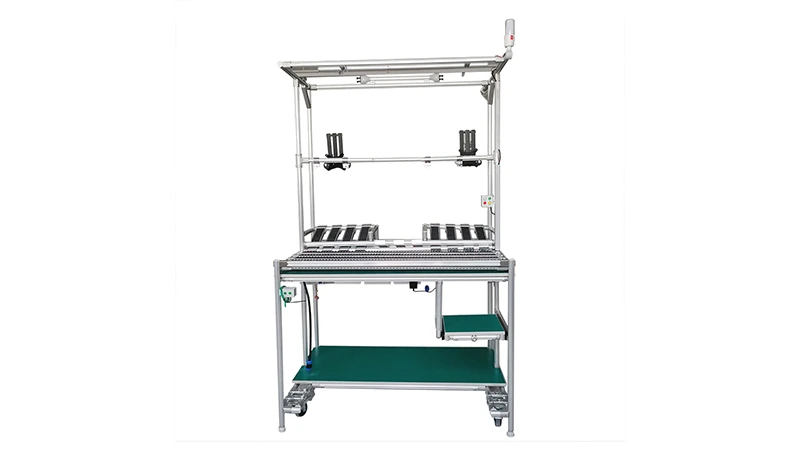
Aluminum Workbench D
Aluminum tube workbench is more flexible and durable, compared with traditional PE/ABS coated steel tube. It is easy to assemble, anti corrosion, rust protection, and recycle use after disassemble.
The Hidden Price Tag of "Cheap" Workstations
Walk into any small manufacturing shop, warehouse, or even a home garage workshop, and you'll likely spot them: rickety particle board tables, flimsy plastic work surfaces, or metal frames that already show signs of rust after just a few months. These are the "disposable workstations"—the ones bought for $100-$200 at big-box stores, marketed as "affordable" or "temporary." But here's the thing no one talks about: their true cost isn't in the initial purchase. It's in the constant replacements, the downtime when they break, and the inefficiency they bring to your workflow. When you add it all up, those "cheap" workstations end up costing far more than a quality solution like the Aluminum Workbench D.
Let's start with the obvious: durability. A typical disposable workstation might last 6-12 months in a busy environment. Spills, heavy tools, daily wear and tear—they take a toll fast. Particle board swells with moisture; plastic cracks under weight; thin metal bends. So you replace it. Then replace it again. And again. Over five years, that's 5-10 replacements. At $150 each, that's $750-$1,500 spent on workstations that never quite meet your needs. Compare that to the Aluminum Workbench D, which is built to last 10+ years with minimal maintenance. Suddenly, the "expensive" upfront cost doesn't seem so steep.
What Makes Aluminum Workbench D Different?
Before diving into the numbers, let's talk about what sets the Aluminum Workbench D apart. This isn't just another table. It's a modular, heavy-duty solution designed with the principles of a lean system in mind—meaning it's built to reduce waste, improve efficiency, and adapt to your changing needs. At its core is high-grade aluminum profile, chosen for its strength, lightweight properties, and resistance to corrosion. Unlike steel, it won't rust when exposed to oils or coolants. Unlike wood or plastic, it won't warp, crack, or degrade under heavy loads. And because it's aluminum, it's easy to clean, which is a game-changer for environments where hygiene matters (think food processing, electronics assembly, or medical device manufacturing).
But the Aluminum Workbench D isn't just durable—it's customizable. Need to add shelves? Attach a tool rail? Mount a monitor arm? The aluminum profile's T-slot design lets you add accessories without drilling or welding. And if your workflow changes six months down the line? You can reconfigure the workbench in minutes, no new equipment needed. That adaptability is key to long-term savings. Disposable workstations are one-size-fits-nothing; the Aluminum Workbench D grows with your business.
Mobility is another hidden advantage. Many models come with optional caster wheels, making it easy to move the workbench where it's needed most—whether that's shifting production lines, reorganizing the shop floor, or cleaning around it. Disposable workstations? They're usually fixed in place, or if they do have wheels, they're cheap plastic casters that lock up or break after a few moves. The Aluminum Workbench D's heavy-duty caster wheel set is built to handle daily movement without wearing out, adding even more value to its lifespan.

The Cost Breakdown: Aluminum Workbench D vs. Disposable Workstations
Let's get concrete. To truly understand the savings, we'll compare the total 5-year cost of owning an Aluminum Workbench D versus a typical disposable workstation (we'll use a mid-range plastic/particle board model costing $150 as our example). We'll include initial purchase, replacements, maintenance, and even downtime costs—because when a workstation breaks, your team isn't just waiting for a new one; they're losing productivity.
| Cost Category | Aluminum Workbench D | Disposable Workstation (Plastic/Particle Board) |
|---|---|---|
| Initial Purchase Cost | $650 (single deck, without caster wheels) | $150 |
| Annual Replacement Cost (5 Years) | $0 (no replacement needed) | $150/year x 5 years = $750 |
| Maintenance Cost (5 Years) | $50 (occasional cleaning, minor part replacements like caster wheel bearings) | $0 (disposable; no maintenance—just replace when broken) |
| Downtime Cost (5 Years) | $0 (rarely breaks; if it does, parts are replaceable in hours) | $1,200 (assuming 1 day of downtime per replacement, 5 replacements, $240/day labor cost) |
| Total 5-Year Cost | $700 | $2,100 |
The numbers speak for themselves: over five years, the Aluminum Workbench D saves you $1,400 compared to a disposable workstation. And that's a conservative estimate. If your team's labor cost is higher (say, $300/day), or if you need to replace the disposable workstation more often (every 6 months instead of 12), the gap grows even wider. For example, with 10 replacements over five years and $300/day downtime, the disposable workstation's total cost jumps to $3,450—nearly five times the cost of the Aluminum Workbench D.

Beyond the Numbers: The Lean System Advantage
Cost savings are important, but the Aluminum Workbench D's value goes beyond dollars and cents. It's designed to support a lean system, which focuses on eliminating waste and maximizing efficiency. In a lean environment, every second counts—and a poorly designed workstation creates waste in ways you might not even notice.
Take workflow, for example. A disposable workstation often lacks proper storage, so tools end up scattered on the floor or across the bench, leading to time wasted searching. The Aluminum Workbench D, with its customizable aluminum profile accessories (think tool hooks, bin rails, and overhead shelves), keeps everything within arm's reach. Studies show that workers spend up to 20% of their day looking for tools; a well-organized workbench can cut that time in half. Over a year, that's hundreds of hours saved—time that can be spent on actual production.
Then there's ergonomics. Disposable workstations are often one height fits all, leading to strain, fatigue, and even injuries over time. The Aluminum Workbench D can be adjusted to match your team's height (some models offer height-adjustable legs), reducing the risk of back pain or repetitive stress injuries. Fewer injuries mean fewer sick days, lower workers' comp costs, and a happier, more productive team. That's an intangible saving, but it's one that impacts your bottom line just as much as the cost of replacements.
Real-World Savings: A Small Manufacturer's Story
Let's put this in context with a real example. Take a small electronics assembly shop with 5 workstations. For years, they used disposable plastic workbenches, replacing each one every 8 months at $180 each. Their team of 5 spent about 10 minutes per day searching for tools (thanks to cluttered workspaces) and lost an average of 2 days per year per workstation to downtime when benches broke. Labor cost was $25/hour.
In 2022, they switched to Aluminum Workbench D. Here's what happened over 3 years:
- Replacement savings: 5 workstations x 4 replacements (every 8 months) = 20 replacements. At $180 each, that's $3,600. With Aluminum Workbench D, $0 replacements. Savings: $3,600.
- Downtime savings: 5 workstations x 2 days/year x 3 years = 30 downtime days. At $25/hour x 8 hours/day = $200/day. Savings: 30 x $200 = $6,000.
- Tool search time savings: 5 workers x 10 minutes/day x 260 workdays/year x 3 years = 6,500 minutes = ~108 hours. At $25/hour, savings: 108 x $25 = $2,700.
Total 3-year savings: $3,600 + $6,000 + $2,700 = $12,300. The initial investment for 5 Aluminum Workbench D units? $3,250 (5 x $650). That means they recouped their investment in less than 4 months—and saved over $9,000 in the first 3 years alone.
Why the Initial Investment Is Worth It
We get it: $650 for a workbench can feel like a lot upfront, especially when there are $150 options on the shelf. But as we've shown, the Aluminum Workbench D isn't an expense—it's an investment. It's an investment in durability, efficiency, and adaptability. It's an investment in your team's productivity and well-being. And it's an investment that pays for itself many times over.
Think about it this way: if you're in business for the long haul, you need equipment that grows with you. The Aluminum Workbench D's modular design means you can add shelves, tool holders, or even connect multiple workbenches into a production line as your business expands. Disposable workstations? They're stuck in time—you'll outgrow them before they wear out. And when you do, you'll be back to square one, spending more money on another temporary fix.
Another angle: resale value. Even after 10 years, an Aluminum Workbench D will still have value. You can sell it, repurpose it, or pass it down to a new team member. Disposable workstations? They end up in landfills, contributing to waste and costing you nothing in return. In a world where sustainability matters (to customers, to employees, and to the planet), that's a small but meaningful bonus.
Final Thoughts: Invest in What Lasts
At the end of the day, the choice between disposable workstations and the Aluminum Workbench D isn't just about cost—it's about priorities. If you value short-term savings over long-term efficiency, disposable might seem tempting. But if you want to build a business that runs smoothly, minimizes waste, and keeps costs low over time, the Aluminum Workbench D is the clear choice.
So the next time you're tempted by that $150 workstation, ask yourself: How much will this really cost me in 5 years? The answer, we think, will lead you to a better investment—one that pays off in durability, efficiency, and peace of mind. The Aluminum Workbench D isn't just a workbench. It's a foundation for your success.