- Company Articles
- Products and Technology
- Product knowledge
- Aluminum Workbench D for Mobile Workstations: Enhancing Workflow Mobility in Factories

Aluminum Workbench D for Mobile Workstations: Enhancing Workflow Mobility in Factories
Related Product
Aluminum Workbench D
Aluminum tube workbench is more flexible and durable, compared with traditional PE/ABS coated steel tube. It is easy to assemble, anti corrosion, rust protection, and recycle use after disassemble.
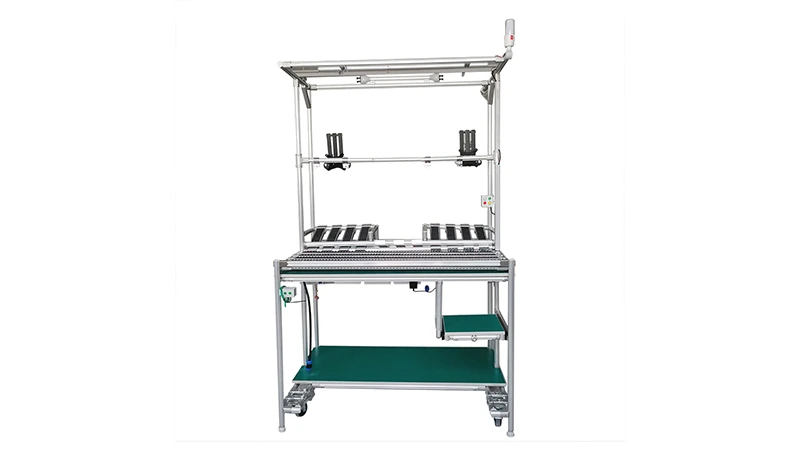
In the bustling heart of any factory, where every second counts and efficiency is the lifeblood of production, the layout of workstations can make or break daily operations. Workers dart between assembly lines, tools are passed back and forth, and materials flow in a constant stream—yet all too often, fixed workbenches become silent bottlenecks. A technician might spend precious minutes walking to a stationary bench to grab a wrench, or a supervisor could delay a shift start because a work surface isn't positioned where it's needed most. This is where the Aluminum Workbench D steps in: not just as a piece of equipment, but as a dynamic solution designed to keep pace with the rhythm of modern manufacturing.
Crafted with the demands of lean manufacturing in mind, Aluminum Workbench D redefines what a workstation can be. Its lightweight yet sturdy aluminum profile frame, paired with smooth-rolling caster wheels, transforms static workspaces into mobile hubs that adapt to your team's needs. Whether you're assembling electronics on a tight timeline, organizing tools for a maintenance check, or rearranging a production line to meet a sudden order surge, this workbench moves with you—eliminating wasted steps, reducing fatigue, and turning chaos into controlled, efficient motion. Let's dive into how this innovative tool is reshaping factory workflows, one roll at a time.
The Anatomy of Aluminum Workbench D: Built for Mobility and Durability
At first glance, Aluminum Workbench D stands out for its clean, industrial design—but its true strength lies in the details. Unlike traditional wooden or steel workbenches that weigh hundreds of pounds and stay rooted to the floor, this workstation is engineered for flexibility. The secret starts with its core material: high-grade aluminum profile. Aluminum isn't just lightweight; it's resistant to corrosion, easy to clean, and strong enough to handle the rigors of factory life. A typical Aluminum Workbench D weighs in at under 80 pounds (when unloaded), making it easy for a single worker to maneuver, yet it can support up to 500 pounds of tools, parts, or equipment—no wobbly surfaces or sagging shelves here.
But what truly sets it apart is its mobility system: premium caster wheels. These aren't your average office chair casters. Each wheel is designed with a 360-degree swivel mechanism, allowing the workbench to glide smoothly around corners, navigate narrow aisles, and pivot precisely into position. Most models come with brake locks, too—flip a lever, and the workstation stays firmly in place, even when workers are leaning on it or heavy items are being placed on top. For factories with uneven floors, some variants include adjustable caster feet, ensuring stability on cracked concrete or grated surfaces without sacrificing mobility.
The workbench's surface is another highlight. Made from a single aluminum deck (similar in design to the "workbench e" model but optimized for mobility), it's flat, scratch-resistant, and non-conductive—ideal for electronics assembly where static electricity could damage components. Optional add-ons, like aluminum profile accessories such as side rails or tool hooks, let teams customize the space to their needs. Need a place to hang power tools? Screw in a hook using the T-slot aluminum pipe edges. Want to separate small parts? Add a divider using compatible aluminum profile brackets. This modularity means the workbench grows with your operations, not against them.
From Fixed to Fluid: How Mobility Solves Lean Manufacturing's Biggest Pain Points
Lean manufacturing isn't just a buzzword—it's a philosophy centered on eliminating waste, and one of the biggest sources of waste in factories is "transportation waste": the unnecessary movement of people, tools, or materials. Traditional fixed workbenches are a prime culprit. Imagine a scenario where an assembly line worker needs a torque wrench stored on a bench 50 feet away. Each trip takes 2 minutes, and over an 8-hour shift, that adds up to 40 minutes of lost productivity—time that could be spent building products instead of walking. Multiply that across a team of 20 workers, and you're looking at over 13 hours of wasted time per day.
Aluminum Workbench D crushes this inefficiency by bringing the workstation to the worker. In a case study at a mid-sized automotive parts plant, teams replaced 10 fixed benches with 8 mobile Aluminum Workbench D units. Within a month, they reported a 22% reduction in "transportation waste" and a 15% increase in daily output. Workers no longer had to leave their stations to retrieve tools; instead, supervisors positioned the workbenches along the assembly line at the start of each shift, ensuring every team member had what they needed within arm's reach. "It's like having a toolbox on wheels that follows you," one technician noted. "I used to make 12 trips a day to the old bench—now I make zero."
Another lean principle Aluminum Workbench D supports is "continuous flow." In factories where production steps are sequential, materials must move seamlessly from one station to the next. With a mobile workbench, this flow becomes dynamic. For example, in a electronics factory assembling circuit boards, a team might use the workbench to hold components at the "soldering" station in the morning, then roll it to the "testing" station in the afternoon as priorities shift. If a bottleneck forms at the packaging line, supervisors can quickly reposition the workbench to add an extra packing surface, keeping the line moving without halting production.

Beyond Mobility: Integrating Roller Track for Smarter Material Handling
While mobility is its headline feature, Aluminum Workbench D becomes even more powerful when paired with roller track—a simple yet game-changing addition for material flow. Roller track, often made from plastic or aluminum guide rails with embedded wheels, turns the workbench's surface into a mini conveyor belt, allowing parts, boxes, or tools to slide smoothly from one end to the other (or even off the side, with the right accessories). This is a game-changer for assembly lines where workers pass components back and forth, or for packaging stations where finished products need to move to a shipping area.
Take a small appliance factory, for instance, where workers assemble blenders. The Aluminum Workbench D, fitted with a yellow plastic roller track guide rail, holds the base components. As each blender base is assembled, the worker pushes it along the roller track to the next station, where another team member adds the motor. No more lifting heavy bases or passing them by hand—gravity and the smooth-rolling track do the work. Some roller track models even include side guides (like the aluminum guide rail A or B) to keep items from slipping off, ensuring precision even during fast-paced shifts.
Roller track isn't just for moving finished goods, either. It's equally useful for organizing tools and supplies. A maintenance team might line the workbench with roller track to hold bins of screws, nuts, and washers. When a repair is needed, they roll the workbench to the machine, then slide the required bin to the edge—no more digging through drawers or tipping over toolboxes. And because the roller track is modular (thanks to aluminum profile accessories like roller track placon mounts), teams can add or remove sections as needed. A busy season might call for a full-length track, while slower periods could use a shorter setup to save space.

Aluminum Profile: The Backbone of Customization
At the core of Aluminum Workbench D's versatility is its use of aluminum profile—a material that has revolutionized industrial design with its modularity. Unlike traditional steel benches, which are welded into fixed shapes, aluminum profile systems use interlocking joints and brackets, allowing workers to reconfigure the workbench on the fly. Need an extra shelf? Screw in an aluminum profile bracket. Want to add a lamp for better visibility? Attach it to the T-slot aluminum pipe frame. This adaptability makes the workbench suitable for virtually any task, from intricate electronics assembly to heavy-duty mechanical repairs.
Aluminum profile accessories are the unsung heroes here. Items like internal rotary aluminum joints let the workbench's shelves pivot, so workers can access tools from multiple angles. Parallel aluminum joints allow for side extensions, turning a single work surface into a L-shaped station for collaborative tasks. Even the smallest details, like aluminum profile end caps, add value—they cover sharp edges, preventing scratches on tools and cuts on hands. For factories with strict hygiene standards (like food processing or pharmaceutical plants), stainless steel pipe series accessories are available, ensuring the workbench resists rust and stands up to frequent sanitization.
Perhaps the most compelling aspect of aluminum profile is its longevity. Unlike wooden benches that warp or steel ones that rust, aluminum holds up to years of heavy use. A factory in Texas, for example, has been using the same set of Aluminum Workbench D units for over 7 years—after regular cleaning and occasional replacement of caster wheels, they still look and function like new. "We used to replace wooden benches every 2-3 years because they'd get water-damaged or termite-eaten," the plant manager explained. "These aluminum ones? They're indestructible. It's the best investment we've made in our workflow."
Comparing Aluminum Workbench D to Traditional Workstations: A Clear Advantage
To truly appreciate the impact of Aluminum Workbench D, it helps to see how it stacks up against traditional workstations. Let's break down the key differences:
| Feature | Traditional Fixed Workbench | Aluminum Workbench D |
|---|---|---|
| Mobility | Stationary; requires disassembly to move | Mobile with caster wheels; can be repositioned in seconds |
| Weight | 200-300 lbs (steel/wood); difficult to move | 60-80 lbs (aluminum); single-person maneuverable |
| Customization | Limited; fixed shelves, no modular add-ons | High; aluminum profile accessories for shelves, roller track, etc. |
| Durability | Prone to rust (steel) or warping (wood); 2-3 year lifespan | Corrosion-resistant aluminum; 7+ year lifespan |
| Lean System Alignment | Causes transportation waste; rigid layout | Reduces waste; supports continuous flow and flexibility |
The table tells a clear story: Aluminum Workbench D isn't just an upgrade—it's a paradigm shift. Traditional workbenches are relics of a time when factory layouts rarely changed and workers were expected to adapt to static environments. Today's factories need tools that adapt to workers, and that's exactly what this mobile workstation delivers.
Real-World Impact: Stories from the Factory Floor
Numbers and specs tell part of the story, but the real proof of Aluminum Workbench D's value lies in the experiences of the teams using it daily. Take Maria, a production supervisor at a consumer electronics plant in California. Her team assembles smartwatches, a process that requires dozens of tiny components and constant collaboration between soldering, testing, and packaging stations. "Before we got the Aluminum Workbench D, our soldering techs had to walk 30 feet to the parts bench every time they needed a new circuit board," she recalls. "It was chaos—people bumping into each other, parts getting misplaced, and we were always behind schedule."
After switching to three mobile workbenches, Maria's team saw immediate results. "We loaded each bench with circuit boards, solder, and tools, then positioned them right next to the soldering stations. Now, the techs never leave their seats—they just roll the bench closer if they need something. Our defect rate dropped by 8% because workers aren't rushing to grab parts, and we're hitting our daily quotas consistently. Plus, at the end of the shift, we roll the benches to the cleaning area, wipe them down, and they're ready for the next day. No more scrubbing rust off steel benches or dealing with splintered wood."
Another success story comes from a furniture manufacturer in Michigan, where space is at a premium. The plant produces custom office chairs, and with orders fluctuating seasonally, the production floor layout needs to change constantly. "We used to have fixed workbenches bolted to the floor, and rearranging them took a crew of four guys and half a day," says Tom, the plant manager. "Now, with Aluminum Workbench D, two workers can reconfigure the entire line in an hour. During our busy season, we set up 10 workbenches in a U-shape for maximum efficiency. In the slow season, we stack half of them (using aluminum pipe clamps to secure them) and free up space for storage. It's like having a factory that shrinks and grows with our needs."
Maintenance and Care: Keeping Your Workbench Rolling Smoothly
Like any tool, Aluminum Workbench D performs best with regular care—but unlike traditional workstations, maintenance is refreshingly simple. The aluminum frame resists rust and corrosion, so a quick wipe with a damp cloth is usually enough to remove grease or dust. For tougher stains (like oil spills), a mild detergent and soft brush work wonders—no harsh chemicals needed. The caster wheels, the workbench's "engine," do require a bit more attention: every month, add a drop of lubricating oil to the swivel joints to keep them turning smoothly, and check the brake locks to ensure they engage firmly. If a wheel gets stuck (common in factories with metal shavings or debris), remove it, clean out the axle, and reattach—most caster wheels are designed for tool-free removal, so you won't need a mechanic to fix them.
Aluminum profile accessories, like roller track or shelves, are equally low-maintenance. Tighten any loose brackets with a hex key every quarter, and replace worn roller track wheels (which are inexpensive and widely available from lean system suppliers) if they start to squeak or slow down. For factories using the workbench in ESD-sensitive areas (like electronics manufacturing), occasional testing with an ESD meter ensures the surface still dissipates static—though aluminum's natural conductivity means this is rarely an issue.
Conclusion: Moving Toward a More Efficient Future
In the fast-paced world of manufacturing, where adaptability and efficiency are non-negotiable, Aluminum Workbench D emerges not just as a workstation, but as a partner in progress. Its lightweight aluminum profile frame, smooth-rolling caster wheels, and modular design address the core challenges of modern factory floors: reducing waste, improving mobility, and adapting to ever-changing demands. Whether you're a small shop looking to streamline workflows or a large plant aiming to scale operations, this mobile workbench delivers tangible results—from fewer worker injuries (thanks to reduced lifting and walking) to higher output and happier teams.
As more factories embrace lean system principles and modular manufacturing, tools like Aluminum Workbench D will become essential. They're not just about moving workbenches—they're about moving forward, one roll at a time. So the next time you walk through your factory floor, take a look at those fixed workbenches. Imagine the time saved, the steps eliminated, and the potential unlocked if they could move with your team. With Aluminum Workbench D, that vision isn't just possible—it's already transforming factories around the world.