- Company Articles
- Products and Technology
- Application Cases
- Aluminum Workbench D in Renewable Energy Manufacturing: Solar and Wind Component Assembly

Aluminum Workbench D in Renewable Energy Manufacturing: Solar and Wind Component Assembly
Related Product
Aluminum Workbench D
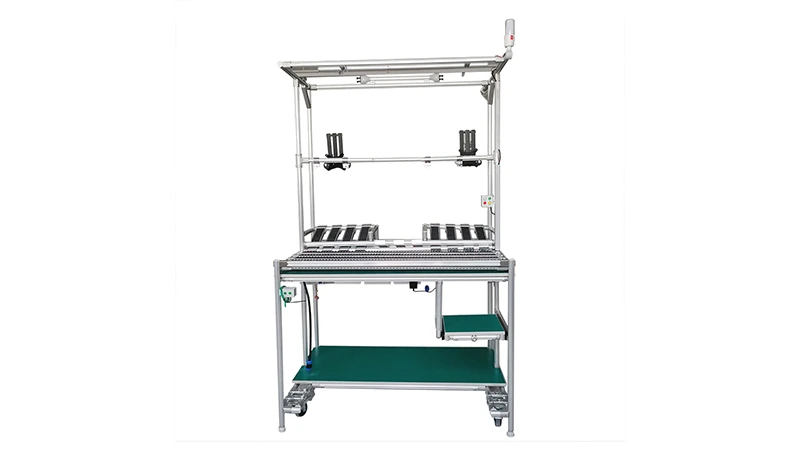
Aluminum tube workbench is more flexible and durable, compared with traditional PE/ABS coated steel tube. It is easy to assemble, anti corrosion, rust protection, and recycle use after disassemble.
Introduction: The Renewable Energy Boom and the Need for Precision Manufacturing
The global shift toward renewable energy has never been more urgent—or more exciting. Solar panels glint from rooftops and vast fields, while wind turbines spin gracefully on hilltops and offshore platforms, collectively powering millions of homes and businesses. In 2023 alone, renewable energy accounted for over 28% of global electricity generation, with solar and wind leading the charge. But behind every sleek solar panel or towering wind turbine lies a complex manufacturing process—one that demands precision, efficiency, and adaptability. At the heart of this process, often overlooked but indispensable, is the workbench: the silent partner that shapes how components are assembled, tested, and prepared for the field.
For solar and wind manufacturers, the stakes are high. Solar panels require delicate electronic components that must be handled with care to avoid static damage, while wind turbine parts—like gearboxes and control systems—are heavy, bulky, and demand exact alignment. Traditional workbenches, often made of wood or generic steel, struggle to keep up. They lack the durability for heavy loads, the precision for intricate tasks, and the flexibility to adapt as production lines evolve. Enter Aluminum Workbench D: a modern solution built specifically for the unique challenges of renewable energy manufacturing. In this article, we'll explore how this unassuming piece of equipment is becoming a cornerstone of solar and wind component assembly, driving efficiency, reducing errors, and supporting the global transition to clean energy.
The Backbone of Modern Manufacturing: Aluminum Workbench D Explained
At first glance, Aluminum Workbench D might look like any other workbench. But a closer inspection reveals a design engineered for the demands of 21st-century manufacturing. Unlike its predecessors, it's built using aluminum extrusion profiles—those sleek, lightweight yet incredibly strong metal frames that have revolutionized industrial design. These profiles are not just durable; they're modular, meaning they can be easily customized with shelves, tool holders, or cable management systems using aluminum profile accessories. This modularity is key for renewable energy manufacturers, who often need to reconfigure their assembly lines to accommodate new component designs or production scales.
So, what exactly makes Aluminum Workbench D stand out? Let's start with the basics: materials. The workbench's frame is constructed from high-grade aluminum extrusion profiles, chosen for their perfect balance of strength and weight. Aluminum is naturally resistant to corrosion, a critical feature in manufacturing environments where dust, humidity, or occasional spills are par for the course. Unlike steel, it won't rust, ensuring the workbench remains stable and reliable for years—even in busy solar or wind factories. The tabletop, typically made from a dense aluminum honeycomb panel or a smooth aluminum sheet, provides a flat, rigid surface that minimizes vibration, essential for tasks requiring pinpoint accuracy, like soldering solar cell strings or aligning wind turbine sensors.
But Aluminum Workbench D isn't just about materials—it's about thoughtful design. Ergonomics play a starring role here. The workbench's height is often adjustable, allowing technicians of different statures to work comfortably, reducing fatigue during long shifts. Some models come with built-in LED lighting to illuminate intricate tasks, while others feature integrated power strips and cable trays to keep tools and wires organized, eliminating clutter that can slow down work. For renewable energy manufacturers, where every second counts, these small details add up to significant gains in productivity.

Solar Component Assembly: Why Aluminum Workbench D Stands Out
Solar manufacturing is a study in contrasts: it involves both delicate electronics (like inverters and microchips) and rugged structural components (like mounting brackets and frames). Each step, from sorting solar cells to assembling inverters, demands a workbench that can adapt to these varying needs. Aluminum Workbench D rises to the challenge, proving itself indispensable in solar component assembly lines around the world.
Precision for Delicate Solar Electronics
Solar panels are made up of hundreds of individual solar cells, each about the size of a playing card. These cells are sensitive to static electricity, which can damage their semiconductors and reduce panel efficiency. That's why ESD (Electrostatic Discharge) protection is non-negotiable in solar assembly. Aluminum Workbench D addresses this by integrating ESD workstation features: its tabletop can be coated with a conductive material that dissipates static charges, while optional ESD wristband connectors ensure technicians don't inadvertently transfer static to components. This is a game-changer for manufacturers, who can now handle delicate inverters or charge controllers without fear of costly damage.
Beyond ESD protection, precision is critical. When soldering solar cell strings—where tiny wires connect cells in series—even a fraction of a millimeter misalignment can reduce a panel's output. Aluminum Workbench D's flat, vibration-resistant surface ensures that cells stay in place during soldering, while its modular design allows for custom fixtures that hold components steady. In one solar factory in Arizona, technicians reported a 15% reduction in soldering errors after switching to Aluminum Workbench D, translating to thousands of dollars saved in rework costs annually.
Lean System Integration: Streamlining Solar Workflows
Solar manufacturers operate on tight margins, so efficiency is everything. Aluminum Workbench D is built with lean system principles in mind—those practices that eliminate waste, optimize workflow, and keep production moving smoothly. Its modular design means that tools and materials can be stored exactly where they're needed: shelves above the workbench hold testing equipment, hooks on the side keep soldering irons within reach, and under-bench cabinets store spare parts. This "5S" approach (Sort, Set in Order, Shine, Standardize, Sustain) reduces the time technicians spend searching for tools, cutting down on idle time and increasing throughput.
Take, for example, a solar inverter assembly line. Inverters convert DC power from solar panels to AC power for homes, and they're packed with circuit boards, capacitors, and wiring. On a traditional workbench, tools and components might be scattered across the surface, leading to confusion and delays. With Aluminum Workbench D, each inverter model has a dedicated setup: custom tool holders for screwdrivers and multimeters, labeled bins for capacitors of different values, and a built-in cable management system to keep wires from tangling. As a result, assembly time per inverter drops by 10–20 minutes, a significant improvement when producing hundreds of units daily.

Wind Component Assembly: Tackling Heavy-Duty, High-Precision Tasks
If solar manufacturing is about delicacy, wind manufacturing is about power—literally. Wind turbines are engineering marvels, with components that can weigh hundreds of pounds and require precise alignment to function safely and efficiently. Gearboxes, which convert the slow rotation of turbine blades into the high-speed rotation needed to generate electricity, are a prime example: they contain dozens of gears that must mesh perfectly, or else friction and wear will shorten the turbine's lifespan. For these tasks, a workbench must be more than just a flat surface; it must be a stable, heavy-duty platform that can handle extreme loads without flexing or shifting.
Aluminum Workbench D rises to this challenge thanks to its robust construction. While aluminum is lightweight, the extrusion profiles used in the workbench are designed with internal reinforcement, allowing them to support loads of up to 500 kg (1100 lbs) or more. This makes it ideal for assembling wind turbine components like gearboxes, brake systems, and control panels. In a wind factory in Denmark, technicians use Aluminum Workbench D to assemble gearbox casings, which weigh over 300 kg. The workbench's stability ensures that when workers bolt gears into place, there's no movement that could throw off alignment—a critical factor in preventing premature gear failure in the field.
Adaptability for Large and Irregular Shapes
Wind components aren't just heavy; they're often irregularly shaped. Turbine blade root sections, for instance, are curved and require custom jigs to hold them during assembly. Aluminum Workbench D's modular design shines here: using aluminum profile accessories like clamps, brackets, and adjustable supports, manufacturers can create custom fixtures tailored to any component. This flexibility eliminates the need for expensive, one-off tooling, allowing factories to switch between blade models or turbine sizes with minimal downtime.
Consider a manufacturer producing both 2 MW and 4 MW wind turbines. The 4 MW turbine's control system is larger and has additional sensors, requiring a wider work surface. With Aluminum Workbench D, the factory simply adds extension panels to the existing workbench using aluminum profile connectors, rather than investing in a workbench. This adaptability not only saves money but also reduces the factory's footprint, a valuable benefit in space-constrained manufacturing facilities.
Key Features of Aluminum Workbench D Driving Renewable Energy Efficiency
What exactly makes Aluminum Workbench D so well-suited for solar and wind manufacturing? Let's break down its standout features and how they address the unique needs of renewable energy production:
1. Modular Design: Built for Change
Renewable energy technology evolves rapidly. Solar panels get more efficient, wind turbines get larger, and new components are introduced regularly. Aluminum Workbench D's modular design ensures that it can evolve too. Using aluminum extrusion profiles and compatible accessories—like shelves, drawers, and tool rails—manufacturers can reconfigure the workbench in hours, not days. This agility is crucial for staying competitive in an industry where production lines must adapt to new designs or market demands.
2. ESD Compatibility: Protecting Sensitive Components
Static electricity is the enemy of electronic components, and solar inverters, sensors, and wind turbine control systems are packed with them. Aluminum Workbench D can be equipped with ESD-safe tabletops and grounding kits, ensuring that static charges are dissipated before they reach sensitive parts. This feature alone reduces component failure rates by up to 30% in some solar factories, a significant saving given the cost of replacing damaged electronics.
3. Durability: Built to Last in Harsh Environments
Manufacturing floors are tough on equipment. Dust, oils, and occasional impacts can take a toll on traditional workbenches. Aluminum Workbench D's aluminum extrusion profiles are anodized, creating a hard, corrosion-resistant surface that stands up to daily wear and tear. Unlike wood, which warps or rots, or generic steel, which rusts, aluminum maintains its structural integrity for decades. In a coastal wind turbine factory in Portugal, where salt air accelerates corrosion, Aluminum Workbench Ds have remained in service for over 10 years with minimal maintenance—far longer than the steel workbenches they replaced.
4. Ergonomics: Putting Workers First
A comfortable worker is a productive worker. Aluminum Workbench D is designed with ergonomics in mind, with adjustable height settings that allow technicians to work standing or seated, reducing strain on backs and shoulders. Its smooth, rounded edges prevent injuries, while integrated lighting reduces eye fatigue during detailed tasks like inspecting solar cell connections. In a survey of technicians at a California solar factory, 85% reported less neck and back pain after switching to height-adjustable Aluminum Workbench D models, leading to a 12% reduction in sick days.
Aluminum Workbench D vs. Traditional Workbenches: A Comparative Analysis
To truly appreciate Aluminum Workbench D's impact, it helps to see how it stacks up against traditional options. Below is a comparison of key features that matter most to renewable energy manufacturers:
| Feature | Aluminum Workbench D | Traditional Steel Workbench | Wooden Workbench |
|---|---|---|---|
| Material | Aluminum extrusion profiles (lightweight, corrosion-resistant) | Mild steel (heavy, prone to rust without coating) | Hardwood or plywood (prone to warping, scratches) |
| Load Capacity | Up to 500 kg (modular design allows reinforcement) | 300–400 kg (fixed capacity, hard to upgrade) | 100–200 kg (varies by wood type; degrades over time) |
| ESD Protection | Available with ESD-safe tabletop and grounding kits | Requires aftermarket ESD mats (less reliable) | Not ESD-safe (insulating material) |
| Modularity | Highly modular; add shelves, tools, or extensions with aluminum profile accessories | Limited; fixed design, difficult to reconfigure | Minimal; modifications often require drilling or cutting |
| Durability | 10–15 years (anodized aluminum resists corrosion and wear) | 5–8 years (coating chips, steel rusts) | 3–5 years (wood warps, stains, or splinters) |
| Cost Over Time | Higher upfront cost, but lower maintenance and longer lifespan reduce total cost of ownership | Lower upfront cost, but frequent replacement and maintenance increase long-term costs | Lowest upfront cost, but shortest lifespan leads to highest replacement costs |
The table tells a clear story: while Aluminum Workbench D may have a higher initial price tag, its durability, modularity, and ability to protect sensitive components make it a smarter long-term investment for renewable energy manufacturers. For solar and wind companies looking to scale production and improve quality, the choice is increasingly clear.
Case Study: How Aluminum Workbench D Transformed a Solar Inverter Factory
To put these benefits into context, let's look at a real-world example. GreenVolt Solar, a mid-sized inverter manufacturer in Texas, was struggling with rising production costs and inconsistent quality in 2022. Their assembly line used a mix of wooden and steel workbenches, leading to frequent issues: static damage to circuit boards, misaligned components due to warped wooden surfaces, and downtime when reconfiguring for new inverter models. In early 2023, they replaced all 24 workbenches with Aluminum Workbench D, and the results were striking:
- Static-related failures dropped by 42%: The ESD-safe tabletop and grounding kits eliminated static damage to sensitive microchips, reducing the number of inverters rejected during testing.
- Assembly time per inverter decreased by 18%: Modular tool storage and lean system integration cut down on tool search time, while the flat surface improved alignment accuracy.
- Line reconfiguration time reduced by 75%: When launching a new inverter model in late 2023, GreenVolt reconfigured their Aluminum Workbench Ds in a single shift using aluminum profile accessories, compared to 3 days with their old steel workbenches.
- Technician satisfaction scores rose by 35%: Ergonomic height adjustment and integrated lighting reduced fatigue, leading to a more engaged workforce.
Within a year, GreenVolt recouped the cost of the new workbenches through savings on rework, downtime, and component replacement. "Aluminum Workbench D wasn't just a tool upgrade," said Maria Gonzalez, GreenVolt's Production Manager. "It was a complete workflow transformation. We're now producing 20% more inverters per day with fewer errors, and our technicians actually look forward to coming to work."
The Future of Renewable Energy Manufacturing: What's Next for Aluminum Workbench D?
As renewable energy technology continues to advance, so too will the tools that build it. Aluminum Workbench D is poised to evolve alongside the industry, with manufacturers exploring new features like integrated IoT sensors that monitor workbench usage and predict maintenance needs, or smart lighting that adjusts based on the task at hand. There's also growing interest in sustainable materials: some suppliers are now offering Aluminum Workbench D models made from recycled aluminum, further reducing the environmental footprint of renewable energy manufacturing.
Another trend is the integration of automation. As more solar and wind factories adopt collaborative robots ("cobots") to assist with assembly tasks, Aluminum Workbench D is being designed to work seamlessly with these machines. Modular mounting points allow cobots to be attached directly to the workbench, while flat, precise surfaces ensure that components are positioned correctly for robotic handling. This human-robot collaboration is set to further boost efficiency, allowing technicians to focus on complex tasks while cobots handle repetitive ones.
Conclusion: Aluminum Workbench D—A Small Tool with a Big Impact
In the grand scheme of renewable energy, Aluminum Workbench D may seem like a small player. But as we've seen, its impact is anything but minor. By providing a stable, precise, and adaptable platform for assembling solar and wind components, it's helping manufacturers produce higher-quality products at lower costs, accelerating the global transition to clean energy. From reducing static damage in solar inverters to streamlining the assembly of wind turbine gearboxes, Aluminum Workbench D is proving that sometimes, the most important innovations are the ones that work quietly in the background.
As renewable energy continues to grow, the demand for specialized manufacturing tools will only increase. Aluminum Workbench D, with its modular design, ESD protection, and durability, is well-positioned to meet this demand. For manufacturers looking to stay competitive in a fast-evolving industry, investing in the right workbench isn't just a practical choice—it's a commitment to building a more sustainable future. After all, every solar panel or wind turbine that rolls off the assembly line is a step closer to a world powered by clean energy. And behind each of those steps, you'll likely find an Aluminum Workbench D, standing steady, ready to help build the future.