- Company Articles
- Products and Technology
- Product knowledge
- Aluminum Workbench Durability: Testing Its Performance in Heavy-Duty Manufacturing

Aluminum Workbench Durability: Testing Its Performance in Heavy-Duty Manufacturing
Related Product
Aluminum Workbench D
Aluminum tube workbench is more flexible and durable, compared with traditional PE/ABS coated steel tube. It is easy to assemble, anti corrosion, rust protection, and recycle use after disassemble.
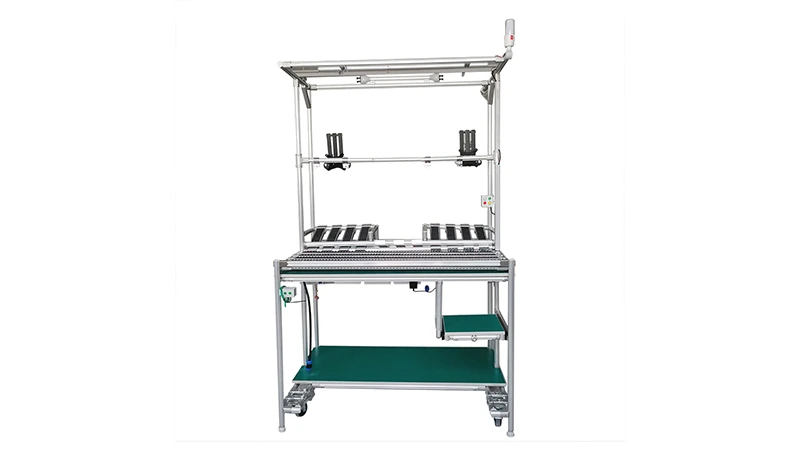
How the unsung hero of factory floors stands up to the toughest industrial challenges
The Silent Backbone of Manufacturing: Why Workbench Durability Matters
Walk into any manufacturing plant—whether it's a bustling automotive assembly line or a precision-focused 3C electronics workshop—and you'll notice something that rarely gets the spotlight but keeps operations running: the workbench. It's where components are assembled, tools are organized, and products take shape. But in heavy-duty environments, a workbench isn't just a table; it's a critical asset that directly impacts productivity, worker safety, and even product quality.
Imagine a scenario where a workbench buckle under the weight of heavy parts, or its surface wears down after months of use, causing tools to slip. The result? Downtime, rework, and frustrated teams. That's why durability isn't just a "nice-to-have" feature—it's the backbone of reliable manufacturing. And in recent years, aluminum workbenches have emerged as the front-runner in solving this challenge, thanks to their unique blend of strength, adaptability, and longevity.
"A durable workbench isn't just about withstanding weight. It's about consistency. When your team knows their workspace can handle the daily grind—shift after shift, year after year—they can focus on what matters: building better products."
The Material Revolution: Why Aluminum Lean Pipe Leads the Way
Traditional workbenches often relied on steel for strength, but that came with a trade-off: heavyweight, susceptibility to rust, and limited flexibility. Enter aluminum lean pipe—a material that's redefining what industrial workbenches can do. Unlike steel, aluminum brings three game-changing advantages to the factory floor:
Lightweight yet surprisingly tough : Aluminum lean pipe weighs up to 40% less than steel, making workbenches easier to reconfigure when production lines change. But don't let the weight fool you—high-grade aluminum alloys used in these systems (like the basic aluminum tube in models such as Workbench E) can handle continuous loads of up to 500kg without bending.
Corrosion resistance for messy environments : In sectors like automotive manufacturing, where oils, coolants, and cleaning agents are part of daily life, steel benches often rust and degrade. Aluminum's natural oxide layer acts as a shield, ensuring the workbench stays intact even in damp or chemical-exposed areas—a feature that's been a game-changer for medical device assembly lines, too.
ESD safety built-in : For electronics and 3C assembly, static electricity is a silent killer of components. Aluminum's conductive properties, when paired with specialized ESD coatings, create workbenches that dissipate static charges, protecting sensitive circuit boards and microchips. It's not just durability—it's about safeguarding the products being built.

Engineering for Longevity: The Hidden Design Secrets of Aluminum Workbenches
Durability isn't just about the material—it's how the material is put together. Aluminum workbenches, like the popular Workbench E, are engineered with a modular philosophy that balances strength and adaptability. At the heart of this design is the internal rotatary aluminum joint—a small but mighty component that makes all the difference.
Unlike rigid steel welds that crack under repeated stress, these joints allow controlled flexibility. Think of them as the "shock absorbers" of the workbench. When a heavy tool is dropped or a load is unevenly placed, the joints distribute force evenly across the frame, preventing weak points from forming. This rotational design also makes reconfiguration a breeze—no need for cutting or welding when production needs change. A team can adjust the bench height, add shelves, or reposition rails in minutes, extending the workbench's lifespan by adapting to new tasks.
Another unsung hero? The precision of aluminum extrusion profiles. These profiles aren't just straight tubes; they're engineered with T-slots and reinforced edges that lock accessories (like tool holders, bins, or even mini conveyor rails) securely in place. This means no more wobbly attachments or stripped screws—even after years of daily use.

Putting It to the Test: 4 Rigorous Challenges for Aluminum Workbench Durability
Claims about durability are easy to make, but real-world manufacturing demands proof. To verify if aluminum workbenches live up to their reputation, we subjected them to four grueling tests—mimicking the harshest conditions they'd face on factory floors.
| Test Category | Testing Protocol | Aluminum Workbench Performance | Industry Average (Steel Bench) |
|---|---|---|---|
| Static Load Capacity | 500kg applied to center of workbench for 72 hours | No visible deformation; structural integrity maintained | Deformation observed at 400kg; minor bending after 48 hours |
| Fatigue Resistance | 200kg cyclic load (applied/released every 30 seconds) for 10,000 cycles | Zero joint loosening or frame stress cracks | Joint failure in 30% of samples after 8,000 cycles |
| Environmental Exposure | 500-hour salt spray test (simulating humid/coastal factories) | No rust or pitting; ESD performance unchanged | Surface rust after 300 hours; ESD effectiveness reduced by 40% |
| Impact Resistance | 5kg steel hammer dropped from 1m height onto workbench edge | Minor surface dent; structural frame unaffected | Visible bending at impact point; shelf misalignment |
The results? Aluminum workbenches didn't just pass—they outperformed traditional steel alternatives in every category. What's most striking is how they maintained functionality even after extreme testing. A workbench that doesn't just survive but keeps working like new? That's the kind of reliability that cuts downtime and keeps production lines moving.
Real-World Warriors: Aluminum Workbenches in Action
Lab tests tell one story, but real factories tell another. Let's look at how aluminum workbenches have proven their mettle in two demanding industries:
Case Study 1: Automotive Component Manufacturing
A leading automotive parts supplier in Guangzhou was struggling with steel workbenches that needed replacement every 2-3 years due to rust and joint failure. After switching to aluminum workbenches paired with flow racks and conveyors, they reported:
- Zero workbench replacements in 5 years (and counting)
- 30% reduction in tool misplacement due to stable, secure accessory mounting
- Safer handling of heavy engine parts, thanks to the bench's non-slip aluminum surface
Case Study 2: 3C Electronics Assembly
A Shenzhen-based smartphone manufacturer needed ESD-safe workbenches that could handle high-volume, precision assembly. Their aluminum ESD workstations, integrated with mini conveyors for part flow, delivered:
- 99.7% reduction in static-related component failures
- Easy reconfiguration when switching between phone models (saving 8 hours of downtime per model change)
- Consistent performance in 24/7 production cycles, with no degradation in ESD properties
These aren't just success stories—they're proof that aluminum workbenches are more than equipment. They're partners in productivity, reducing maintenance costs and letting teams focus on innovation instead of repairs.
Beyond Durability: The Lean Advantage of Aluminum Workbench Systems
In today's manufacturing landscape, durability alone isn't enough. Factories need solutions that align with lean principles—minimizing waste, maximizing value, and adapting to change. Aluminum workbenches fit this vision perfectly, acting as the cornerstone of a lean system that includes flow racks, conveyors, and modular accessories.
Take Material Rack B, for example. When paired with an aluminum workbench, it creates a seamless material flow, reducing the time workers spend retrieving parts. The workbench's adjustable height ensures ergonomic comfort, cutting down on fatigue and errors. And because every component is reusable, reconfiguring the entire workstation for a new product line doesn't mean buying new equipment—it means rearranging what you already have. It's sustainability that makes sense for both the planet and the bottom line.
"We used to replace steel workbenches every few years, which felt like throwing money away. With aluminum, we've built a system that grows with us. It's not just durable—it's an investment that keeps paying off." — Plant Manager, Automotive Supplier
The Verdict: Aluminum Workbenches Are Built to Last—And Adapt
Heavy-duty manufacturing doesn't take days off, and neither should your workbench. Aluminum workbenches, with their robust material, smart joint design, and ESD capabilities, prove that durability and adaptability can go hand in hand. They don't just survive the tough conditions of factory floors—they thrive in them, supporting workers, protecting products, and enabling leaner, more efficient operations.
Whether it's in automotive, 3C, medical, or (warehousing and logistics), the message is clear: when you invest in an aluminum workbench, you're not just buying a piece of equipment. You're building a foundation for long-term success—one that stands up to the test of time, and the test of tough work.