- Company Articles
- Products and Technology
- Product knowledge
- Anti-Slip Adjustable Leveling Feet and Internal Rotating Aluminum Joints: Compatibility

Anti-Slip Adjustable Leveling Feet and Internal Rotating Aluminum Joints: Compatibility
Related Product
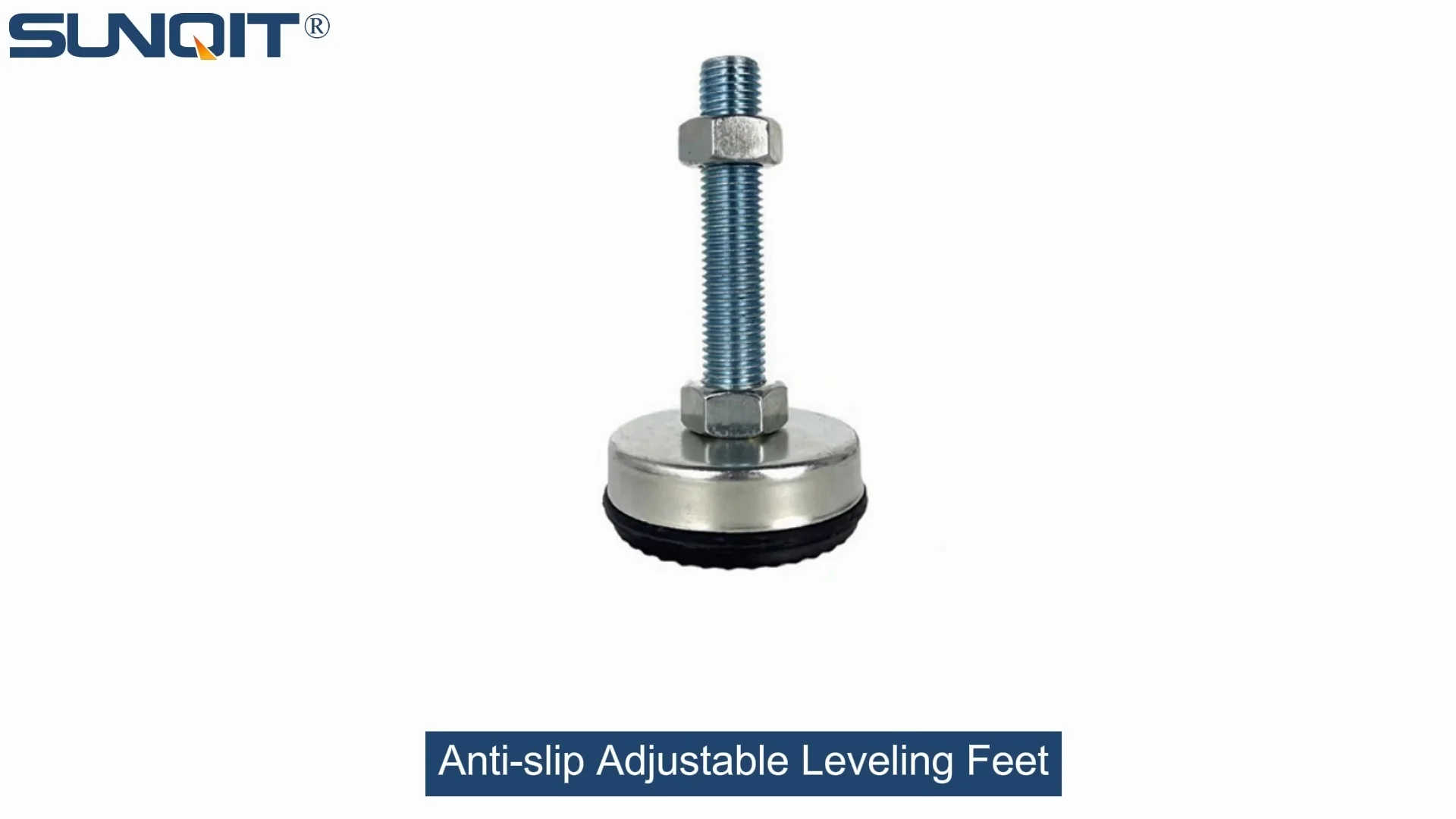
Anti-slip Adjustable Leveling Feet
Anti-slip Adjustable Leveling Feet are designed to keep machines level when placed on uneven or sloped ground, the rubber base will prevent product slip during work.
Introduction: Why the "Small Parts" Matter in Big Industrial Setups
Walk into any manufacturing plant, warehouse, or assembly line, and your eyes might first be drawn to the large machinery—the conveyor belts snaking through the facility, the robotic arms precision-placing components, or the towering material racks stacked with goods. But if you look closer, you'll notice something just as critical: the smaller, often overlooked components that hold everything together. These are the unsung heroes of industrial efficiency—parts like leveling feet that keep workbenches steady, joints that let structures bend without breaking, and connectors that turn a pile of aluminum tubes into a functional workstation. Today, we're shining a spotlight on two such components: anti-slip adjustable leveling feet and internal rotating aluminum joints . Individually, they're workhorses; together, they're a dynamic duo that transforms how we build, adapt, and optimize industrial spaces.
In a world where downtime costs money and flexibility is key to staying competitive, stability and adaptability aren't just nice-to-haves—they're non-negotiable. A wobbly workbench can throw off assembly precision, leading to faulty products. A rigid structure that can't be reconfigured slows down process improvements, making it harder to adopt lean manufacturing principles. That's where these two components come in: leveling feet ensure stability, even on uneven floors, while internal rotating joints add the flexibility to adjust structures on the fly. Whether you're setting up a new workbench , reconfiguring a lean system , or building a custom material rack, understanding how these parts work and why their compatibility matters can save you time, reduce frustration, and boost your bottom line.
Anti-Slip Adjustable Leveling Feet: The Foundation of Stability
Let's start with the basics: the feet that keep everything grounded. Imagine trying to assemble a delicate electronic component on a workbench that rocks back and forth with every movement. Not only is it frustrating, but it's also a recipe for errors. Anti-slip adjustable leveling feet solve this problem by providing a stable, customizable base for almost any industrial structure—from workbenches and material racks to conveyor frames and testing stations.
What Are Anti-Slip Adjustable Leveling Feet, Exactly?
At their core, these feet are simple devices: a threaded stem (usually made of steel or stainless steel) topped with a base (often rubber or plastic) that can be screwed up or down to adjust height. The "anti-slip" feature comes from the base material—rubber, for example, creates friction with the floor, preventing the structure from sliding even when bumped or vibrated. The "adjustable" part is key: by twisting the stem, you can raise or lower individual feet to compensate for uneven flooring, ensuring the entire structure sits level. Some models even include a locking nut to keep the height setting in place once adjusted, so you don't have to re-tweak them every time the floor vibrates.
Why They're Non-Negotiable in Industrial Settings
Stability isn't the only benefit. Let's break down why these feet are a must-have:
- Uneven Floors Are Everywhere : Very few industrial floors are perfectly flat. Concrete slabs crack, wear down, or settle over time, creating small (or not-so-small) dips and bumps. Leveling feet let you "fix" these issues without expensive floor repairs.
- Vibration Dampening : Machinery vibrates—that's a fact. Rubber-based leveling feet absorb some of that vibration, preventing it from transferring to the workbench or material rack. This is crucial for precision work, like assembling circuit boards or measuring parts, where even tiny shakes can throw off measurements.
- Safety First : A sliding or tipping structure is a safety hazard. Anti-slip bases reduce the risk of accidents, whether it's a workstation sliding into a worker or a material rack toppling over. In environments where heavy loads are involved, this can be life-saving.
- Load Distribution : When a structure is level, weight is distributed evenly across all feet. This reduces stress on individual components (like joints or aluminum profiles ), extending their lifespan and reducing the need for frequent repairs.
Common Types and When to Use Them
Not all leveling feet are created equal. The right choice depends on your needs: load capacity, floor type, and environment. For example, in a food processing plant, you might need stainless steel feet to resist corrosion from water and cleaning chemicals. In a warehouse with rough concrete floors, a larger rubber base (to spread weight and grip better) would be ideal. One popular model is the M10*56 rubber leveling foot—a standard size that fits most workbenches and light to medium-duty racks. Its 10mm thread size and 56mm stem length offer enough adjustability for most minor floor irregularities, while the rubber base provides reliable anti-slip performance.

Internal Rotating Aluminum Joints: Flexibility Without Compromise
Now, let's shift to the "flexibility" side of the equation: internal rotating aluminum joints . If leveling feet are the foundation, these joints are the "elbows and knees" of industrial structures—they let you connect aluminum profiles (or tubes) at angles, and, crucially, rotate them without loosening the connection. This might sound simple, but in a world where lean manufacturing demands constant process tweaks, this rotation is a game-changer.
What Makes Internal Rotating Aluminum Joints Unique?
Traditional rigid joints lock two tubes or profiles at a fixed angle—say, 90 degrees for a corner or 180 degrees for a straight line. That's great if you never need to change the structure, but in reality, production lines evolve. Maybe you need to raise a shelf by 10 degrees to make loading easier, or angle a workbench top to reduce operator strain. Rigid joints would require disassembling and rebuilding the structure; internal rotating joints let you adjust the angle on the spot.
Here's how they work: The joint has an internal mechanism (often a ball-and-socket or pivot design) that allows one connected tube to rotate relative to the other, even when the joint is tightened. The aluminum construction keeps them lightweight but strong—important for structures that need to be both portable and durable. Some models even let you lock the rotation at a specific angle once you've found the perfect position, so it stays put during use.
Where You'll Find Them (And Why They're a Game-Changer)
Internal rotating joints shine in applications where adaptability is key. Think about a lean system for assembling small electronics: one day, you're assembling smartphones, and the next, you're switching to tablets, which are larger. With rotating joints, you can adjust the height of the component bins or the angle of the pick-and-place surface without taking the entire workstation apart. Or consider a material rack in a warehouse: during peak season, you might need steeper inclines on the roller tracks to speed up order picking; during slower times, shallower angles to prevent items from sliding too quickly. Rotating joints make that adjustment possible in minutes, not hours.
Another big advantage? They reduce waste. In traditional setups, if you need a new angle, you might have to buy new rigid joints or cut tubes to different lengths. With rotating joints, the same structure can be repurposed over and over, aligning with the lean principle of "reduce, reuse, recycle."

Compatibility: When Leveling Feet and Rotating Joints Team Up
So, we've established that anti-slip adjustable leveling feet provide stability and internal rotating aluminum joints add flexibility. But what happens when these two components are used together? That's where the magic really happens. Their compatibility isn't just about "fitting together"—it's about creating structures that are both rock-solid and adaptable, two qualities that often seem at odds.
Mechanical Compatibility: Threads, Sizes, and Loads
First, let's talk about the nuts and bolts (literally) of compatibility: size and load capacity. Most industrial structures—whether workbenches , material racks, or lean system stations—are built using standardized components. For example, aluminum profiles often come in standard widths (like 20x20mm, 30x30mm, or 40x40mm), and leveling feet and joints are designed to fit these sizes. A 40x40mm aluminum profile, for instance, will pair with leveling feet that have a stem diameter (like M10 or M12) that fits the pre-drilled holes in the profile's base. Similarly, internal rotating joints are sized to clamp onto the same 40mm profile, ensuring a snug, secure fit.
Load capacity is another key factor. A leveling foot rated for 500kg per foot won't do much good if the rotating joint it's attached to can only handle 300kg. When designing a structure, you need to ensure both components can support the total weight of the structure plus any loads (tools, materials, products) placed on it. This is where working with reputable suppliers matters—they'll provide load ratings for both feet and joints, making it easy to match them correctly.
Functional Compatibility: Stability + Flexibility = Productivity
Mechanical compatibility is important, but functional compatibility is where the real value lies. Let's take a common example: a workbench used for electronics assembly. The workbench top is made of aluminum profiles connected by internal rotating joints, so the operator can adjust the angle of the surface to reduce neck strain. The base of the workbench uses anti-slip adjustable leveling feet to keep it steady on the shop floor, which has a small dip near the corner.
Here's how they work together: The leveling feet compensate for the uneven floor, ensuring the workbench doesn't rock. The rotating joints let the operator tilt the top to a 15-degree angle, making it easier to see small components. If the next operator prefers a flat surface, they can rotate the joints back to 0 degrees without disturbing the leveling feet, which stay locked in place. The result? A workstation that's both stable (no more wobbly soldering irons) and personalized (each operator can adjust it to their needs), leading to happier workers and fewer errors.
| Feature | Anti-Slip Adjustable Leveling Feet | Internal Rotating Aluminum Joints | Why Compatibility Matters |
|---|---|---|---|
| Primary Function | Stabilize structures on uneven surfaces; prevent sliding | Allow angle adjustment of connected aluminum profiles | Stability ensures adjustments (via joints) don't compromise safety |
| Key Material | Steel/stainless steel stem; rubber/plastic base | Aluminum alloy (lightweight, corrosion-resistant) | Mixed materials (metal feet + aluminum joints) balance strength and weight |
| Adjustment Range | Typically 10-50mm (height) | 360-degree rotation (some lockable at set angles) | Height (feet) + angle (joints) = multi-dimensional customization |
| Load Capacity (per unit) | 200-1000kg (varies by size/design) | 100-500kg (varies by joint type) | Matching capacities prevent overloading and structural failure |
Real-World Example: A Lean Assembly Line Transformation
To put this in context, let's look at a real-world scenario (names changed for privacy). A mid-sized electronics manufacturer was struggling with their assembly line for smartwatches. The line was made of fixed, rigid workstations, and whenever they introduced a new watch model, they had to shut down production for a day to reconfigure the workbenches and material racks. This downtime was costing them $10,000 per day in lost output.
Their solution? They switched to a lean system built with aluminum profiles, internal rotating joints, and anti-slip adjustable leveling feet. Here's how it worked: The workstations were now modular—each section connected by rotating joints, so operators could adjust the height and angle of component bins, tool holders, and even the assembly surface itself. The leveling feet kept each workstation steady, even though the factory floor had a noticeable slope near the loading dock. When a new watch model was introduced, instead of shutting down, the team spent 2 hours adjusting the rotating joints to accommodate the new component sizes, with no need to re-level the feet. Downtime dropped from 8 hours to 2, saving $7,500 per changeover. Over a year with 12 new models, that's a savings of $90,000—all thanks to the compatibility of two "small parts."

Choosing the Right Components: Tips for Your Next Project
Now that you understand the value of anti-slip adjustable leveling feet and internal rotating aluminum joints, how do you choose the right ones for your project? Here are some practical tips to ensure you get the most out of these components:
1. Start with the Floor (for Leveling Feet)
The type of floor in your facility will dictate the best leveling foot base material. For smooth concrete, rubber bases work well for anti-slip grip. For rough or uneven floors, consider larger, thicker bases to distribute weight better. If you're in a wet environment (like a food processing plant), look for non-slip, corrosion-resistant materials like stainless steel stems with rubber bases that resist water damage.
2. Think About Adjustment Needs (for Both Components)
How much height adjustment do you need? If your floor has major dips, go for leveling feet with a longer stem (e.g., 50mm adjustment range). For rotating joints, ask: Do you need 360-degree rotation, or just a fixed range (like 0-45 degrees)? Do you need to lock the angle in place, or will it stay put with friction alone? Answering these questions will narrow down your options.
3. Don't Skimp on Load Capacity
It's tempting to buy the cheapest components, but undersized leveling feet or joints can lead to failure. Calculate the total weight your structure will need to support (structure + tools + materials) and choose components with load capacities that exceed that by at least 20% (a safety margin). For example, if your workbench will hold 300kg, pick leveling feet rated for 360kg or more.
4. Look for Standardization
Stick to standardized sizes (like M10 threads for leveling feet or 40x40mm aluminum profiles for joints) whenever possible. This makes it easier to replace parts, add extensions, or reconfigure structures later. Most suppliers offer compatibility charts that list which feet, joints, and profiles work together—keep these handy!
Conclusion: Small Parts, Big Impact
In the grand scheme of industrial operations, anti-slip adjustable leveling feet and internal rotating aluminum joints might seem small. But as we've explored, their impact is anything but. They're the difference between a workstation that frustrates operators and one that empowers them. Between a lean system that stagnates and one that evolves with your business. Between a facility that struggles with downtime and one that thrives on efficiency.
The next time you're planning a new workstation, reconfiguring a material rack, or building a lean system, take a moment to appreciate these unsung heroes. Think about how the stability of leveling feet will keep your operations steady and the flexibility of rotating joints will let you adapt to whatever the future brings. And remember: their true power lies not just in what they do alone, but in how well they work together. After all, in industrial efficiency, the whole really is greater than the sum of its parts.