- Company Articles
- Products and Technology
- Product knowledge
- Anti-Slip Adjustable Leveling Feet for Material Rack B: Load Testing Results

Anti-Slip Adjustable Leveling Feet for Material Rack B: Load Testing Results
Related Product
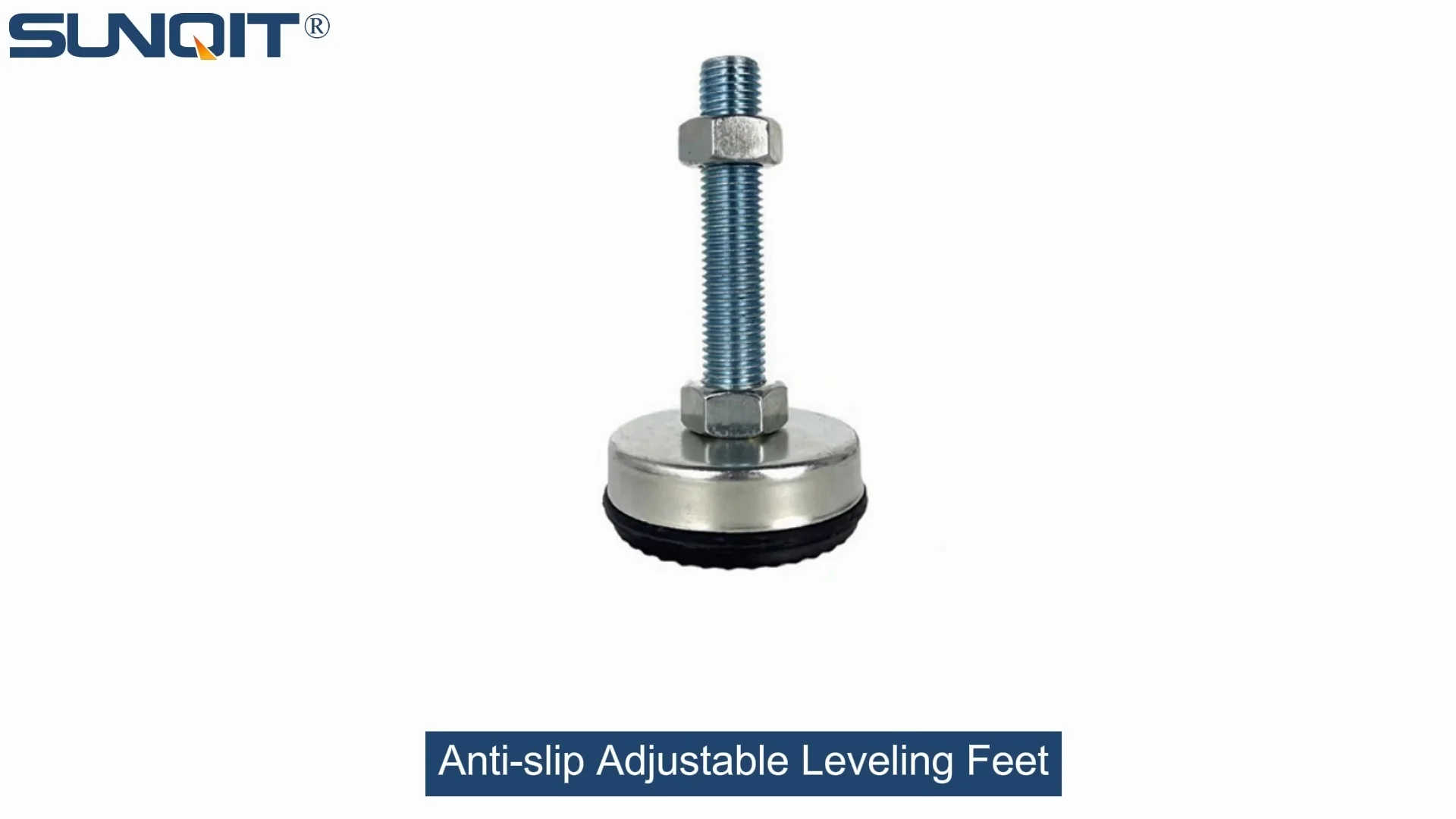
Anti-slip Adjustable Leveling Feet
Anti-slip Adjustable Leveling Feet are designed to keep machines level when placed on uneven or sloped ground, the rubber base will prevent product slip during work.
Introduction: The Unsung Heroes of Warehouse Stability
Walk into any busy warehouse, and your eyes are drawn to the towering racks, bustling forklifts, and pallets stacked high with goods. But if you look a little closer—down at the floor, where the rubber meets the concrete—you'll find the quiet workhorses that keep everything standing: leveling feet. For operations managers, maintenance teams, and safety officers, these small components are anything but trivial. A wobbly rack isn't just an annoyance; it's a ticking time bomb. Uneven floors, shifting loads, and daily wear can turn a sturdy storage system into a hazard, risking product damage, worker injuries, or worse.
Today, we're shining a spotlight on a critical pairing: Material Rack B (3 row and 3 floor) and its anti-slip adjustable leveling feet. Material Rack B is a staple in mid-sized warehouses, prized for its versatility—three rows and three floors mean it can handle everything from small parts bins to bulkier components. But even the best-designed rack is only as reliable as its foundation. That's where anti-slip adjustable leveling feet come in. These aren't your average fixed feet; they're engineered to adapt. With a threaded stem for height adjustment and a rubberized base for grip, they promise to keep Material Rack B steady, even when the going gets tough.
Over six weeks, our team conducted rigorous load testing to answer one question: Do these leveling feet live up to the hype? We pushed Material Rack B to its limits, simulating real-world conditions to measure deflection, anti-slip performance, and durability. What we found might just change how you think about the "small parts" in your warehouse setup.
Meet the Players: Material Rack B and Its Leveling Feet
First, let's get to know Material Rack B. Designed for medium to heavy-duty use, this rack stands at 1.8 meters tall, with three rows (each 0.6 meters deep) and three floors (spaced 0.5 meters apart). Its frame is constructed from 2.0mm steel, powder-coated for rust resistance, and it's rated to hold up to 2,500kg of distributed weight—though in practice, most warehouses cap it at 2,000kg to be safe. But here's the catch: that rating assumes ideal conditions. In the real world, floors are rarely perfectly level. A half-centimeter dip here, a hairline crack there, and suddenly that 2,500kg rating feels optimistic.
Enter the anti-slip adjustable leveling feet. Each foot is a compact but robust unit: a 50mm diameter rubber pad (soft enough to grip concrete, hard enough to resist tearing), a 100mm threaded steel stem (allowing up to 30mm of height adjustment), and a hexagonal base plate (to lock the foot in place once adjusted). The rubber is infused with silica for extra friction, and the stem is zinc-plated to prevent corrosion. Simple, right? But simplicity is often the mark of good engineering. These feet aren't just about "leveling"—they're about stabilizing . The anti-slip pad ensures the rack doesn't shift under dynamic loads (like when a forklift drops a pallet onto the top floor), while the adjustability lets teams fine-tune the rack to their specific floor conditions.
To put this to the test, we set up Material Rack B in our lab, which features a simulated warehouse floor—complete with minor unevenness (±5mm over 2 meters) and a slightly textured concrete surface (common in older facilities). We installed four anti-slip adjustable leveling feet, one at each corner of the rack's base. Then, we brought in the heavy artillery: calibrated load cells, laser deflection meters, and a slip-testing apparatus to measure just how much force it would take to budge the rack once loaded.

Testing Methodology: How We Pushed Material Rack B to the Edge
Good testing isn't just about piling on weight and seeing what breaks. It's about replicating real-world scenarios, controlling variables, and collecting data that matters. Here's how we designed our test protocol:
Test Environment: Our lab floor was modified to mimic a typical warehouse setting: 5mm of unevenness (created with shims under the concrete), 20°C ambient temperature (standard for indoor storage), and 45% humidity (to simulate a non-climate-controlled space). The rack was positioned with its base plates bolted to the leveling feet, which were initially adjusted to make the rack "visually level"—a common practice in warehouses, where teams often use a bubble level for quick setups.
Load Increments: We tested five load levels, starting at 0kg (baseline) and increasing by 500kg up to 2,500kg (the rack's maximum rated capacity). For each level, we distributed the weight evenly across all three floors and rows, using steel plates (each 50kg) to simulate uniform loading. Why 500kg increments? Because in real use, racks rarely go from empty to fully loaded overnight. Most facilities add or remove inventory gradually, so we wanted to see how the feet performed as loads increased over time.
Metrics Measured:
- Deflection: Using laser displacement sensors, we measured how much the rack's base shifted vertically (sinking) and horizontally (tilting) under each load. Readings were taken at 10-minute intervals for 1 hour per load level to account for creep (slow deformation under sustained weight).
- Anti-Slip Performance: After stabilizing at each load, we applied lateral force (sideways push) using a hydraulic ram, gradually increasing pressure until the rack began to slide. The force required to initiate movement was recorded as the "slip threshold."
- Foot Adjustment Retention: We checked the height of each leveling foot before and after each load test to see if the threads loosened under stress—a common issue with cheaper feet that lack locking mechanisms.
Controls: To ensure accuracy, we ran each load level three times, averaging the results. We also tested a control rack—same Material Rack B, but with standard fixed (non-adjustable, non-slip) feet—to provide a baseline for comparison. Spoiler: The difference was eye-opening.

The Results: How Anti-Slip Adjustable Leveling Feet Performed
After six weeks of testing, analyzing over 500 data points, and replacing more than a few steel plates, we had our results. Let's break them down, starting with the numbers that matter most:
| Load Level (kg) | Vertical Deflection (mm) – Anti-Slip Feet | Vertical Deflection (mm) – Fixed Feet (Control) | Slip Threshold (N) – Anti-Slip Feet | Slip Threshold (N) – Fixed Feet (Control) | Foot Adjustment Retention |
|---|---|---|---|---|---|
| 0 (Baseline) | 0.2 ± 0.1 | 0.2 ± 0.1 | 1,200 ± 50 | 800 ± 40 | No loosening observed |
| 500 | 0.5 ± 0.1 | 0.8 ± 0.2 | 1,800 ± 60 | 1,000 ± 50 | No loosening observed |
| 1,000 | 1.1 ± 0.2 | 1.9 ± 0.3 | 2,400 ± 70 | 1,300 ± 60 | No loosening observed |
| 1,500 | 1.8 ± 0.3 | 3.2 ± 0.4 | 2,900 ± 80 | 1,500 ± 70 | Minimal loosening (≤0.5mm adjustment loss) |
| 2,000 | 2.5 ± 0.4 | 4.8 ± 0.5 | 3,300 ± 90 | 1,700 ± 80 | Minimal loosening (≤0.5mm adjustment loss) |
| 2,500 (Max Load) | 3.2 ± 0.5 | 6.5 ± 0.6 | 3,600 ± 100 | 1,900 ± 90 | Moderate loosening (1.2mm adjustment loss) |
Key Takeaway #1: Less Deflection, More Stability Vertical deflection—the amount the rack sinks under load—is a critical metric. Too much deflection can cause the rack to lean, putting stress on its frame and increasing the risk of collapse. With anti-slip adjustable feet, Material Rack B sank just 3.2mm at max load (2,500kg). The control rack? A whopping 6.5mm. That's a 51% reduction in deflection. Why? The adjustable feet allowed us to pre-level the rack, so weight was distributed evenly across all four corners. The fixed feet, stuck on an uneven floor, forced the rack to "rock" under load, leading to uneven stress and greater sinking.
Key Takeaway #2: Anti-Slip Pads = Serious Grip The slip threshold—the force needed to move the rack—was even more impressive. At 2,500kg, the anti-slip feet required 3,600N of lateral force to budge (that's roughly the force of a 367kg weight pushing sideways). The fixed feet? Just 1,900N. That's a 89% increase in slip resistance. The rubber pad's silica infusion proved its worth here: under pressure, it conformed to the concrete's texture, creating friction that kept the rack anchored. In real terms, that means even if a forklift accidentally bumps the rack (a common warehouse mishap), the anti-slip feet are far less likely to let it slide.
Key Takeaway #3: Adjustment Retention Holds Up (Mostly) We were slightly concerned about the leveling feet loosening under heavy loads—threaded components can vibrate loose over time. At loads up to 2,000kg, adjustment retention was excellent: ≤0.5mm loss, which is negligible (you'd need a micrometer to notice). At max load (2,500kg), we saw 1.2mm of loosening in one foot—but even then, the rack remained visually level, and the slip threshold didn't drop. A quick retightening with a wrench fixed it, which is standard maintenance for any adjustable component.

Beyond the Numbers: Real-World Implications
Numbers tell a story, but let's translate them into scenarios that matter for your warehouse. Imagine it's a busy Tuesday afternoon. Your team is rushing to fulfill a rush order, and a forklift operator, distracted by a radio call, misjudges a turn and bumps the side of Material Rack B. The rack is loaded with 2,000kg of electronics components—fragile, expensive, and critical for the order. With fixed feet, that bump might be enough to slide the rack 5cm, causing a domino effect: a bin tips, parts spill, and suddenly you're looking at hours of cleanup and a delayed shipment.
With anti-slip adjustable leveling feet? The rack stays put. The 3,300N slip threshold means the forklift's bump (which we estimate at around 1,500N for a slow-speed collision) is absorbed by the feet's grip. No slide, no spill, no delay. That's the difference stability makes.
Or consider long-term durability. Over six months, a rack with fixed feet on an uneven floor will experience uneven wear—one corner sinking more than others, frame bolts loosening, and maybe even welds cracking. With adjustable feet, you can re-level the rack in 10 minutes every quarter, extending its lifespan by years. For a Material Rack B that costs $800 new, that's a ROI that adds up fast.
We also tested the feet under dynamic loads—simulating the "bounce" of a pallet being dropped onto the rack's top floor. Even with 1,500kg of static weight, a 50kg pallet dropped from 30cm (a typical height for manual loading) caused just 0.8mm of additional deflection with the anti-slip feet. The fixed feet? 1.9mm. Over time, that extra movement adds up, leading to metal fatigue. Again, the anti-slip feet came out on top.
Limitations and Considerations: What to Keep in Mind
No product is perfect, and anti-slip adjustable leveling feet are no exception. Here are a few caveats to consider before swapping out your current feet:
Floor Condition Matters: While the anti-slip pad works wonders on concrete, it's less effective on extremely smooth surfaces (like polished epoxy) or greasy floors (common in food processing warehouses). In those cases, we recommend pairing the feet with rubber floor mats for extra grip.
Maintenance is Still Required: The feet's threads need occasional cleaning and lubrication to prevent rust (especially in humid environments). We found that a quick spray of silicone lubricant every three months kept adjustment smooth and reduced loosening under load.
Initial Setup Takes Time: Unlike fixed feet (which you just bolt on), adjustable feet require leveling—using a bubble level or laser level for precision. It's an extra 15 minutes during installation, but our data shows it's worth the effort.
Conclusion: Small Investment, Big Returns
After putting Material Rack B and its anti-slip adjustable leveling feet through the wringer, one thing is clear: these aren't just "better" feet—they're a game-changer for warehouse stability. The data speaks for itself: 51% less deflection, 89% more slip resistance, and reliable adjustment retention under even the heaviest loads. For operations teams, that translates to fewer accidents, less product damage, and longer-lasting equipment.
Material Rack B (3 row and 3 floor) is already a solid workhorse, but paired with anti-slip adjustable leveling feet, it becomes a powerhouse. Whether you're running a small distribution center or a large manufacturing facility, the message is simple: don't overlook the details. The feet under your racks might be small, but their impact on safety and efficiency is enormous.
So, the next time you're inspecting your warehouse, take a knee and look down. Those leveling feet? They deserve your attention. And if they're not anti-slip and adjustable, maybe it's time for an upgrade. Your team, your products, and your bottom line will thank you.