- Company Articles
- Products and Technology
- Product knowledge
- Anti-Slip Adjustable Leveling Feet vs. Standard Leveling Feet: Differences Explained

Anti-Slip Adjustable Leveling Feet vs. Standard Leveling Feet: Differences Explained
Related Product
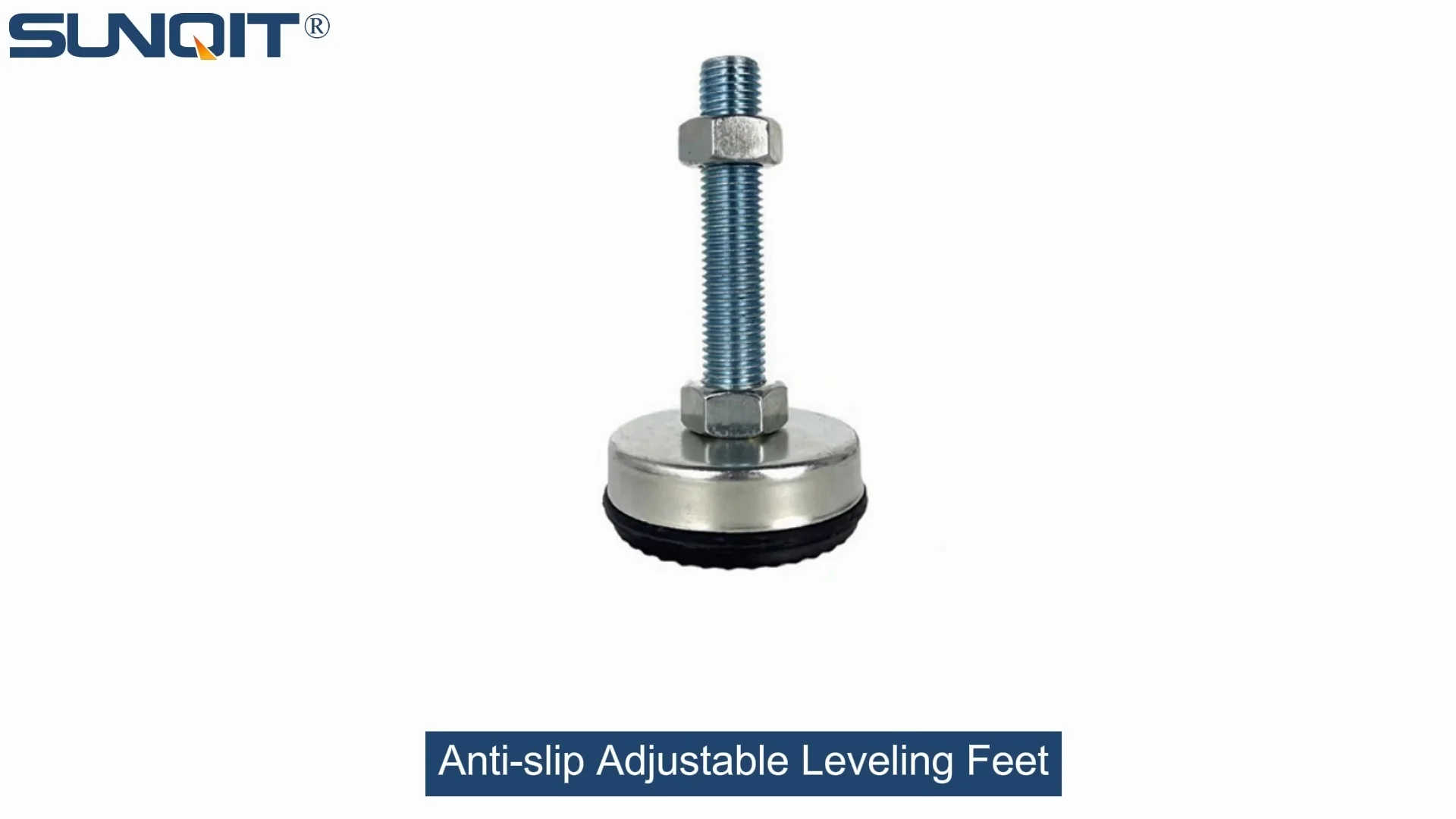
Anti-slip Adjustable Leveling Feet
Anti-slip Adjustable Leveling Feet are designed to keep machines level when placed on uneven or sloped ground, the rubber base will prevent product slip during work.
Walk into any factory, workshop, or warehouse, and you'll notice a silent workhorse keeping operations steady: the humble leveling foot. Tucked under workbenches, material racks, and assembly lines, these unassuming components play a critical role in maintaining stability—yet they're often overlooked until something goes wrong. A wobbly workstation, a sliding shelf, or a misaligned conveyor can throw off an entire production schedule, leading to delays, errors, and even safety risks. That's why choosing the right leveling feet isn't just a matter of "making things level"—it's about investing in the efficiency, safety, and longevity of your workspace.
In this guide, we'll dive into two of the most common types of leveling feet: standard leveling feet and anti-slip adjustable leveling feet. We'll break down how they work, where they shine, and why one might be a better fit for your lean pipe system, aluminum profile workstation, or heavy-duty material rack. By the end, you'll have a clear picture of which option will keep your operations running smoothly—no more wobbly workbenches, no more slipping shelves, just reliable stability when you need it most.
What Are Standard Leveling Feet?
Let's start with the basics: standard leveling feet. These are the most common type you'll find in garages, small workshops, and light industrial settings. Think of them as the "entry-level" option—simple, affordable, and designed for basic stability needs. At their core, standard leveling feet consist of three main parts: a threaded stem, a base plate, and often a nut to lock the height in place once adjusted.
The threaded stem is what allows for height adjustment. Twist the foot clockwise, and it extends downward; twist counterclockwise, and it retracts. The base plate, usually made of plastic, rubber, or mild steel, sits between the stem and the floor, distributing weight and preventing the stem from sinking into soft surfaces like wood or carpet. Some models add a thin rubber pad to the base plate for minimal grip, but this is often more about protecting floors from scratches than preventing slipping.
So, where do standard leveling feet work best? They're ideal for light-duty applications: a home woodworking bench, a small shelving unit in a retail stockroom, or a portable cart used to move tools around a garage. Their simplicity is their strength—no complicated mechanisms, easy to install, and budget-friendly. For example, a hobbyist building a workbench from basic aluminum tube might opt for standard feet to keep costs low, since the bench will only hold a few hand tools and see occasional use.
But standard feet have limits. Their adjustability is often coarse—you might get height increments of 1/4 inch or more, making it hard to fine-tune leveling on slightly uneven floors. The base plates, while functional, offer little resistance to lateral movement. If you push or bump a workstation with standard feet, it might slide across a smooth concrete floor, especially if the load is heavy. And under repeated stress—like the constant vibration of a power tool—their threads can loosen, requiring frequent readjustment.
Anti-Slip Adjustable Leveling Feet: Built for Stability
Now, let's step up to anti-slip adjustable leveling feet. These are the heavyweights of the leveling world, engineered to solve the weaknesses of standard feet in industrial and high-demand settings. If standard feet are the flip-flops of the workshop, anti-slip adjustable feet are steel-toed boots—sturdy, grippy, and ready for tough conditions.
At first glance, they might look similar to standard feet, but the devil is in the details. The most obvious upgrade is the anti-slip base. Instead of a smooth rubber pad, these feet often feature textured, high-friction materials like vulcanized rubber or even suction cup designs (think of the "suction cup anti-slip foot adjuster" you might find in specialized industrial catalogs). These bases dig into floors—concrete, tile, or even polished hardwood—creating a bond that resists sliding, even when the workstation is jostled or loaded with heavy components.
Adjustability gets a major boost too. Anti-slip adjustable feet often use fine-threaded stems, allowing for precise height tweaks in increments as small as 0.5mm. This is a game-changer in settings where precision matters, like an electronics assembly line where a workbench must be perfectly level to ensure components align correctly. Some models even add a hex nut or a knurled knob to the top of the stem, making adjustment easier with a wrench or by hand, even when the foot is under load.
Materials matter here, too. The stems are often made of high-strength steel or aluminum alloy, and the base plates are reinforced to handle heavier loads—we're talking 1,000 pounds or more per foot, compared to the 200–500 pounds of standard feet. This makes them a staple in lean pipe systems, where material racks and assembly stations must support pallets of parts or heavy machinery without buckling.
Take, for example, a automotive parts manufacturer using a "material rack b (3 row and 3 floor)" to store engine components. Each shelf might hold 500 pounds of parts, and the entire rack could weigh over 2,000 pounds when full. Standard feet would struggle here—their thin base plates might crack, or the rack might slide when workers load and unload parts. Anti-slip adjustable feet, with their reinforced bases and high-grip pads, keep the rack anchored, even during the busiest shifts.

Side-by-Side: Standard vs. Anti-Slip Adjustable Leveling Feet
To make the differences clearer, let's put these two types head-to-head. The table below breaks down key features, from adjustability to ideal use cases, so you can see which foot fits your needs:
| Feature | Standard Leveling Feet | Anti-Slip Adjustable Leveling Feet |
|---|---|---|
| Adjustment Precision | Coarse (1/4 inch increments or larger); limited fine-tuning. | Fine (0.5mm–1mm increments); easy to dial in exact height. |
| Anti-Slip Capability | Minimal (smooth or lightly textured base; prone to sliding on smooth floors). | High (textured, vulcanized rubber or suction cup base; resists lateral movement). |
| Load Capacity | Light to medium (200–500 lbs per foot). | Medium to heavy (500–2,000+ lbs per foot). |
| Materials | Mild steel, plastic, or basic rubber; prone to wear under heavy use. | High-strength steel, aluminum alloy, and industrial-grade rubber; built for durability. |
| Ideal Applications | Home workshops, light shelving, small carts, and low-traffic areas. | Lean pipe systems, aluminum profile workbenches, heavy material racks, and high-traffic industrial zones. |
| Price Point | Budget-friendly ($5–$15 per foot). | Higher initial cost ($15–$40 per foot), but lower long-term maintenance. |

Where Anti-Slip Adjustable Feet Shine: Real-World Applications
To understand why anti-slip adjustable leveling feet are worth the investment, let's look at three key settings where they make a tangible difference: workbenches, aluminum profile structures, and lean pipe systems. These are the backbones of modern manufacturing and warehousing, and their performance hinges on stability.
1. Workbenches: Precision in Every Task
A workbench is more than just a table—it's a command center. Whether you're assembling circuit boards, packaging products, or repairing machinery, even the smallest wobble can lead to mistakes. Imagine a technician soldering a microchip onto a circuit board: a 1mm shift could bridge two contacts, rendering the board useless. Anti-slip adjustable feet eliminate this risk by locking the workbench in place and allowing precise leveling, even on floors that have seen years of wear and tear.
Take the "workbench e (single deck-without caster)" often used in electronics manufacturing. This workbench might hold a soldering iron, a microscope, and bins of tiny components. With anti-slip feet, the bench stays steady when the technician leans in to work, and the height can be adjusted to match the technician's seated or standing position, reducing fatigue. Standard feet, by contrast, might let the bench rock slightly, increasing eye strain and error rates.
2. Aluminum Profile Structures: Custom Builds, Unwavering Stability
Aluminum profiles are the building blocks of custom industrial furniture—think modular workstations, material racks, and test fixtures. Their versatility is unmatched: you can bolt, clamp, or slot components together to create almost any shape. But this flexibility demands stable foundations. A rack built with 4040 or 3030 aluminum profiles might look sturdy, but if its feet slip, the entire structure could twist, bending the profiles or even collapsing.
Anti-slip adjustable feet pair perfectly with aluminum profiles. Their threaded stems fit easily into the T-slots of most profiles, and their high load capacity supports the weight of stacked materials. For example, a warehouse using aluminum profiles to build a multi-tiered storage rack for automotive parts can trust anti-slip feet to keep the rack upright, even when forklifts zoom past or workers bump into it. Standard feet, with their weaker grip, might let the rack shift over time, creating gaps between shelves or misaligning labels.
3. Lean Pipe Systems: Efficiency Through Stability
Lean manufacturing is all about eliminating waste—whether it's time, materials, or motion. Lean pipe systems, made from steel or aluminum pipes and joints, are designed to streamline workflows by bringing tools and materials to the worker. But for this to work, the system itself must be rock-solid. A conveyor or material rack that slides or wobbles disrupts the flow, forcing workers to stop and readjust, wasting precious time.
Anti-slip adjustable feet are a cornerstone of effective lean systems. Consider a roller track used to move boxes from a storage area to a packing station. If the track isn't level, boxes might get stuck or slide off. Anti-slip feet let you adjust each section of the track to create a smooth, gradual slope, ensuring boxes glide evenly. And because the feet grip the floor, the track won't shift as boxes bump against it, maintaining alignment day in and day out.

The Cost of Cutting Corners: Problems with Standard Feet
It's tempting to save money by sticking with standard leveling feet, but the hidden costs can add up. Let's look at three common issues that arise when standard feet are used in industrial settings—and how anti-slip adjustable feet solve them.
1. Slippage: When "Good Enough" Turns Dangerous
In a busy warehouse, floors get polished, oiled, or wet—all of which reduce friction. Standard feet, with their smooth rubber or plastic bases, become ticking time bombs. A material cart with standard feet might slide when a worker pushes it, crashing into a rack and damaging inventory. Or a workbench might shift when a heavy tool is placed on it, knocking over a container of small parts and sending them scattering across the floor.
Anti-slip feet put an end to this. Their textured bases dig into even slippery floors, creating friction that resists movement. In one case study, a food packaging plant switched to anti-slip feet on their conveyor systems after a standard-footed conveyor slid during a cleaning, spilling 500 pounds of product. The upgrade cost $200 per conveyor, but it prevented thousands of dollars in lost product and downtime.
2. Poor Adjustability: Fighting Uneven Floors
Factory floors are rarely perfect. Years of heavy machinery, dropped tools, and chemical spills leave them pockmarked and uneven. Standard feet, with their coarse adjustment, struggle to compensate. You might get three feet level, but the fourth sits an inch above the floor, leaving the workstation rocking like a seesaw.
Anti-slip adjustable feet's fine threads let you dial in the height with precision. A few twists of the knob, and even the most uneven floor becomes a stable foundation. This isn't just about comfort—it's about safety. A level workstation reduces the risk of tools rolling off, and it ensures that machinery operates as designed. For example, a 3D printer on an unlevel surface might produce warped parts; with anti-slip adjustable feet, the printer stays level, and print quality improves dramatically.
3. Low Load Capacity: When Feet Fail Under Pressure
Standard feet are built for light loads, not the heavyweights of industrial work. A material rack holding 100-pound boxes might seem okay with standard feet—until the feet bend under the strain. Bent feet lead to uneven weight distribution, which can crack the rack's frame or cause it to tip. In the worst cases, this leads to injuries or damaged equipment.
Anti-slip adjustable feet are engineered to handle the pressure. Their reinforced stems and thick base plates distribute weight evenly, preventing bending or cracking. A heavy-duty anti-slip foot can support over 2,000 pounds per foot, making it suitable for everything from CNC machines to pallet racks. For warehouses storing raw materials or finished goods, this durability translates to fewer accidents and lower replacement costs.
Investing in Stability: Why Anti-Slip Adjustable Feet Pay Off
At the end of the day, the choice between standard and anti-slip adjustable leveling feet comes down to one question: What's the cost of instability? Standard feet might save you a few dollars upfront, but they risk delays, errors, and accidents in industrial settings. Anti-slip adjustable feet, by contrast, are an investment in efficiency, safety, and peace of mind.
If you're running a lean pipe system, building aluminum profile workstations, or managing material racks that hold heavy loads, anti-slip adjustable feet aren't a luxury—they're a necessity. They keep your equipment steady, your workers safe, and your operations on track. And while they cost more initially, their durability and performance mean they'll outlast standard feet, saving you money in the long run.
So, take a look at your current setup. Are your workbenches wobbling? Do your racks slide when loaded? Is adjusting heights a frustrating chore? If so, it might be time to upgrade to anti-slip adjustable leveling feet. Your team, your products, and your bottom line will thank you.