- Company Articles
- Products and Technology
- Product knowledge
- Anti-Static Swivel Stem Caster Wheel with Brake: Protecting Sensitive 3C Components

Anti-Static Swivel Stem Caster Wheel with Brake: Protecting Sensitive 3C Components
Related Product
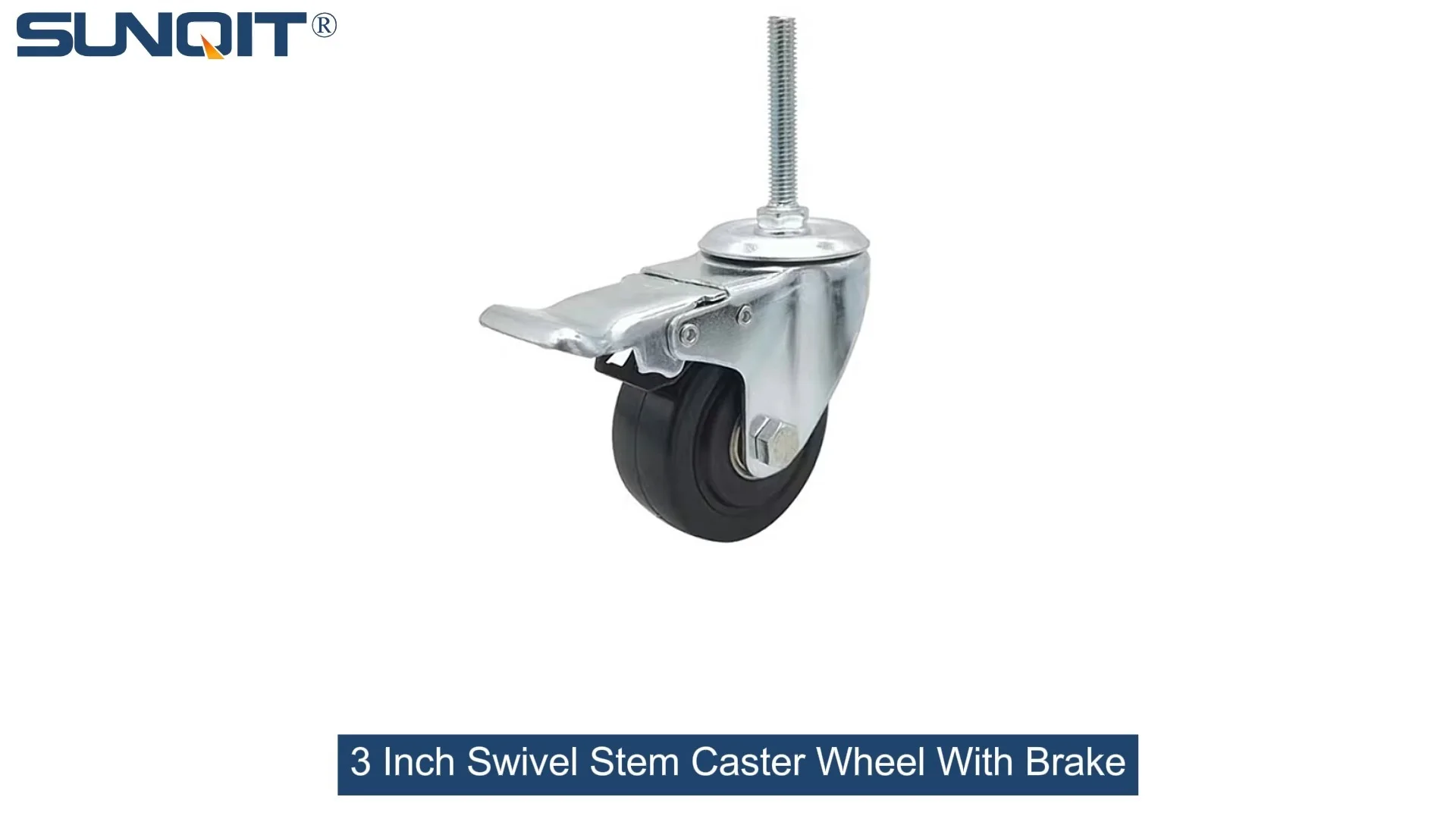
Swivel Stem Caster Wheel with Brake
360 Degree Swivel Stem Caster with brake. Threaded-post mount design, castors diameter 3 inch.Each swivel caster wheels loading 70KGS. Heavy enough and widely suit for carts, chairs, cabinet, flow rack, workbench, turnover rolley.
Walk into any modern 3C (Computer, Communication, Consumer Electronics) manufacturing facility, and you'll be met with a symphony of precision: robotic arms assembling tiny circuit boards, workers in cleanroom suits handling smartphone screens, and conveyor belts gliding components from one station to the next. But amid all this visible activity, there's an invisible threat lurking—one that can render a $500 microchip useless in an instant: static electricity. In this high-stakes environment, even the smallest details matter, including the wheels beneath the workbenches and trolleys. Enter the anti-static swivel stem caster wheel with brake: a humble yet critical component that acts as a silent guardian for sensitive electronics. Let's dive into why this unassuming tool is a game-changer for 3C manufacturers.
The Hidden Danger: Why Static Electricity Haunts 3C Production
First, let's talk about static. We've all experienced it—zapping a doorknob after shuffling across a carpet, or seeing clothes cling together fresh out of the dryer. But in a factory making laptops, smartwatches, or IoT sensors, static isn't just an annoyance; it's a destroyer. Here's why:
Electronic components like microchips, capacitors, and LCD panels are delicate. Many have circuits thinner than a human hair, and even a tiny electrostatic discharge (ESD)—as small as 250 volts—can damage them. To put that in perspective, humans can only feel static discharges above 3,000 volts. That means a component could be quietly ruined by a discharge we don't even notice. Over time, these "latent defects" can cause products to fail weeks or months after they've left the factory, leading to costly recalls, unhappy customers, and damaged brand reputations.
In 2023, a leading smartphone manufacturer reported losing over $20 million due to ESD-related defects in just one quarter. The root cause? Static buildup on mobile workbenches that weren't properly grounded. When workers moved these workbenches across the factory floor, the friction between the wheels and the concrete generated static, which then transferred to the sensitive motherboards being assembled. That's where anti-static casters come in—not just any casters, but ones designed to dissipate static safely while keeping workstations mobile and stable.
What Makes Anti-Static Swivel Stem Casters with Brake Unique?
Not all casters are created equal. A standard caster might roll smoothly, but it won't protect against static. An anti-static fixed caster might ground static, but it limits maneuverability. The anti-static swivel stem caster with brake, though? It's a triple threat: it moves freely, locks securely, and keeps static at bay. Let's break down its key features:
1. Anti-Static Properties: Dissipating Static, Not Just Blocking It
The magic starts with the wheel material. Unlike regular rubber or plastic wheels, these casters use conductive rubber or polyurethane infused with carbon black. This material doesn't just resist static buildup—it dissipates it. As the wheel rolls, any static charge on the workstation or trolley flows through the conductive wheel, down the stem, and into the ground (when paired with an ESD-safe floor or grounding mat). Think of it like a lightning rod for static, channeling the charge away from sensitive components instead of letting it build up and zap.
2. Swivel Stem: Maneuverability in Tight Spaces
3C factories are often packed with equipment: conveyor lines, testing stations, and storage racks leave little room for error. A fixed caster only rolls forward and backward, making it hard to navigate around corners or reposition workstations. The swivel stem, however, lets the wheel rotate 360 degrees. This means a worker can push a trolley loaded with circuit boards through a narrow aisle, pivot smoothly to align with an esd workstation, and slide into place—all without straining or risking a collision. In a study by the Manufacturing Ergonomics Institute, facilities using swivel casters reported a 30% reduction in time spent moving equipment, freeing up workers to focus on assembly rather than wrestling with heavy trolleys.
3. Brake Mechanism: Stability When You Need It Most
Mobility is great, but stability is critical during assembly. Imagine a worker soldering a microchip onto a motherboard while the workstation slowly drifts across the floor—that's a recipe for disaster. The brake on these casters solves this by locking two parts: the wheel (to prevent rolling) and the swivel (to keep the caster from rotating). A simple foot pedal press engages the brake, turning a mobile workstation into a rock-solid platform. Some models even have a "total lock" feature, which locks both the wheel and swivel with one push, ensuring the workstation stays exactly where it's needed until the brake is released.
4. Durable Construction: Built for the Factory Floor
Factory environments are tough. Casters take a beating from constant rolling, heavy loads (some workstations carry up to 500 lbs of equipment), and exposure to oils, coolants, and cleaning chemicals. These casters are built to last, with rust-resistant steel stems, sealed bearings to keep out debris, and wheels that stand up to abrasion. Many are also tested to withstand 100,000+ rolls without losing their anti-static properties—a must for 24/7 production lines.

How Anti-Static Casters Fit Into the ESD Workstation Ecosystem
An anti-static caster doesn't work alone. It's part of a larger ESD control system that includes anti-static mats, wrist straps, flooring, and workbenches. Let's see how it integrates with one common setup: the lean pipe workbench. Lean pipe workbenches are popular in 3C manufacturing because they're flexible—you can reconfigure them with aluminum profile frames, shelves, and tool holders to fit changing production needs. Adding anti-static swivel stem casters with brakes turns these workbenches into mobile, ESD-safe hubs.
Here's how it works: The lean pipe workbench's frame is built using aluminum profile (lightweight, strong, and easy to assemble). The top is covered with an anti-static mat, and the legs are fitted with our star casters. When a worker needs to move the bench to a new assembly line, they release the brakes, swivel around obstacles, and lock the brakes once in position. As they work, static from the bench, tools, or their hands flows through the mat, into the aluminum frame, down the caster stems, and out through the conductive wheels—keeping the entire workspace grounded. It's a seamless system that balances flexibility with protection.
| Caster Type | ESD Protection | Maneuverability | Brake Function | Ideal For |
|---|---|---|---|---|
| Standard Swivel Caster | None | High (360° swivel) | Wheel lock only (some models) | Non-sensitive loads (boxes, tools) |
| Anti-Static Fixed Caster | Yes (dissipates static) | Low (only forward/backward) | Wheel lock only | Stationary ESD workstations |
| Anti-Static Swivel Stem Caster with Brake | Yes (conductive material) | High (360° swivel) | Wheel + swivel lock | Mobile ESD workstations, 3C component trolleys |

Real-World Impact: A Case Study in 3C Manufacturing
To understand just how much these casters matter, let's look at a case study. A mid-sized 3C manufacturer in Shenzhen, China, was struggling with a 4.2% defect rate in its smartwatch production line. After investigating, engineers traced most defects to ESD damage during the final assembly phase. Workers were using mobile workbenches with standard casters, and tests showed static charges as high as 1,500 volts on the bench surfaces—more than enough to damage the watch's tiny battery management chips.
The solution? They replaced all standard casters with anti-static swivel stem casters with brakes. Within three months, the defect rate dropped to 0.8%. "It was like night and day," said the production manager. "Workers no longer had to worry about zapping components when moving benches, and the brakes meant they could focus on assembly without the bench shifting. We saved over $120,000 in rework costs in the first year alone."
But the benefits went beyond cost savings. The casters' swivel design cut down on the time workers spent maneuvering benches, increasing production output by 15%. And because the casters were durable enough to handle daily use, maintenance requests for stuck or broken wheels dropped by 70%. "We used to have a technician fixing casters twice a week," the manager added. "Now, we barely think about them—they just work."

Choosing the Right Anti-Static Caster: Key Considerations
Not every anti-static swivel stem caster with brake is right for every job. Here's what to keep in mind when selecting casters for your 3C facility:
Load Capacity: Match the Caster to the Workload
Casters are rated for maximum load, and exceeding that can damage the wheel, stem, or brake. A lightweight trolley carrying small components might need a 150-lb caster, while a heavy lean pipe workbench with tools and testing equipment could require 500-lb casters. Always factor in the total weight of the workstation plus its contents—err on the side of overcapacity to avoid failure.
Floor Type: Smooth vs. Rough Surfaces
Factory floors vary: some are smooth concrete, others have cracks or uneven tiles. Soft rubber wheels work best on smooth floors, offering better grip and quieter operation. For rough or uneven surfaces, polyurethane wheels are more durable and less likely to get stuck. If your facility uses ESD vinyl flooring, check that the caster wheels won't scratch or damage it—some manufacturers offer "floor-friendly" options with softer treads.
Brake Type: Total Lock vs. Wheel-Only Lock
As mentioned earlier, some brakes lock only the wheel, while others lock both the wheel and swivel. For workstations that need to stay perfectly aligned (like those feeding components to a conveyor), a total lock is essential. For simpler tasks, a wheel-only lock might be sufficient—and often more affordable.
ESD Compliance: Look for Certifications
Not all "anti-static" casters meet industry standards. Look for models certified to ANSI/ESD S20.20, the global benchmark for ESD control. This ensures the caster's surface resistance (a measure of how well it dissipates static) is between 10^6 and 10^9 ohms—low enough to ground static but not so low that it causes a dangerous electrical shock.
The Future of Anti-Static Casters: Smarter, More Connected
As 3C manufacturing moves toward Industry 4.0, casters are getting smarter, too. Imagine a caster with a built-in sensor that monitors static dissipation in real time. If the wheel's conductive properties start to degrade (say, due to wear), it sends an alert to the facility's maintenance system—preventing ESD failures before they happen. Some manufacturers are even experimenting with casters that connect to IoT platforms, tracking how often workstations are moved, which brakes are used most, and where bottlenecks occur in the production line. These "smart casters" could one day help factories optimize workflows while keeping components safe.
Conclusion: Small Wheels, Big Impact
In the world of 3C manufacturing, where precision and reliability are everything, the anti-static swivel stem caster with brake is a unsung hero. It's not flashy, but it plays a critical role in protecting sensitive components from static damage, keeping workers efficient, and ensuring products reach customers defect-free. Whether you're assembling the latest smartphone, a high-performance laptop, or a cutting-edge IoT device, don't overlook the wheels beneath your workstations. Invest in quality anti-static casters, and you'll be investing in the future of your products—and your bottom line.
So the next time you pick up your phone or turn on your laptop, take a moment to appreciate the tiny technologies that made it possible—including the humble caster wheel that kept its components safe during production. After all, great things really do come in small packages.