- Company Articles
- Products and Technology
- Application Cases
- Applications of 3060 Aluminum Angle Yards in 3C Assembly Workstations

Applications of 3060 Aluminum Angle Yards in 3C Assembly Workstations
Related Product
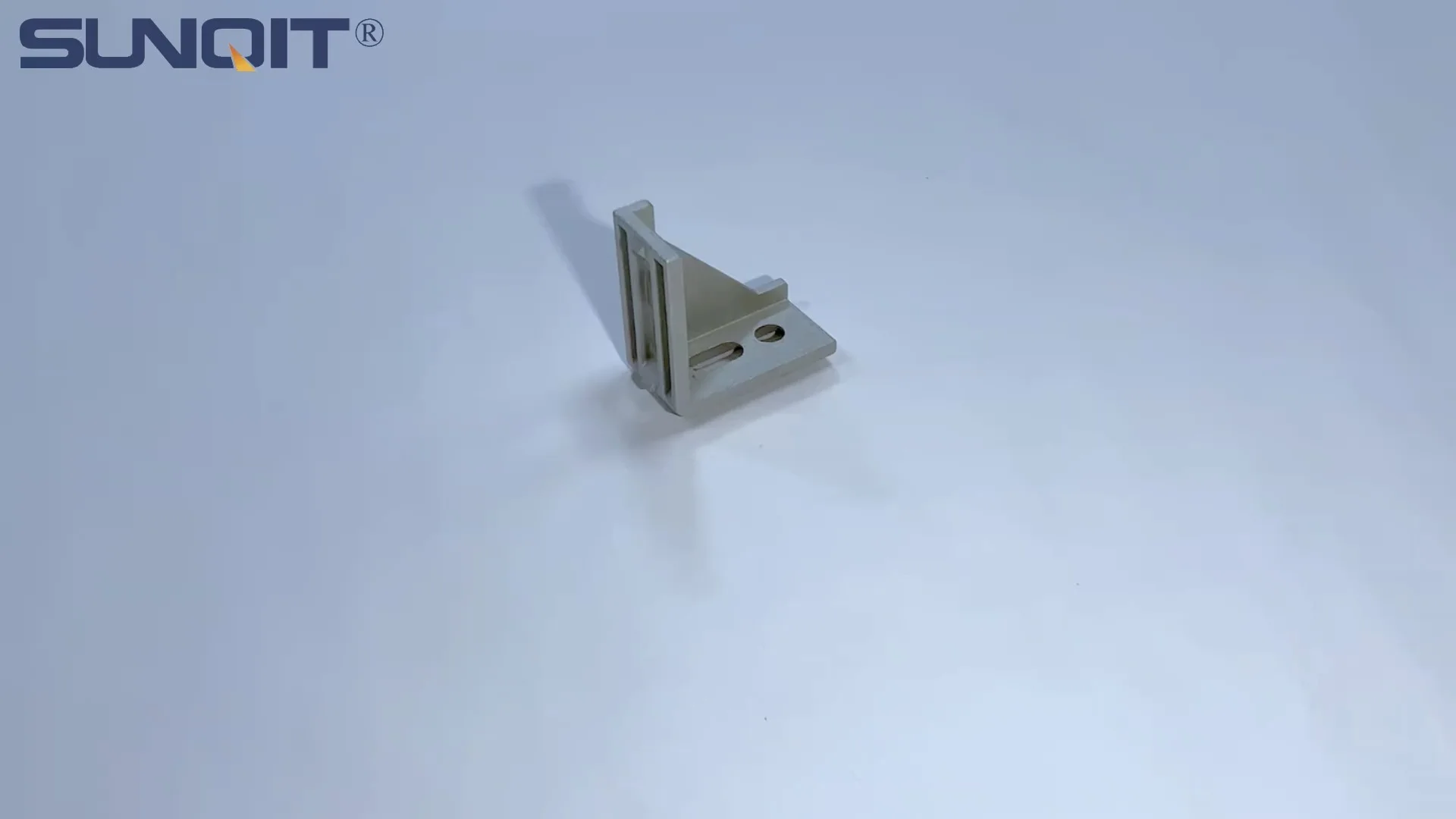
3060 Aluminum Angle Yards
It used for 90° flat connection for 20 series aluminum profile.
Walk into any 3C manufacturing facility—where smartphones, laptops, and tablets come to life—and you'll notice a silent hero behind the scenes: the assembly workstation. These workbenches, racks, and material flow systems are the backbone of production, dictating how efficiently workers can piece together tiny, delicate components. But in an industry where product cycles shrink from months to weeks, and customization demands grow by the day, rigid, one-size-fits-all workstations just don't cut it anymore. Enter 3060 aluminum angle yards—a humble yet transformative component that's redefining flexibility, durability, and adaptability in 3C assembly lines. Let's dive into how these unassuming aluminum pieces are making a big impact.
The 3C Manufacturing Challenge: Why Workstation Flexibility Matters
3C products—short for computers, communications, and consumer electronics—are marvels of miniaturization. A single smartphone might contain over 1,000 components, from microchips smaller than a fingernail to precision-machined camera modules. Assembling these requires workstations that can accommodate not just the product itself, but also specialized tools, ESD (electrostatic discharge) protection, and ergonomic layouts to keep workers comfortable during long shifts.
The problem? Traditional workstations, often built with steel frames or wooden surfaces, are static. If a manufacturer switches from assembling a 6-inch phone to an 11-inch tablet, the workstation might need a complete overhaul. Welding, drilling, or replacing heavy steel parts takes time—time that could be spent producing goods. Worse, rigid setups often lead to inefficiencies: tools are out of reach, material racks are too tall or too short, and workers strain to adjust, leading to fatigue and errors.
This is where modular solutions shine. And at the heart of many modular workstation systems lies the 3060 aluminum angle yard, paired with components like the 3060 national standard profile a and aluminum profile accessories. Together, they create workstations that can be reconfigured in minutes, not days, adapting to new products, processes, and worker needs.
What Are 3060 Aluminum Angle Yards, Anyway?
Let's start with the basics. A 3060 aluminum angle yard is a lightweight, L-shaped component made from aluminum extrusion profile—meaning it's formed by pushing heated aluminum through a die to create a consistent, precise shape. The "3060" refers to its dimensions: 30mm in one leg and 60mm in the other, forming a right angle (90 degrees). This simple L-shape is deceptively versatile, acting as a connector, a support brace, or a mounting point in workstation frames.
But why aluminum? Unlike steel, aluminum is corrosion-resistant, so it won't rust in humid factory environments—a critical feature when handling electronics that hate moisture. It's also lightweight: a 1-meter length of 3060 aluminum angle yard weighs just 0.8kg, compared to 2.5kg for a similar steel angle. This makes it easy for workers to carry, adjust, and install without heavy lifting equipment. And because it's an aluminum extrusion profile, each piece is uniform—no warping or inconsistencies, ensuring a snug fit every time.
The real magic, though, is in the details. Most 3060 aluminum angle yards feature T-slots—longitudinal grooves along their length—that work with aluminum profile accessories like T-nuts, bolts, and brackets. These slots let you attach components anywhere along the angle yard, no pre-drilled holes required. Need to add a shelf 15cm from the top? Slide a T-nut into the slot, bolt on a bracket, and you're done. It's this flexibility that makes them indispensable in dynamic 3C environments.

Pairing with 3060 National Standard Profile A: The Foundation of Modular Workstations
3060 aluminum angle yards rarely work alone. Their most common partner is the 3060 national standard profile a—a straight, rectangular aluminum extrusion with T-slots on all four sides. Together, they form the "bones" of a workstation frame. Think of the 3060 profile as the vertical and horizontal beams, and the angle yards as the "cornerstones" that reinforce joints and add stability.
Let's break down a typical assembly: Imagine building a workbench frame. You start with four vertical 3060 national standard profile a posts—one for each corner. To connect the top horizontal beams, you could bolt them directly to the posts, but that might wobble under heavy tools. Instead, you attach 3060 aluminum angle yards to the top of each post using T-slot bolts. The angle yards' L-shape wraps around the post and the horizontal beam, creating a 90-degree joint that's far sturdier than a direct connection. Add a few more angle yards along the beams for extra support, and you've got a frame that can handle 50kg+ of weight without flexing.
What if you need to adjust the workbench height later? No problem. Loosen the bolts holding the angle yards to the vertical posts, slide the horizontal beams up or down, and retighten. It takes two workers less than five minutes per workstation—no cutting, welding, or re-drilling. This adaptability is a game-changer for 3C manufacturers, where a single production line might switch between assembling smartwatches (requiring low workbenches) and laptops (needing higher surfaces) in the same week.

Aluminum Profile Accessories: Turning Frames into Functional Workstations
A frame made of 3060 angle yards and profiles is just the start. To turn it into a fully functional 3C assembly workstation, you need aluminum profile accessories—the nuts, brackets, panels, and hooks that add purpose. Let's walk through how these accessories transform a bare frame into a tool-ready workspace.
First, the work surface. Most 3C workstations use an aluminum honeycomb panel—lightweight, rigid, and ESD-safe—mounted on top of the horizontal beams. To attach it, you'd use angle brackets (another type of aluminum profile accessory) secured to the 3060 angle yards via T-slots. The brackets lift the panel slightly, creating space underneath for cable management—a must when dealing with chargers, testing tools, and ESD wrist straps.
Next, tool storage. Workers need quick access to screwdrivers, tweezers, and anti-static brushes. Enter T-slot tool hooks: slide them into the angle yards' slots, tighten with a hex key, and hang tools within arm's reach. No more fumbling through drawers or reaching across cluttered surfaces. For bulkier items like soldering irons or magnifying lamps, adjustable shelves—supported by angle yards and bracket accessories—can be added at eye level or waist height, depending on what's most ergonomic.
ESD protection is non-negotiable in 3C assembly, where a single static charge can fry a $500 microchip. Aluminum profile accessories like ESD mat clamps attach directly to the angle yards, grounding the work surface to prevent static buildup. Even the casters (if the workstation is mobile) can be ESD-rated, with conductive wheels that dissipate charge as the bench moves.
The best part? If the workstation needs to evolve—say, adding a second shelf for a new component—you don't need to buy a whole new setup. Just grab a few extra brackets and angle yards, adjust the T-slots, and you're ready. It's modularity at its finest.

Real-World Applications: How 3060 Aluminum Angle Yards Solve 3C Assembly Pain Points
Enough theory—let's look at how these components work in actual 3C factories. Below are three common scenarios where 3060 aluminum angle yards make a tangible difference.
1. Ergonomic Workbenches: Reducing Fatigue, Boosting Productivity
Assembly line workers spend 8+ hours a day at their workstations, often hunched over small components. Poor ergonomics leads to back pain, eye strain, and slower output. 3060 aluminum angle yards help solve this by enabling height-adjustable workbenches.
Take a smartphone assembly line in Shenzhen. Workers here alternate between placing SIM card trays (requiring fine motor skills, best done at waist height) and attaching back glass panels (needing a flatter, chest-height surface). With a traditional wooden bench, they'd be stuck at one height. But with a frame built from 3060 national standard profile a and angle yards, the work surface can be adjusted in 5cm increments. Using a hand crank or electric lift, workers set the height to their comfort level, reducing strain and cutting error rates by 15% in one factory's case study.
Angle yards also play a role in tilting work surfaces. For tasks like soldering or inspecting circuit boards, a 10-15° tilt reduces neck strain. By mounting hinges (another aluminum profile accessory) to the angle yards, the surface can be tilted and locked in place—no tools required.
2. Material Flow Racks: Keeping Components Moving Efficiently
In 3C assembly, parts need to flow smoothly from storage to the workstation. Bottlenecks here can bring production to a halt. 3060 aluminum angle yards are key to building flexible flow racks—sloped shelves with roller tracks that let bins of components glide to workers.
A typical flow rack might have three levels, each holding bins of screws, connectors, or display screens. The frame is built with 3060 profiles, and 3060 angle yards are used to mount the roller tracks at a 5° angle (just enough to let gravity do the work). If a new component bin is taller than the others, workers can adjust the angle yards to raise one section of the track, ensuring the bin still slides smoothly. No need to rebuild the entire rack—just reposition the angle yards and tighten the bolts.
These racks also adapt to changing component sizes. When a factory switches from 6-inch to 7-inch phone screens, the bins get wider. With angle yards, workers can loosen the roller track mounts, slide them apart, and resecure—all in 10 minutes. Traditional steel racks would require cutting and welding, taking hours.
3. Mobile Workstations: Adapting to Dynamic Floor Plans
Many 3C factories use "cellular manufacturing"—small teams working on specific product modules (e.g., camera assembly, battery installation). These teams need workstations that can move to different areas of the factory as production needs shift. 3060 aluminum angle yards make mobile workbenches possible and durable.
A mobile workstation frame uses 3060 profiles for the structure and angle yards to reinforce the base, where heavy-duty casters are mounted. The angle yards distribute the weight of tools and components evenly across the casters, preventing the frame from warping when rolled over factory floors. And since aluminum is lightweight, even a fully loaded workstation (with tools, parts, and a worker) can be pushed by one person—no forklift needed.
One factory in Guangzhou reported a 30% reduction in "dead time" (when workers wait for materials or reconfigured workstations) after switching to mobile benches with 3060 angle yards. Teams can now reposition their workstations to be closer to material storage or adjacent modules, cutting down on walking time and streamlining communication.
Case Study: XYZ Electronics Cuts Setup Time by 70% with Aluminum Angle Yards
XYZ Electronics, a mid-sized 3C manufacturer in Dongguan, used to struggle with workstation reconfigurations. When they launched a new tablet model in 2023, their old steel workbenches couldn't accommodate the larger screen assembly jigs. Setup took 8 hours per line—time they couldn't afford with a tight launch deadline.
They switched to a modular system built with 3060 national standard profile a, 3060 aluminum angle yards, and aluminum profile accessories. For the new tablet line, workers needed to: widen the work surface by 20cm, add a second shelf for screen protectors, and install a tilted inspection platform. Using T-slots and angle yards, the team reconfigured 10 workstations in just 2.5 hours—70% faster than before.
"We used to dread product launches because of the workstation chaos," said Li Wei, XYZ's production manager. "Now, with the aluminum angle yards, my team can adjust a bench during a lunch break. It's like having a workstation that bends to our needs, not the other way around."
Traditional vs. Modular: A Comparison Table
| Criteria | Traditional Steel/Wood Workstations | 3060 Aluminum Angle Yard + Profile A Workstations |
|---|---|---|
| Setup Time | 4–8 hours per workstation (requires welding/drilling) | 30–60 minutes per workstation (tool-free adjustments) |
| Flexibility | Fixed; reconfiguration requires replacement parts | Highly adaptable; adjust heights, add/remove components via T-slots |
| Durability | Steel is strong but prone to rust; wood warps with moisture | Aluminum resists corrosion; extrusion profiles withstand 500+kg loads |
| Weight | Heavy (50–100kg per workstation); requires machinery to move | Lightweight (15–30kg per workstation); movable by hand |
| ESD Compatibility | Difficult; requires retrofitted grounding kits | Easy; ESD accessories integrate directly via T-slots |
| Long-Term Cost | Low upfront, high replacement costs (5–7 year lifespan) | Higher upfront, low maintenance (10–15 year lifespan, reusable components) |
Future-Proofing 3C Assembly: Why Aluminum Extrusion Profile Systems Are Here to Stay
The 3C industry isn't slowing down. As products get smarter, components get smaller, and customization becomes the norm, factories need tools that can keep up. 3060 aluminum angle yards and their modular counterparts aren't just a trend—they're a long-term investment in adaptability.
Consider sustainability, too. Aluminum is 100% recyclable, and modular systems generate less waste than traditional setups (no cutting steel or discarding warped wood). For factories aiming to reduce their carbon footprint, this is a win-win.
Looking ahead, we'll likely see even more integration with Industry 4.0 technologies. Imagine workstations with sensors mounted via 3060 angle yards that track tool usage or alert managers when a component bin is low. Or AI-powered systems that suggest workstation configurations based on upcoming production runs—all made possible by the flexibility of aluminum extrusion profiles.
Conclusion: Empowering 3C Manufacturers to Build Smarter, Not Harder
3060 aluminum angle yards might not grab headlines like the latest smartphone, but they're quietly revolutionizing how 3C products are made. By pairing with 3060 national standard profile a and aluminum profile accessories, they create workstations that are flexible enough to keep up with rapid product cycles, durable enough to withstand factory rigors, and ergonomic enough to keep workers happy and productive.
For 3C manufacturers, the message is clear: your workstations shouldn't be a bottleneck. They should be a competitive advantage. And with 3060 aluminum angle yards, that advantage is within reach—one T-slot, one bracket, and one perfectly adjusted workbench at a time.