- Company Articles
- Products and Technology
- Application Cases
- Applications of 4040C EU Standard Aluminum Profile in 3C Assembly Workstations

Applications of 4040C EU Standard Aluminum Profile in 3C Assembly Workstations
Related Product
4040C EU Standard Aluminum Profile
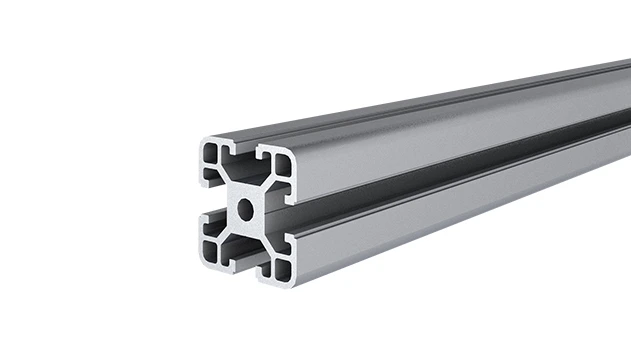
4040C is a 4.00x4.00 CM fractional 40 series square extrusion T-slot profile with four open T-slots, each side with 4.00cm face. The profile has align-a-grooves to assist in aligning connecting profiles.
Walk into any modern 3C (computers, communications, consumer electronics) assembly plant today, and you'll notice a quiet revolution unfolding. The once rigid, bolted-down production lines of yesteryear are giving way to sleek, modular setups that adapt as quickly as the industry itself. At the heart of this transformation lies a humble yet powerful component: the 4040C EU Standard Aluminum Profile. From smartphone assembly lines to laptop production floors, this unassuming aluminum extrusion has become the backbone of flexible manufacturing, solving age-old challenges of rigidity, inefficiency, and high reconfiguration costs. Let's dive into how this profile is reshaping 3C assembly workstations, and why manufacturers worldwide are making it their go-to choice.
What Makes 4040C EU Standard Aluminum Profile Stand Out?
First, let's get to know the star of the show. The 4040C EU Standard Aluminum Profile is a precision-engineered extrusion with a cross-section of 40mm x 40mm—hence the "4040" in its name. Made from high-grade 6063-T5 aluminum alloy, it balances strength and lightweight properties perfectly: strong enough to support heavy equipment, yet light enough to reconfigure without heavy machinery. Its defining feature? The T-slot design running along all four sides. These slots act as universal connection points, allowing manufacturers to attach accessories, shelves, panels, and tools with minimal effort—no welding, drilling, or specialized tools required.
But what sets the "C" variant apart? Unlike some profiles with rounded edges or uneven slot spacing, the 4040C adheres strictly to EU standards, ensuring consistent slot dimensions (typically 8mm or 10mm) and precise tolerances. This uniformity means accessories from different suppliers fit seamlessly, reducing compatibility headaches. For 3C manufacturers, where even a millimeter of misalignment can throw off delicate assembly tasks, this precision is non-negotiable.
Why 3C Assembly Needs 4040C: The Pain Points It Solves
The 3C industry moves at a breakneck pace. New smartphone models launch yearly, laptops get slimmer by the quarter, and wearables evolve monthly. For assembly lines, this means constant retooling: adjusting workbench heights, reconfiguring material flow paths, or even rebuilding entire sections to accommodate new product dimensions. Traditional setups—think steel frames welded together or wooden workbenches bolted to the floor—simply can't keep up. They're time-consuming to modify, expensive to replace, and often result in downtime that costs manufacturers thousands per hour.
Here's where 4040C shines. Its modularity turns "months to reconfigure" into "days—or even hours." Need to lower a workbench by 10cm for a new ergonomic standard? Swap out the leg brackets. Want to add a shelf for tool storage? Slide in T-slot nuts and bolt on the shelf. The profile's compatibility with a vast range of aluminum profile accessories—from 90° connectors to end caps—means customization is limited only by imagination, not hardware constraints. For 3C manufacturers, this translates to faster time-to-market for new products, reduced downtime during line changes, and a workforce that feels empowered, not constrained, by their tools.

Application 1: Building Ergonomic, Adaptable Workstations
At the core of any 3C assembly line are the workstations where operators spend 8+ hours daily, meticulously fitting tiny components like circuit boards, connectors, and screens. These workstations need to be sturdy, precise, and—above all—ergonomic to prevent fatigue and errors. 4040C has become the gold standard for building such workstations, and it's easy to see why.
Take, for example, a typical smartphone assembly workstation. The frame, built from 4040C profiles, supports a lightweight yet rigid tabletop—often an aluminum honeycomb panel for durability and static control (critical for electronics). Using 90° aluminum profile connectors, manufacturers can attach adjustable shelves above the work surface to hold tools, magnifying glasses, or component bins. Need to add a power strip for soldering irons or testing equipment? Simply slide T-slot nuts into the profile's slots and mount the strip—no drilling holes or rerouting wires.
Ergonomics are where 4040C truly excels. Many 3C plants now use height-adjustable workstations built with 4040C frames and gas-spring mechanisms. Operators can tweak the height with a lever, ensuring the work surface aligns with their elbows—reducing strain on shoulders and wrists. Casters (another key accessory) can be added to the base, turning fixed workstations into mobile units that follow operators as they move between tasks. Even details like anti-fatigue mat mounting become simpler: use T-slot brackets to secure the mat to the profile frame, preventing slips or trips.
One manufacturer in Shenzhen, a hub for electronics production, recently shared how switching to 4040C workstations cut operator complaints about discomfort by 40%. "Before, we had one-size-fits-all wooden benches," they noted. "Now, each operator can adjust their station in 2 minutes—no maintenance team needed. The difference in focus and speed is night and day."
Application 2: Streamlining Material Flow with 4040C Flow Racks
In 3C assembly, time is money—and nowhere is this truer than in material handling. Components like microchips, batteries, and LCD screens need to move from storage to workstations quickly, without damage or delays. Enter flow racks: inclined structures that use gravity to feed materials to operators, ensuring a steady, first-in-first-out (FIFO) supply. And 4040C is making these racks smarter, more durable, and infinitely customizable.
Traditional flow racks often use steel frames, which are heavy and hard to adjust. A 4040C-based flow rack, by contrast, is lightweight but rigid enough to support stacked component bins. The T-slots allow for easy installation of roller tracks—another critical accessory in 3C setups. These tracks, often made of plastic or aluminum, let bins glide smoothly down the incline, reducing the need for manual lifting. Need to adjust the angle of the incline for heavier bins? Loosen the T-slot bolts, reposition the roller track brackets, and retighten—done in minutes.
What about varying component sizes? 4040C's modularity shines here, too. Manufacturers can add dividers or vertical panels (using 45° aluminum profile connectors) to create custom-sized lanes for different bins. For example, a lane for small screw bins might be 10cm wide, while a lane for battery packs could be 30cm. When a new component is introduced, simply reposition the dividers—no need to build a new rack. This flexibility is a game-changer for 3C plants, where component sizes change with every product iteration.
A case in point: a major laptop manufacturer in Taiwan was struggling with frequent stockouts of small components, as operators had to walk to distant storage areas to restock. By installing 4040C flow racks adjacent to workstations, they cut restocking time by 60%. "Operators now have components right at their fingertips," a production manager explained. "The racks adjust when we switch to new laptop models, so we never waste space or time."
Application 3: Connecting Workstations with 4040C-Powered Conveyors
No 3C assembly line is complete without conveyors—the arteries that link workstations, moving semi-finished products from one task to the next. Whether it's a smartphone chassis moving from soldering to testing, or a tablet back cover moving to quality inspection, conveyors need to be reliable, adaptable, and space-efficient. 4040C is proving to be the ideal frame material for these systems, replacing bulky steel frames and rigid plastic tracks.
Roller conveyors, in particular, benefit from 4040C's versatility. The profile's T-slots make it easy to mount roller tracks at precise intervals, ensuring smooth product movement. Need a curved section to navigate around a workstation? Use flexible 4040C sections (yes, even curved profiles exist!) and roller track connectors to create bends without compromising stability. For delicate electronics, manufacturers often opt for soft-touch roller tracks (like plastic or rubber-coated options), which attach to 4040C frames using simple brackets—no custom machining required.
Belt conveyors, too, are getting a 4040C upgrade. The profile's strength supports the weight of motorized belt systems, while its lightweight nature makes it easy to reposition the entire conveyor line when layouts change. For example, when a manufacturer shifts from assembling 10-inch tablets to 12-inch models, they can extend the conveyor by adding 4040C segments and extra belt length—no need to replace the entire system. This adaptability is crucial in 3C, where product sizes and production volumes fluctuate constantly.
Perhaps the biggest advantage? Integration with smart manufacturing tools. The T-slots in 4040C frames make it simple to mount sensors, cameras, or barcode scanners along the conveyor line. These tools track product flow, flag defects, or log production data in real time—key for Industry 4.0 initiatives. A smartwatch manufacturer in South Korea, for instance, used 4040C conveyors with mounted cameras to detect misaligned watch faces, reducing defect rates by 25%.
The Unsung Heroes: Aluminum Profile Accessories
A profile is only as good as the accessories that bring it to life, and 4040C's ecosystem of aluminum profile accessories is what truly unlocks its potential. These small, often overlooked components turn basic aluminum extrusion into a fully functional workstation, flow rack, or conveyor. Let's highlight a few that are indispensable in 3C assembly:
- 90° Aluminum Profile Connectors: These L-shaped brackets join two 4040C profiles at right angles, forming the corners of workstations or racks. They slide into T-slots and secure with bolts, creating a rigid joint without welding.
- 4040 Aluminum Profile End Caps: Simple plastic or aluminum caps that snap onto the ends of profiles, preventing sharp edges (a safety must in busy plants) and keeping dust out of T-slots.
- Gusset Alp 4040: Triangular brackets that reinforce joints, adding extra stability to heavy-load areas like workbench corners or flow rack bases.
- Roller Track Connectors: These specialized brackets attach roller tracks to 4040C frames, allowing precise adjustment of track height and angle for optimal material flow.
- Casters: Heavy-duty casters with T-slot mounting plates, turning static workstations or racks into mobile units. Lockable options ensure stability during use.
The beauty of these accessories is their interoperability. A 90° connector from one supplier works with a gusset from another, thanks to 4040C's EU-standard T-slot dimensions. This reduces vendor lock-in and lets manufacturers mix and match for the best price and performance.
Comparing 4040C to Other Profiles: Why It's the 3C Industry's Top Pick
With so many aluminum profiles on the market—3030, 2020, 4080—why has 4040C become the darling of 3C assembly? Let's break it down with a quick comparison:
| Profile Type | Key Use Case | Best for 3C? | Limitation vs. 4040C |
|---|---|---|---|
| 2020 (20x20mm) | Light-duty shelving, small workbenches | No | Too narrow for heavy tools or equipment; limited accessory compatibility. |
| 3030 (30x30mm) | Medium-duty racks, small conveyors | Sometimes | Lower load capacity (max ~300kg/m vs. 4040C's 500kg/m); less space for T-slot accessories. |
| 4080 (40x80mm) | Heavy machinery frames, industrial workbenches | Rarely | Overkill for most 3C tasks; bulkier and more expensive than needed. |
| 4040C (40x40mm) | Workstations, flow racks, conveyors | Yes | None for 3C—balances strength, size, and cost perfectly. |
For 3C assembly, where most tasks involve medium loads (50-200kg per workstation) and frequent reconfiguration, 4040C hits the sweet spot. It's not too big to waste space, not too small to skimp on strength, and its EU-standard design ensures global compatibility—critical for manufacturers with plants in multiple countries.
Looking Ahead: 4040C and the Future of 3C Manufacturing
As the 3C industry continues to evolve—with foldable phones, AR glasses, and IoT devices pushing the boundaries of design—one thing is clear: flexibility will only grow more important. Manufacturers will need assembly lines that can switch from producing 10,000 units of one smartphone model to 5,000 units of another in days, not weeks. 4040C EU Standard Aluminum Profile is poised to lead this charge, thanks to its adaptability, precision, and ever-expanding ecosystem of accessories.
We're already seeing innovations: 4040C profiles with integrated cable management channels to reduce clutter, or profiles with antimicrobial coatings for cleanroom assembly of medical devices (a close cousin of 3C manufacturing). As sustainability becomes a priority, the profile's recyclability (aluminum is 100% recyclable with no loss of quality) will also play a bigger role, aligning with brands' net-zero goals.
For manufacturers still on the fence, consider this: the cost of 4040C and its accessories is quickly offset by reduced downtime, faster reconfigurations, and longer equipment lifespan. In an industry where margins are tight and competition fierce, that's not just an advantage—it's a necessity.
Final Thoughts: The 4040C Revolution
The 4040C EU Standard Aluminum Profile may not grab headlines like the latest smartphone or wearable, but it's quietly revolutionizing how 3C products are made. By turning rigid assembly lines into flexible, adaptable workspaces, it's helping manufacturers keep pace with an industry that waits for no one. From ergonomic workstations that prioritize worker well-being to flow racks that streamline material handling, and conveyors that connect it all—4040C is more than a component; it's a catalyst for change.
So the next time you unbox a new phone or laptop, take a moment to appreciate the invisible hero behind its assembly: a simple aluminum profile that's making modern manufacturing smarter, faster, and more human-centric. The 4040C revolution is here—and it's only just getting started.