- Company Articles
- Products and Technology
- Application Cases
- Applications of Flat Rigid Castor Wheels in Home Appliance Manufacturing Racks

Applications of Flat Rigid Castor Wheels in Home Appliance Manufacturing Racks
Related Product
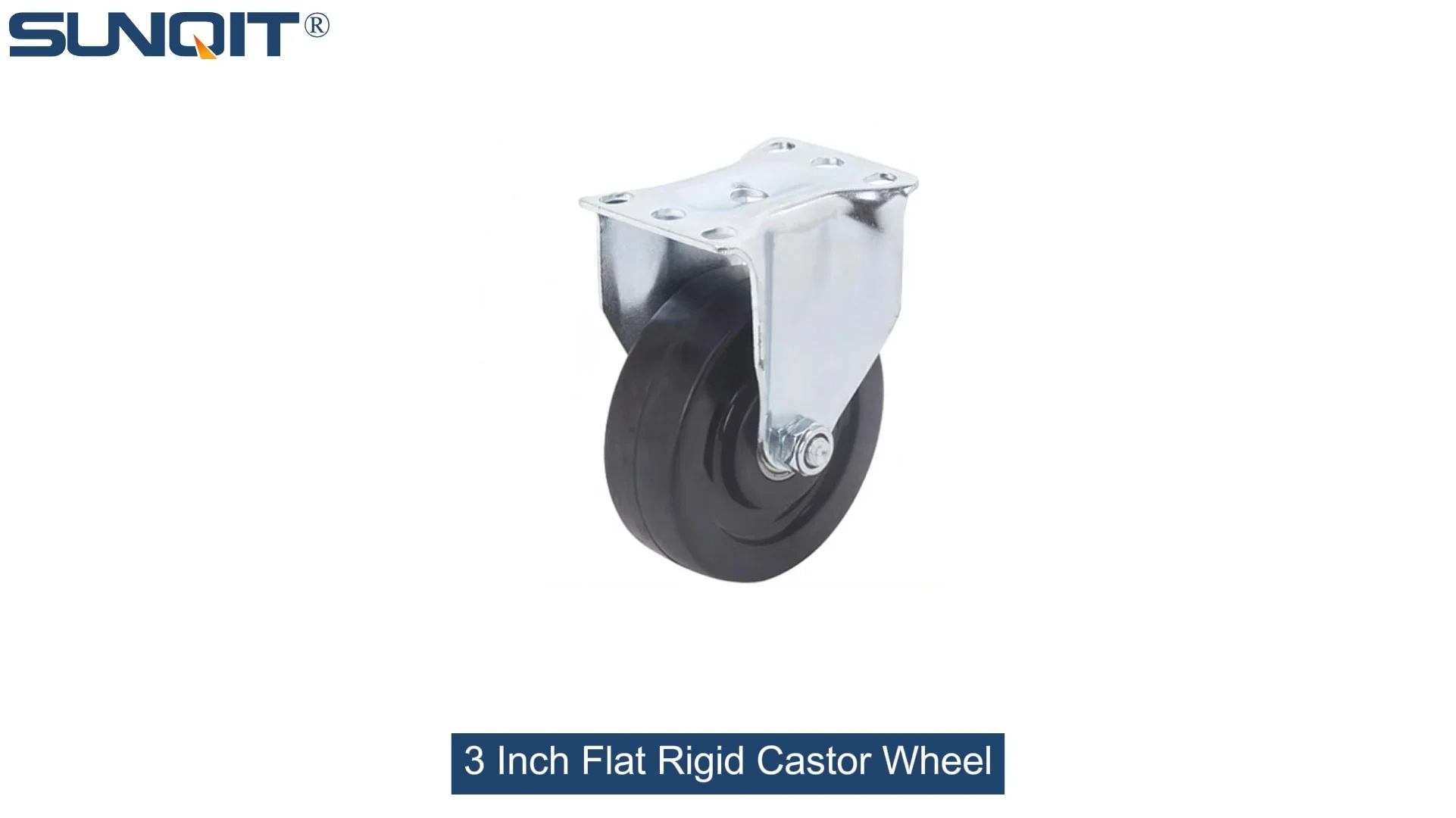
Flat Rigid Castor Wheel
Chair Casters Ball Bearing Wheels Rubber Base. Resistant to abrasion, impact and corrosion. Heavy payload can hold 70Kgs per pcs,which can make it works at a stable and smooth status.
Introduction: The Unsung Heroes of Home Appliance Manufacturing
Walk into any home appliance manufacturing plant, and your eyes might first be drawn to the sleek assembly lines, the hum of robotic arms, or the precision of workers piecing together refrigerators, washing machines, or ovens. But behind the scenes, there's a quieter, yet equally critical, component keeping the entire operation running smoothly: material handling equipment. From storing bulky motor parts to transporting delicate circuit boards, the right racks, trolleys, and storage systems can make or break efficiency, safety, and productivity. And at the heart of many of these systems? Castor wheels. Specifically, flat rigid castor wheels—unassuming, sturdy, and often overlooked, but indispensable for creating stable, reliable workspaces.
Home appliance manufacturing is a high-stakes industry. With tight production deadlines, heavy components (think stainless steel drum assemblies for washing machines or compressor units for refrigerators), and the need for consistent quality, every piece of equipment must perform flawlessly. Material racks, in particular, are workhorses here. They hold raw materials, semi-finished parts, and even finished products, often in high-density storage setups to maximize floor space. But a rack is only as good as its mobility and stability. This is where flat rigid castor wheels come into play. Unlike their swiveling counterparts, which prioritize maneuverability, flat rigid castor wheels are designed for stability and load-bearing—two qualities that are non-negotiable when dealing with hundreds of pounds of appliance parts.
In this article, we'll dive deep into the world of flat rigid castor wheels, exploring how they're used in home appliance manufacturing racks, why they're preferred over other caster types in specific scenarios, and how they integrate with accessories and systems to support lean manufacturing goals. We'll also look at real-world applications, from the humble turnover trolley to specialized material racks, and explain why choosing the right caster can transform a chaotic production floor into a model of efficiency.
Understanding Flat Rigid Castor Wheels: Design, Materials, and Function
Before we jump into applications, let's clarify what a flat rigid castor wheel is. At its core, a caster is a wheel mounted on a bracket, designed to be attached to the bottom of a piece of furniture, equipment, or—relevant here—a rack or trolley. "Flat rigid" refers to two key features: the wheel's orientation (fixed, not swiveling) and its mounting plate (flat, for easy attachment to the base of the rack). Unlike swivel casters, which can rotate 360 degrees to allow movement in any direction, rigid casters are fixed in place, meaning they only roll forward or backward along a straight path. This fixed orientation is what gives them their stability advantage, especially when the rack is stationary or only needs to be moved occasionally along a predictable route.
The construction of a flat rigid castor wheel is deceptively simple, but every component is engineered for durability. The wheel itself is typically made from materials like polyurethane, rubber, or cast iron, depending on the load capacity and floor type. Polyurethane wheels, for example, are popular in manufacturing because they're non-marking (critical for keeping factory floors clean) and offer good shock absorption, which protects delicate parts from jostling during transport. Cast iron wheels, on the other hand, are better for extremely heavy loads—think 1,000+ pounds—though they're noisier and can scratch floors if not used carefully.
The bracket, or "yoke," of the caster is usually made from steel, aluminum, or stainless steel, depending on the environment. In home appliance plants, where moisture or chemicals might be present (e.g., in cleaning or coating areas), stainless steel brackets are preferred for their corrosion resistance. The bracket attaches to the rack via a flat mounting plate, which is drilled with holes to align with pre-drilled holes in the rack's base. This is where caster accessories like castor fixed plates or installation bases come into play—they ensure a secure, wobble-free connection between the caster and the rack, preventing accidents and extending the life of both the caster and the rack.
Load capacity is another critical factor. Flat rigid castor wheels are rated by how much weight they can support individually, and racks are typically outfitted with four or more casters (depending on size). For home appliance manufacturing, where a single rack might hold multiple oven door assemblies (each weighing 50-70 pounds) or dishwasher tubs (up to 100 pounds each), casters with load capacities of 300-500 pounds per wheel are common. This ensures that even when fully loaded, the rack remains stable and the wheels don't warp or fail under stress.

Why Flat Rigid Castor Wheels? Advantages in Home Appliance Racks
You might be wondering: why use rigid casters at all when swivel casters offer more flexibility? The answer lies in the specific needs of home appliance manufacturing racks. Let's break down the key advantages of flat rigid castor wheels in this context:
1. Unmatched Stability
: When a rack is holding heavy, unevenly distributed loads (like a stack of refrigerator doors, which are top-heavy), stability is paramount. Swivel casters, with their ability to rotate, can cause the rack to shift or even tip if bumped, especially when loaded to capacity. Flat rigid castor wheels, fixed in a straight line, keep the rack grounded. This is particularly important in high-traffic areas, where forklifts, pallet jacks, or workers might accidentally brush against the rack—rigid casters minimize movement, reducing the risk of parts falling or the rack itself tipping over.
2. Higher Load Capacity
: Because they don't have the swivel mechanism, which adds complexity and potential weak points, rigid casters can often support more weight than swivel casters of the same size. The swivel joint in a swivel caster is a common failure point under heavy loads, whereas rigid casters distribute weight directly from the bracket to the wheel, reducing stress on components. For home appliance racks that need to hold 1,000+ pounds, this is a game-changer.
3. Lower Maintenance
: Swivel casters have more moving parts—bearings, swivel races, and locking mechanisms—that can wear out or get clogged with dirt, grease, or debris from the factory floor. Flat rigid castor wheels, with their simple fixed design, require less upkeep. A quick check of the mounting bolts (secured with caster accessories like lock washers) and occasional lubrication of the wheel bearings is usually all that's needed to keep them running smoothly. In a busy manufacturing plant, where downtime is costly, this lower maintenance requirement translates to higher productivity.
4. Predictable Movement
: In many cases, material racks in home appliance plants don't need to be highly maneuverable. They might be positioned along an assembly line, moved occasionally to restock parts, or shifted to a new location during retooling. For these scenarios, rigid casters are ideal—they roll straight, so operators can push the rack along a predefined path (like between two assembly stations) without worrying about it veering off course. This predictability is especially useful when the rack is loaded with delicate parts, such as glass oven doors or electronic control panels, which can't withstand sudden jolts or turns.
5. Cost-Effectiveness
: Rigid casters are generally less expensive than swivel casters, thanks to their simpler design. For manufacturers looking to optimize costs (a key part of lean system principles), this is an added bonus. When outfitting an entire factory with dozens or hundreds of racks, the savings from choosing rigid casters can add up quickly—without sacrificing performance.
| Feature | Flat Rigid Castor Wheels | Swivel Castor Wheels | Best For |
|---|---|---|---|
| Stability | High (fixed direction prevents tipping) | Medium (swivel joint can cause shifting under load) | Rigid: Heavy, uneven loads; high-traffic areas |
| Load Capacity | Higher (no swivel joint to weaken structure) | Lower (swivel joint is a potential failure point) | Rigid: Racks with 1,000+ pound loads |
| Maneuverability | Low (only rolls forward/backward) | High (360° rotation for tight spaces) | Swivel: Trolleys needing frequent direction changes |
| Maintenance | Low (fewer moving parts) | Medium (swivel joint requires lubrication/cleaning) | Rigid: High-volume, low-downtime environments |
| Cost | Lower (simpler design) | Higher (swivel mechanism adds cost) | Rigid: Budget-sensitive, large-scale deployments |

Key Applications: Where Flat Rigid Castor Wheels Shine in Home Appliance Plants
Now that we understand the "why" behind flat rigid castor wheels, let's explore their "where." In home appliance manufacturing, these casters are used in a variety of rack and trolley systems, each tailored to specific tasks. Here are the most common applications:
1. Material Racks: Storing Heavy Components with Confidence
Material racks are the backbone of any manufacturing plant's storage system, and in home appliance production, they're often customized to hold specific parts. One popular configuration is the
material rack b (3 row and 3 floor)
—a multi-tiered rack with three rows and three levels, designed to maximize vertical storage space. These racks are ideal for storing small to medium-sized parts, such as control knobs, gaskets, or motor brackets, but they can also hold heavier items when paired with the right casters.
Material rack b is often outfitted with flat rigid castor wheels for two reasons: first, to allow occasional repositioning (e.g., moving the rack closer to an assembly line when parts run low), and second, to ensure stability when fully loaded. Imagine a 3-row, 3-floor rack filled with stainless steel heating elements for ovens—each element weighs 15-20 pounds, and with 10 elements per shelf, that's 1,350 pounds total. Four flat rigid castor wheels, each rated for 400 pounds, would easily support this load, while keeping the rack stable even when workers are pulling parts from the top shelf (which could otherwise cause tipping with swivel casters).
To ensure the casters stay securely attached to material rack b, manufacturers often use
caster accessories
like castor fixed plates or castor install bases. These accessories act as intermediaries between the caster and the rack's frame, distributing the weight evenly and preventing the mounting bolts from loosening over time. For example, a castor fixed plate might be welded or bolted to the rack's steel frame, with the caster then bolted to the plate—creating a stronger connection than if the caster were attached directly to the frame. This is especially important in environments where racks are moved frequently, as vibrations from rolling can loosen bolts without proper reinforcement.
2. Turnover Trolley and Rack: Transporting Parts Between Stations
While material racks are primarily for storage,
turnover trolley and rack
systems are designed for transporting parts between workstations. Think of them as mobile storage units that bridge the gap between the warehouse and the assembly line. For example, a turnover trolley might carry a batch of dishwasher door panels from the painting station to the assembly station, where workers attach hinges and handles. These trolleys need to be both mobile and stable—they're moved by hand, so they can't be too heavy, but they also can't tip over when loaded with parts.
Flat rigid castor wheels are a popular choice for turnover trolleys, especially those used to transport long or bulky items. A trolley carrying refrigerator side panels (which are tall and narrow) would be prone to tipping if equipped with swivel casters, as the high center of gravity combined with swivel movement could cause instability. Rigid casters, fixed in a straight line, keep the trolley moving forward smoothly, even when navigating the slight bumps between factory floor tiles.
Many turnover trolleys also feature foldable or adjustable shelves, allowing them to be customized for different parts. When the trolley is empty, it can be folded and stored to save space—a key part of lean system principles, which emphasize minimizing waste (including wasted floor space). Flat rigid castor wheels make folding easier because they don't swivel unexpectedly; workers can simply tilt the trolley back on its rigid casters and fold the shelves without worrying about the trolley rolling away.
3. Workbenches: Stable Surfaces for Assembly and Repair
Workbenches are where the magic happens in home appliance manufacturing—this is where workers assemble components, test parts, or repair defective units. While many workbenches are stationary, some are mobile, allowing them to be moved to where they're needed most (e.g., a repair bench might be wheeled to a production line to fix a faulty motor without disrupting the entire line). For mobile workbenches, flat rigid castor wheels are often paired with swivel casters in a "two rigid, two swivel" configuration, but in some cases—such as workbenches used for heavy-duty tasks like mounting compressor units—all four casters are rigid for maximum stability.
A workbench used for assembling washing machine drum assemblies, for example, might weigh 500 pounds when fully equipped with tools and parts. Flat rigid castor wheels ensure that when a worker leans on the bench to torque a bolt, the bench doesn't shift or rock—critical for precision work. Even when the bench is moved, rigid casters make it easy to roll in a straight line to a new location, then lock into place (using brake mechanisms, another common caster accessory) to stay put during use.
4. Lean System Integration: Supporting Efficiency and Waste Reduction
Lean system
principles—focused on eliminating waste, improving flow, and maximizing value—are central to modern home appliance manufacturing. Flat rigid castor wheels play a subtle but important role in supporting these goals. For example:
-
Reduced Downtime
: By minimizing maintenance needs and failures, rigid casters keep racks and trolleys in operation, reducing the time workers spend fixing equipment instead of building appliances.
-
Space Optimization
: Racks and trolleys with rigid casters can be positioned more closely together because they don't require extra space for swiveling. This allows factories to fit more storage in the same footprint, reducing the need for expansion.
-
Safer Work Environment
: Stable racks mean fewer accidents, which translates to less downtime, lower workers' compensation costs, and a more productive team. Lean systems prioritize safety as a form of waste reduction—accidents waste time, resources, and morale.
-
Standardization
: Using the same type of caster (flat rigid) across multiple racks and trolleys simplifies training and maintenance. Workers know how to move and maintain these systems, and spare parts (like replacement wheels or caster accessories) can be standardized, reducing inventory costs.
Case Study: How a Major Oven Manufacturer Improved Safety and Efficiency with Flat Rigid Castor Wheels
A leading home appliance manufacturer specializing in ovens was facing a problem: their existing material racks, equipped with swivel casters, were tipping over during peak production times. The racks held heavy oven door assemblies (each weighing 65 pounds), and with workers rushing to meet deadlines, the racks were often overloaded or bumped by forklifts. In one month alone, there were three incidents of racks tipping, resulting in damaged parts and a near-miss injury.
The manufacturer turned to flat rigid castor wheels as a solution. They replaced the swivel casters on 50 material racks with 4-inch flat rigid castor wheels, each rated for 450 pounds. They also added caster accessories, including castor fixed plates, to reinforce the connection between the casters and the racks. The results were immediate: over the next six months, there were zero tipping incidents, and workers reported feeling more confident when loading and unloading the racks. Additionally, the rigid casters reduced maintenance costs—where the swivel casters had required monthly lubrication and occasional bearing replacements, the rigid casters only needed quarterly inspections. The manufacturer estimated annual savings of $12,000 in maintenance and reduced part damage, all while supporting their lean system goals of waste reduction and safety improvement.

Choosing the Right Flat Rigid Castor Wheels: Key Considerations
Not all flat rigid castor wheels are created equal, and choosing the right one for your home appliance manufacturing racks requires careful consideration. Here are the key factors to keep in mind:
Load Capacity
: Always calculate the total weight the rack will carry (including the rack itself) and divide by the number of casters to determine the minimum load rating per caster. It's wise to add a 20% safety margin to account for uneven loading or occasional overloading.
Wheel Material
: Polyurethane wheels are a safe bet for most factory floors, as they're non-marking and absorb shocks. For outdoor use or rough surfaces (e.g., loading docks), rubber or cast iron wheels may be better. Avoid plastic wheels for heavy loads—they can crack under pressure.
Bracket Material
: Steel brackets are strong and affordable, but stainless steel is better for humid or corrosive environments (e.g., near washing machine assembly lines, where water exposure is common). Aluminum brackets are lightweight but less durable for heavy loads.
Caster Accessories
: Don't skimp on accessories like castor fixed plates, lock washers, or brake mechanisms (if needed). These components ensure safety and longevity. For example, a brake on one or two casters can prevent the rack from rolling when stationary, even on sloped floors.
Floor Conditions
: Consider the factory floor surface. If the floor is smooth and even, smaller wheels (3-4 inches) work well. For uneven or cracked floors, larger wheels (5-6 inches) will roll more smoothly and reduce stress on the caster bearings.
The Future of Flat Rigid Castor Wheels in Home Appliance Manufacturing
As home appliance manufacturing continues to evolve—with trends like automation, IoT-connected equipment, and sustainability driving innovation—flat rigid castor wheels are also adapting. One emerging trend is the use of eco-friendly materials, such as recycled polyurethane for wheels, to align with manufacturers' sustainability goals. Another is the integration of smart sensors into caster brackets, which can monitor load capacity in real time and alert workers if a rack is overloaded (a feature that would have prevented the oven manufacturer's tipping incidents).
Additionally, as more manufacturers adopt aluminum or stainless steel for racks (to reduce weight without sacrificing strength), we're seeing flat rigid castor wheels designed specifically for these materials. For example, casters with aluminum brackets are lighter, making racks easier to move, while still supporting heavy loads. There's also growing demand for corrosion-resistant casters, as manufacturers push to reduce chemical use in cleaning (making stainless steel pipe series and stainless steel swivel components more popular).
Finally, the rise of lean system principles is driving demand for more modular caster systems. Manufacturers want casters that can be easily swapped out or upgraded without replacing the entire rack—for example, switching from rigid to swivel casters on a rack that's being repurposed from storage to transport. This modularity is made possible by standardized caster accessories, such as universal mounting plates, which allow for quick changes.
Conclusion: Flat Rigid Castor Wheels—Small Components, Big Impact
In the grand scheme of home appliance manufacturing, flat rigid castor wheels might seem like small players. But as we've explored, they play a critical role in ensuring safety, stability, and efficiency. From supporting heavy material racks like material rack b to enabling smooth transport with turnover trolley and rack systems, these casters are the unsung heroes that keep production lines moving and workers safe.
By choosing the right flat rigid castor wheels—considering load capacity, materials, and accessories—manufacturers can reduce waste, improve safety, and support lean system goals. And as the industry evolves, these casters will continue to adapt, incorporating new materials and technologies to meet the demands of modern manufacturing.
So the next time you walk through a home appliance factory, take a moment to look down at the racks and trolleys. Chances are, you'll see flat rigid castor wheels quietly doing their job—sturdy, reliable, and essential to the making of the appliances that power our daily lives.