- Company Articles
- Products and Technology
- Application Cases
- Applications of Lean Pipe Clamps in Home Appliance Production

Applications of Lean Pipe Clamps in Home Appliance Production
Related Product
Lean Pipe Clamp
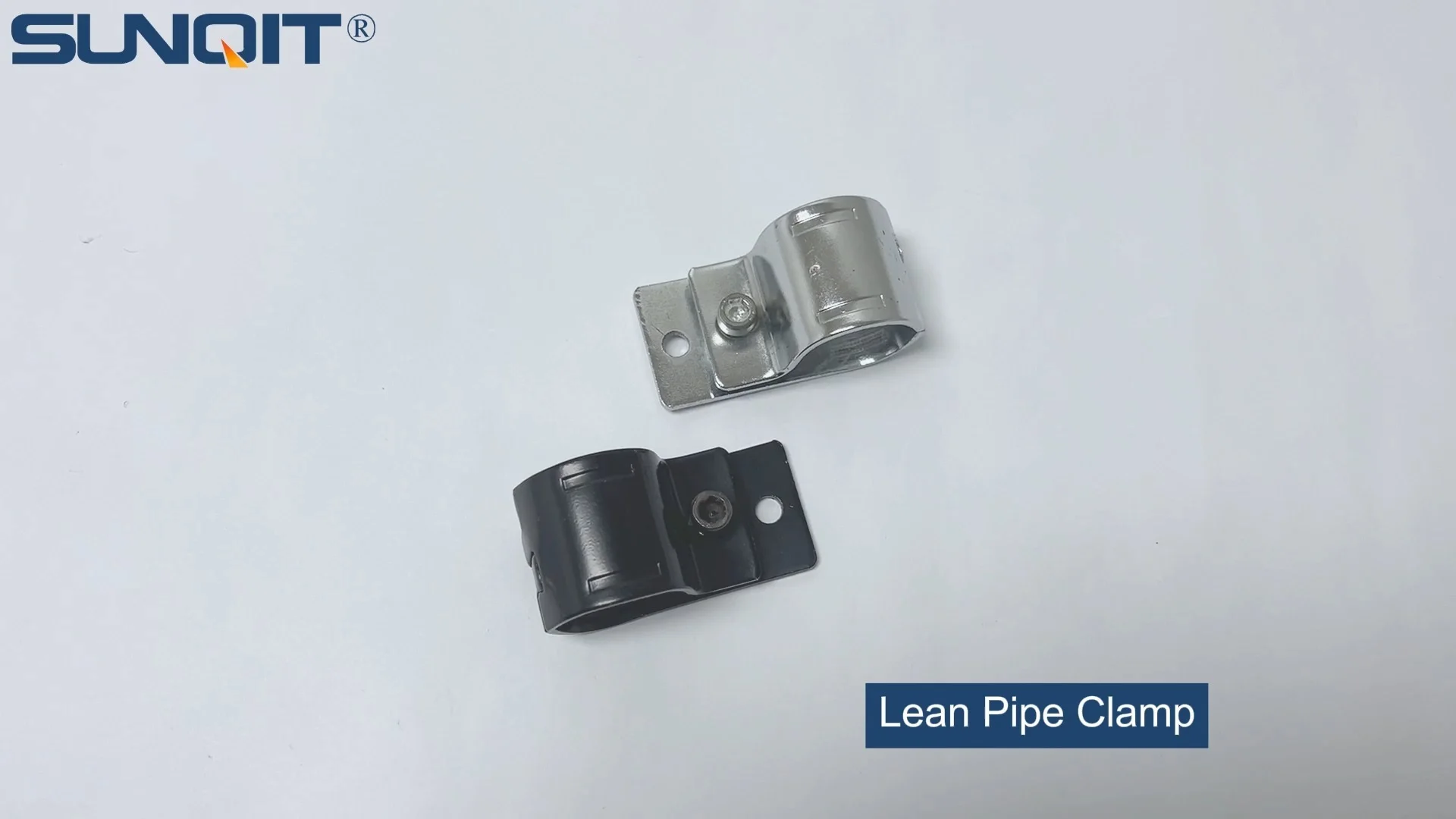
Lean pipe clamp is used for rack system hang monitor or other panel for workbenck, flowrack in production daily use.
Walk into any modern home appliance factory, and you'll be met with a symphony of precision: robots assembling circuit boards, workers fitting door hinges onto refrigerators, and conveyor belts gliding with washing machine drums. Behind this orchestration of efficiency lies a quiet but critical player: lean manufacturing. At the heart of lean systems—those frameworks designed to eliminate waste, boost flexibility, and keep production lines agile—are components so unassuming they might blend into the background. Enter lean pipe clamps : small, unpretentious connectors that hold together the modular structures powering today's appliance production. From custom workbenches where technicians assemble sensitive control panels to flow racks that keep parts moving seamlessly, these clamps are the unsung heroes ensuring factories adapt, scale, and thrive in an industry where consumer demands (and appliance models) change faster than ever.
What Are Lean Pipe Clamps, Anyway?
Let's start with the basics. Lean pipe clamps—sometimes called lean tube joints—are mechanical fasteners designed to connect lengths of lean pipe (hollow tubes made from materials like aluminum, stainless steel, or plastic-coated steel) into rigid or flexible structures. Think of them as the "building blocks" of lean manufacturing. Unlike traditional welding or permanent fasteners, these clamps allow for tool-free assembly and disassembly, making them perfect for creating modular setups that can be reconfigured in hours, not days.
Most lean pipe clamps are made from durable materials like stainless steel or zinc-plated steel, built to withstand the wear and tear of factory floors—think heavy loads, constant movement, and occasional bumps from forklifts or turnover trolleys. Some are fixed, locking pipes into a rigid angle (like a 90-degree corner for a workbench), while others swivel or rotate, adding a layer of flexibility. There are three-way clamps that connect pipes in multiple directions, parallel clamps that hold tubes side-by-side, and even swivel roller ball clamps that integrate with roller tracks to move parts smoothly. Each type serves a unique purpose, but all share a common goal: to turn simple pipes into powerful, adaptable tools for production.
Why Lean Systems Matter in Home Appliance Production
Home appliance manufacturing is a high-stakes game. Consumers want smarter, more energy-efficient appliances—think refrigerators with touchscreens, washing machines that connect to Wi-Fi, and ovens that preheat via smartphone apps. To keep up, factories can't rely on rigid, one-size-fits-all production lines. A single factory might produce 10+ appliance models in a year, each with different dimensions, parts, and assembly steps. That's where lean systems come in. Lean manufacturing focuses on minimizing waste (time, materials, space) and maximizing flexibility, allowing factories to switch between models quickly, reduce downtime, and respond to market trends in real time.
But lean systems don't just happen. They require physical infrastructure that can keep up—and that's where lean pipe clamps shine. By connecting lean pipes into workbenches, flow racks, conveyors, and material carts, clamps enable factories to build exactly what they need, when they need it. Need a taller workbench for assembling large refrigerator doors? Swap out the pipe lengths and reposition the clamps. Switching from producing toaster ovens to microwaves? Dismantle the old flow rack, reconfigure the clamps, and build a new one tailored to microwave parts. This modularity isn't just convenient—it's essential. In an industry where a single production line might make 50,000 units of one appliance model before switching to the next, every minute saved on retooling translates to thousands of dollars in cost savings.

Application 1: Building Custom Assembly Workbenches
Walk over to the assembly area of any appliance factory, and you'll see the first major application of lean pipe clamps: workbenches . These aren't your average desks. They're custom-built stations where technicians spend hours fitting intricate parts—like wiring harnesses into dishwasher doors or circuit boards into oven control panels. And every detail matters: height, layout, tool placement, even electrostatic discharge (ESD) protection for sensitive electronics.
Lean pipe clamps make these workbenches possible. Here's how it works: Start with aluminum or stainless steel lean pipes cut to length. Use 90-degree fixed clamps to form the frame—four vertical pipes for legs, connected by horizontal pipes for the top and bottom shelves. Add parallel clamps to attach side rails, where tools like screwdrivers, torque wrenches, and cable ties hang within arm's reach. For ESD-sensitive work (like assembling control boards for smart refrigerators), top the bench with an ESD mat and use conductive clamps to ground the structure, preventing static electricity from frying delicate components. The result? A workstation tailored to the task, the worker, and the appliance model.
Take, for example, a factory assembling washing machine control panels. These panels are packed with sensors, LEDs, and circuit boards—parts that require precision and a clutter-free workspace. Using lean pipe clamps, the factory might build a workbench with a tilted top (thanks to swivel clamps that adjust the angle) to reduce neck strain, a lower shelf (held by three-way clamps) for storing spare parts, and a side-mounted tool rack (parallel clamps) for holding soldering irons and wire strippers. When the next model comes in—say, a panel with a larger touchscreen—the clamps make it easy to widen the workbench top or raise the shelf height. No need to buy a new bench; just reconfigure the old one.

Application 2: Streamlining Material Flow with Flow Racks
In home appliance production, "flow" is everything. Parts need to move from storage to assembly lines quickly, without getting stuck, misplaced, or damaged. That's where flow racks —tilted racks with roller tracks that let parts glide by gravity—come in. And lean pipe clamps are the backbone of these systems, holding the racks together and ensuring parts flow smoothly, even when dealing with heavy items like oven doors or dryer drums.
Imagine a flow rack in a refrigerator factory, designed to feed door handles to the assembly line. The rack needs to hold hundreds of handles, each weighing 2-3 pounds, and release them one by one as workers need them. To build this, factories use lean pipes for the frame, then attach roller tracks (those grooved rails with small wheels) using specialized clamps. Swivel roller ball clamps, for instance, can be mounted along the tracks to reduce friction, ensuring handles slide down without jamming. Three-way clamps connect the vertical supports to the horizontal rails, while parallel clamps reinforce the sides to prevent bowing under the weight.
But flow racks aren't one-and-done. When the factory switches from producing standard refrigerator handles to larger, curved handles for a premium model, the rack's angle or width might need adjusting. With lean pipe clamps, this is a breeze: loosen the clamps holding the roller tracks, tilt the rails to a steeper angle (using swivel clamps), and tighten them back down. No welding, no new parts—just a quick tweak. This flexibility is a game-changer for reducing "waiting waste"—the time workers spend hunting for parts because the flow rack isn't set up correctly.

Application 3: Powering Conveyor Systems for Seamless Production
Conveyor belts are the arteries of appliance factories, moving everything from small screws to fully assembled dishwashers across the production floor. But not all conveyors are created equal. Some need to be straight; others need to curve. Some carry lightweight parts (like plastic knobs), while others haul heavy loads (like oven bodies). Enter lean pipe clamps, which turn basic roller tracks into customized conveyor sections that integrate seamlessly into larger production lines.
Consider a conveyor system for assembling microwave ovens. The line might start with a flat section where workers install the inner cavity, then a curved section to rotate the oven 90 degrees, followed by an inclined section to raise it to waist height for door installation. To build this, factories use aluminum or steel lean pipes as the conveyor frame, with roller tracks mounted on top using clamps. For straight sections, fixed clamps lock the tracks in place. For curves, swivel clamps allow the tracks to bend gradually, preventing parts from getting stuck. Even the height of the conveyor can be adjusted using telescoping pipes and adjustable clamps, ensuring workers don't strain their backs lifting heavy ovens.
One of the biggest advantages of clamp-based conveyors is their scalability. If demand spikes and the factory needs to add a second conveyor line, workers can disassemble unused flow racks or old workbenches, reuse the pipes and clamps, and build the new conveyor in a fraction of the time it would take with traditional metal framing. It's sustainability in action—reducing waste by reusing materials—and it keeps production costs in check, which is critical in an industry with tight profit margins.
| Lean Pipe Clamp Type | Key Features | Primary Application in Home Appliance Production | Real-World Benefit |
|---|---|---|---|
| 90° Fixed Lean Pipe Joint | Rigid 90-degree connection, stainless steel construction, high weight capacity (up to 500 lbs per joint) | Workbench frames, vertical supports for flow racks, conveyor legs | Stability for heavy loads, like holding a 100-lb workbench top where technicians assemble refrigerator compressors |
| 180° Swivel Lean Pipe Joint | Rotates 180 degrees, adjustable tension, zinc-plated steel | Tiltable workbench shelves, adjustable conveyor angles, flow rack incline adjustments | Allows workers to tilt a shelf from flat to 30 degrees to access hard-to-reach parts, like small gears in blender motors |
| Three-Way Lean Pipe Joint | Connects 3 pipes at once (e.g., 2 horizontal, 1 vertical), multi-directional | Flow rack intersections, corner supports for conveyor systems, material cart frames | Reduces the number of clamps needed to build complex structures, like a T-junction in a parts distribution rack |
| Parallel Lean Pipe Joint | Joins 2 parallel pipes horizontally or vertically, even weight distribution | Side rails on flow racks, tool holder bars on workbenches, guardrails on conveyors | Keeps long, thin parts (like oven door hinges) from rolling off the rack during transport |
Customization: The Secret Sauce for Adapting to Market Trends
Home appliance trends shift faster than a dishwasher cycle. One year, French-door refrigerators are all the rage; the next, compact "apartment-sized" models dominate. Factories that can't pivot quickly get left behind. Lean pipe clamps excel here because they turn "fixed infrastructure" into "flexible toolkit." Let's say a factory specializes in small appliances—blenders, toasters, coffee makers—and suddenly gets a bulk order for commercial-grade mixers, which are twice as large. With traditional setups, this might require investing in new workbenches, flow racks, and conveyors. With lean pipe clamps? It's a matter of reconfiguring existing structures.
Take workbenches again. A standard toaster assembly bench might be 3 feet wide and 2 feet deep. For a commercial mixer, which has a larger base, workers can simply add extension pipes to the sides using parallel clamps, widening the bench to 4 feet. The height can be adjusted by swapping out shorter legs for longer ones (using fixed clamps to lock them in place), ensuring workers don't have to bend over. Even the tool holders can be rearranged: parallel clamps can be moved to hold larger wrenches, while swivel clamps can angle screwdrivers for easier access to the mixer's motor housing.
Flow racks, too, can be customized on the fly. If the new mixer requires larger plastic gears, the existing roller tracks (which might have small 0.5-inch swivel roller balls) can be swapped for 1-inch balls using roller track placon mount clamps. The rack's depth can be increased by adding crossbars with three-way clamps, and the angle can be steepened with swivel clamps to ensure the heavier gears glide smoothly. All of this can be done in a day, meaning the factory can start production on the new order without missing a beat.
Cost Efficiency: Saving Money Without Sacrificing Quality
Let's talk numbers. Traditional factory setups—welded steel workbenches, fixed conveyor systems, custom-built flow racks—are expensive. A single welded workbench can cost $500-$1,000, and if you need to replace it because the appliance model changes, that's another $500-$1,000 down the drain. Lean pipe clamps, by contrast, turn $20 worth of pipes and $30 worth of clamps into a functional workbench that can be reused indefinitely. Even better, when a structure is no longer needed, the pipes and clamps can be disassembled and stored, ready for the next project. Over time, this reusability cuts equipment costs by 30-40%, according to industry studies.
Labor costs are another area where clamps shine. Building a welded workbench requires skilled labor (a welder) and hours of setup time. A lean pipe workbench? Any factory worker can assemble it with a hex key or adjustable wrench in under an hour. Disassembly is just as fast. When production lines need to be reconfigured for a new appliance model, downtime is reduced from days to hours, which translates to thousands of dollars saved in lost production. For example, a factory producing 100 washing machines per hour might lose $10,000 in revenue for every hour of downtime. If clamps cut reconfiguration time from 8 hours to 2, that's $60,000 saved—per model change.
Case Study: How a Mid-Sized Factory Boosted Efficiency with Lean Pipe Clamps
Let's put this all into context with a real-world example. Consider a mid-sized appliance manufacturer in Ohio that produces small kitchen appliances: blenders, toasters, and coffee makers. A few years ago, the factory was struggling with two major issues: long changeover times between models (up to 2 days) and high worker fatigue from poorly designed workbenches. Their solution? Investing in lean pipe clamps and rethinking their production setup.
First, they replaced all welded workbenches with modular ones built using lean pipes and clamps. Workers could now adjust the height of their benches (using telescoping pipes and adjustable clamps) to match their height, reducing back strain. Tool holders were mounted on swivel clamps, so tools could be positioned exactly where needed. For ESD-sensitive work (like assembling coffee maker circuit boards), they added ESD mats and grounded the benches using conductive clamps, cutting static-related defects by 75%.
Next, they revamped their material flow. Old, fixed shelving units were replaced with flow racks built using lean pipes, roller tracks, and swivel roller ball clamps. Parts now rolled directly to the assembly line, reducing the time workers spent walking to fetch parts by 40%. When switching from blenders to toasters, they reconfigured the flow racks in 2 hours (down from 2 days) by loosening the clamps, adjusting the roller tracks, and repositioning the shelves.
The results? Productivity increased by 25%, changeover time dropped by 90%, and worker compensation claims for strains and injuries fell by 60%. All from a simple switch to lean pipe clamps. As the factory manager put it: "We used to see our workbenches and racks as 'permanent fixtures.' Now we see them as 'tools we can rearrange.' It's changed how we think about production."
Looking Ahead: Lean Pipe Clamps in the Future of Appliance Production
The home appliance industry isn't slowing down. With the rise of smart homes, appliances are becoming more complex, with more parts and tighter tolerances. Factories will need to be even more flexible, adaptive, and efficient to keep up. Lean pipe clamps, already a staple, will play an even bigger role in this future.
One trend to watch is the integration of smart technology. Imagine lean pipe clamps with built-in sensors that monitor weight distribution on flow racks, alerting workers if a shelf is overloaded. Or clamps with RFID tags that track which parts of the production line are using which components, making inventory management easier. While these are still in development, the modularity of lean systems makes them ripe for innovation.
Another trend is sustainability. As consumers and regulators push for greener manufacturing, the reusability of lean pipe clamps will become even more valuable. Factories that use clamps to build modular structures reduce their reliance on raw materials, cut down on waste, and lower their carbon footprint—all while saving money. It's a win-win.
Conclusion: The Little Clamps That Keep Factories Moving
In the grand scheme of home appliance production, lean pipe clamps might seem small. But as any factory manager will tell you, it's the small things that make the biggest difference. These unassuming connectors turn simple pipes into workbenches that adapt to workers' needs, flow racks that keep parts moving, and conveyors that scale with demand. They reduce waste, cut costs, and turn rigid factories into agile hubs ready to tackle whatever the market throws their way.
So the next time you unbox a new refrigerator or start a load of laundry, take a moment to appreciate the invisible work happening behind the scenes. Somewhere, in a factory far away, a lean pipe clamp is holding it all together—quietly, reliably, and flexibly. And in the world of home appliance production, that's nothing short of revolutionary.