- Company Articles
- Products and Technology
- Solution
- Automotive Component Assembly: Gusset ALP 4040 for JIT Production Line Stability

Automotive Component Assembly: Gusset ALP 4040 for JIT Production Line Stability
Related Product
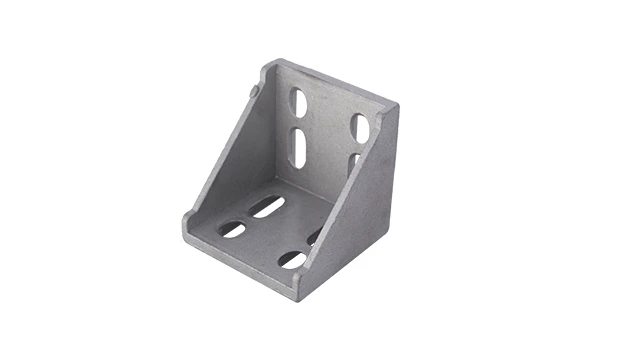
Gusset ALP 4040
The 4040 bracket/Gusset is an external fastening method that creates a 90 degree connection. 4040 means this size is used for 40 series aluminum profile with a quick connection by bolt and nut. It is a lightweight bracket that requires no machining servic
In the fast-paced world of automotive manufacturing, where every second counts and precision is non-negotiable, Just-In-Time (JIT) production isn't just a buzzword—it's the backbone of operational excellence. Imagine a well-choreographed dance where components arrive exactly when they're needed, no excess inventory cluttering the floor, no delays disrupting the rhythm. But here's the thing: that dance falls apart if the stage itself isn't stable. Production lines, the unsung heroes of JIT, need to be rock-solid to keep the entire operation on track. Today, we're diving into a small but mighty component that's quietly revolutionizing stability in automotive assembly: the Gusset ALP 4040. Let's unpack why this unassuming piece of hardware is becoming a cornerstone for manufacturers aiming to master JIT.
The Critical Role of Production Line Stability in JIT
Before we get into the nitty-gritty of gussets and aluminum profiles, let's step back and ask: why does stability matter so much for JIT? At its core, JIT is about eliminating waste—whether that's excess inventory, unnecessary movement, or downtime. But to pull this off, every part of the production line needs to perform with unwavering consistency. Think about it: if a workbench wobbles slightly when a technician tightens a bolt, that tiny misalignment could lead to a component that doesn't fit properly downstream. If a flow rack sags under the weight of parts, items might get stuck, delaying delivery to the assembly line. Even a minor hiccup like a loose roller track connector can throw off the timing of an entire shift.
Stability, in this context, isn't just about "not shaking." It's about predictability. It's knowing that when a worker places a 20-pound engine bracket on a workbench, the surface won't flex. It's trusting that a flow rack loaded with door panels will maintain its angle, ensuring gravity feeds parts to the line at exactly the right speed. Without this predictability, JIT becomes a game of chance—and in automotive manufacturing, chance is a luxury no one can afford.
Traditional production lines often relied on heavy, rigid structures—think welded steel frames and fixed wooden workbenches. These setups were built to last, but "last" came with a trade-off: inflexibility. When a manufacturer needs to switch from producing sedans to SUVs, or modify a component design to meet new safety standards, these rigid systems become liabilities. Welded brackets rust, bolts loosen over time, and adjusting the line means cutting, rewelding, and reconfiguring—wasting hours (or days) that could have been spent producing.
The Hidden Culprits: Why Traditional Setups Struggle with Stability
Let's talk about the silent enemies of production line stability: time and adaptability. Traditional reinforcement methods, like basic angle irons or welded gussets, might work initially, but they degrade slowly and surely. Welds can develop micro-cracks from constant vibration, especially in high-traffic areas like near conveyor belts. Steel brackets rust, weakening their grip. Even simple wooden workbenches warp with humidity, creating uneven surfaces that throw off precision work.
Then there's the issue of maintenance. A typical automotive plant might have hundreds of workbenches, flow racks, and material trolleys. Each month, maintenance teams spend hours tightening loose bolts, replacing corroded brackets, or even re-welding joints. That's time taken away from proactive tasks—like upgrading equipment or training staff—and adds up to thousands of dollars in labor costs annually. Worse, these fixes are often temporary. A welded bracket might hold for six months, but eventually, the same problem returns, creating a cycle of "patch and pray."
Perhaps the biggest frustration? Lack of adaptability. When a production line needs to be reconfigured—say, to accommodate a new component size—traditional setups force teams to start from scratch. Cutting down a welded steel frame or replacing an entire wooden workbench isn't just time-consuming; it's wasteful. And in JIT, waste is the enemy.

Meet Gusset ALP 4040: The Small Component with a Big Impact
Enter the Gusset ALP 4040. If traditional reinforcement methods are like using duct tape to fix a broken pipe, this little gusset is the precision-engineered coupling that actually solves the problem. Part of the modern aluminum profile system, the Gusset ALP 4040 is designed to reinforce connections between aluminum profiles—those sleek, modular rails that are becoming the gold standard in flexible manufacturing.
First, let's clarify what it is: a gusset is a triangular (or sometimes rectangular) plate used to strengthen the joint between two structural members. The ALP 4040 specifically is tailored for 40x40mm aluminum profiles—the workhorses of modular production systems. Made from high-grade aluminum alloy, it's lightweight, corrosion-resistant, and built to handle the daily grind of automotive assembly lines.
What makes it stand out? Let's break down the design. Unlike clunky steel brackets, the Gusset ALP 4040 is slim and unobtrusive, fitting neatly into the T-slots of aluminum profiles. Its triangular shape isn't just for looks—it's a physics win. Triangles distribute weight evenly, meaning when force is applied to a joint (say, a workbench leg supporting a heavy load), the gusset spreads that force across the profile, preventing bending or warping. And because it's made from aluminum, it won't rust, even in the humid environments common in manufacturing plants.
Installation is another highlight. Forget welding torches or heavy tools. The Gusset ALP 4040 slides into place and secures with T-slot nuts and bolts—no special training required. A technician can attach one in under five minutes, and if the line needs to be reconfigured later? Simply loosen the bolts, move the gusset, and retighten. It's modularity at its finest, and that's a game-changer for JIT.

Gusset ALP 4040 and Lean System Integration: A Match Made for Efficiency
At this point, you might be thinking, "Okay, it's a strong bracket—so what?" Here's where it ties back to the bigger picture: lean system principles. Lean manufacturing, which JIT is a key part of, is all about maximizing value while minimizing waste. And one of the biggest wastes in production is "motion waste"—the time and effort spent adjusting, repairing, or reconfiguring equipment.
Traditional rigid systems force teams into motion waste. Want to raise a workbench by 6 inches to accommodate taller technicians? You'll need to cut new legs, weld them on, and repaint—hours of work. With aluminum profiles and Gusset ALP 4040, it's a 20-minute job: loosen the bolts on the leg joints, adjust the height, add a gusset for extra stability, and you're done. No cutting, no welding, no downtime.
The Gusset ALP 4040 also supports another lean principle: "leveling the workload." In JIT, production schedules can fluctuate based on demand, and lines need to scale up or down quickly. For example, if a sudden order spike requires adding an extra assembly station, aluminum profile workbenches with Gusset ALP 4040 can be assembled and reinforced in hours, not days. The gusset ensures the new station is just as stable as the existing ones, so quality doesn't drop even when output increases.
Perhaps most importantly, the Gusset ALP 4040 reduces "defect waste." By keeping workbenches, flow racks, and roller tracks stable, it minimizes errors caused by unstable surfaces. A study by the Manufacturing Technology Insights found that unstable workstations contribute to up to 12% of assembly defects in automotive plants—defects that require rework, scrap, or even product recalls. By investing in stability with components like the Gusset ALP 4040, manufacturers directly cut down on these costly mistakes.
Workbench Stability: The Foundation of Precision Assembly
Let's zoom in on one of the most critical areas of the production line: the workbench. If the production line is the body of JIT, workbenches are the hands—they're where the actual assembly happens, where technicians spend 8+ hours a day fitting, tightening, and inspecting components. A stable workbench isn't a luxury here; it's a necessity.
Consider a technician assembling a transmission housing. They're working with tolerances as tight as 0.001 inches—about the width of a human hair. If the workbench shifts even 0.01 inches when they apply torque to a bolt, that housing might not mate correctly with the engine block later. Now, multiply that by hundreds of technicians across a plant, and you see how quickly small instabilities snowball into big problems.
Aluminum profile workbenches, reinforced with Gusset ALP 4040, solve this. The gussets are typically placed at the joints where the legs meet the tabletop frame, and where cross-braces connect to the legs. This creates a "cage" of stability, ensuring the workbench can handle both static loads (like heavy tools) and dynamic loads (like a technician leaning on the edge to reach a part). Unlike wooden workbenches, which can warp, or welded steel benches, which loosen over time, aluminum profiles with Gusset ALP 4040 maintain their rigidity for years.
One automotive supplier in Michigan recently shared a story that drives this home. They'd been struggling with a 3% defect rate on brake caliper assemblies, tracing the issue to a wobbly workbench in their final inspection station. After switching to an aluminum profile workbench reinforced with Gusset ALP 4040, the defect rate dropped to 0.5% in three months. The technicians reported less eye strain (from having to constantly adjust for the wobbly surface) and fewer repetitive motion injuries—proving that stability isn't just good for production; it's good for people, too.
Flow Racks and Roller Tracks: Keeping Materials Moving Smoothly
Workbenches aren't the only area where stability matters—flow racks and roller tracks are equally critical. These systems are the "arteries" of JIT, transporting parts from storage to the assembly line via gravity or minimal power. But if a flow rack isn't stable, that artery can get blocked.
Flow racks, which use inclined shelves with roller tracks, rely on a precise angle to ensure parts glide smoothly without jamming. If the rack sags in the middle (a common issue with traditional steel racks), the angle changes, and parts slow down or stop. Similarly, roller tracks depend on consistent alignment—if the track itself is wobbly, rollers can bind, causing delays.
This is where the Gusset ALP 4040 shines. When building flow racks with aluminum profiles, gussets are used at the joints between vertical uprights and horizontal beams, and between beams and roller track supports. This prevents the rack from "racking" (twisting) under load, maintaining the critical angle needed for gravity flow. For roller tracks, gussets reinforce the connection points between the track and the aluminum profile frame, ensuring the track stays level even when heavy parts (like engine blocks or door panels) roll over it.
Take, for example, a flow rack used to store and dispense wiring harnesses—delicate components that can get tangled if they don't feed smoothly. A traditional steel rack might start to sag after six months of use, causing harnesses to bunch up. With an aluminum profile rack reinforced with Gusset ALP 4040, the structure remains rigid, and the harnesses feed to the line one at a time, exactly when needed. No more technicians stopping to untangle wires, no more delays in the assembly sequence.
Traditional vs. Gusset ALP 4040 Reinforcement: A Head-to-Head Comparison
| Feature | Traditional Reinforcement (Welded Steel Brackets/Angle Irons) | Gusset ALP 4040 with Aluminum Profiles |
|---|---|---|
| Installation Time | 2–4 hours per joint (requires welding, painting, curing) | 10–15 minutes per joint (bolt-on, no special tools) |
| Flexibility | Fixed; requires cutting/welding to reconfigure | Modular; bolts can be loosened/tightened to adjust or relocate |
| Durability | Prone to rust, weld fatigue, and loosening over time | Corrosion-resistant aluminum; even load distribution prevents fatigue |
| Maintenance Needs | Monthly tightening/welding; annual repainting | Quarterly bolt checks; no repainting or welding |
| Cost Over 5 Years | Higher (labor for installation, maintenance, and replacement) | 30–40% lower (faster installation, minimal maintenance, reusability) |
The Long-Term Benefits: Beyond Stability
By now, it's clear that Gusset ALP 4040 improves stability—but its impact goes beyond just keeping things from wobbling. Let's talk about the long-term benefits that make it a smart investment for automotive manufacturers.
1. Cost Savings: While aluminum profiles and gussets have a higher upfront cost than basic steel brackets, the total cost of ownership is significantly lower. A study by the Aluminum Extruders Council found that modular aluminum systems with components like Gusset ALP 4040 reduce lifetime costs by 35% compared to traditional steel setups, thanks to lower maintenance, faster reconfiguration, and reusability.
2. Sustainability: Aluminum is 100% recyclable, and modular systems generate less waste during reconfiguration (no cutting or welding means no scrap metal). For manufacturers aiming to reduce their carbon footprint—an increasingly important goal for both customers and regulators—this is a big win.
3. Safety: Loose brackets, rusted welds, and unstable workbenches are safety hazards. A wobbly flow rack could collapse, injuring workers or damaging expensive components. Gusset ALP 4040's secure, corrosion-resistant design reduces these risks, making the plant a safer place to work.
4. Scalability: As automotive manufacturers pivot to electric vehicles (EVs) or expand into new markets, production lines need to scale quickly. Modular systems with Gusset ALP 4040 allow for rapid expansion—adding new workbenches, flow racks, or conveyor sections without disrupting existing operations.
Conclusion: Small Component, Big Difference for JIT Success
In the grand scheme of automotive manufacturing, the Gusset ALP 4040 might seem like a small player. It's not as flashy as a robotic arm or as high-tech as AI-driven quality control. But in the world of JIT, where every detail matters, it's the unsung hero that keeps the line moving, the defects down, and the waste out. By reinforcing aluminum profiles with precision and flexibility, it transforms production lines from rigid, maintenance-heavy setups into agile, adaptable systems that can keep pace with the demands of modern automotive manufacturing.
So the next time you see a sleek, efficient automotive assembly line—one that delivers components just in time, with zero waste and maximum precision—remember: it's not just the robots or the software making it happen. It's the little things, like a well-placed gusset, that lay the foundation for success. And in the race to master JIT, the Gusset ALP 4040 is proving to be a difference-maker.