- Company Articles
- Products and Technology
- Product knowledge
- Automotive Parts Storage: Five Way Straight Lean Pipe Joint Applications

Automotive Parts Storage: Five Way Straight Lean Pipe Joint Applications
Related Product
Five Way Straight Lean Pipe Joint
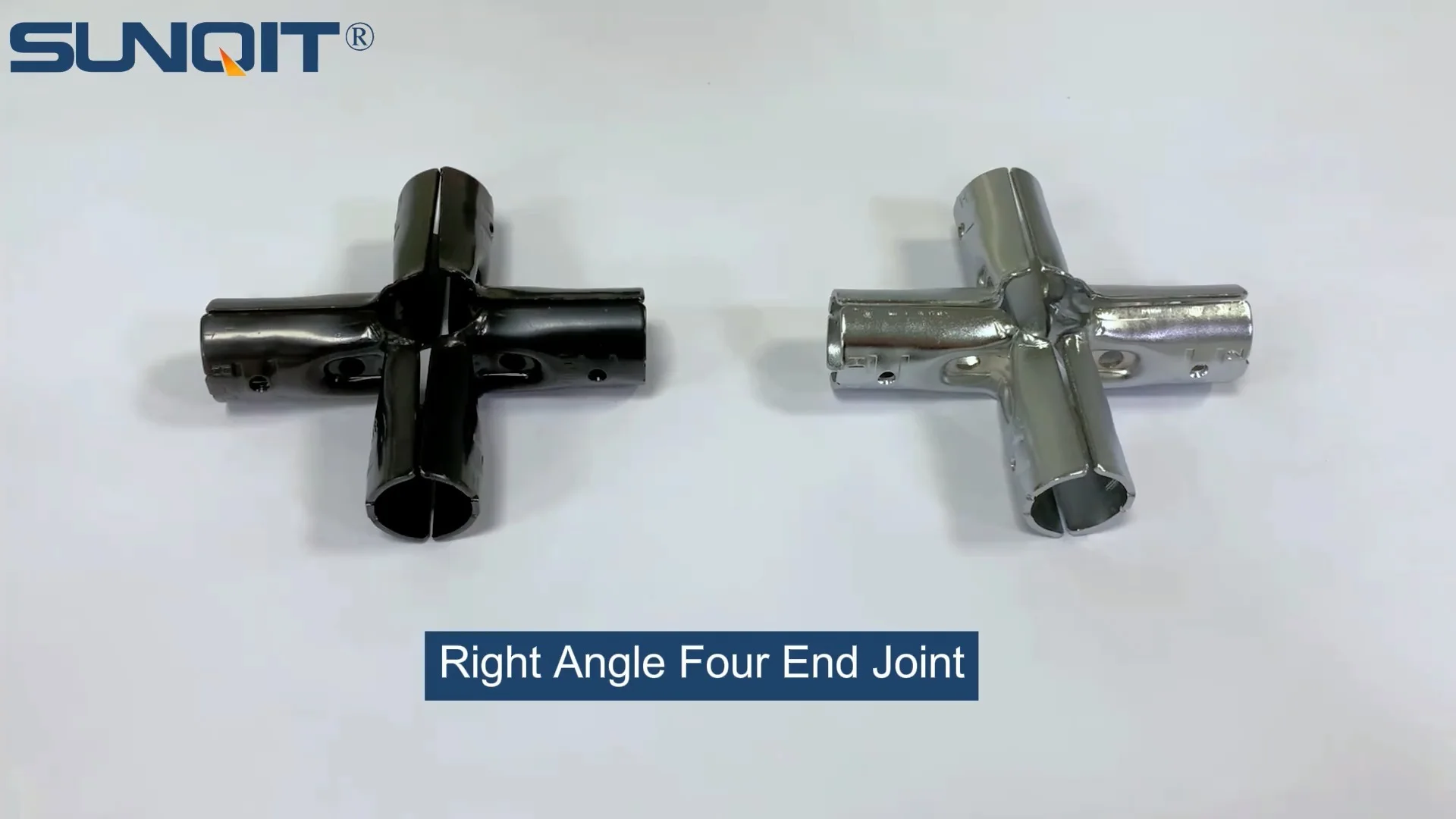
Five way straight lean pipe joint, for 5 pcs 28mm lean pipe connect in straight angle,which used widely in workbench, flow rack, hand trolley frame connection.
Walk into any thriving automotive manufacturing plant, and you'll notice a quiet hero behind the scenes: organization. Parts zip from shelves to assembly lines, tools snap into place with precision, and teams move with the kind of rhythm that only comes from a well-oiled system. But peek into a struggling facility, and the story changes. Boxes pile up in corners, workers hunt for missing components, and assembly lines stall—all because the storage system couldn't keep up. The difference? Lean systems built on adaptable, worker-centric tools. And at the heart of those systems lies a component so versatile, it's like the Swiss Army knife of industrial organization: the five way straight lean pipe joint.
What Makes the Five Way Straight Lean Pipe Joint a Game-Changer?
Let's start with the basics: What even is a five way straight lean pipe joint? Picture this: a small, unassuming connector, often made of durable materials like stainless steel or aluminum, designed to link lean pipes (those lightweight, corrosion-resistant tubes) at multiple angles. Unlike standard two-way or three-way joints, the five way straight variant lets you connect up to five pipes in a straight line or at precise angles—think of it as a traffic controller for your storage setup, directing pipes where they need to go without bottlenecks.
For automotive plants, where parts range from tiny screws to bulky engine components, this flexibility is gold. "We used to have fixed metal racks that took days to reconfigure when a new part line launched," says Jake, a production supervisor at a Midwest auto parts manufacturer. "Now, with these five way joints, we can build a custom flow rack in hours. If tomorrow we need to add a shelf or widen a lane for larger components, we just loosen a few bolts, adjust the pipes, and we're back in business. It's like having a storage system that grows with us."
Applications in Automotive Parts Storage: Where It Truly Shines
The five way straight lean pipe joint isn't just a connector—it's a problem-solver. Let's dive into the real-world scenarios where it transforms chaos into order, starting with the backbone of any parts storage system: the flow rack.
1. Flow Racks: Keeping Parts Moving, No Stalls Allowed
In automotive assembly, time is money. When a line worker needs a specific bolt or washer, they can't wait for someone to fetch it from a distant shelf. That's where flow racks—tilted shelves with roller tracks—come in, letting parts slide forward as the front ones are used. But not all flow racks are created equal. Fixed racks struggle with varying part sizes, while cheap plastic versions buckle under heavy loads. Enter the five way straight lean pipe joint.
"We handle everything from small plastic clips to steel brackets that weigh 10 pounds each," explains Lina, a materials handler at an electric vehicle (EV) battery plant. "Our old flow racks had wooden shelves that warped, and the metal ones were so rigid, we couldn't adjust the spacing. Now, we built flow racks using aluminum lean pipes and five way joints. The joints let us set up three rows of roller tracks on one rack—small parts on the top, medium on the middle, heavy on the bottom. And if a bracket is wider than expected? We just add another pipe section with a joint, and suddenly we've got extra space. No more cramming parts or leaving gaps that waste space."
The magic lies in the joint's ability to support multiple pipe directions. A standard flow rack might use two-way joints for vertical supports, but the five way variant lets you add horizontal cross-braces for stability, diagonal reinforcements for heavy loads, or even side extensions for tools and labels. It's not just about holding parts—it's about creating a system that works with the people using it.
2. Workbenches: Where Precision Meets Adaptability
Assembly workbenches are the command centers of automotive manufacturing. Here, workers spend hours piecing together components, requiring tools, parts, and documentation to be within arm's reach. A cluttered or ill-fitting workbench doesn't just slow them down—it increases the risk of errors. The five way straight lean pipe joint solves this by letting teams build workbenches tailored to their exact needs.
Take Maria, an assembler at a transmission plant, who helped design her team's new workbench setup. "I'm 5'2", and the old workbench was built for someone 6 feet tall. I was constantly reaching up for tools, which hurt my shoulders. Now, we used five way joints to adjust the height of the upper shelf—lower for me, higher for my taller coworker. We added a side rack for our torque wrenches using extra pipes and a joint, and even a small flow track for incoming parts that slides right onto the bench. It's like the workbench was made for us , not the other way around."
These workbenches aren't just static tables, either. Many include casters (another keyword from the list!) for mobility, letting teams roll the bench to different stations as needed. The five way joints ensure the structure stays sturdy even when moving, with reinforced connections that prevent wobbling. And when the assembly process changes—say, a new transmission model requires different tools—the bench can be reconfigured in minutes, no power tools needed.
3. Lean Systems: Building a Foundation for Continuous Improvement
At its core, lean manufacturing is about eliminating waste—whether that's wasted time, space, or effort. The five way straight lean pipe joint is a lean tool through and through, because it lets teams build exactly what they need, no more, no less. Unlike prefab metal shelving that comes with fixed dimensions (and often extra space you don't need), lean pipe systems with five way joints let you optimize every inch.
"We used to have a storage room filled with unused shelves because they were too big or too small for our current parts," says Raj, a lean coordinator at a major auto OEM. "With lean pipe and five way joints, we've cut that waste by 60%. We build only what we need today, and if tomorrow's needs change, we take apart the old structure and reuse the pipes and joints. It's sustainable, cost-effective, and aligns perfectly with our lean goals."

Why It Beats Traditional Storage Solutions: A Closer Look
To truly appreciate the five way straight lean pipe joint, let's compare it to common alternatives in automotive storage. Below is a breakdown of how it stacks up against fixed metal racks and plastic shelving:
| Feature | Fixed Metal Racks | Plastic Shelving | Lean Pipe Systems with Five Way Joints |
|---|---|---|---|
| Flexibility | Low—fixed dimensions; hard to reconfigure | Medium—adjustable shelves, but limited weight capacity | High—reconfigure in minutes; adapt to any part size/weight |
| Durability | High, but prone to rust if not coated | Low—bends under heavy loads; cracks over time | High—stainless steel/aluminum joints resist corrosion; supports up to 500 lbs per shelf |
| Cost Over Time | High—requires replacement when needs change | Medium—cheap upfront, but frequent replacements | Low—reusable components; minimal replacement costs |
| Worker Satisfaction | Low—frustration with fixed setups; ergonomic issues | Mixed—lightweight but unstable; limited customization | High—customizable to worker needs; reduces physical strain |

The Future of Automotive Storage: More Than Just a Joint
As automotive manufacturing evolves—with EVs, autonomous vehicles, and smaller, more complex components—the need for flexible storage systems will only grow. The five way straight lean pipe joint isn't just keeping up; it's leading the charge by empowering teams to adapt on the fly. It's a reminder that the best industrial tools aren't just about metal and bolts—they're about people.
"When we first started using these joints, I thought they were just another piece of hardware," says Jake, the production supervisor. "Now? I see them as a symbol of how we work—smarter, not harder. Our team doesn't just build racks with these joints; they build solutions. And that's the real power of lean: giving people the tools to make their jobs better, every single day."
So the next time you walk through an automotive plant and marvel at the seamless flow of parts, take a closer look at the structures holding it all together. Chances are, you'll spot the five way straight lean pipe joint—quiet, unassuming, and hard at work, proving that sometimes the smallest components make the biggest difference.