- Company Articles
- Products and Technology
- Product knowledge
- Automotive Tier 1 Supplier: How Four Way Straight Lean Pipe Joint Optimized Component Assembly

Automotive Tier 1 Supplier: How Four Way Straight Lean Pipe Joint Optimized Component Assembly
Related Product
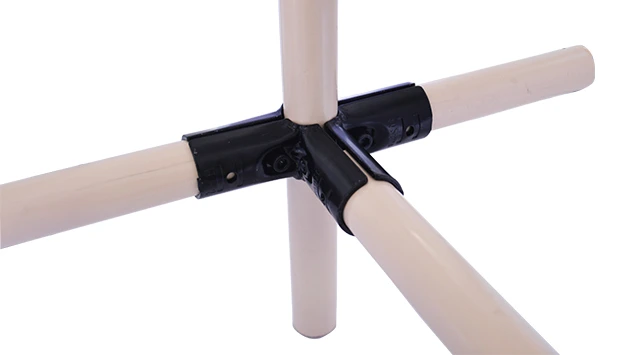
Four Way Straight Lean Pipe Joint
Four way lean pipe joint for 4 pcs 28MM lean pipe connection in straight angle, which used widely in workbench, flow rack, hand trolley frame connection.
In the high-stakes world of automotive manufacturing, Tier 1 suppliers sit at the critical intersection of speed, precision, and adaptability. Every day, they're tasked with delivering thousands of components—from intricate wiring harnesses to heavy-duty brackets—to automakers, where even a 10-minute delay can ripple through an entire production line. For one mid-sized Tier 1 supplier in the Midwest, this pressure had long felt overwhelming. Their assembly floor, cluttered with rigid workbenches and static material racks, struggled to keep up with the industry's relentless pace of change: new vehicle models, shifting component specs, and the ever-growing demand for customization. That is, until a small but mighty component entered the picture: the four way straight lean pipe joint. What followed was a transformation that redefined their workflow, cut waste, and turned frustration into efficiency.
The Breaking Point: A Floor Stuck in Rigidity
Let's rewind to two years ago at Precision Auto Components (PAC), a supplier specializing in powertrain components for major automakers. Maria Gonzalez, the plant's production manager, still remembers the day that would become their "aha moment." It was a Tuesday morning, and the team had just received a last-minute order for a new bracket design—part of a rush shipment for an electric vehicle (EV) prototype. The problem? The existing assembly workbench, bolted to the floor and built with fixed steel frames, was too narrow to accommodate the bracket's larger dimensions. Workers, already stretched thin, had to hunch over the edge, balancing parts on their laps or stacking them precariously on nearby carts. By midday, two brackets had been dropped (scrapping $1,200 in materials), and the line was 90 minutes behind schedule. "I stood there watching and thought, 'This can't be how we operate,'" Maria recalls. "We were letting our tools dictate our process, not the other way around."
PAC's struggles weren't unique. Like many suppliers, they'd relied on traditional, one-size-fits-all equipment for years. Their material flow relied on heavy, immovable flow racks that took hours to reconfigure when component sizes changed. The lean pipe workbenches, once hailed as "flexible," were actually held together by basic T-joints and L-joints that required wrenches and a team of two to adjust. When a new component came in—say, a battery housing that was 3 inches taller than the previous model—the entire setup had to be disassembled and rebuilt, often taking an entire shift. Overtime costs soared, employee morale dipped, and PAC's reputation with automakers was starting to fray. "Our customers were asking for faster turnarounds, but our floor was stuck in 2010," says James Chen, PAC's operations director. "We needed a lean solution, but not the kind that required a complete overhaul. We needed something that could grow with us, one joint at a time."
The Discovery: A Joint That Changed Everything
James and Maria began researching lean manufacturing solutions, attending trade shows and consulting with lean system suppliers. They'd heard about aluminum lean pipe systems—lightweight, modular, and often marketed as "adaptable"—but were skeptical. Their previous foray into "flexible" workbenches had left them burned. Then, at a regional manufacturing expo, they stumbled upon a demo booth for a lean pipe supplier showcasing a range of joints, including the four way straight lean pipe joint. "It looked simple at first—a small, silver connector with four ports—but the rep demonstrated how it could link four lean pipes at once, in any direction, without tools," Maria says. "He reconfigured a mini workbench right there in 2 minutes, and I thought, 'That's it. That's what we need.'"
The four way straight lean pipe joint, they learned, was designed for versatility. Unlike traditional T-joints (which only connect two pipes) or L-joints (limited to 90-degree angles), this joint featured a central hub with four equally spaced ports, allowing users to connect pipes horizontally, vertically, or diagonally. Made from high-grade aluminum with a quick-lock mechanism, it could be tightened by hand—no wrenches, no bolts, no downtime. "The beauty is in its simplicity," explains Raj Patel, the lean consultant PAC hired to oversee the transition. "It turns static structures into dynamic ones. A workbench isn't just a workbench anymore; it's a toolkit that can adapt to whatever comes down the line."
PAC started small, ordering 50 four way joints and a batch of aluminum lean pipes to test on one assembly line. Their goal was modest: Reduce the time to reconfigure a workbench from 8 hours to under 2. What they got, however, was far more transformative.

From Test to Transformation: The Assembly Floor Reborn
The first project was revamping the bracket assembly station—the same one that had caused the Tuesday morning disaster. The team dismantled the old steel workbench and replaced it with a frame built from aluminum lean pipes and four way joints. Within an hour, they had a sturdy, adjustable surface that could be widened, raised, or repositioned with a few twists of the joint's locking rings. "The first time we needed to adjust for a new part, I walked over, loosened three joints, slid the pipes into place, and locked them back down," says Carlos Mendez, a lead assembler with 15 years at PAC. "It took 12 minutes. I remember standing back, waiting for something to break or wobble, but it was solid. I called Maria over and said, 'We need these everywhere.'"
Encouraged by the success, PAC expanded the use of four way joints to their flow racks and roller track systems. The flow racks, once static, were now modular: using the joints, workers could add or remove shelves in minutes, adjusting heights to fit taller components or adding dividers for smaller parts. The roller track, which transports components from the warehouse to the assembly line, was upgraded with the joints to create flexible, branching paths—no more backtracking when a station needed materials stat. "Before, if the roller track got backed up, we'd have to stop the line and manually carry parts," Carlos adds. "Now, we just reposition a section with a few joints, and the flow resumes. It's like giving the floor a brain."
Perhaps the biggest win was employee buy-in. PAC's workers, who'd grown frustrated with the old setup, became champions of the new system. "I used to dread changeovers," says Lina Torres, an assembler who works on wiring harnesses. "Now, when a new model comes in, we joke about how 'easy' it is. Last month, we reconfigured three workbenches and two flow racks in an afternoon—and still left on time. That never happened before."
The Metrics: Numbers That Tell the Story
Six months into the transition, Maria's team compiled data to measure the impact. The results, she says, "spoke for themselves."
| Metric | Before Four Way Joint Implementation | After Implementation | Improvement |
|---|---|---|---|
| Workbench Reconfiguration Time | 8 hours | 15 minutes | 96.9% reduction |
| Assembly Line Downtime (per week) | 4.5 hours | 45 minutes | 90% reduction |
| Scrap Rate (due to handling errors) | 3.2% | 0.8% | 75% reduction |
| Overtime Hours (per month) | 280 hours | 65 hours | 76.8% reduction |
| Employee Satisfaction Score (1-10) | 5.2 | 8.7 | 67.3% improvement |
For PAC, the savings went beyond time and money. The reduced scrap rate alone saved them $45,000 in the first year, while lower overtime costs added another $85,000 to their bottom line. But Maria insists the intangible benefits were just as crucial. "When your team stops dreading change and starts embracing it, that's when you know you've made real progress," she says. "Our workers feel empowered now. They're not just assembling parts—they're problem-solvers, using these joints to make their jobs better. That kind of culture shift is priceless."

Beyond the Joint: Building a Lean Ecosystem
The four way straight lean pipe joint wasn't PAC's only investment in lean systems, but it became the cornerstone. As they saw the benefits of modularity, they expanded to other tools: adding roller track with adjustable guides (to match the new flow racks), upgrading to ESD workbenches (critical for EV components sensitive to static), and even experimenting with aluminum profile accessories to add storage bins and tool holders to their workstations. "The joint taught us that flexibility isn't about replacing everything at once—it's about choosing tools that work together," James explains. "Our aluminum lean pipes, roller track, and four way joints now form a single ecosystem. If we need to add a new station, we don't start from scratch; we build on what we already have."
This adaptability proved vital when PAC landed a major contract to supply components for a new hybrid SUV line. The contract required them to ramp up production by 30% within three months—a challenge that would have once seemed impossible. Instead, using their modular setup, they reconfigured two existing lines into dedicated hybrid component stations, adding new workbenches and flow racks in just two weeks. "The automaker was shocked we could scale that quickly," Maria laughs. "They kept asking, 'How did you do it?' I showed them a four way joint and said, 'This is how.'"
The Ripple Effect: Competing in the Future of Auto Manufacturing
Today, PAC is unrecognizable from the struggling supplier of two years ago. Their assembly floor, once a maze of fixed structures, now hums with purpose: workbenches adjust on the fly, flow racks shift to meet demand, and roller track glides components to where they're needed, when they're needed. The four way straight lean pipe joint, once a tool, has become a symbol of their transformation. "It's funny," Maria says, "how something so small can have such a big impact. We didn't need to tear down the plant or invest millions in robotics. We just needed to rethink how we build the tools we use every day."
For other Tier 1 suppliers facing similar pressures, Maria has a simple message: Start small, but start. "The automotive industry isn't slowing down—if anything, it's accelerating with EVs, autonomous tech, and customization," she says. "Rigid systems can't keep up. Lean solutions like the four way joint aren't just about efficiency; they're about survival. They let you pivot, adapt, and keep up with the innovators."
As for PAC? They're already looking ahead. With their newfound flexibility, they're exploring partnerships with startups in the EV space, confident they can meet even the most demanding specs. And Maria? She keeps a four way joint on her desk—a reminder that sometimes, the biggest breakthroughs come in the smallest packages. "Every time I look at it," she says, "I see the future of manufacturing: agile, worker-centric, and ready for whatever comes next."