- Company Articles
- Products and Technology
- Product knowledge
- Benefits of Pre-Cut 2040 National Standard Profile for Quick Assembly

Benefits of Pre-Cut 2040 National Standard Profile for Quick Assembly
Related Product
2040 National Standard Profile
45° external bending joint, used for 45° external connection of two aluminum pipes.
Walk into any manufacturing facility, workshop, or even a small-scale production studio, and you'll notice the unsung heroes of productivity: the workbenches where assemblers piece together components, the flow racks that keep materials within arm's reach, and the lean systems that turn chaos into streamlined workflow. These structures aren't just metal and bolts—they're the backbone of how work gets done. But here's the thing: building them shouldn't feel like solving a puzzle with missing pieces. For years, teams have grappled with the frustration of ill-fitting parts, wasted materials from botched cuts, and endless hours spent measuring and sawing aluminum profiles. That's where pre-cut 2040 national standard aluminum profiles step in. More than just a "pre-sized" material, they're a game-changer for anyone who wants to build faster, smarter, and with less stress. Let's dive into why these profiles are becoming the go-to choice for quick assembly, and how they're transforming the way teams set up, adapt, and grow.
What Exactly is the 2040 National Standard Aluminum Profile?
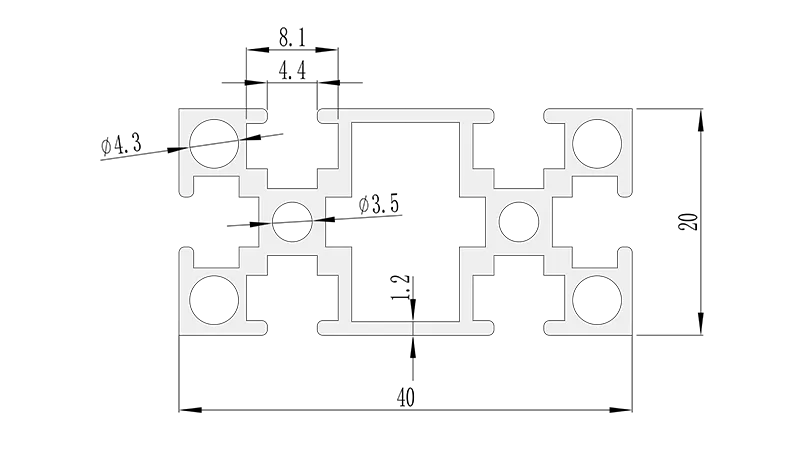
Before we jump into the benefits, let's get clear on what makes the 2040 national standard profile special. If you've ever worked with aluminum extrusion profiles, you know they come in all shapes and sizes—but the 2040 stands out for a reason. Its name gives away the key detail: it measures 20mm in width and 40mm in height, with a sleek, rectangular cross-section. But it's not just the dimensions that matter; it's the "national standard" part. This means every 2040 profile is manufactured to strict, consistent specifications, ensuring that no matter which supplier you buy from, the T-slots (those handy grooves along the length for attaching accessories), the wall thickness, and the overall rigidity are uniform.
Made from high-grade aluminum alloy, these profiles are lightweight enough to maneuver by hand (no need for heavy machinery to carry a single piece) but strong enough to support heavy loads—think workbenches holding tools, flow racks stacked with components, or even small conveyor systems. And because they're extruded (pulled through a die to form their shape), they have a smooth, precise finish that's ready to use right out of the box. No rough edges, no uneven surfaces—just clean, consistent material that's begging to be assembled.
The Problem with "Cut-to-Order" Profiles (and Why Pre-Cut Solves It)
Let's set the scene: You're a production manager at a mid-sized electronics factory, and you need to set up three new workbenches by the end of the week to handle a rush order. Your team orders aluminum profiles, but they arrive in 6-meter lengths—way longer than you need. So, you grab a saw, measure twice, cut once… or try to. The first cut is off by 5mm, so you adjust. The second cut leaves a jagged edge that won't fit the connector. By the time you get three usable pieces, you've wasted 30 minutes, a chunk of material, and everyone's patience. Sound familiar?
This is the reality of "custom-cut" profiles. Even with skilled operators, manual cutting introduces human error. Measuring tools slip, saw blades wander, and what should take 10 minutes turns into an hour-long project. And it's not just time—material waste adds up, too. Those off-cuts? They're too short to use for most projects, so they end up in the scrap bin, eating into your budget. Plus, when you're building something like a workbench, every piece needs to align perfectly. A 2mm difference in length between two side rails can make the entire structure wobble, compromising safety and functionality.
Real Talk from the Shop Floor: "We used to spend half a day just cutting profiles for a single workbench," says Mike, a workshop foreman at a small automotive parts supplier. "One guy would measure, another would cut, and we'd still end up with pieces that didn't fit. Then we switched to pre-cut 2040s. Last month, we built four workbenches in under three hours—start to finish. No sawdust, no cussing, just assembling. It's like night and day."
The Top Benefits of Pre-Cut 2040 Profiles for Quick Assembly
1. Time Savings: From Hours to Minutes
The biggest win with pre-cut 2040 profiles? Time. Lots of it. When you order profiles pre-cut to your exact length—say, 1200mm for a workbench leg or 800mm for a flow rack side—you skip the entire measuring and cutting process. No more setting up saws, no more double-checking measurements, no more sanding rough edges. Instead, you open the box, grab the pieces, and start assembling. It's like going from cooking a meal from scratch to heating up a pre-made dish—you still get a great result, but you're done in a fraction of the time.
For teams working on tight deadlines, this is a lifesaver. Imagine needing to reconfigure a production line overnight to accommodate a new product. With pre-cut profiles, you can have the new workstations or material racks built and ready by morning. Without them? You might be looking at a full day of cutting alone, delaying production and missing deadlines.
2. Precision You Can Count On
Consistency is key in assembly, and pre-cut 2040 profiles deliver it in spades. These profiles are cut by machines, not humans, which means tolerances as tight as ±0.5mm. That might sound small, but when you're attaching aluminum profile accessories—like hinges, T-slot nuts, or end caps—those tiny differences make a huge impact. A pre-cut profile will slide into a connector smoothly, every single time, because the length is exact. No forcing pieces, no gaps, no wobbly structures.
This precision also makes it easier to replicate builds. If you need ten identical workbenches, you can order ten sets of pre-cut profiles and trust that each set will assemble exactly like the first. With custom-cut profiles, even a skilled operator might cut one leg 1mm shorter than the others, leading to inconsistent workbenches that wobble or don't align with conveyor systems.
3. Less Waste, More Savings
Material waste is the silent budget killer in workshops. A 6-meter profile cut down to 1.2 meters leaves 4.8 meters of leftover material—but if you only need a few short pieces, those leftovers often go unused. Pre-cut profiles eliminate this problem by giving you exactly what you need, no more, no less. You pay for the length you'll use, and there's no scrap pile to clean up. Over time, this adds up to significant savings, especially for businesses that build or reconfigure systems regularly.
And let's not forget labor costs. Every hour spent cutting profiles is an hour your team isn't spent assembling, testing, or improving your production line. Pre-cut profiles free up your team to focus on the work that actually moves the needle—like training new assemblers, optimizing workflows, or troubleshooting bottlenecks.
4. Easy Assembly for Everyone (No Expertise Required)
You don't need to be a master craftsman to assemble with pre-cut 2040 profiles. Because the pieces are already the right length, and the T-slots are standardized, even someone with minimal experience can put together a sturdy workbench or material rack. Just line up the profiles, slide in the accessories, tighten the bolts, and you're done. This is a game-changer for small teams or businesses with high turnover—you don't need to train someone for hours on saw safety or precision cutting; they can start contributing to assembly on day one.
Pre-Cut vs. Custom-Cut: A Side-by-Side Comparison
| Aspect | Pre-Cut 2040 Profiles | Custom-Cut Profiles |
|---|---|---|
| Time to Assemble (per workbench) | 1–2 hours (assembly only) | 4–6 hours (measuring + cutting + assembly) |
| Precision Tolerance | ±0.5mm (machine-cut) | ±2–3mm (varies by operator skill) |
| Material Waste | Less than 2% (minimal off-cuts) | 15–20% (leftover lengths from long stock) |
| Skill Required | Basic hand tools; no cutting expertise needed | Skilled operator with sawing/measuring experience |
| Consistency Across Builds | High (every piece matches specs) | Low (varies by operator and tool calibration) |
Integrating with Aluminum Profile Accessories: A Match Made in Assembly Heaven
Pre-cut 2040 profiles are great on their own, but their true power shines when paired with aluminum profile accessories. Think of the profiles as the "bones" of your structure, and the accessories as the "muscles" that hold everything together and add functionality. From simple end caps that protect hands from sharp edges to hinges that let workbench shelves fold up, these accessories are designed to work seamlessly with standard 2040 profiles—especially pre-cut ones.
For example, let's say you're building a lean system workbench. You start with pre-cut 2040 legs (1000mm long) and a pre-cut tabletop frame (1500mm x 800mm). Then you add:
-
90° aluminum profile connectors
to join the legs to the frame (no drilling required—they slide into the T-slots).
- Aluminum honeycomb panels for the tabletop (lightweight but strong, they attach with T-slot bolts).
- Swivel caster wheels (so the workbench can roll to where it's needed—casters bolt directly to the leg bases).
- Tool hooks and holders (slotted into the T-slots along the frame, keeping tools organized and within reach).
- Aluminum honeycomb panels for the tabletop (lightweight but strong, they attach with T-slot bolts).
- Swivel caster wheels (so the workbench can roll to where it's needed—casters bolt directly to the leg bases).
- Tool hooks and holders (slotted into the T-slots along the frame, keeping tools organized and within reach).
Because the profiles are pre-cut and standardized, every accessory fits perfectly. No modifying the profile to make a hinge work, no filing down edges to get a caster to bolt on. It's assembly as it should be: simple, intuitive, and fast.
Real-World Applications: Where Pre-Cut 2040 Profiles Shine
Workbenches: The Heart of the Workshop
Workbenches are where the magic happens—assembling products, testing components, packing orders. They need to be sturdy, adjustable, and easy to set up. Pre-cut 2040 profiles make building a workbench a breeze. Whether you need a small, mobile bench for a repair station or a large, fixed bench for assembly lines, pre-cut legs, frames, and crossbars come together in minutes. And because the profiles are lightweight, you can even design a bench that's easy to disassemble and reconfigure if your needs change.
Lean Systems: Streamlining Workflow
Lean systems are all about eliminating waste and optimizing flow—and pre-cut 2040 profiles are a natural fit here. From flow racks that move materials smoothly from one station to the next to kanban boards that keep track of inventory, these profiles let you build lean structures quickly and adapt them as your workflow evolves. For example, a manufacturer might use pre-cut profiles to build a roller conveyor system in a day, then add extra shelves or adjust the height a week later as production demands change.
Case Study: A Small Electronics Firm's Lean Makeover "We used to have a chaotic assembly line—materials piled up, tools were scattered, and workers wasted time walking to grab parts," says Lisa, operations manager at a startup that builds smart home devices. "We invested in pre-cut 2040 profiles and built custom flow racks, workbenches, and material carts. The entire setup took two days instead of two weeks. Now, materials flow right to the assemblers, tools are at their fingertips, and production has increased by 30%. It's not just about building faster—it's about working smarter."
Material Racks and Trolleys: Keeping Things Moving
Moving materials around a workshop shouldn't be a workout. Pre-cut 2040 profiles make it easy to build lightweight but strong material racks and trolleys. A simple trolley with pre-cut frame rails and caster wheels can carry heavy boxes without bending or breaking, and because the profiles are corrosion-resistant (thanks to their aluminum construction), they'll hold up in busy, dusty environments. Plus, if you need to adjust the shelf height or add more racks later, pre-cut profiles let you expand without starting from scratch.
Choosing the Right Pre-Cut 2040 Profile Supplier
Not all pre-cut profiles are created equal. To get the most out of your investment, look for a supplier who:
-
Offers custom lengths:
You should be able to order profiles cut to your exact specifications, not just standard lengths.
- Guarantees precision: Ask about their cutting tolerance (look for ±0.5mm or better).
- Provides a range of accessories: A good supplier will stock aluminum profile accessories, so you can get everything you need in one order.
- Has fast turnaround times: The whole point of pre-cut profiles is speed—you don't want to wait weeks for delivery.
- Guarantees precision: Ask about their cutting tolerance (look for ±0.5mm or better).
- Provides a range of accessories: A good supplier will stock aluminum profile accessories, so you can get everything you need in one order.
- Has fast turnaround times: The whole point of pre-cut profiles is speed—you don't want to wait weeks for delivery.
Take the time to read reviews or ask for samples. A quality pre-cut profile will have clean, burr-free edges and consistent dimensions. Once you find a reliable supplier, you'll wonder how you ever built anything without them.
Conclusion: Building the Future, One Pre-Cut Profile at a Time
In the world of manufacturing and workshop management, time is money—and frustration is the enemy. Pre-cut 2040 national standard aluminum profiles eliminate both by making assembly faster, more precise, and less wasteful. They're not just a material; they're a tool for empowerment, letting teams of all sizes build, adapt, and grow without being held back by slow, error-prone cutting processes.
Whether you're setting up a new workshop, upgrading your production line, or just need a better way to build workbenches and racks, pre-cut 2040 profiles are the solution. They turn assembly from a chore into a quick, satisfying task—one that lets you focus on what really matters: creating great products and growing your business.
So, the next time you're staring at a pile of uncut aluminum profiles and a tight deadline, remember: there's a better way. Pre-cut 2040 national standard profiles are here to make your assembly process smoother, faster, and a whole lot less stressful. Your team (and your budget) will thank you.