- Company Articles
- Products and Technology
- Product knowledge
- Benefits of Swivel Stem Caster Wheels in Flexible Production Lines

Benefits of Swivel Stem Caster Wheels in Flexible Production Lines
Related Product
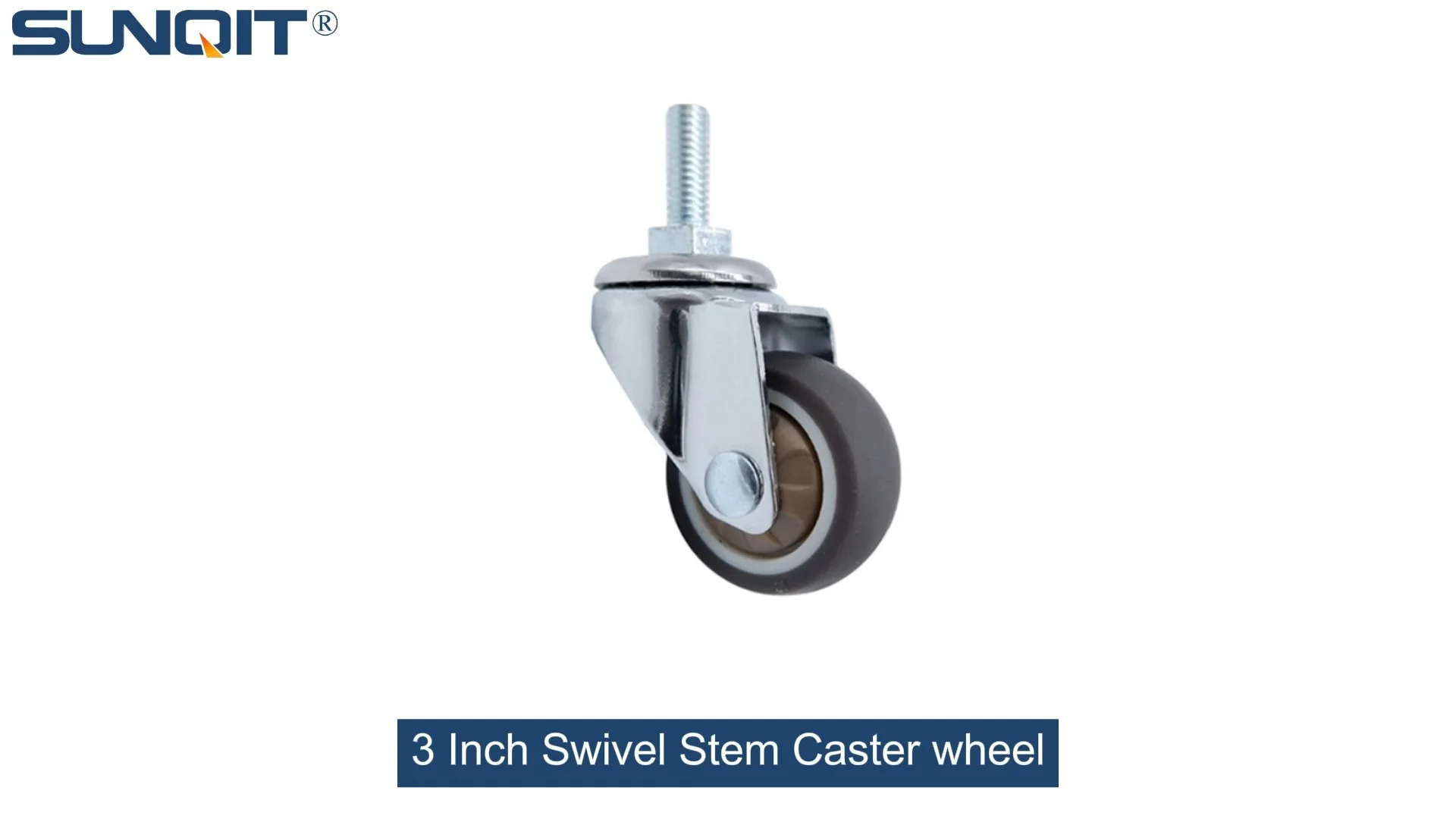
Swivel Stem Caster wheel
360 Degree Swivel Stem Caster. Threaded-post mount design, castors diameter 3 inch.Each swivel caster wheels loading 70KGS. Heavy enough and widely suit for carts, chairs, cabinet, flow rack, workbench, turnover rolley.
How a Small Component Drives Big Efficiency in Modern Manufacturing
Walk into any thriving manufacturing facility today, and you'll notice a common theme: movement. Materials glide from station to station, workstations shift to accommodate new tasks, and teams adapt quickly to changing production demands. In this fast-paced environment, flexibility isn't just a buzzword—it's the backbone of staying competitive. And while large machinery and advanced software often get the credit for driving efficiency, there's a humble component working behind the scenes that deserves just as much recognition: the swivel stem caster wheel. These small, unassuming wheels are the unsung heroes of flexible production lines, turning static workspaces into dynamic, adaptable ecosystems that respond to the needs of lean systems, agile teams, and ever-evolving customer demands.
What Are Swivel Stem Caster Wheels, Anyway?
Before diving into their benefits, let's clarify what swivel stem caster wheels are. Unlike fixed casters, which only roll forward and backward, swivel stem casters feature a rotating joint (the "stem") that allows the wheel to pivot 360 degrees. This design lets the caster turn freely, making it easy to maneuver equipment in tight spaces, around corners, or in any direction needed. The "stem" refers to the vertical rod that attaches the caster to the equipment—think of it as the wheel's "neck," allowing it to swivel independently of the unit it's mounted on. Common in everything from workbenches to turnover trolleys, these casters are engineered to balance load capacity, durability, and maneuverability, making them ideal for the fast-paced, space-constrained world of modern production.
What sets swivel stem casters apart from other caster types (like plate-mounted swivel casters) is their compact design. The stem mount takes up less space than a plate, making them perfect for equipment where undercarriage room is limited—such as lightweight workbenches or small turnover trolleys. They're also easy to install: simply drill a hole, insert the stem, and secure it with a nut or locking mechanism. This simplicity means they can be retrofitted onto existing equipment, too, making them a cost-effective upgrade for facilities looking to boost flexibility without replacing entire workstations.
Swivel Stem Casters and the Lean System: A Match Made in Manufacturing Heaven
Lean manufacturing—a philosophy centered on minimizing waste while maximizing value—has become the gold standard for efficient production. At its core, lean aims to eliminate seven types of waste: overproduction, waiting, transportation, defects, inventory, motion, and overprocessing. Swivel stem caster wheels directly target one of the most insidious forms of waste: motion. Every unnecessary step a worker takes to retrieve materials, reposition a workstation, or adjust a production line eats into productivity. Swivel stem casters reduce this waste by putting control of movement directly into the hands of the team, turning static setups into fluid, on-demand workspaces.
Consider a typical scenario: A production line needs to switch from assembling Product A to Product B. In a rigid setup, workers might spend 20 minutes disassembling and reconfiguring workbenches, moving heavy material racks, or manually carrying tools to new locations. With workbenches and turnover trolleys equipped with swivel stem casters, that same transition could take 5 minutes. A worker can simply unlock the caster brakes, glide the workstation into place with minimal effort, and lock it down—no heavy lifting, no wasted time. This isn't just about speed; it's about empowering teams to focus on what matters: building quality products, not moving equipment.
Real-World Lean Impact: A Case Study
A mid-sized electronics manufacturer in Ohio recently upgraded 80% of its workbenches and turnover trolleys to swivel stem casters. Within three months, they reported a 17% reduction in "motion waste" (measured by time spent moving equipment) and a 12% increase in on-time production. Workers noted that the ability to reposition workstations quickly cut down on physical strain, leading to a 9% drop in reported fatigue-related errors. "It sounds small, but being able to spin a workbench 90 degrees in 10 seconds instead of 2 minutes changes everything," said the plant manager. "Our teams no longer plan their day around moving tools—they plan their day around building better products."

5 Key Benefits of Swivel Stem Caster Wheels in Production Lines
The impact of swivel stem casters goes beyond just supporting lean principles. Let's break down the specific advantages that make them indispensable in flexible production lines:
1. Unmatched Maneuverability in Tight Spaces
Production floors are rarely wide-open spaces. They're filled with machinery, conveyor belts, and workers—all competing for limited room. Fixed casters or rigid wheels often get stuck, requiring multiple people to maneuver even light equipment. Swivel stem casters, with their 360-degree rotation, glide around obstacles with ease. A worker can push a loaded turnover trolley through a narrow aisle, pivot 90 degrees to avoid a passing forklift, and roll straight to the next station—all with one hand. This agility is especially critical in high-mix, low-volume production, where line layouts change frequently and space is at a premium.
2. Reduced Physical Strain, Happier (and More Productive) Teams
Ergonomics isn't just a buzzword; it's a bottom-line concern. Musculoskeletal injuries from heavy lifting or repetitive motion cost manufacturers billions annually in lost productivity and workers' compensation claims. Swivel stem casters reduce the force required to move equipment by up to 70% compared to dragging or pushing fixed-wheel setups. The 360-degree swivel action means workers don't have to twist their bodies to change direction, and features like brake levers (a common caster accessory) let them lock equipment in place with a simple foot tap—no bending or kneeling required. Happier, healthier workers are more engaged, and engaged workers are 17% more productive, according to Gallup research. It's a win-win.
3. Adaptability to Changing Production Needs
Modern manufacturing demands adaptability. Customer orders fluctuate, product designs evolve, and new regulations require process changes. A production line that worked yesterday might not work today. Swivel stem casters turn equipment into modular building blocks. Need to add a new workstation? Roll in a caster-equipped bench. Short on storage? Repurpose a turnover trolley as a temporary inventory rack. This adaptability extends equipment lifespan, too—instead of replacing a workbench when needs change, you can reconfigure it. Over time, this reduces capital costs and waste, aligning perfectly with lean's "do more with less" ethos.
4. Improved Material Flow and Just-In-Time (JIT) Delivery
Just-In-Time production—where materials arrive exactly when they're needed—relies on precise, on-demand movement. Delays in material delivery can bring an entire line to a halt. Swivel stem casters ensure that turnover trolleys (the workhorses of material transport) can navigate from storage to the production line in record time. Even in busy environments, their maneuverability means trolleys can weave through traffic, reaching workers exactly when they need parts. This reduces inventory waste (another lean target) by eliminating the need to stockpile materials "just in case"—because restocking is fast and reliable.
5. Durability That Stands Up to the Factory Floor
Factory floors are tough environments: concrete surfaces, oil spills, heavy loads, and constant use. Swivel stem casters are built to last, with features like reinforced stems, rust-resistant coatings, and wheel materials (like polyurethane or rubber) that absorb shocks and resist wear. Many models also include sealed bearings to prevent dust and debris from jamming the swivel mechanism. This durability means less downtime for caster replacement and fewer unexpected disruptions—critical for maintaining consistent production schedules.
| Benefit | How It Works | Impact on Production |
|---|---|---|
| Maneuverability | 360-degree swivel rotation allows movement in any direction | Reduces time spent navigating tight spaces by up to 60% |
| Ergonomics | Low-friction wheels and easy-to-use brakes minimize physical strain | Decreases worker fatigue and injury rates by 15-20% |
| Adaptability | Modular design enables quick reconfiguration of workspaces | Cuts changeover time between production runs by 50-70% |
| Material Flow | Fast, reliable movement of turnover trolleys supports JIT delivery | Reduces inventory holding costs by 10-15% |
| Durability | Reinforced stems and wear-resistant wheels withstand factory conditions | Lowers maintenance costs by 25% over fixed caster setups |

From Workbench to Turnover Trolley: Real-World Applications in Action
Swivel stem caster wheels aren't a one-size-fits-all solution—they're a versatile tool that enhances nearly every piece of mobile equipment in a production line. Let's look at two common applications where their impact is most tangible: the workbench and the turnover trolley.
The Workbench: Your Team's Most Flexible Tool
The workbench is the heart of any production station. It's where assembly happens, tools are stored, and quality checks are performed. Traditionally, workbenches were bolted to the floor or so heavy that moving them required a forklift. Today, a workbench equipped with swivel stem casters becomes a mobile command center. Need to collaborate with a teammate? Roll the bench next to theirs. Short on space during a rush? Tuck it into a corner until needed. Conducting maintenance on the line? Position the bench at the exact angle for easy access.
Many modern workbenches (like the "workbench e (single deck-without caster)" model, which can be retrofitted with swivel stem casters) are designed with this flexibility in mind. They feature sturdy frames that support heavy loads (up to 500 lbs or more) while remaining easy to move. Add caster accessories like brake levers or soft-grip wheels (to protect floor surfaces), and you've got a workstation that adapts to your team's needs, not the other way around.
The Turnover Trolley and Rack: Moving Materials Without the Muscle
Turnover trolleys and racks are the backbone of material transport, shuttling parts, components, and finished goods between stations. In a busy facility, these trolleys might be pushed dozens of times a day—often by workers already juggling multiple tasks. Fixed-wheel trolleys can be frustrating to maneuver, especially when loaded with heavy inventory. A fully loaded trolley with fixed casters might require two people to push around a corner; with swivel stem casters, one person can navigate it with ease, even in tight aisles.
Take the "material rack b (3 row and 3 floor)" model, a popular choice for storing small parts. When equipped with swivel stem casters, this rack transforms from a static storage unit into a mobile inventory station. Workers can roll it directly to the production line, eliminating the need to walk back and forth to retrieve parts. For fragile items, casters with shock-absorbing wheels reduce the risk of damage during transport. It's a simple upgrade that turns a tool for storage into a tool for efficiency.

Caster Accessories: The Little Extras That Make a Big Difference
While the swivel stem caster itself is a powerful tool, its performance can be enhanced even further with the right accessories. These add-ons address specific challenges like safety, floor protection, and load capacity, ensuring the caster works as hard as your team does.
Brake mechanisms are perhaps the most critical accessory. A good brake locks both the wheel and the swivel joint, preventing accidental movement during use. Foot-operated brakes are popular because they let workers lock/unlock the caster without bending down. For outdoor or uneven surfaces, heavy-duty brakes with reinforced levers ensure stability even with maximum loads.
Wheel material is another key consideration. Rubber wheels are ideal for indoor use, offering quiet operation and good traction on concrete. Polyurethane wheels, on the other hand, are more durable and resistant to oil and chemicals—perfect for factories with harsh conditions. For sensitive floors (like polished concrete or tile), soft-grip wheels prevent scratches and marks, reducing maintenance costs over time.
Mounting hardware is often overlooked but essential. Stems come in different lengths and diameters, so choosing the right size ensures a secure fit. For heavier equipment, stem extenders or reinforced mounting plates (even with stem casters) can distribute weight more evenly, preventing bending or breakage. It's these small details that turn a basic caster into a customized solution for your facility's unique needs.
The Bottom Line: Swivel Stem Casters Drive Efficiency from the Ground Up
In the grand scheme of manufacturing, swivel stem caster wheels might seem like a minor component. But as any seasoned plant manager will tell you, the smallest details often have the biggest impact. By reducing motion waste, enhancing ergonomics, and enabling rapid reconfiguration, these casters empower teams to work smarter, not harder. They turn rigid production lines into flexible ecosystems that can adapt to changing demands, reduce costs, and deliver higher-quality products.
Whether you're upgrading an existing lean system or building a new production line from scratch, don't overlook the power of the swivel stem caster wheel. It's not just about moving equipment—it's about moving your entire operation forward.