- Company Articles
- Products and Technology
- Product knowledge
- Benefits of Using Aluminum Profile 3 Way Connectors in Medical Device Production

Benefits of Using Aluminum Profile 3 Way Connectors in Medical Device Production
Related Product
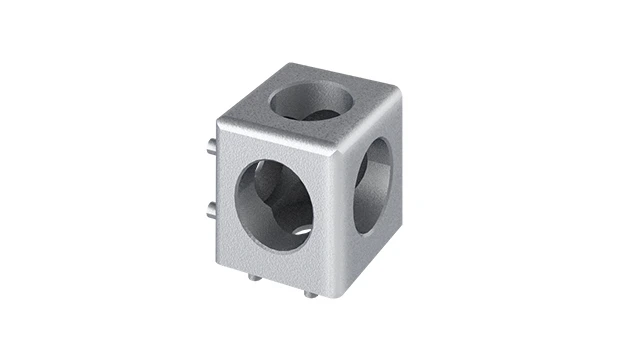
Aluminum Profile 3 Way Connector
The 3 way - squared corner connector is an external fastening method that is typically used to create a corner connection between three profiles. It is a heavy-duty connection that is simple to use and provides a polished look.
In the world of medical device manufacturing, where precision can mean the difference between a life-saving tool and a costly mistake, every component of the production process matters. From the smallest screw in a pacemaker to the assembly line that brings it all together, reliability, flexibility, and safety are non-negotiable. One often-overlooked hero in this high-stakes environment is the aluminum profile 3 way connector —a simple yet ingenious component that has quietly transformed how medical device producers build workspaces, streamline workflows, and ensure compliance with rigorous industry standards. Paired with aluminum extrusion profiles , these connectors aren't just parts; they're the building blocks of a production system that adapts, protects, and endures. Let's dive into why they've become indispensable in creating the tools that build the tools of modern medicine.
What Are Aluminum Profile 3 Way Connectors, Anyway?
At first glance, an aluminum profile 3 way connector might seem unassuming—a small, angular piece of metal designed to link three lengths of aluminum extrusion. But its simplicity is its strength. These connectors are engineered to join aluminum extrusion profiles at precise angles (90°, 45°, or 135°, depending on the model) without the need for welding, drilling, or specialized tools. Made from high-grade aluminum alloys, they're lightweight yet surprisingly robust, with a design that leverages the T-slot architecture of modern aluminum profiles. This T-slot compatibility means they slide into the grooves of the profiles, securing with a simple bolt or set screw to form a joint that's both rigid and reconfigurable.
Think of them as the "Lego bricks" of industrial manufacturing—but for grown-ups building critical infrastructure. Unlike traditional steel brackets that require welding (and thus permanent, unchangeable structures), 3 way connectors let you twist, turn, and reimagine your workspace on demand. Need to add a shelf to a workbench? Swap out a 90° joint for a 135° to angle a component? It's as easy as loosening a screw, repositioning, and tightening back down. In medical device production, where product designs evolve rapidly (think: smaller sensors, more complex surgical tools), this adaptability isn't just convenient—it's essential.
Aluminum Extrusion Profiles: The Perfect Partner
To truly appreciate 3 way connectors, you need to understand their dance partner: aluminum extrusion profiles . These are the long, custom-shaped aluminum beams that form the skeleton of workbenches, racks, and assembly lines. Created through an extrusion process—where molten aluminum is forced through a die to create consistent cross-sections—they're designed with T-slots running their length. These slots are the secret sauce: they allow connectors, shelves, tool holders, and even esd workstation accessories to attach securely without modifying the profile itself.
Aluminum extrusion profiles bring a lot to the table in medical settings. They're non-magnetic (critical for devices like MRI machines), non-sparking (safe for cleanrooms), and have a natural resistance to corrosion—vital when production areas are sanitized daily with harsh disinfectants. Their strength-to-weight ratio is impressive too: a 2-meter length of 40x40mm aluminum profile can support hundreds of pounds without bending, yet remains light enough for a single worker to maneuver during reconfiguration. When paired with 3 way connectors, they become a system that's only as permanent as you need it to be.

Why Medical Device Production Can't Afford to Ignore These Connectors
Medical manufacturing isn't just about building products—it's about building trust. Patients trust that the devices they rely on are made in environments that prioritize safety, and regulators trust that producers can prove every step of the process meets standards like ISO 13485 or FDA guidelines. Aluminum profile 3 way connectors play a quiet but critical role in upholding that trust. Let's break down their biggest benefits:
1. Flexibility That Keeps Pace With Innovation
Medical device design is a fast-moving field. A manufacturer might spend six months perfecting a diagnostic tool, only to pivot to a new model with a smaller footprint or additional features. In a traditional setup with welded steel workbenches, that pivot would mean halted production, new equipment orders, and wasted time. With 3 way connectors, it's a different story.
Take, for example, a company producing wearable health monitors. Their assembly workbench —built with aluminum extrusion profiles and 3 way connectors—was originally designed for a 2-inch-wide device. When they release a slimmer, 1.5-inch model, they don't need a new workbench. Instead, they loosen the connectors, remove a section of profile, and reattach the components. The whole process takes an hour, not a week. This flexibility cuts down on downtime, reduces capital expenses, and lets teams iterate faster—all while keeping production on track.
2. ESD Protection: Safeguarding Sensitive Components
Many medical devices, from pacemakers to glucose monitors, rely on delicate electronics: microchips, circuit boards, and sensors that can be fried by a single electrostatic discharge (ESD). That's where esd workstations come in, and aluminum profile 3 way connectors are key to making them effective. Aluminum is naturally conductive, so when used in a workstation frame, it creates a path for static electricity to dissipate safely to the ground. Unlike plastic connectors, which can insulate and trap static, aluminum 3 way connectors ensure the entire structure—from the work surface to the shelves—acts as a unified ESD shield.
Consider a production line assembling neurostimulation devices, where a single static spark could damage a $500 component. By using aluminum 3 way connectors to build the workstation frame, and pairing it with an ESD-safe tabletop and grounding straps, the manufacturer eliminates that risk. The connectors don't just hold the workstation together; they're active participants in protecting the product.
3. Durability That Stands Up to Cleanrooms (and Cleaners)
Medical device production demands sterile environments. Workbenches, racks, and tools are sanitized daily with aggressive chemicals—alcohols, hydrogen peroxide, and industrial disinfectants that would corrode lesser materials. Aluminum profile 3 way connectors laugh off these treatments. Their smooth, anodized surfaces resist pitting and rust, and their simple geometry (no crevices, no hidden corners) leaves nowhere for bacteria or residue to hide. Unlike plastic connectors, which can degrade or become brittle with repeated exposure to cleaners, aluminum connectors last for years, maintaining their integrity through thousands of wipe-downs.
In a cleanroom setting, where even a speck of dust can ruin a batch, this durability isn't just about longevity—it's about compliance. Regulators don't care if your workstation "mostly" stays clean; they need proof it can be sanitized to a science. Aluminum 3 way connectors make that proof easy to provide.
4. Lean System Integration: Doing More With Less Waste
Lean manufacturing isn't just a buzzword in medical production—it's a survival strategy. With tight margins and high regulatory costs, every minute of downtime, every square foot of wasted space, and every unnecessary movement of materials eats into profitability. Lean system principles focus on eliminating that waste, and aluminum profile 3 way connectors are tailor-made for this mission.
Imagine a material rack used to store components for surgical tools. Built with traditional steel shelving, it's fixed: if a new component is taller than the existing shelves, you either buy a new rack or cram it in, risking damage. With 3 way connectors and aluminum profiles, the rack is modular. Add a shelf? Loosen the connectors, insert a new profile section, and secure. Reposition shelves to fit taller boxes? Adjust the connector angles. This adaptability reduces "motion waste"—the time workers spend searching for tools or moving materials—by keeping everything within arm's reach. It also maximizes space: a rack that once held 10 bins can now hold 15 with a few tweaks, letting the facility run leaner without expanding its footprint.

Traditional vs. Aluminum 3 Way Connectors: A Side-by-Side Comparison
| Feature | Traditional Connectors (Welded Steel/Plastic) | Aluminum Profile 3 Way Connectors |
|---|---|---|
| Flexibility | Permanent; requires cutting/welding to reconfigure. Modifications take days. | Reconfigurable in minutes with basic tools. Profiles and connectors can be reused. |
| ESD Safety | Plastic insulates static; steel may rust, disrupting conductivity over time. | Aluminum is conductive, providing consistent ESD dissipation for sensitive components. |
| Cleanroom Compatibility | Steel can corrode; plastic may harbor bacteria in crevices. Hard to sanitize thoroughly. | Smooth, non-porous surfaces resist corrosion and bacterial growth. Easy to disinfect. |
| Cost Over Time | Low upfront cost, but high replacement costs (permanent structures become obsolete). | Slightly higher upfront cost, but reusable and durable—lower total cost of ownership. |
| Lean System Alignment | Static design leads to waste (space, time, materials) as needs change. | Modular design reduces waste by adapting to workflow changes and space constraints. |
Beyond Workbenches: Real-World Applications in Medical Production
Aluminum profile 3 way connectors aren't limited to workbenches —they're used wherever medical device producers need strong, adaptable structures. Here are a few standout examples:
Material Flow Racks
In a lean production line, materials should flow to workers, not the other way around. Racks built with aluminum extrusion profiles and 3 way connectors can be outfitted with roller tracks (another T-slot accessory) to let bins glide smoothly to assembly stations. When production volume increases, adding a second level to the rack is as simple as attaching more profiles with 3 way connectors. No need for a new rack—just a few extra parts.
Mobile Assembly Carts
For teams that need to move tools or subassemblies between stations, mobile carts are a game-changer. Built with aluminum profiles and 3 way connectors, these carts are lightweight enough to push easily but sturdy enough to hold 200+ pounds of equipment. When not in use, they can be disassembled to save space—a huge plus in crowded production facilities.
Custom Enclosures for Testing
Medical devices often require specialized testing environments—temperature-controlled chambers, EMI shielding, or dust-free zones. Aluminum profile 3 way connectors make building these enclosures a breeze. Producers can create frames of any size, then attach panels (acrylic, metal, or ESD-safe materials) using T-slot accessories. When test requirements change, the enclosure can be resized or modified without starting from scratch.
Compliance: Checking All the Regulatory Boxes
Regulators like the FDA don't just care about the devices themselves—they care about how they're made. Aluminum profile 3 way connectors help producers meet these strict standards in several ways. First, aluminum is a traceable material: suppliers provide certificates of compliance, ensuring the alloy meets purity and safety requirements (no lead, no harmful additives). Second, the modular design of connector-based systems makes it easier to document and validate processes. If an auditor asks, "How was this workbench sanitized last week?" the producer can show that the smooth, crevice-free connectors and profiles are compatible with their cleaning protocols. Finally, because these systems are reconfigurable, they support continuous improvement—a key part of ISO 13485—by letting teams adjust workflows and prove the changes are effective.
The Bottom Line: Investing in the Future of Production
Aluminum profile 3 way connectors might not be the most glamorous part of medical device production, but they're a quiet revolution. They turn rigid, static workspaces into dynamic, responsive systems that grow with your needs, protect your products, and stand up to the demands of a regulated industry. When paired with aluminum extrusion profiles , they're more than components—they're an investment in agility, safety, and long-term efficiency. In a field where every detail matters, isn't it worth building your production line on something that's built to adapt?
So the next time you walk through a medical device factory, take a closer look at those workbenches, racks, and carts. Chances are, there's an aluminum profile 3 way connector holding them together—and holding up the promise of better, safer, more reliable medical tools for all of us.