- Company Articles
- Products and Technology
- Product knowledge
- Building Modular Production Lines with 4040B EU Standard Aluminum Profile

Building Modular Production Lines with 4040B EU Standard Aluminum Profile
Related Product
4040B EU Standard Aluminum Profile
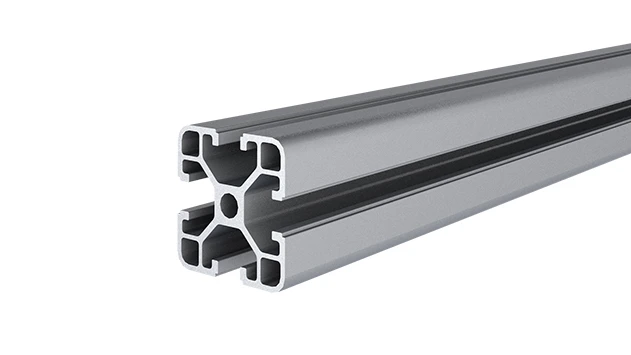
4040B is a 4.00x4.00 CM fractional 40 series square extrusion T-slot profile with four open T-slots, each side with 4.00cm face. The profile has align-a-grooves to assist in aligning connecting profiles.
Walk into any modern manufacturing facility, and you'll likely notice a shift—gone are the days of, fixed production lines bolted to the floor, resistant to change. Today's factories hum with adaptability: lines that reconfigure overnight, workstations that adjust to new tasks, and systems that grow with demand. At the heart of this transformation lies a deceptively simple material: aluminum extrusion profiles. Specifically, the 4040B EU Standard Aluminum Profile has emerged as a cornerstone for building modular production lines that balance strength, flexibility, and cost-effectiveness. For plant managers, engineers, and small business owners alike, this isn't just about metal and bolts—it's about unlocking the agility to thrive in a market where change is the only constant.
What is 4040B EU Standard Aluminum Profile?
Let's start with the basics. The term "4040B" refers to the profile's cross-sectional dimensions: 40 millimeters by 40 millimeters, a size that strikes a sweet spot between strength and versatility. The "EU Standard" tag ensures it meets rigorous European manufacturing norms for quality, consistency, and safety—meaning you're not just buying a piece of metal, but a component engineered to work seamlessly with a global ecosystem of accessories and systems.
Made from high-grade aluminum alloy (typically 6063-T5, known for its excellent strength-to-weight ratio), 4040B profiles are created through an extrusion process. Imagine pushing molten aluminum through a precision die, shaping it into a long, uniform beam with internal channels and external T-slots. These T-slots are the secret sauce: they run the length of the profile, allowing you to attach accessories—connectors, brackets, shelves, even tools—anywhere along the beam, no drilling or welding required. This design turns a simple aluminum extrusion profile into a building block for almost any structure you can imagine.
Why 4040B, specifically? While larger profiles (like 80x80mm) handle heavier loads and smaller ones (like 20x20mm) suit lightweight tasks, 40x40mm is the workhorse of industrial settings. It's sturdy enough to support workbenches, conveyor systems, and material racks, yet lightweight enough to assemble and reposition without heavy machinery. For modular production lines—where adaptability is key—this balance makes 4040B indispensable.
The Case for Modular Production Lines
Traditional production lines are built to last—literally. Welded steel frames, fixed conveyor belts, and permanent workstations make sense for high-volume, static manufacturing. But in today's market, where product lifecycles shrink and customer demands shift, "permanent" often translates to "obsolete." A factory that invested in a fixed line for smartphones might struggle when the next model is 20% larger, or when demand drops and they need to scale back. Tearing down and rebuilding costs time, money, and productivity—three things no business can afford to waste.
Modular lines, built with 4040B EU Standard Aluminum Profile, flip this script. They're designed to evolve. Need to add a new workbench? Grab a few profiles, some connectors, and you're done in hours. Want to reposition a conveyor to reduce material handling? Loosen the brackets, move the sections, and tighten—no welding crew needed. This flexibility isn't just convenient; it's strategic. It lets businesses respond to trends, test new processes, and scale operations up or down without overhauling their entire setup.
Key Benefits of 4040B-Based Modular Systems
- Cost-Efficiency: While the upfront cost of aluminum profiles might be higher than basic steel, the long-term savings are significant. Reusing components for new projects eliminates the need to buy new materials. Quick reconfigurations mean less downtime during transitions.
- Speed: Traditional lines take weeks or months to build. A modular line with 4040B? Days. No waiting for welders or custom fabricators—just assemble, adjust, and start production.
- Durability: Aluminum resists corrosion, even in harsh factory environments. The 6063-T5 alloy holds up under repeated use, and T-slots won't wear out from frequent accessory adjustments.
- Sustainability: Aluminum is 100% recyclable, and modular systems generate less waste than one-and-done setups. When a line is retired, its profiles live on in the next project.
- Safety: Smooth edges (thanks to 4040 aluminum profile end caps) and stable structures reduce workplace accidents. Profiles are lightweight enough to handle safely, and accessories like casters make moving heavy sections easier.

Building Blocks: 4040B and Aluminum Profile Accessories
A 4040B profile alone is just a beam. It's the ecosystem of aluminum profile accessories that turns it into a modular powerhouse. Think of it like a grown-up Lego set: the profiles are the bricks, and the accessories are the connectors, hinges, and wheels that bring your design to life. Let's break down the essentials:
| Component | Function | Example |
|---|---|---|
| 4040B Aluminum Extrusion Profile | The base structure; provides strength and T-slots for attachment. | 40x40mm cross-section, 6063-T5 alloy, T-slots along all four sides. |
| 90° Aluminum Profile Connector | Joins two profiles at a right angle, no welding required. | Slides into T-slots, secured with bolts; ideal for corners in workbenches or racks. |
| 4040 Aluminum Profile End Cap | Covers exposed ends of profiles to prevent cuts and debris buildup. | Snap-on or screw-on design; available in plastic or aluminum. |
| T-Slot Nuts and Bolts | Secures accessories to T-slots; can be positioned anywhere along the profile. | Square nuts that lock into T-slots, paired with hex bolts for a tight fit. |
| Gusset Plates | Reinforces joints for extra stability, especially in heavy-load applications. | Triangular or rectangular plates that attach to two profiles at a joint. |
Beyond these basics, the accessory lineup is vast: casters for mobile workstations, hinges for foldable sections, tool holders that clip into T-slots, and even LED light strips for illuminated workbenches. The beauty is that these accessories are standardized—so a 90° connector from one supplier works with a 4040B profile from another, as long as both meet EU standards. This interoperability means you're never locked into a single brand, giving you freedom to choose the best components for your needs.
Step-by-Step: Building a Modular Production Line with 4040B
Let's put theory into practice. Suppose you run a small electronics assembly plant and need to build a modular line for smartphone chargers. Your goals: easy reconfiguration for new charger models, space efficiency, and integration with a lean system to minimize waste. Here's how you'd do it with 4040B EU Standard Aluminum Profile:
1. Plan Your Layout
Start by mapping your workflow. For charger assembly, the steps might be: component sorting → PCB soldering → housing assembly → testing → packaging. Each step needs a workstation, and materials should flow smoothly from one to the next. Sketch the layout, noting dimensions: how much space between workstations? Will operators stand or sit? What tools (soldering irons, testers) need to be within reach?
Measure twice, cut once—even with modular systems. While you can adjust later, getting the initial layout right saves time. Use CAD software or even graph paper to plot the line, marking where 4040B profiles will go, where conveyors (if any) will run, and where workbenches will sit.
2. select Components
For workstations, you'll need:
- 4040B profiles (cut to length for table frames: 1200mm for the tabletop, 800mm for legs).
- 90° aluminum profile connectors to join legs to the tabletop frame.
- 4040 aluminum profile end caps for the leg bottoms (to protect floors and add stability).
- T-slots nuts and bolts to attach a plywood or metal tabletop to the frame.
- Casters (optional) if you want mobile workstations.
For material flow between stations, add a simple gravity-fed conveyor using 4040B profiles as side rails and roller tracks (another accessory) to slide components along. Use 45° aluminum profile connectors to angle the rails slightly downward, so parts move automatically to the next workstation—no motors needed, saving energy and simplifying setup.
3. Assemble the Line
Now, the fun part: building. Start with the workbenches. Lay out four 1200mm profiles for the tabletop frame, joining them at the corners with 90° connectors. Tighten the bolts just enough to hold the frame square, then attach the 800mm legs to each corner. Add gusset plates at the leg joints for stability—important if operators will be leaning on the bench or placing heavy tools on it.
Next, secure the tabletop. Drill holes in your plywood (or use a pre-cut metal sheet) and align them with the T-slots on the frame. drop T-slot nuts into the slots, insert bolts through the tabletop, and tighten—no need to pre-drill the profiles. Snap 4040 aluminum profile end caps onto the legs to finish the look and prevent snags.
For the conveyor, mount two 4040B profiles parallel to each other on stands (using more 4040B legs and connectors). Attach roller tracks to the inner T-slots, spacing them to fit your component trays. Angle the entire assembly by adjusting the stand heights with 45° connectors—just enough for gravity to do its work, but not so steep that parts slide too fast.
4. Integrate Lean Principles
A lean system thrives on organization and waste reduction. Use T-slots to add tool holders above each workstation, keeping soldering irons, screwdrivers, and testers within arm's reach (no more walking to a tool cart). Attach small bins for scrap materials (wires, excess solder) to the side of workbenches, making it easy to sort waste and recycle.
Since the line is modular, you can test different layouts to find the most efficient flow. Maybe moving the testing station closer to packaging cuts down on walking time. Or adding a third workstation during peak demand reduces bottlenecks. With 4040B, these changes take hours, not weeks.
5. Test and Adjust
Run a trial production run with your new line. Are components flowing smoothly? Is there enough space for operators to work comfortably? Do any joints feel wobbly? Tighten connectors, adjust conveyor angles, or add extra profiles for support as needed. Remember: modularity means perfection isn't required on day one—you can tweak as you go.
Real-World Impact: How 4040B Transforms Manufacturing
Still skeptical? Let's look at a real example. A mid-sized automotive parts supplier was struggling with a fixed production line for brake calipers. When their biggest client switched to a new car model, the calipers grew by 15%, and the old line—with its welded steel frames and fixed conveyor—couldn't accommodate the larger parts. Rebuilding would cost $150,000 and take six weeks of downtime.
Instead, they invested in a modular line with 4040B EU Standard Aluminum Profile. They reused 80% of their existing aluminum extrusion profile accessories, bought new 4040B beams for longer sections, and reconfigured the line in three days. Total cost? $45,000—less than a third of the traditional rebuild. Six months later, when demand spiked, they added two more workstations by repurposing profiles from a low-use line, scaling up without new infrastructure.
For small businesses, the impact is even more profound. A startup making custom 3D printer kits uses 4040B to build workbenches that double as assembly stations and shipping stations. When a new printer model launches, they reconfigure the benches in an afternoon, adding tool rails or adjusting heights to fit the new kit's components. "We used to rent extra space for storage," says the founder. "Now, we just disassemble old workstations and build new ones—no more wasted square footage."
Maintaining Your Modular Line: Tips for Longevity
A modular line with 4040B is built to last, but it still needs care. Here's how to keep it running smoothly:
- Clean Regularly: Dust and debris can build up in T-slots, making accessories harder to adjust. Wipe profiles with a damp cloth weekly, and use a small brush to clean out slots.
- Check Connections: Vibrations from machinery can loosen bolts over time. Tighten connectors and T-slot nuts monthly to prevent wobbling.
- replace Worn Parts: End caps can crack, and casters may wear out. Keep spares on hand—they're inexpensive and easy to swap.
- Label Components: If you frequently disassemble and rebuild, label profiles with their lengths (e.g., "1200mm – Workbench A") to speed up reassembly.
- Train Your Team: Show operators how to safely adjust the line—tightening bolts, adding accessories, or moving sections. Empowering them to make small tweaks reduces downtime.
Conclusion: The Future of Manufacturing is Modular
In a world where change is constant, rigidity is a liability. 4040B EU Standard Aluminum Profile isn't just a material—it's a mindset. It's about building production lines that grow with your business, adapt to new challenges, and turn obstacles into opportunities. Whether you're a multinational manufacturer or a small workshop, the modular approach offers a path to greater efficiency, lower costs, and a competitive edge.
So, the next time you walk through your facility, look at your production line. Is it holding you back, or is it ready to evolve? With 4040B, aluminum extrusion profile, and the right accessories, the answer can be the latter. The future of manufacturing isn't fixed—it's modular. And it starts with a simple 40x40mm beam.