- Company Articles
- Products and Technology
- Procurement Guidelines
- Buying Guide: Choosing 3060 National Standard Profile A Suppliers

Buying Guide: Choosing 3060 National Standard Profile A Suppliers
Related Product
3060 National Standard Profile A
Workbench, production line, logistic rack, warehouse rack Industry: Manufacturer workshop, Automobile, Electronic, Assembling, logistic
Everything you need to know to find a reliable partner for your aluminum profile projects
Introduction: Why Your Supplier Choice Matters More Than You Think
Let's start with a scenario we've all lived through, whether in business or even personal shopping: you need a specific part for a project. You find a supplier online with rock-bottom prices, hit "order," and wait. When the package arrives, the part is flimsy, doesn't fit, or worse—breaks after a week of use. Suddenly, that "great deal" becomes a headache: you're stuck with returns, delays, and a project timeline in shambles. Now, imagine that part is a 3060 National Standard Profile A— a critical component in building workbenches, material racks, or lean production systems. The stakes just got a lot higher.
Aluminum profiles like the 3060 National Standard Profile A are the backbone of countless industrial and commercial projects. They're used in assembly lines, warehouse storage, retail displays, and even custom furniture. Their versatility comes from their strength-to-weight ratio, corrosion resistance, and the ease with which they can be connected using aluminum profile accessories like brackets, joints, and end caps. But none of that matters if the profile itself is low-quality, or if the supplier can't deliver the right specifications when you need them.
Choosing the right 3060 National Standard Profile A supplier isn't just about getting a product—it's about securing a partner who understands your needs, delivers consistent quality, and supports you through every step of the process. Whether you're a small manufacturer building workbenches for a local workshop or a large enterprise scaling up a lean system, the supplier you pick will impact your project's efficiency, durability, and bottom line. In this guide, we'll walk you through how to navigate the crowded supplier market, ask the right questions, and avoid common pitfalls. By the end, you'll feel confident in identifying a supplier that doesn't just sell you profiles, but helps you succeed.
Key Factor 1: Quality First—What to Look for in 3060 National Standard Profile A
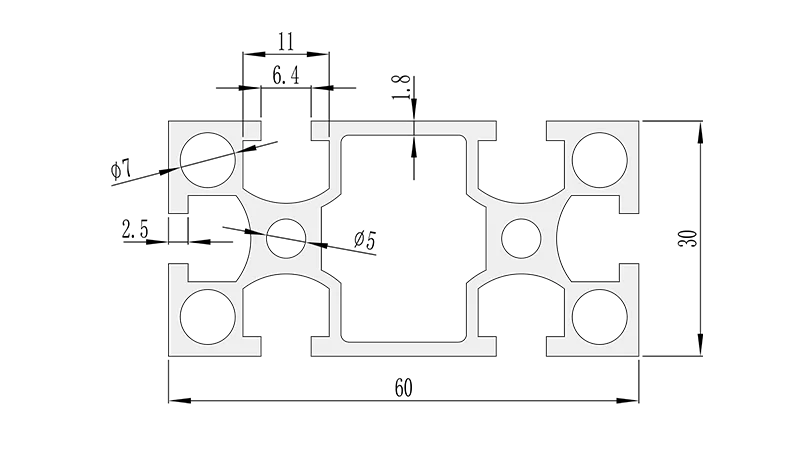
When it comes to aluminum profiles, "quality" isn't just a buzzword—it's the difference between a workbench that lasts 10 years and one that wobbles after six months. The 3060 National Standard Profile A is defined by specific dimensions (30mm x 60mm cross-section) and material standards, but not all suppliers adhere to these specs strictly. Here's how to separate the reliable from the risky:
Material Grade: Not All Aluminum is Created Equal
The 3060 profile is typically made from 6063-T5 aluminum alloy, a common choice for industrial profiles due to its excellent combination of strength, weldability, and corrosion resistance. But some suppliers cut corners by using recycled or lower-grade aluminum, which can lead to profiles that bend under load or corrode quickly in humid environments.
Pro Tip:
Ask suppliers for a material certification (like a mill test report) that confirms the alloy grade. Reputable suppliers will have no problem providing this—if they hesitate or claim "it's not necessary," that's a red flag.
Dimensional Accuracy: When "Close Enough" Isn't Enough
The "3060" in the profile name refers to its width (30mm) and height (60mm), but even small deviations can throw off your entire project. Imagine building a workbench where the profiles are 1mm too narrow—suddenly, the aluminum profile accessories like connectors or brackets won't fit snugly, leading to loose joints and unstable structures.
How to check? If possible, request a sample profile and measure it with a caliper. Pay attention to wall thickness too—some suppliers thin the walls to save on material, weakening the profile. The national standard for 3060 Profile A typically specifies a wall thickness of 1.5mm or 2.0mm (depending on the application), so confirm that with your supplier.
Surface Treatment: More Than Just Looks
Most 3060 profiles come with anodized or powder-coated finishes. Anodizing creates a protective oxide layer that resists scratches and corrosion, while powder coating adds color and durability. A shoddy finish, however, can peel, chip, or fade—ruining both aesthetics and functionality.
Inspect samples for uneven coloring, bubbles, or rough patches. Run your finger along the surface— it should feel smooth and consistent. For outdoor or high-moisture environments, ask about the anodizing thickness (measured in microns); 10-15 microns is standard for industrial use.
Key Factor 2: Customization—Can They Meet Your Unique Needs?
"".3060,.,,..
Let's say you're building a material rack B (3 row and 3 floor) for your warehouse. The standard 3060 profile length is 6 meters, but you need 2.5-meter sections to fit your space. A supplier with in-house cutting capabilities can do this cleanly, with precise, burr-free edges. A supplier without that equipment might outsource the cutting, leading to delays or rough cuts that require extra sanding (and extra labor costs on your end).
Common Customization Requests to Discuss:
- Cut-to-length: Ensure they can handle your required tolerances (e.g., ±0.5mm for critical lengths).
- Drilling/tapping: If you need holes for bolts or connectors, ask if they use CNC machines for accuracy.
- Surface finishes: Beyond standard anodizing, do they offer powder coating, electrophoresis, or wood-grain finishes?
- Special packaging: For large orders, can they bundle profiles by project (e.g., "Workbench Set A: 4x 3060 profiles, 8x brackets") to save you time on sorting?
Not every supplier offers full customization, and that's okay—some specialize in high-volume standard products. The key is to find a supplier whose capabilities align with your project. If you need one-off custom parts, a specialized aluminum profile supplier is better than a generalist. If you're buying bulk standard profiles, a large distributor might offer better pricing.
Key Factor 3: Pricing—Looking Beyond the Sticker Price
Let's be honest: price is always a factor. But here's the hard truth: the cheapest supplier rarely ends up being the best value. Why? Because low prices often come with hidden costs—like poor quality leading to replacements, slow shipping that delays your project, or terrible customer service when things go wrong.
The Total Cost of Ownership (TCO) Mindset
Instead of fixating on the per-meter price of 3060 profiles, calculate the total cost of ownership. For example:
- Supplier A charges $15/m for 3060 profiles but has a 2-week lead time and no returns.
- Supplier B charges $18/m but ships in 3 days, offers free samples, and has a 30-day return policy.
If your project is time-sensitive, the extra $3/m from Supplier B might save you thousands in downtime. Or if Supplier A's profiles warp and need replacement, you're actually paying more in the long run.
| Supplier Type | Typical Price Range (3060 Profile A/m) | Minimum Order Quantity (MOQ) | Best For |
|---|---|---|---|
| Large-Scale Industrial Suppliers | $12–$16 | 500+ meters | High-volume, standard profiles; long-term contracts |
| Specialized Aluminum Profile Suppliers | $15–$20 | 100–500 meters | Customization, technical support, small-to-medium batches |
| Local Distributors | $18–$25 | 10–50 meters | Small projects, urgent orders, same-day pickup |
| Lean System Suppliers | $20–$28 | Varies (often bundles with accessories) | Turnkey solutions (e.g., "Lean Workbench Kit with 3060 profiles, casters, and tools") |
Negotiating Tips for Better Deals
Don't be afraid to negotiate—especially if you're placing a large or repeat order. Here are a few angles to try:
- Long-term contracts: Offer to commit to 6 months of orders in exchange for a 5–10% discount.
- Bundling: Buy aluminum profile accessories (brackets, end caps) from the same supplier—they may offer a package deal.
- Off-season ordering: Many suppliers have slower periods (e.g., post-holiday lulls) and may cut prices to boost sales.
Key Factor 4: Lead Times and Logistics—Can They Deliver When You Need It?
You've found a supplier with great quality, customization, and pricing. Now, ask: "Can they get it to me on time?" In manufacturing, a delay of even a few days can throw off production schedules, leading to overtime costs or missed client deadlines. This is especially true for lean system projects, where every component relies on the previous one—if the 3060 profiles arrive late, the workbench can't be built, and the assembly line stalls.
What Affects Lead Times?
Lead times depend on several factors: the supplier's inventory, production capacity, and location. A supplier with 3060 Profile A in stock can ship within 1–3 days. One that manufactures to order may take 7–14 days (or longer for custom finishes). If the supplier is overseas, add shipping time (2–4 weeks for sea freight, 3–5 days for air freight—at a premium).
Be upfront about your timeline. Say, "I need these profiles by [date] for a workbench installation—can you guarantee delivery?" A good supplier will be honest if they can't meet it, rather than overpromising and underdelivering.
Red Flag:
A supplier who says, "We can definitely meet that date!" without checking their inventory or production schedule. Always get the delivery date in writing (email is fine) to avoid disputes later.
Logistics Support: Making Sure It Arrives Intact
Aluminum profiles are long, slender, and prone to bending if not packaged properly. A supplier that uses flimsy packaging (e.g., just shrink wrap) risks damaging profiles in transit. Ask about their packaging methods—do they use wooden crates, foam padding, or reinforced cardboard? For international shipments, do they handle customs clearance, or will you need to arrange that?
Also, inquire about shipping partners. Reputable suppliers often work with established carriers (e.g., DHL, FedEX for small orders; Maersk, CMA CGM for sea freight) that have experience handling industrial goods. A supplier that uses unknown carriers may save money, but you'll pay the price if your order gets lost or delayed.
Key Factor 5: Customer Support—The Unsung Hero of Supplier Relationships
Let's wrap up with a factor that's easy to overlook until something goes wrong: customer support. Imagine this: you receive your 3060 profiles, unbox them, and notice a few are bent. You call the supplier, and after 30 minutes on hold, you're transferred to someone who has no idea about your order. Frustrating, right? Now, contrast that with a supplier who answers the phone on the second ring, apologizes, and arranges a replacement shipment to arrive the next day. Which one would you work with again?
Signs of Great Customer Support:
- Responsive communication: They reply to emails within 24 hours and answer phone calls promptly.
- Dedicated account managers: For large orders, a single point of contact who knows your project details.
- Technical expertise: Their sales team can answer questions like, "What's the maximum load a 3060 Profile A can support?" or "Which aluminum profile accessories work best for a mobile workbench?"
- Flexible returns: A clear return policy (e.g., "30 days, no questions asked for defective products") shows they stand behind their quality.
How to test their support before ordering? Send a detailed inquiry (e.g., "I need 50 meters of 3060 National Standard Profile A, cut to 1.8m lengths, with 2mm wall thickness and silver anodizing. Can you provide a quote and lead time?"). Notice how quickly and thoroughly they respond. Do they ask clarifying questions (e.g., "Do you need end caps for these profiles?") or just send a generic quote?
You can also check online reviews. Sites like Alibaba, Google, or industry forums (e.g., Reddit's r/manufacturing) often have comments about supplier support. Look for phrases like "went above and beyond to fix the issue" or "responsive to questions"—these are good signs. Avoid suppliers with multiple reviews complaining about unreturned calls or blame-shifting when problems arise.
How to Evaluate Suppliers: A Step-by-Step Checklist
By now, you know the key factors to consider—but how do you put this into action? Here's a step-by-step checklist to evaluate potential 3060 National Standard Profile A suppliers:
Step 1: Define Your Needs Clearly
Before reaching out to suppliers, write down exactly what you need: profile specifications (length, wall thickness, finish), quantity, customization requirements, delivery date, and budget. The more specific you are, the easier it is to compare quotes.
Step 2: Source Potential Suppliers
Start with a list of candidates. Where to look?
- Industry directories: Thomasnet, Made-in-China, or Alibaba (filter for "Verified Suppliers").
- Trade shows: Events like Chinaplas or Hannover Messe are great for meeting suppliers in person.
- Referrals: Ask colleagues or industry peers, "Who do you use for aluminum profiles?" Word-of-mouth is often the most reliable.
Step 3: Screen Suppliers with Initial Questions
Narrow down your list by emailing or calling with these questions:
- Do you stock 3060 National Standard Profile A, or do you manufacture to order?
- What material grade do you use (e.g., 6063-T5)? Can you provide certification?
- What customization services do you offer (cutting, drilling, finishes)?
- What's your lead time for [X quantity] with [Y customization]?
- What's your minimum order quantity (MOQ)?
Eliminate suppliers who can't meet your basic requirements (e.g., if you need 100 meters and their MOQ is 1000).
Step 4: Request Samples and Quotes
For the remaining suppliers (aim for 3–5), request samples of the 3060 profile and a detailed quote. Pay for the samples— it's a small investment to avoid big headaches later. When evaluating samples, check:
- Quality (weight, finish, straightness).
- Dimensional accuracy (measure with a caliper).
- Fit with aluminum profile accessories (if you have a bracket or joint on hand, test assembly).
Step 5: Check References and Reviews
Ask suppliers for references from customers in your industry (e.g., "Can you connect me with a manufacturer who bought 3060 profiles for workbenches?"). Call those references and ask:
- Was the quality consistent across orders?
- Did they meet delivery deadlines?
- How did they handle issues (e.g., damaged products, wrong sizes)?
Also, search for online reviews, but take them with a grain of salt—one bad review isn't a dealbreaker, but multiple complaints about the same issue (e.g., "always late") are.
Step 6: Make Your Decision
Compare the quotes, samples, and reference checks. Don't just pick the cheapest—weigh all factors: quality, customization, lead time, support, and total cost. Once you've chosen, ask for a written contract that includes all details (quantity, specs, price, delivery date, warranty) before paying any deposits.
Common Mistakes to Avoid When Choosing a Supplier
Even with careful planning, it's easy to fall into traps. Here are the most common mistakes to steer clear of:
Mistake 1: Choosing Based on Price Alone
We've said it before, but it's worth repeating: the lowest price rarely equals the best value. A $10/m profile might save you money upfront, but if it bends under load, you'll spend more on replacements and repairs.
Mistake 2: Ignoring MOQs
Ordering less than the supplier's MOQ often means paying a premium (e.g., 50% more per meter). If you only need a small quantity, either find a supplier with a low MOQ or team up with another buyer to split a larger order.
Mistake 3: Overlooking Cultural or Language Barriers
If you're working with an overseas supplier, language differences can lead to miscommunication (e.g., "3060" might be misunderstood as "30x60mm" vs. "3060 national standard"). Use simple language, confirm details in writing, and consider hiring a translator for complex orders.
Mistake 4: Skipping the Contract
A verbal agreement isn't enough. A written contract protects both you and the supplier by outlining expectations. Include clauses for late delivery (e.g., "5% discount for each week late"), defective products (e.g., "full refund or replacement"), and payment terms (e.g., "30% deposit, 70% upon delivery").
Conclusion: Your Supplier is Your Partner—Choose Wisely
Choosing a 3060 National Standard Profile A supplier isn't just a transaction—it's the start of a partnership. The right supplier will help you navigate challenges, offer advice on aluminum profile accessories, and grow with your business. The wrong one will cost you time, money, and stress.
Remember, the best supplier isn't necessarily the cheapest or the biggest—it's the one that aligns with your needs: quality, customization, reliability, and support. By following the steps in this guide—defining your needs, screening suppliers, testing samples, and checking references—you'll be well on your way to finding that partner.
And when you do find them, nurture the relationship. Pay invoices on time, communicate openly, and give feedback (e.g., "The last batch of profiles was perfect—we loved the new packaging!"). A strong supplier relationship can turn into preferential pricing, priority delivery, and even early access to new products.
Now, go out there and find your ideal 3060 National Standard Profile A supplier. Your workbench, material rack, or lean system will thank you.