- Company Articles
- Products and Technology
- Application Cases
- Case Study: 2040 National Standard Profile Reducing Downtime in 3C Assembly

Case Study: 2040 National Standard Profile Reducing Downtime in 3C Assembly
Related Product
2040 National Standard Profile
45° external bending joint, used for 45° external connection of two aluminum pipes.
In the high-stakes world of 3C manufacturing—where "computers, communications, and consumer electronics" translate to razor-thin margins and relentless production targets—downtime isn't just a hassle. It's a crisis. Every minute a line sits idle erodes profits, delays shipments, and frays the nerves of teams racing to meet quarterly goals. For mid-sized electronics manufacturer TechFlow Electronics, this reality hit hard in early 2024. Their assembly lines, cluttered with mismatched workstations, jamming roller tracks, and aging equipment, were bleeding time: an average of 12 hours of unplanned downtime per week, costing the company over $150,000 annually in lost productivity alone.
"We were stuck in a cycle," recalls Maria Gonzalez, TechFlow's Production Manager. "One week, a workstation leg would bend under the weight of our new 5G router components. The next, our roller tracks for circuit board trays would jam, bringing the entire line to a halt. When we tried to reconfigure a line for a new tablet model, it took two full shifts to disassemble and rebuild the steel workbenches. Our team was exhausted, and our clients were asking questions about missed deadlines."
That's when TechFlow turned to a lean system supplier with a reputation for solving exactly these kinds of problems. What followed was a transformation centered on a deceptively simple component: the 2040 National Standard Profile. This unassuming aluminum extrusion, paired with standardized aluminum profile accessories, would become the backbone of a solution that cut downtime by 68% and redefined how TechFlow approached flexibility and efficiency. Let's dive into how it all happened.
The Breaking Point: TechFlow's Downtime Nightmare
To understand why the 2040 National Standard Profile made such a difference, we first need to unpack TechFlow's specific pain points. The company, which produces everything from smartwatch motherboards to wireless headphone chargers, operated three primary assembly lines in a 40,000-square-foot facility. By early 2024, two critical issues had reached a boiling point:
1. Rigid, Unreliable Workstations
TechFlow's original workstations were built with heavy steel tubing and wooden countertops—sturdy, but about as flexible as a brick wall. "We'd had them for over a decade," Gonzalez explains. "When we launched a new smart speaker line in 2023, the workbenches were too low for the taller component trays. We had to stack plywood on top to raise them, which wobbled and created safety hazards. When we tried to drill new holes for tool holders, the steel cracked. It was a disaster."
Even worse, the workstations weren't standardized. Each line had been upgraded piecemeal over the years, meaning no two workbenches were the same. Spare parts were impossible to track, and when a leg or bracket broke, maintenance teams had to fabricate replacements in-house—a process that could take 4-6 hours per repair. "One time, a bracket on Line 2 snapped at 9 a.m.," says Jake Miller, TechFlow's Maintenance Lead. "We didn't get the line back up until 2 p.m. That's five hours of downtime for a $10 part we couldn't source."
2. Chaotic Material Flow with Jamming Roller Tracks
Beyond workstations, TechFlow's material handling system was another source of grief. To move circuit boards, casings, and small components between stations, the company relied on roller tracks—long, sloped channels with plastic wheels that let trays glide from one workstation to the next. But these tracks were a constant headache.
"The plastic rollers would wear down unevenly, so trays would get stuck halfway," Miller says. "We'd have operators stopping every 15 minutes to unjam them. And when a roller did break, the tracks were made of custom-molded plastic, so we couldn't just swap in a new part. We had to order a whole new section from the original manufacturer, which took 2-3 weeks. In the meantime, we'd rig up temporary conveyor belts with duct tape and zip ties—hardly ideal for precision electronics."
Compounding the issue was the fact that TechFlow's existing aluminum profiles (used sparingly in some material racks) were non-standard. "They were from a no-name supplier," Gonzalez adds. "The T-slots were a weird size, so when we tried to add a shelf or a tool holder, nothing fit. We'd end up drilling holes or using zip ties, which made the whole setup unstable. It was like building with mismatched Lego bricks."
By February 2024, TechFlow's leadership team knew something had to change. Their quarterly report showed downtime had spiked to 14.5 hours per week, and employee turnover in assembly roles was rising—no one wanted to work on lines that broke down constantly. That's when they reached out to LeanLine Solutions, a lean system supplier specializing in 3C manufacturing optimization.
The Turning Point: 2040 National Standard Profile Takes Center Stage
When LeanLine's consultant, Priya Patel, first walked TechFlow's floor, she didn't need long to spot the root cause. "The problem wasn't just the equipment—it was the lack of standardization," Patel explains. "Workstations, tracks, profiles—nothing was consistent. That made repairs slow, reconfigurations impossible, and upgrades a nightmare. The fix? Start with a common building block: the 2040 National Standard Profile."
What Is the 2040 National Standard Profile?
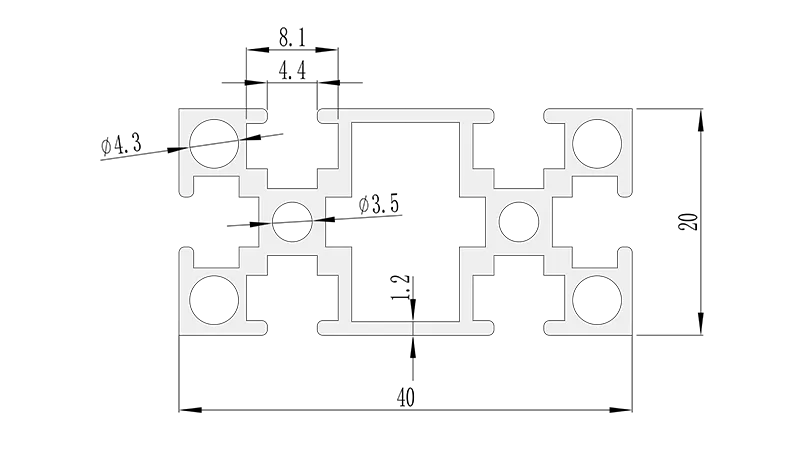
At its core, the 2040 National Standard Profile is a type of aluminum extrusion profile—think of it as a long, rectangular tube with precision-engineered T-slots running along its length. The "2040" refers to its dimensions: 20mm wide and 40mm tall. But its real power lies in its standardization. Unlike TechFlow's old, custom profiles, the 2040 is built to national standards, meaning any supplier of aluminum profile accessories (connectors, brackets, end caps, etc.) will have parts that fit seamlessly.
"It's like switching from a proprietary phone charger to a USB-C cable," Patel says. "Suddenly, everything works together. You can buy accessories off the shelf, swap parts between systems, and reconfigure on the fly." Lightweight but surprisingly strong (it can support up to 150kg per linear meter), the 2040 profile is also corrosion-resistant, making it ideal for electronics manufacturing environments where cleanliness is critical.
The Solution: Three Pillars of Transformation
Patel and her team proposed a three-part solution centered on the 2040 profile, designed to address TechFlow's workstations, roller tracks, and material handling all at once:
1. Modular Workstations with 2040 Profiles and Standard Accessories
First, replace all steel workstations with new setups built from 2040 National Standard Profiles. These workstations would feature:
- Adjustable Heights: Using aluminum profile accessories like 90° aluminum profile connectors and height-adjustable feet, workbench heights could be tweaked in minutes (no more plywood stacks).
- Tool Integration: T-slots along the 2040 profiles would let workers clip on tool holders, LED task lights, and anti-static wristband stations—no drilling required.
- Quick Reconfiguration: Standardized end caps and brackets meant that when product lines changed, workstations could be disassembled and rebuilt in under an hour, not two shifts.
"We even added small shelves for bins of screws and connectors, mounted directly to the 2040 profiles," Patel notes. "Workers no longer have to reach across the table—everything's within arm's reach. That alone cut down on minor delays and errors."
2. Upgraded Roller Tracks with Aluminum Guide Rails
Next, overhaul the roller tracks using aluminum guide rails (specifically, "aluminum guide rail A" and "aluminum guide rail B" from LeanLine's catalog) paired with 2040 profiles for support. The new tracks would feature:
- Steel-Reinforced Rollers: Replacing plastic wheels with 40 steel roller track black wheels (ESD-safe, critical for electronics) that could handle heavier loads and resist wear.
- Modular Sections: Tracks built in 1-meter sections connected by roller track placon mount connectors, so a single broken roller could be swapped out in 10 minutes, not 3 weeks.
- Smooth Slopes: Aluminum guide rails with precision-machined grooves ensured trays glided evenly, eliminating jams from uneven wear.
3. Standardized Material Racks for Spare Parts
Finally, build a centralized spare parts rack using 2040 profiles and aluminum honeycomb panels. This rack would store all critical aluminum profile accessories—connectors, end caps, roller replacements—so maintenance teams could grab parts instantly, cutting repair times from hours to minutes.
"We color-coded bins by part type," Miller says. "Now, if a connector breaks, I walk to the rack, grab the red bin labeled '90° Joints,' and I'm back at the line in 2 minutes. No more scavenger hunts through the warehouse."
From Blueprint to Reality: The Implementation Journey
TechFlow greenlit the project in March 2024, with a tight timeline: complete the transformation before the summer production rush in June. Patel's team and TechFlow's engineers worked in phases to minimize disruption—starting with Line 3 (the smallest line), then Line 2, then Line 1. Here's how it unfolded:
Phase 1: Assessment and Design (Week 1-2)
First, LeanLine's team conducted a 3D scan of TechFlow's facility to map existing layouts, workflow patterns, and space constraints. They also interviewed operators and maintenance staff to understand pain points firsthand. "We asked Line 3 operators, 'What's the most frustrating thing about your workstation?'" Patel says. "The answer was unanimous: 'Not enough space for tools, and the table wobbles when we place heavy components.' That feedback directly shaped the design."
Using CAD software, the team drafted custom workstation designs for each line, incorporating operator feedback. For example, Line 1 (smartwatch motherboards) required smaller work surfaces with integrated ESD mats, while Line 3 (headphone chargers) needed extra shelf space for bulky casings. All designs, however, shared the same 2040 profile backbone to ensure standardization.
Phase 2: Installation (Week 3-6)
Installation began with Line 3 in late March. To avoid shutting down production entirely, work was done during night shifts and weekends. The old steel workstations were dismantled and recycled, and the new 2040 profile frames went up in a matter of hours. "Aluminum is so much lighter than steel," Miller notes. "A two-person team could carry a workstation frame that would've needed a forklift before. We assembled the first Line 3 workstation in under 3 hours—unheard of with the old steel setups."
Roller tracks were installed next. The team used laser levels to ensure slopes were consistent, then secured aluminum guide rails to 2040 profile supports bolted to the floor. "We tested the tracks with dummy trays first," Miller says. "No jams. The steel wheels rolled so smoothly, one operator joked we could 'send a feather down and it would glide.'"
By mid-April, Line 3 was fully converted. Line 2 followed in May, and Line 1 wrapped up by early June—just in time for the summer rush.
Phase 3: Training (Week 7-8)
To ensure the new system stuck, LeanLine provided hands-on training for TechFlow's operators and maintenance staff. "We taught them how to use the T-slot accessories—how to slide a connector into the profile, tighten it with an Allen key, and adjust heights," Patel explains. "Within a day, the maintenance team was reconfiguring workstations on their own. One operator even came up with a custom tool holder design using spare brackets—exactly the kind of innovation we wanted to spark."
The Results: Downtime Plummets, Productivity Soars
By July 2024, three months after the first installation, TechFlow began seeing dramatic improvements. The data spoke for itself:
| Metric | Before Implementation (Feb 2024) | After Implementation (July 2024) | Improvement |
|---|---|---|---|
| Average Weekly Downtime | 14.5 hours | 4.6 hours | -68% |
| Workstation Reconfiguration Time | 4-6 hours | 30-45 minutes | -90% |
| Roller Track Jam Frequency | 8-10 per day | 0-1 per week | -98% |
| Maintenance Response Time | 2-4 hours | 15-30 minutes | -92% |
| Employee Turnover (Assembly Roles) | 18% (quarterly) | 5% (quarterly) | -72% |
"The most surprising result? How much happier the team is," Gonzalez says. "Operators no longer dread coming to work because the line is always breaking down. And maintenance isn't stuck in reactive mode—they can focus on preventive upkeep instead of putting out fires. It's transformed the culture."
Financially, the impact was equally clear. With downtime reduced by 68%, TechFlow was able to produce an extra 1,200 units per week across all lines—enough to meet a backlog of orders and even take on a new client. The ROI on the 2040 profile investment? Just 4.5 months.
Perhaps the biggest win, though, is flexibility. In August 2024, TechFlow launched a new line of wireless earbuds—a product requiring a completely different assembly process. Thanks to the modular 2040 workstations, the team reconfigured Line 2 in a single day. "Before, that would've taken a week and a half," Gonzalez says. "Now, we can pivot almost instantly. That's the difference between keeping up with the 3C industry and falling behind."
Why 2040 National Standard Profile Matters for 3C Manufacturing
TechFlow's story isn't unique. In the 3C industry, where product cycles shorten by the month and customization is king, flexibility and reliability are non-negotiable. The 2040 National Standard Profile, paired with standardized aluminum profile accessories, isn't just a "part"—it's a foundation for resilience.
What makes it work? Three key traits:
- Standardization: National standards mean accessories are widely available, reducing lead times for repairs and upgrades.
- Flexibility: T-slots and modular design let manufacturers adapt quickly to changing product lines without rebuilding from scratch.
- Durability: Aluminum extrusion profiles are lightweight yet strong enough to handle the demands of 3C assembly, with corrosion resistance that ensures longevity.
For TechFlow, the transformation has been life-changing. "We're no longer chasing downtime—we're chasing innovation," Gonzalez says. "The 2040 profile didn't just fix our problems; it gave us the freedom to grow. And in this industry, freedom is everything."
As 3C manufacturers continue to navigate pressure to produce faster, cheaper, and more custom products, stories like TechFlow's serve as a reminder: sometimes, the most powerful solutions are the ones that simplify. In a world of complexity, the humble 2040 National Standard Profile is proving to be a quiet revolution—one workstation, one roller track, and one minute of saved downtime at a time.