- Company Articles
- Products and Technology
- Application Cases
- Case Study: 2040 National Standard Profile Transforming Automotive Parts Storage

Case Study: 2040 National Standard Profile Transforming Automotive Parts Storage
Related Product
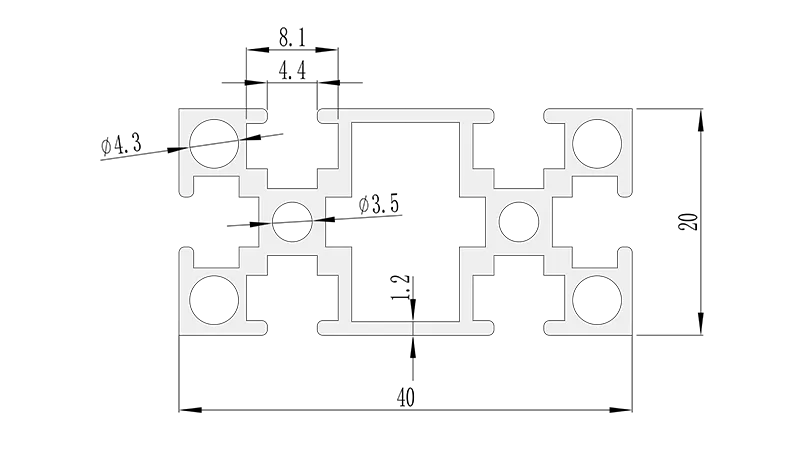
2040 National Standard Profile
45° external bending joint, used for 45° external connection of two aluminum pipes.
Introduction: The Storage Struggle in Automotive Manufacturing
In the fast-paced world of automotive manufacturing, every second counts. For mid-sized players like Precision Auto Components (PAC), a manufacturer specializing in engine valves and transmission parts, the warehouse isn't just a storage space—it's the heartbeat of operations. Parts need to move quickly from shelves to assembly lines; delays here can ripple through production, causing missed deadlines and frustrated clients. But until last year, PAC's warehouse was more of a bottleneck than a well-oiled machine.
"We were drowning in inefficiency," recalls Mark Thompson, PAC's warehouse manager, during a walkthrough of their 12,000-square-foot facility. "Our old steel racks were fixed in place, so if a part's dimensions changed—say, a new valve design came in—we couldn't adjust the shelves. We'd end up stacking boxes on the floor, blocking walkways, or wasting entire sections of the warehouse because the racks were too tall, too short, or just the wrong width. And don't get me started on picking times. My team was spending 20 minutes just hunting for a single gasket because there was no rhyme or reason to where things were stored."
Sound familiar? For many manufacturers, the warehouse becomes an afterthought—until disorganization starts eating into profits. PAC's story isn't unique, but their solution? It's a masterclass in how the right tools can turn chaos into clarity. Enter the 2040 National Standard Profile: a modular aluminum extrusion that's quietly revolutionizing how businesses store, organize, and access parts. Paired with the right aluminum profile accessories, this unassuming piece of metal became the key to PAC's turnaround.
The Challenge: A Warehouse Stuck in the Past
To understand why the 2040 profile made such a difference, let's first dive into PAC's pre-transformation pain points. Before the upgrade, their warehouse relied on traditional steel racking systems installed over a decade ago. At first glance, these racks seemed sturdy—welded steel frames, fixed shelves, and a "one-size-fits-all" approach to storage. But in reality, they were holding PAC back in three critical ways:
1. Rigidity That Killed Flexibility
Automotive parts come in all shapes and sizes: from tiny O-rings (small enough to fit in a pocket) to bulky transmission housings (weighing 50+ pounds). PAC's steel racks had fixed shelf heights—18 inches between levels—with no way to adjust. This meant:
- Small parts wasted vertical space (shelves were twice as tall as needed, so they'd stack bins on top of each other, leading to crushed boxes).
- Large parts often didn't fit at all, forcing workers to store them on the warehouse floor, creating trip hazards.
- When PAC added a new line of high-performance valves (longer and slimmer than older models), they had to buy entirely new racks—costing $15,000 and taking two weeks to install.
2. Time-Consuming Picking and High Damage Rates
With no standardized labeling system and racks that weren't designed for easy access, picking parts became a scavenger hunt. "Our team used to joke that we needed a treasure map to find anything," Thompson says. "A new employee might spend 45 minutes looking for a part that should take 5. And when they did find it? Half the time, the box was crushed because it had been wedged between other items. We were losing $2,000 a month in damaged inventory alone."
Compounding the issue was the lack of flow. Parts were stored in no particular order—some by size, some by vendor, some by "wherever there was space." This meant assembly line workers often had to walk back and forth across the warehouse, doubling the time it took to restock their stations.
3. Safety Risks and Compliance Headaches
Steel racks are strong, but they're also heavy. When PAC needed to rearrange (which was rare, given the effort involved), they had to hire a third-party crew with industrial lifts. Even then, the welded joints made disassembly risky—one wrong move could bend a frame, rendering the entire rack unstable. OSHA inspections became stressful, too: blocked fire exits, overloaded shelves, and uneven weight distribution were constant red flags.
"We knew we needed a change," Thompson says. "The question was, what? We looked at plastic bins, automated systems, even moving to a new warehouse. But nothing felt right—either too expensive, too flimsy, or just as rigid as what we had."
The Solution: 2040 National Standard Profile—Modularity Meets Muscle
Enter the 2040 National Standard Profile. During a trade show, Thompson stumbled upon a booth (showcasing aluminum profile solutions) and was immediately drawn to the 2040 model. "It looked simple—just an aluminum extrusion with T-slots running along its length—but the sales rep explained how those slots changed everything. You could attach brackets, shelves, dividers, even wheels, without welding or drilling. It was like building with giant Legos, but for industrial use."
Intrigued, Thompson brought in a team from a local aluminum profile supplier for a site assessment. What they proposed wasn't just new racks—it was a complete warehouse redesign centered on three key components: the 2040 profile itself, a suite of aluminum profile accessories, and custom configurations like the Material Rack B (3 row and 3 floor) for high-density storage.
What Is the 2040 National Standard Profile?
Let's break it down. The 2040 profile is an aluminum extrusion measuring 20mm in width and 40mm in height (hence "2040"). Its defining feature? T-shaped slots running along all four sides, which allow accessories like brackets, connectors, and shelves to slide in and lock into place with simple bolts. Unlike steel, aluminum is lightweight (about 1/3 the weight of steel) but surprisingly strong—each 2040 profile can support up to 200 pounds per linear foot when properly mounted. And because it's aluminum, it resists rust, a huge plus in PAC's humid warehouse.
Aluminum Profile Accessories: The Glue That Holds It All Together
The profile alone is just a frame; the magic lies in the accessories. For PAC's needs, the supplier recommended:
- Corner brackets and T-slot nuts: To connect profiles at 90-degree angles, building the skeleton of the racks.
- Adjustable shelf supports: These slide into the T-slots, letting PAC set shelf heights in 1-inch increments—perfect for varying part sizes.
- End caps: To cover sharp edges, improving safety and giving the racks a clean look.
- Divider rails: To split shelves into smaller sections, preventing parts from shifting during storage.
"The accessories made customization easy," Thompson explains. "Want a shelf at 12 inches? Slide the support into the slot. Need to raise it to 18 inches next month? Just loosen the nut and move it. No tools, no hassle. It was exactly the flexibility we'd been missing."
Material Rack B (3 Row and 3 Floor): A Workhorse for High-Density Storage
For PAC's bulkier parts—like transmission housings and valve covers—the team designed Material Rack B (3 row and 3 floor), a custom configuration built with 2040 profiles. "We needed something that could hold heavy items but still let us access them easily," Thompson says. "Material Rack B has three rows of shelves, each with three levels, and we added roller tracks (using aluminum profile accessories) on the top two levels. Now, when a part is placed on the back, it slides forward as the front one is removed—first in, first out. No more digging to reach the last box."
The rack's modularity shined here, too. "We initially set the bottom shelf for our largest parts (25 inches tall), but when we started receiving even bigger housings, we just removed two shelf supports and raised it to 30 inches. Took 10 minutes, no extra parts needed."
Workbench Integration: From Storage to Assembly
The transformation wasn't limited to storage racks. PAC also replaced their old wooden workbenches—where parts were inspected and packed—with 2040 profile workstations. "Our packing area was a disaster," Thompson admits. "Tools were scattered, boxes piled up, and the benches were too low for taller employees. Now, we built adjustable-height workbenches using the 2040 profile. We added tool holders (T-slot brackets with hooks) for screwdrivers and tape guns, and even mounted small shelves above for labels and packing slips. It's like night and day—productivity in packing is up 30%."
Implementation: From Design to Deployment in 3 Weeks
Convincing the executive team to invest in aluminum profiles wasn't hard—Thompson had crunched the numbers: the total cost, including design, materials, and installation, was $45,000, compared to $80,000 for steel racks or $200,000+ for automation. "We projected ROI in under a year, just from reduced damage and faster picking," he says. "They greenlit it on the spot."
The implementation process was surprisingly smooth, thanks to the 2040 profile's modularity. Here's how it unfolded:
Week 1: Design and Prep
The supplier's design team used 3D modeling software to map out the warehouse. They measured every part PAC stored (over 500 SKUs) and created a layout that grouped similar items by assembly line location. "It was like Tetris, but optimized for efficiency," Thompson laughs. "They even color-coded zones—red for engine parts, blue for transmission, green for gaskets—to reduce confusion."
Meanwhile, PAC's team cleared out the old steel racks (a one-day job with the supplier's crew) and deep-cleaned the warehouse. "It was cathartic," Thompson says. "We found parts we'd written off as lost, and even a few coffee mugs from 2018."
Week 2: Assembly
Assembly day arrived, and Thompson was shocked by how quickly it went. "We had four guys from the supplier and my team of six, and we built 15 racks in two days. No welding, no heavy machinery—just hand tools. The T-slot nuts clicked into place, brackets slid on, and shelves locked in. It was almost fun."
Material Rack B (3 row and 3 floor) was assembled first, as it would hold the heaviest items. "We started with the frame—four vertical 2040 profiles anchored to the floor with aluminum foot bases—then added horizontal beams, shelf supports, and finally the roller tracks. By lunch, the first rack was up, and we all stood back like, 'Is that it?' It felt too easy."
Week 3: Testing and Training
With racks built, it was time to load them up—this time, with a system. Each part got a designated spot, labeled with QR codes that linked to its location in PAC's inventory software. "We trained the team on the new layout for two days," Thompson says. "Mostly, it was just showing them, 'See this T-slot? If you need to move a shelf, just loosen this bolt.' They caught on fast—especially the younger guys, who grew up building things with modular toys."
There were a few hiccups: a few shelf supports slipped initially (fixed by tightening the nuts), and one team member worried the aluminum would bend under heavy loads. "We tested it with 300 pounds on a single shelf—way more than we'd ever put there—and it didn't budge," Thompson says. "That put everyone's minds at ease."
Results & Impact: The Numbers Speak for Themselves
Nine months later, the impact of the 2040 National Standard Profile is undeniable. Thompson pulls up a spreadsheet, grinning: "These numbers don't lie. We've transformed from a warehouse that held us back to one that's pushing us forward."
| Metric | Before Transformation | After Transformation | Improvement |
|---|---|---|---|
| Storage Capacity (sq ft used) | 7,200 sq ft (60% of warehouse) | 10,200 sq ft (85% of warehouse) | +25% efficiency |
| Average Picking Time (per part) | 22 minutes | 7 minutes | -68% time saved |
| Monthly Damaged Inventory | $2,000 | $350 | -83% reduction |
| OSHA Safety Incidents (quarterly) | 4 incidents | 0 incidents | 100% improvement |
| Employee Satisfaction (survey score) | 6/10 | 9/10 | +33% happier team |
Space: From Wasted to Maximized
By using adjustable shelves and Material Rack B's vertical design, PAC now uses 85% of their warehouse space—up from 60%. "We added 3,000 square feet of usable storage without expanding the building," Thompson says. "That alone justified the cost. We even have room to add 10 more racks if we need to, which we will next quarter when our new valve line launches."
Time: Picking Parts in a Fraction of the Time
The biggest win? Picking time plummeted from 22 minutes to 7 minutes per part. "Assembly line supervisors used to complain daily about 'parts shortages,' but it was rarely a shortage—it was just that the parts were stuck in the warehouse," Thompson says. "Now, they send a request, my team grabs it in 5 minutes, and it's on the line in 10. We've cut production delays by 40%."
Costs: Damaged Inventory and Beyond
Damaged inventory dropped from $2,000 to $350 a month, thanks to better organization and sturdier storage. But the savings go further: "We haven't had to buy new racks in a year, and we avoided moving to a bigger warehouse (which would have cost $5,000/month in rent). The ROI hit in seven months—way faster than we projected."
Safety: A Culture Shift
Zero OSHA incidents in nine months is a milestone Thompson is proud of. "The end caps eliminated sharp edges, adjustable shelves mean no more overloading, and the racks are lightweight enough to move safely when needed. The team feels more confident, and that translates to better work."
Employee satisfaction scores jumped from 6/10 to 9/10, too. "People hate feeling like they're fighting their tools," Thompson says. "Now, the warehouse works with them, not against them. One guy even said, 'It's like we finally got the warehouse we deserve.'"
Conclusion: The 2040 Profile—More Than a Rack, a Revolution
PAC's transformation isn't just about new shelves. It's about reimagining what a warehouse can be: flexible, efficient, and adaptable to change. The 2040 National Standard Profile, paired with aluminum profile accessories and custom solutions like Material Rack B (3 row and 3 floor), proved that you don't need a million-dollar budget to fix storage struggles—you just need the right tools.
"I used to dread warehouse meetings," Thompson says, standing in front of a row of neatly labeled 2040 racks. "Now, I look forward to them. We're talking about adding mobile workstations (with casters and accessories), integrating barcode scanners into the T-slots, even building a small assembly line right in the warehouse. The possibilities feel endless."
For other manufacturers stuck in the same cycle of rigid storage and wasted time, Thompson has a simple message: "Don't sleep on aluminum profiles. The 2040 isn't just a profile—it's a way to future-proof your operations. Business changes fast; your warehouse should too."
As we wrap up, a worker passes by, wheeling a cart loaded with valve covers toward the assembly line. He nods at Thompson and smiles. "This new setup? Game-changer," he says. And in that moment, it's clear: the 2040 National Standard Profile didn't just transform PAC's warehouse—it transformed their entire approach to work.